Objekte ähnlich wie Impressionistic Portrait of the Equestrian Artist Baptista Schreiber - Drawing
Möchten Sie mehr Bilder oder Videos?
Zusätzliche Bilder oder Videos von dem*der Anbieter*in anfordern
1 von 11
Gosta von HennigsImpressionistic Portrait of the Equestrian Artist Baptista Schreiber - Drawing1910-1920
1910-1920
650 €Einschließlich MwSt.
Angaben zum Objekt
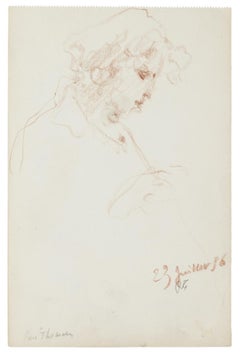
This expressive and atmospheric graphite drawing by Gösta von Hennigs (1866–1941) portrays the celebrated equestrian artist Baptista Schreiber within the charged setting of a circus manège. In the foreground, Schreiber is captured in an impressionistic moment of motion, her head turned toward her horse Menelik, which is only faintly suggested in the background. Behind her, her partner stands ready to lift her onto the horse, reinforcing the sense of immediacy and preparation before performance. On the reverse (a tergo), Schreiber is depicted riding her horse Menelik in the arena, wearing a striking feathered headdress. The audience appears schematically in the background, while to the right stands a male figure, possibly the circus director or presenter. The drawing is possibly a study for a painting, probably executed around 1905- 1915, and demonstrates von Hennigs’s assured command of line and movement, as well as his keen interest in performers and modern spectacle. The back panel has an old note describing the present drawing and attesting the artist, signed by Sven Petersohn, artexpert and one of the authors of the Swedish National Encyclopedia of Swedish artists. It is not signed.
Carl Gustaf Albert von Hennigs (1866-1941) was a Swedish painter whose career spans the transition from late 19th-century Impressionism to a highly personal engagement with modern urban and performative life.
Von Hennigs received his artistic training at the Artists’ Association School (Konstnärsförbundets skola) between 1891 and 1893, where he studied under Richard Bergh, Per Hasselberg, and Anders Zorn. During his early career, he painted street scenes, and focused on Stockholm motifs rendered in an impressionistic manner. He was an active member of the Artists’ Association (Konstnärsförbundet) and participated in many of its exhibitions until the organisation was dissolved in 1920.
From the early 1900s, von Hennigs gradually moved away from purely urban landscapes and developed a distinctive new subject matter. From around 1903 onwards, he increasingly drew inspiration from the world of the circus, the arena, and the manège, a thematic focus that earned him the epithet “the circus painter.” His works from this period depict acrobats, riders, jugglers, and clowns, executed in oil and watercolour. These compositions are marked by strong, vibrant colours and an impressionistic handling that emphasises movement, rhythm, and spectacle.
Stylistically, von Hennigs evolved from Impressionism toward a more decorative expression, influenced in part by Japanese colour woodcuts. His choice of viewpoints and compositional cropping often recalls Edgar Degas, particularly in the way figures are captured mid-motion and seen from unconventional angles. This approach allowed him to convey the fleeting, dynamic nature of performance with immediacy and visual intensity.
The Artists’ Association exhibition in Stockholm in 1912 marked a major breakthrough in his career. Prince Eugen purchased nine of his works at the exhibition, which were subsequently incorporated into the collection at Prins Eugens Waldemarsudde.
Von Hennigs’s reputation as an artist of movement and light was summarised in Svenska Dagbladets Yearbook in 1941, which noted his particular strength in capturing motion and the interplay of light and colour, while also observing a certain coolness in his work, arising from a strong focus on visual sensation despite the temperament of his motifs.
In addition to his artistic practice, von Hennigs played an important role in Swedish art education. He served as acting professor at the Royal University College of Fine Arts (Konsthögskolan) in Stockholm from 1928 to 1933. Today, Gösta von Hennigs is regarded as a key figure in Swedish early modern painting, especially celebrated for his vivid and innovative depictions of circus and performance life.
His works can be found in the Swedish National Museum, Modern museum of art, Prince Eugen Waldemarsudde and others.
Baptista Schreiber’s fame as an equestrian artist cannot be fully understood without placing her celebrated horse Menelik at the centre of her life and career. Schreiber, also known as Mijares-Schreiber, was the owner and trainer of Menelik, a white Arabian stallion who came to be regarded as the most famous circus horse in Sweden. Their partnership symbolized the height of artistic horsemanship in the early 20th century, when the bond between rider and horse was central to the show.
Menelik arrived in Schreiber’s life under extraordinary circumstances. In 1914, he was presented to her as a gift from Queen Alexandra of Great Britain and the British royal court, an exceptional gesture that reflects both Schreiber’s international reputation and the prestige surrounding her performances. The stallion was named after Emperor Menelik II of Ethiopia, a name that further enhanced the horse’s aura of strength, nobility, and exotic distinction.
Menelik’s death in 1931 caused widespread public attention and marked the end of an era. Together, their story has become part of Swedish cultural memory, illustrating how artistic performance, personal attachment, and public recognition could intersect in a way that elevated a circus horse to the level of a national icon.
- Schöpfer*in:Gosta von Hennigs (1866 - 1941, Schwedisch)
- Entstehungsjahr:1910-1920
- Maße:Höhe: 39 cm (15,36 in)Breite: 33 cm (13 in)Tiefe: 2 cm (0,79 in)
- Medium:
- Bewegung und Stil:
- Zeitalter:
- Zustand:The drawing is in good condition. The paper has turned slightly brown. It has presently an acid free mounting.
- Galeriestandort:Stockholm, SE
- Referenznummer:1stDibs: LU2608217370262
Anbieterinformationen
5,0
Gold-Anbieter*in
Premium-Anbieter*innen mit einer Bewertung über 4,3 und 24 Stunden Reaktionszeit
1stDibs-Anbieter*in seit 2023
33 Verkäufe auf 1stDibs
Typische Antwortzeit: <1 Stunde
- VersandAngebot wird abgerufen …Versand von: Stockholm, Schweden
- Rückgabebedingungen
Einige Inhalte dieser Seite wurden automatisch übersetzt. Daher kann 1stDibs nicht die Richtigkeit der Übersetzungen garantieren. Englisch ist die Standardsprache dieser Website.
Mehr von diesem*dieser Anbieter*in
Alle anzeigenPorträt einer Zigeunerin - Zeichnung aus dem 19.
Graphit-Porträtzeichnung einer Frau auf Papier von Johannes Collin (1873-1951), signiert "Johannes Collin 98" und betitelt "Zigenerska". Dieses frühe und ungewöhnliche Werk von Colli...
Kategorie
1890er, Sonstige Kunststile, Porträtzeichnungen und - aquarelle
Materialien
Papier, Grafit
Kavallerieoffizier auf seinem Pferd
Ein fein ausgearbeitetes Aquarell auf Papier zeigt einen berittenen Kavallerieoffizier - formell in Haltung und Kostüm - gemalt mit der feinen Klarheit, für die Egron Lundgren am bes...
Kategorie
Mittleres 19. Jahrhundert, Sonstige Kunststile, Tierzeichnungen und -aqu...
Materialien
Papier, Wasserfarbe
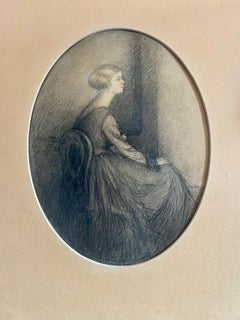
Profilbildnis einer auf einem Stuhl sitzenden Frau
Eine fein abgestimmte ovale Zeichnung der finnischen Künstlerin Ester Helenius, die eine junge Frau im Profil auf einem Stuhl sitzend darstellt. Der Raum wird nur durch einen diffuse...
Kategorie
1910er, Jugendstil, Porträtzeichnungen und - aquarelle
Materialien
Papier, Holzkohle, Gouache
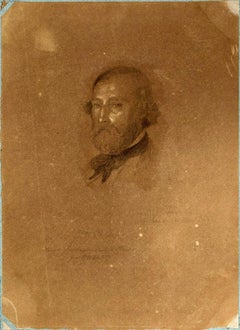
Porträt Gustav Wilhelm Palm - 19. Jahrhundert Bleistift und Pastell auf Papier
Porträt von Gustaf Wilhelm Palm (1810-1890) by Lorenz Frølich (1820-1908)
Signiert mit Monogram und datiert Mai 1849. Bleistift und Pastell auf Papier. 29,5 × 21 cm.
Dieses Porträt d...
Kategorie
1840er, Naturalismus, Porträtzeichnungen und - aquarelle
Materialien
Papier, Pastell, Kohlestift
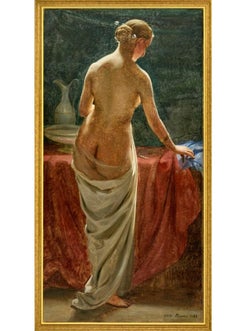
Psyche - 19. Jahrhundert Öl auf Leinwand
Von Otto Bache
In diesem neoklassizistischen Öl auf Leinwand, das mit "Otto Bache 1864" signiert und datiert ist, stellt der Künstler Psyche dar, die mit dem Rücken zum Betrachter neben einem rot d...
Kategorie
1860er, Sonstige Kunststile, Figurative Gemälde
Materialien
Öl
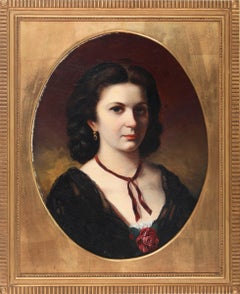
Russische Prinzessin Olga Gortschakoff - 19. Jahrhundert Porträt, Öl auf Leinwand
Porträt der Prinzessin Olga Gortschakoff von Elise Hügel, einer Künstlerin des 19. Jahrhunderts.
Ovales Porträt der Fürstin Olga Gortschakoff (1838-1926), spätere Baronin von Meyend...
Kategorie
1850er, Sonstige Kunststile, Porträts
Materialien
Leinwand, Öl
Das könnte Ihnen auch gefallen
Porträt - Bleistiftzeichnung auf Papier - Mitte des 20. Jahrhunderts
Das Porträt ist eine Original-Bleistiftzeichnung auf Papier, die von einem anonymen Künstler Mitte des 20. Jahrhunderts angefertigt wurde. Mit einer weiteren Zeichnung auf der Rückse...
Kategorie
Mitte des 20. Jahrhunderts, Moderne, Figurative Zeichnungen und Aquarelle
Materialien
Bleistift
Porträt – Kohlezeichnung von Pierre Georges Jeanniot – Anfang des 20. Jahrhunderts
Von Pierre Georges Jeanniot
Das Porträt ist eine Original-Zeichnung auf Papier des Malers Pierre Georges Jeanniot (1848-1934).
Zeichnen mit Bleistift.
Handsigniert auf der Unterseite.
Guter Zustand bis auf d...
Kategorie
Frühes 20. Jahrhundert, Moderne, Porträtzeichnungen und - aquarelle
Materialien
Bleistift
Portrt einer Dame Zeichnung von Hermann Paul -1890er Jahre
Portrait of a Lady ist eine Bleistiftzeichnung von Hermann Paul.
Handsigniert in der linken unteren Ecke. Passpartout enthalten cm 51x35
Guter Zustand.
René Georges Hermann-Paul ...
Kategorie
1890er, Moderne, Figurative Zeichnungen und Aquarelle
Materialien
Papier, Bleistift
Porträt einer Frau – Original Kohlezeichnung - Anfang des 20. Jahrhunderts
Das Porträt einer Frau ist ein Originalkunstwerk, das von einem unbekannten Künstler geschaffen wurde.
Graue Punktzeichnung und unsigniertes Aquarell, hinter CH.L. Papier auf Karton...
Kategorie
Frühes 20. Jahrhundert, Moderne, Figurative Zeichnungen und Aquarelle
Materialien
Papier, Bleistift
Study for a Portrait - Original-Bleistiftzeichnung - 20. Jahrhundert
"Studie für ein Porträt" ist ein Original-Zeichnung in Tempera auf Papier, realisiert von einem anonymen Französisch Künstler des XX Jahrhunderts.
Der Erhaltungszustand der Kunstwer...
Kategorie
20. Jahrhundert, Moderne, Figurative Zeichnungen und Aquarelle
Materialien
Bleistift
Equestrienne", Salon d
Automne, Musée du Luxembourg, Französischer Post-Impressionismus
Von Henri Ottmann
Rechts unten signiert "Henry Ottmann" (Franzose, 1877-1927) und um 1915 entstanden.
Eine elegante Bleistift- und Tuschezeichnung, die zwei Frauen im Gespräch zeigt, eine im Damensat...
Kategorie
1910er, Figurative Gemälde
Materialien
Papier, Tusche, Bleistift
