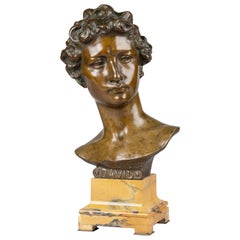
Objekte ähnlich wie American Bronze Sculpture Bust Percy Shelley (1912) by William Partridge
Möchten Sie mehr Bilder oder Videos?
Zusätzliche Bilder oder Videos von dem*der Anbieter*in anfordern
1 von 21
American Bronze Sculpture Bust Percy Shelley (1912) by William Partridge
6.925,03 €
Angaben zum Objekt
WILLIAM ORDWAY PARTRIDGE
American, 1861-1930
Portrait Bust of Percy Bysshe Shelley (modeled 1899, cast ca. 1912)
Bronze, lost-wax cast and patinated, situated over a honed marble plinth cast signature "Partridge / 1912", incised "ROMAN BRONZE WORKS N.Y." to edge of plate
23 5/8" H x 13" W x 7 3/8" D (base)
This impressionistic bronze bust of the English Romantic poet Percy Bysshe Shelley was cast in 1912 by Roman Bronze Works, New York. The form is partially realized, with expressive toolwork and rough surface textures that suggest the energy of the modeling process. The hollow, open-back sculpture is raised on a bronze plate bolted to a shaped, honed marble base. The signature, captured directly from the original wax, retains crisp, raised edges indicative of a fresh mold. The surface bears a golden-brown patina sealed under wax. The poet is captured as an introspective young man, looking into an unknown space as he is entirely lost in thought. As a poet himself, Partridge shows a deeply personal portrait of the lost dreamer inside a man, capturing the essence of a melancholy loneliness that haunts the highly individual and largely rejected thinker.
A plaster example of this portrait, executed in 1899, is held in the permanent collection of the Smithsonian American Art Museum, Gift of Mrs. William Ordway Partridge, accession no. 1994.73.
Condition: Well-preserved. Retaining its original surface patina. Light rubbing wear. Carefully cleaned and sealed in wax. Minor age-appropriate wear to the stone plinth. Ready to place.
Ref. 503TGI28Q-1
William Ordway Partridge (1861–1930)
William Ordway Partridge was an American sculptor known for his public monuments, portrait busts, and contributions to American academic sculpture at the turn of the 20th century. Born in Paris in 1861 to American parents, he was raised in New York and pursued a classical education before turning to sculpture in his early twenties.
Partridge studied in Florence, Rome, and Paris, where he trained under prominent academic sculptors and absorbed the influence of both Renaissance and Beaux-Arts traditions. He returned to the United States in the 1880s and quickly established himself with portrait commissions and idealized figurative works that reflected the neoclassical aesthetic favored in public art of the period.
Among his most notable commissions are the equestrian statue of General Ulysses S. Grant in Brooklyn’s Grant Square, the statue of Shakespeare in Lincoln Park, Chicago, and a well-regarded bronze of Alexander Hamilton at Columbia University. His portrait busts—of figures such as Percy Bysshe Shelley, Richard Wagner, and Robert E. Peary—demonstrate a careful study of likeness and psychological presence, often combining formal restraint with subtle emotion.
In addition to his studio work, Partridge was a dedicated teacher and author. He lectured widely and held teaching positions at institutions such as Columbia University and the New York School of Applied Design for Women. He also published several books on art and sculpture, including Technique of Sculpture (1895) and Art for America (1894), which reflect his belief in the moral and civic function of the arts. He began having his work cast at Roman Bronze Works in New York starting in 1912 and continued to work with the foundry through 1918.
The last years of his life proved difficult, suffering through increasingly poor health and also enduring the loss of all of his plaster casts when coal was accidentally dumped on them. Partridge died in New York in 1930. His work survives in public and private collections across the country and remains an important example of the American sculptural response to European academic traditions during a formative period in national art history.
Percy Bysshe Shelley (1792–1822)
Percy Bysshe Shelley was a central figure in the English Romantic movement. Born into a wealthy Sussex family, he attended Eton and Oxford but was expelled in 1811 after publishing a pamphlet advocating atheism. He remained a lifelong critic of organized religion, monarchy, and social injustice.
Shelley’s poetry reflects his radical political views and deep idealism. His major works include Queen Mab, Alastor, Prometheus Unbound, and Adonais. He often used classical themes to challenge authority and promote reform, writing with both lyrical intensity and philosophical depth.
He eloped with Mary Godwin, later the author of Frankenstein, and spent much of his life abroad. His circle included Lord Byron and other leading literary figures of the time. Shelley drowned off the Italian coast in 1822 at age 29.
Though overlooked during his lifetime, he is now regarded as one of the most influential poets of the 19th century.
About silla antiques
art
Established in 2009, we have available in our 9000 square foot brick-and-mortar gallery an ever-changing selection of carefully curated and catalogued furniture, decorative arts, paintings, sculpture and estate jewelry. Our company has long specialized in sculpture circa 1860 through 1930 and as such the gallery always has a very large collection of exceptional European and American sculpture available on display.
The gallery is located at 117 W Burd Street in Shippensburg, Pennsylvania and is open by appointment only. We welcome your visit and would love to meet with you at the shop. For clients located outside of the area, we are always available to discuss items by video conferencing or by phone.
- Schöpfer*in:Roman Bronze Works (Schöpfer*in)
- Maße:Höhe: 60,03 cm (23,63 in)Breite: 33,02 cm (13 in)Tiefe: 18,75 cm (7,38 in)
- Materialien und Methoden:Bronze,Ahornholz
- Herkunftsort:
- Zeitalter:
- Herstellungsjahr:1912
- Zustand:Well-preserved. Retaining its original surface patina. Light rubbing wear. Carefully cleaned and sealed in wax. Minor age-appropriate wear to the stone plinth. Ready to place.
- Anbieterstandort:Shippensburg, PA
- Referenznummer:Anbieter*in: 503TGI28Q-11stDibs: LU1059048080532
Roman Bronze Works
Roman Bronze Works, jetzt unter dem Namen Roman Bronze Studios, ist eine Bronzegießerei in New York City. Sie wurde 1897 von Riccardo Bertelli gegründet und war die erste amerikanische Gießerei, die sich auf das Wachsausschmelzverfahren spezialisierte. Während der amerikanischen Renaissance (1876-1917) war sie die bedeutendste Kunstgießerei des Landes.
Anbieterinformationen
4,9
Anerkannte Anbieter*innen
Diese renommierten Anbieter*innen sind führend in der Branche und repräsentieren die höchste Klasse in Sachen Qualität und Design.
Platin-Anbieter*in
Premium-Anbieter*innen mit einer Bewertung über 4,7 und 24 Stunden Reaktionszeit
Gründungsjahr 2009
1stDibs-Anbieter*in seit 2014
522 Verkäufe auf 1stDibs
Typische Antwortzeit: 1 Stunde
- VersandAngebot wird abgerufen …Versand von: Shippensburg, PA
- Rückgabebedingungen
Einige Inhalte dieser Seite wurden automatisch übersetzt. Daher kann 1stDibs nicht die Richtigkeit der Übersetzungen garantieren. Englisch ist die Standardsprache dieser Website.
Mehr von diesem*dieser Anbieter*in
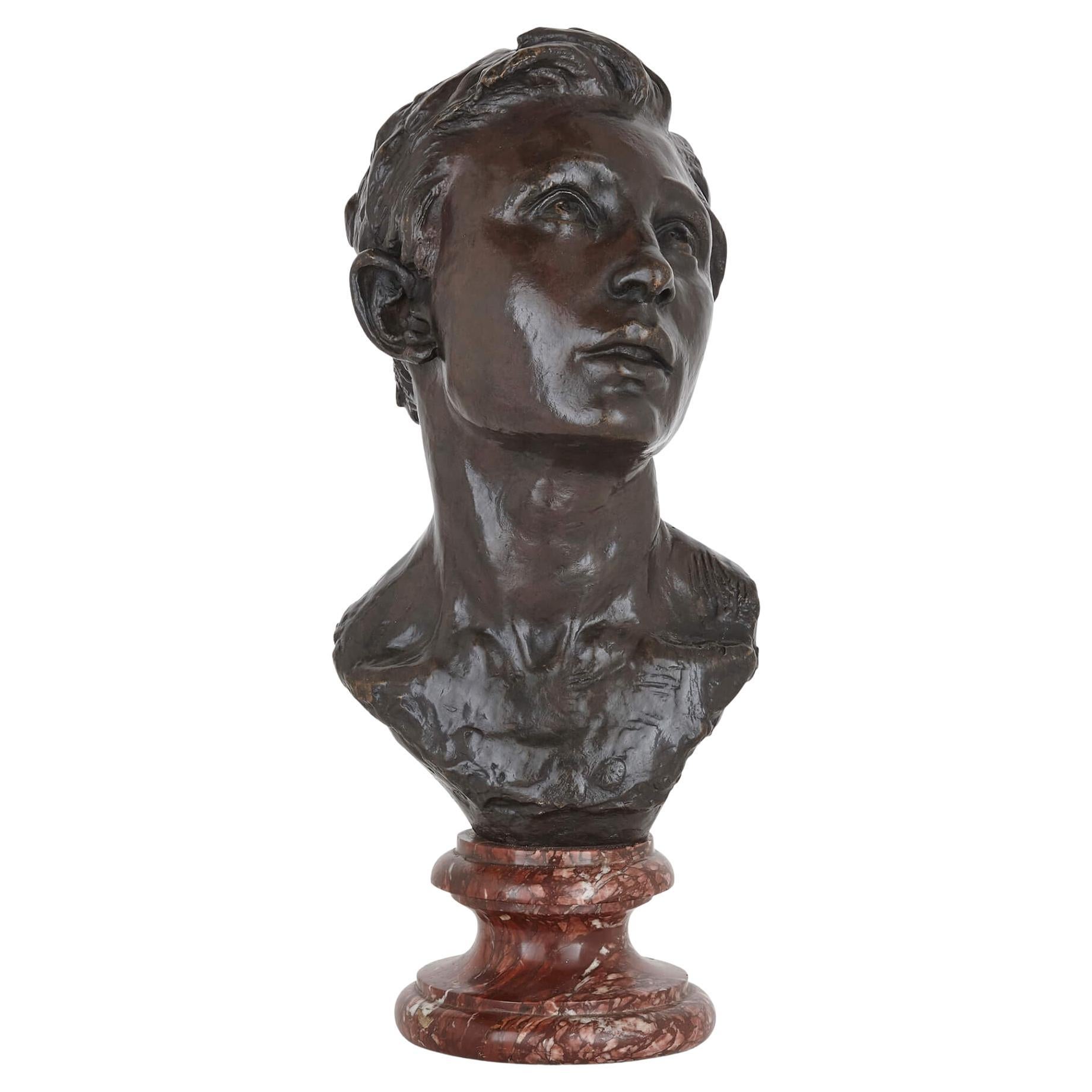
Alle anzeigenFranzösische modernistische Bronzeskulptur eines jungen Mannes im Art déco-Stil, Alfredo Pina
Von Alfredo Pina
ALFREDO PINA
Französisch, 1883-1966
Büste eines jungen Mannes
Im Wachsausschmelzverfahren gegossene, mittelbraun patinierte Bronze auf massivem Sockel aus grünem Marmor signiert i...
Kategorie
20. Jahrhundert, Französisch, Art déco, Büsten
Materialien
Marmor, Bronze
Antike italienische Grand Tour-Skulptur aus Bronzeskulptur, Büste von Julius Caesar
Die fein gegossene und schön patinierte Büste von Julius Cäsar stammt wahrscheinlich aus Rom, etwa aus dem dritten Viertel des 19. Jahrhunderts, und ruht auf ihrem originalen Sockel ...
Kategorie
Antik, 19. Jahrhundert, Italienisch, Grand Tour, Büsten
Materialien
Marmor, Bronze
Antike französische Bronzeskulpturbüste aus der Zeit um 1880 von Eugene Aizelin
Von F. Barbedienne Foundry, Eugene-Antoine Aizelin
EUGENE AIZELIN
Französisch, 1821-1902
Büste einer jungen Frau (1864)
Patinierte Bronze auf einem originalen gedrechselten Rouge-Marmorsockel mit Messingrand signiert auf der Schul...
Kategorie
Antik, 19. Jahrhundert, Französisch, Romantik, Büsten
Materialien
Marmor, Messing, Bronze
Jugendstil-Bronze-Skulptur-Büste einer Frau im Jugendstil von Cesare Ceribelli
Von Cesar Constantino Ceribelli
CESARE CONSTANTINO CERIBELLI
Italienisch, 1841-1918
"Büste einer jungen Frau"
Polychromierte und chemisch patinierte Bronze signiert auf der Rückseite "C. Ceribelli" auf original...
Kategorie
20. Jahrhundert, Italienisch, Art nouveau, Büsten
Materialien
Marmor, Bronze
Italienische Grand Tour Bronzeskulptur Büste der Diana von Del Nerro Foundry
GRAND TOUR
Italien, Mitte des 19. Jahrhunderts
Büste der Göttin Diana
Gegossen von der Gießerei Del Nero, Rom, scharfe Inschrift auf dem Halsansatz verso DEL NERO ROMA
Patinierte B...
Kategorie
Antik, 19. Jahrhundert, Italienisch, Grand Tour, Büsten
Materialien
Marmor, Bronze
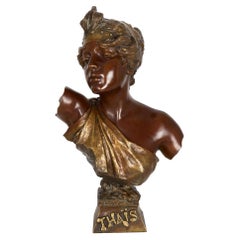
Französische Jugendstil-Bronze-Skulptur-Büste der Thailänder von Emmanuel Villanis
Von Emmanuel Villanis
EMMANUEL VILLANIS
Französisch, um 1880-1920
"Büste von Thais"
Signiert im Guss entlang der Schulter "E. Villanis" und kalt gestempelt "1146" mit Gießereisiegel der "Societe des Bro...
Kategorie
20. Jahrhundert, Französisch, Büsten
Materialien
Bronze
Das könnte Ihnen auch gefallen
Vintage Regency Glenda Goodacre Attr. Bronzebüste eines Mannes
Eine auffallende Vintage Boho Bronzebüste von Mann. Ein schickes Profil eines gut aussehenden jungen Mannes. Der Künstlerin Glenda Goodacre zugeschrieben. Nicht signiert. Erworben au...
Kategorie
Ende des 20. Jahrhunderts, amerikanisch, Regency, Büsten
Materialien
Bronze
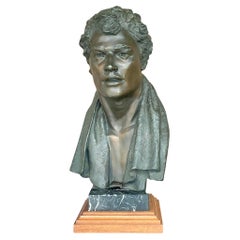
Antike Bronzebüste des Lord Byron aus Bronze
Eine antike patinierte Bronzebüste von Lord Byron (1788-1824).
Diese großformatige Skulptur des einflussreichen Dichters ist ein beeindruckendes Element für eine historische Immobil...
Kategorie
Antik, Spätes 19. Jahrhundert, Französisch, Viktorianisch, Büsten
Materialien
Metall, Bronze
Patinierte Bronzebüste eines jungen Mannes von Aimé Jules Dalou
Von Aimé-Jules Dalou
Die Büste ruht auf einem taillierten Sockel aus rotem Marmor, auf der Rückseite mit der Inschrift "DALOU 1888" versehen.
Aimé Jules Dalou (Franzose, 1838-1902) absolvierte seine A...
Kategorie
Antik, 19. Jahrhundert, Französisch, Büsten
Materialien
Griotte-Marmor, Bronze
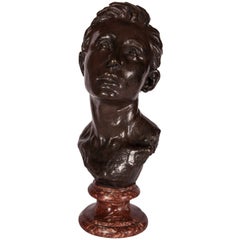
Französische Bronze-Skulptur Büste eines Mannes von Aimé-Jules Dalou
Von Aimé-Jules Dalou
Französische Bronzebüste eines Mannes von Aimé-Jules Dalou
Französisch, 1888
Höhe 49cm, Breite 20cm, Tiefe 21cm
Diese fein patinierte Bronzebüste des französischen Bildhauers Aimé-J...
Kategorie
Antik, 1880er, Französisch, Büsten
Materialien
Griotte-Marmor, Bronze
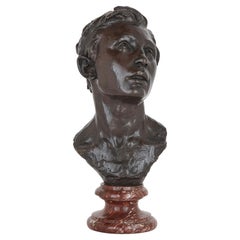
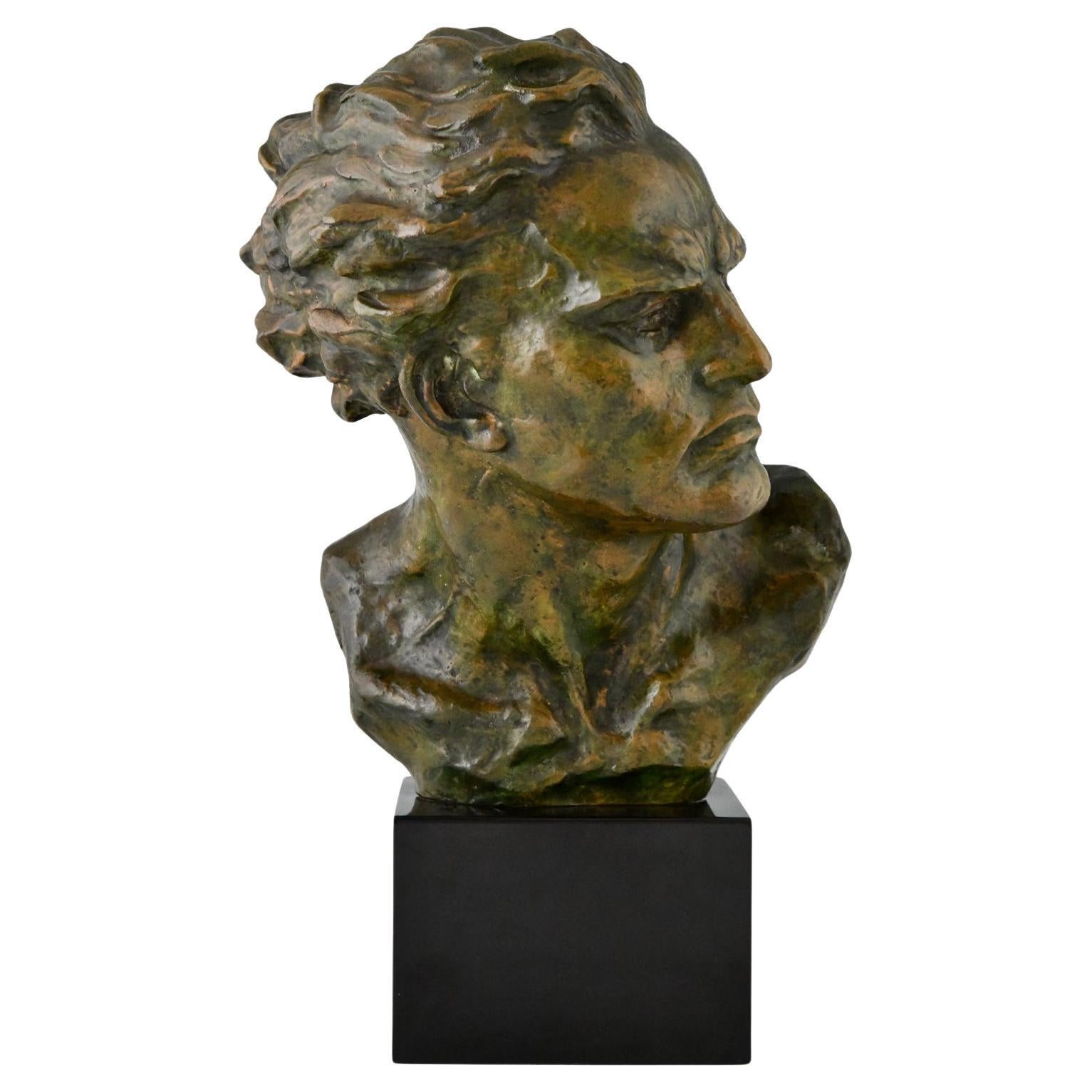
Art Deco Bronzeskulptur Männliche Büste Ugo Cipriani auf Marmorsockel Frankreich 1930
Von Cipriani
Bronzeskulptur männliche Büste im Art Deco-Stil von Ugo Cipriani.
Patinierte Bronze.
Sockel aus schwarzem belgischem Marmor.
Frankreich 1930.
Literatuur:
"Art-Déco-Skulptur" Alast...
Kategorie
Mitte des 20. Jahrhunderts, Französisch, Art déco, Büsten
Materialien
Belgischer schwarzer Marmor, Bronze
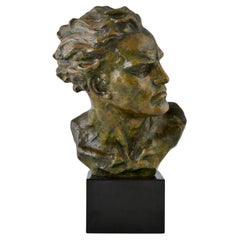
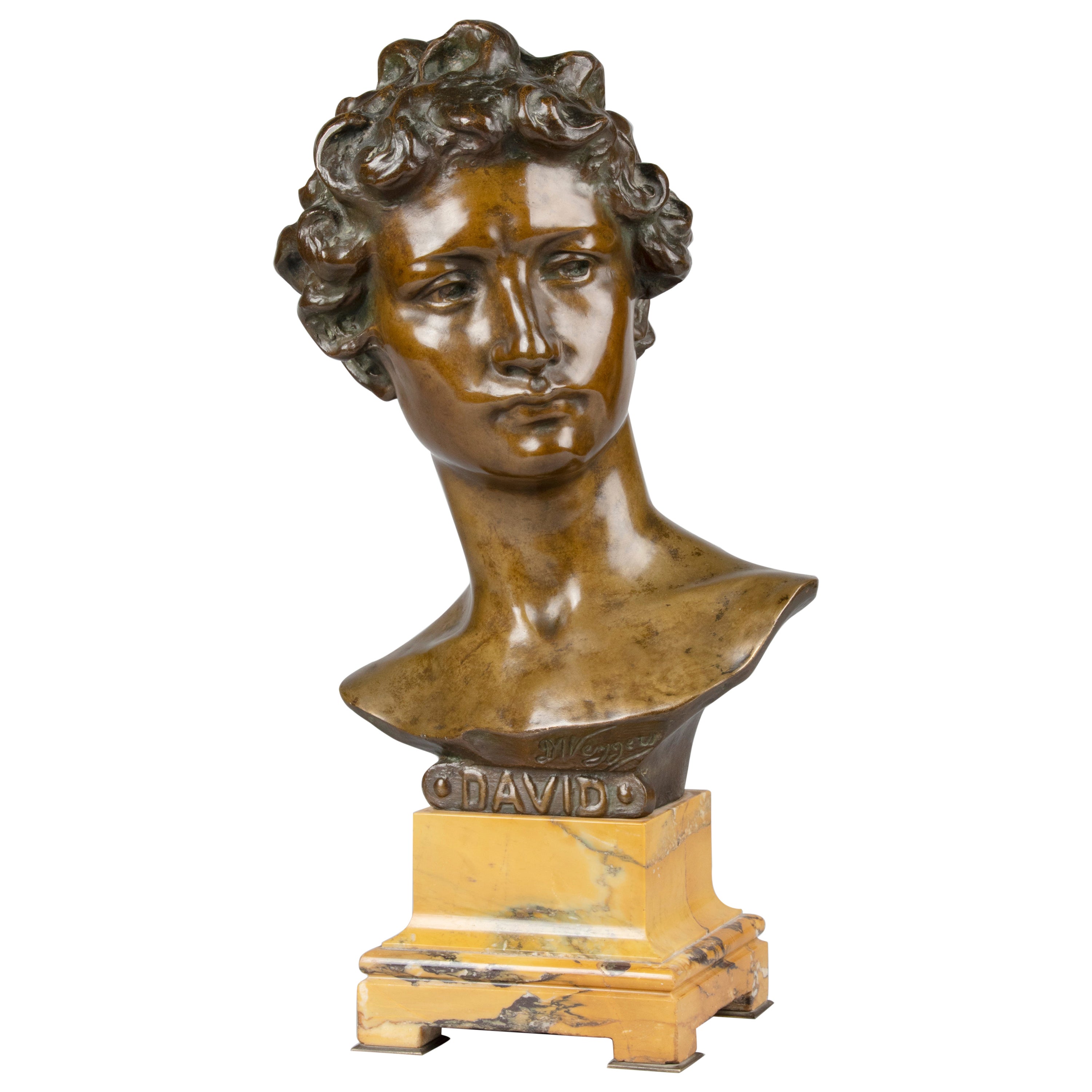
Bronzebüste des Davids aus dem frühen 20. Jahrhundert, Dsir Weygers
Eine antike, braun patinierte Bronzebüste, die den mythischen David nach Michelangelos Meisterwerk darstellt, das im Museum von Florenz ausgestellt ist. Die dunkelbraun patinierte Br...
Kategorie
Antik, Frühes 20. Jhdt., Belgisch, Klassisch-römisch, Büsten
Materialien
Siena-Marmor, Bronze