Objekte ähnlich wie Pair of candelabrum with 9 lights in gilded, silvered and burnished bronze
Möchten Sie mehr Bilder oder Videos?
Zusätzliche Bilder oder Videos von dem*der Anbieter*in anfordern
1 von 21
Pair of candelabrum with 9 lights in gilded, silvered and burnished bronze
281.250 €Einschließlich MwSt.
Angaben zum Objekt
This splendid pair of candelabrum was made by Auguste-Louis Marquis (bronze maker) for the Maison Giroux circa 1855 in gilded, silvered and burnished bronze, the set on a cylindrical stand made of blackened wood resting on a square base.
Reflection of the eclecticism from the second half of the 19th century, our pair of candelarbum illustrates the exuberance of the Napoleon III style and the classicism of the Louis XVI style. The bronze maker has represented here the theme of the silent children, through winged putti with one finger put on their mouth, in burnished bronze. From their free hands, they hold a gilt bronze quiver where is resting a roses bouquet below large lily flowers being shaped to be light arms and of which the flowers are lightened up with a beautiful silver work. The putti are lightly dressed with a drapery hold by a strap roses garland and are bearing a crown of this same flower in their hair. About the cylindrical stand made of blackened wood, it is very typical of the Louis XVI style with its gilded bronze decoration of flowers garlands and laurel leaves flowers on which they stand.
We find on a sketching book indexing the works made by the maison Giroux, conserved in the Musée des Arts Décoratifs of Paris, a drawing depicting one of our candelabra, allowing us to confirm that they were sold by the maison created by Alphonse Giroux in the late 1790’s.
This store which was originally selling all kind of supplies and small objects such as paints, varnishes, albums, writing-papers, fans, toys, boxes and souvenirs, but also lithographs, drawings and watercolors, considerably developed in the first decades of the 19th century. First, because they count among the clients, important persons such as the Duchesse de Berry, Louis XVIII or even Charles X, then by the drive given by Alphonse Giroux’s sons who joined the firm in 1833. Thus, Alphonse-Gustave Giroux, the eldest son, had the idea to sell small furniture. Even though he was an artist himself, he worked like furniture dealers of the 18th century, with artists who did not have the right to put their signature and exerted a hold over the design of the creation that he chose. He also decided to move the store in the new Opera district on the corner of the 43 boulevard des Capucines and the 24 rue Neuve des Capucines in 1855.
On this same year, the company which had already won medals for the quality of its production during previous events, sells during the World Fair, to the Impress Eugénie, a bonheur du jour, conserved today in the château de Compiègne. In 1867, the store direction is given to Ferdinand Duvinage, Harinkouck and Brune. Little things are known about Harinkouck and Brune who seem to have been associated for a short period of time as Duvinage remains the only one in 1874.
A similar pair, a little bit smaller, with only 7 light arms, and made entirely of gilded bronze is illustrated on Marie-France Dupuy-Bellet’s book: Les bronzes du mobilier national 1800-1870, on the page 303.
The handwritten documentation of the Mobilier national allows to name their author: Auguste-Louis Marquis, who delivered them to the Garde-Meuble in April 1855 for the Palais Royal. They are next send, 22 years later to the Palais de l’Élysée where their presence is mentioned in the Ladies Salon in 1894.
The maison Chaumont and Marquis, founded in 1731, made and sold bronze, chandeliers, clocks, candelabrum, etc. They participated during the World Fairs of 1862 and 1867.
Thus, as written above, it seems that Alphonse Giroux asked Auguste Marquis to make a model of candelabrum from his original one, while imposing his modifications that we can notice by comparing the formal differences between the two pair of candelabrum. This manner to ask other artists to create models is really usual for the important companies selling art in the late 19th century. We can also mentionned l'Escalier de Cristal which worked with Gabriel Viardot, Emile Gallé and others, or Edouard Lièvre who worked for the maison Barbedienne.
Bibliography :
Marie-France Dupuy-Bellet, L’heure, le feu, la lumière, Les bronzes du mobilier National 1800-1870, Editions Faton, 2005
- Maße:Höhe: 232 cm (91,34 in)Breite: 58 cm (22,84 in)Tiefe: 72 cm (28,35 in)
- Stil:Napoleon III. (Im Stil von)
- Materialien und Methoden:
- Herkunftsort:
- Zeitalter:
- Herstellungsjahr:Circa 1855
- Zustand:
- Anbieterstandort:SAINT-OUEN-SUR-SEINE, FR
- Referenznummer:Anbieter*in: 132001stDibs: LU7662232252852
Anbieterinformationen
Noch keine Bewertungen
Anerkannte Anbieter*innen
Diese renommierten Anbieter*innen sind führend in der Branche und repräsentieren die höchste Klasse in Sachen Qualität und Design.
1stDibs-Anbieter*in seit 2022
6 Verkäufe auf 1stDibs
Typische Antwortzeit: 1 bis 2 Tage
- VersandAngebot wird abgerufen …Versand von: SAINT-OUEN-SUR-SEINE, Frankreich
- Rückgabebedingungen
Einige Inhalte dieser Seite wurden automatisch übersetzt. Daher kann 1stDibs nicht die Richtigkeit der Übersetzungen garantieren. Englisch ist die Standardsprache dieser Website.
Mehr von diesem*dieser Anbieter*in
Alle anzeigenEin Paar antike Kristalllampen
Dieses schöne Lampenpaar wurde Ende des 19. und Anfang des 20. Jahrhunderts aus Kristall hergestellt.
Die Lampen bestehen aus Kristallanhängern in verschiedenen Formen und Größen, di...
Kategorie
Frühes 20. Jahrhundert, Französisch, Belle Époque, Tischlampen
Materialien
Kristall, Marmor
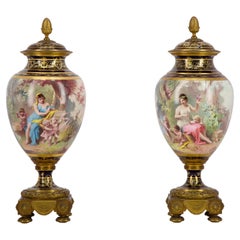
Paar Porzellanvasen in vergoldeter Bronze montiert, um 1890
Von Charles Labarre, Manufacture Nationale de Sèvres
Dieses sehr schöne Paar eiförmiger und bedeckter Vasen wurde aus Sèvres-Porzellan hergestellt und in vergoldete Bronze gefasst. Die beiden Vasen stellen ein gemaltes Dekor von Charle...
Kategorie
Antik, 19. Jahrhundert, Französisch, Napoleon III., Vasen
Materialien
Bronze
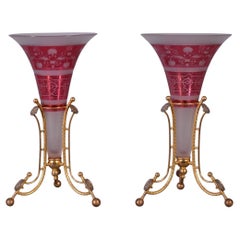
BACCARAT, Paar montierte Vasen, um 1878
Von Baccarat
Die unter Ludwig XV. gegründete französische Kristallmanufaktur Baccarat stellte im 19. Jahrhundert auf den Weltausstellungen ihre Exzellenz unter Beweis.
Dieses elegante Vasenpaar...
Kategorie
Antik, Spätes 19. Jahrhundert, Französisch, Napoleon III., Vasen
Materialien
Kristall, Bronze
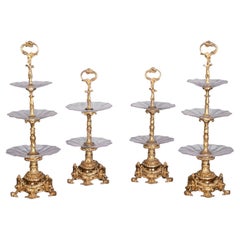
Centre de table de style Napoléon III en bronze doré et cristal taillé, vers 185
Ancienne collection du château de Dampierre
Bedeutende Tischplatte mit vier Stücken aus Bronze mit Ziselierung und Kristall, im Stil von Napoléon III. Deux pièces sont à trois nivea...
Kategorie
Antik, 1850er, Napoleon III., Serviergeschirr und -besteck
Materialien
Kristall, Bronze
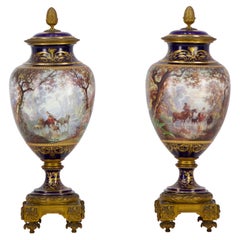
Paar Vasen aus Sèvres-Porzellan, montiert in vergoldeter Bronze, gemalt von J. Machereau
Von Manufacture Nationale de Sèvres, Charles Labarre
Dieses schöne Paar gedeckter Vasen aus Porzellan stammt ursprünglich aus der Manufaktur von Sèvres, wo die weißen Stücke 1869 gekauft und dann von J. Machereau in vergoldete Bronze g...
Kategorie
Antik, 19. Jahrhundert, Französisch, Napoleon III., Vasen
Materialien
Bronze
Vergoldete Bronze-Hängelampe mit Glas-Edelsteinen, Napoleon III.-Periode
Dieser Kronleuchter aus vergoldeter Bronze hat acht Zweige, die die Form von Gläsern und Kerzen annehmen und eine mit Glassteinen verzierte Halbkugel umgeben. Das Ergebnis einer sehr...
Kategorie
Antik, 19. Jahrhundert, Französisch, Napoleon III., Kronleuchter und Hän...
Materialien
Edelsteinmix, Bronze
Das könnte Ihnen auch gefallen
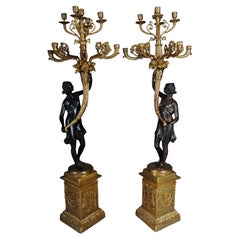
Paar große französische Kandelaber aus Bronze und vergoldeter Bronze
Von François Rémond
Dieses beeindruckende Kandelaberpaar zeigt zwei klassisch modellierte Jungfrauen, die über ihrem Kopf einen extravaganten, mit Früchten gefüllten goldenen Kranz halten, aus dem jewei...
Kategorie
Antik, Spätes 19. Jahrhundert, Französisch, Neoklassisch, Kandelaber
Materialien
Bronze, Goldbronze
Paar außergewöhnliche französische vergoldete und versilberte Bronzekandelaber des 19.
Ein Paar klassizistische Figurenleuchter aus versilberter und vergoldeter Bronze, entworfen von dem französischen Schriftsteller, Essayisten und Künstler,
Judith Gautier (1845-1917)...
Kategorie
Antik, Spätes 19. Jahrhundert, Französisch, Neoklassisches Revival, Kand...
Materialien
Bronze
Paar französische Kandelaber aus vergoldeter Bronze des 19. Jahrhunderts mit Marmorsockel
Paar patinierte und vergoldete Bronze-Figurenkandelaber Napoleon III. Die Figuren stehen jeweils auf Sockeln aus rotem Marmor und scheinen anmutig ein Füllhorn voller blühender Zweig...
Kategorie
Antik, Spätes 19. Jahrhundert, Französisch, Kandelaber
Materialien
Marmor, Bronze
Paar (2) prächtige französische Kandelaber aus vergoldeter Messingbronze
Paar (2) prächtige französische Kandelaber aus vergoldeter Messingbronze und patinierter Bronze.
Paar französische Kandelaber aus vergoldeter Bronze und patinierter Bronze
Französis...
Kategorie
20. Jahrhundert, Französisch, Kerzenständer
Materialien
Messing
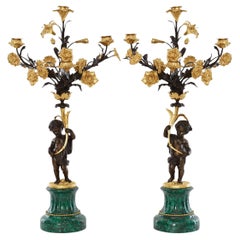
Paar Kandelaber, Napoleon III.-Periode, 19. Jahrhundert
Dieses elegante Kandelaberpaar ist ein Beispiel für die Grandeur und die raffinierte Ästhetik der Zeit Napoleons III. in Frankreich. Die Kandelaber zeigen eine harmonische Mischung a...
Kategorie
Antik, 19. Jahrhundert, Französisch, Napoleon III., Kerzenständer
Materialien
Malachit, Bronze
7.035 € Verkaufspreis / Set
23 % Rabatt
Monumentales Paar Napoleon III.-Bronze-Kandelaber
Ein monumentales Paar antiker französischer Kandelaber aus Bronze und weißem Onyx von Napoleon III. aus dem späten 19. In Balusterform mit vergoldeten Bronzegriffen in Form von weibl...
Kategorie
Antik, 19. Jahrhundert, Französisch, Napoleon III., Kandelaber
Materialien
Onyx, Bronze