Objekte ähnlich wie Japanese Antique Flap-Front Storage Cabinet with Kanji Markings, Late Meiji Era

Video wird geladen …
Möchten Sie mehr Bilder oder Videos?
Zusätzliche Bilder oder Videos von dem*der Anbieter*in anfordern
1 von 21
Japanese Antique Flap-Front Storage Cabinet with Kanji Markings, Late Meiji Era
2.425,79 €
Angaben zum Objekt
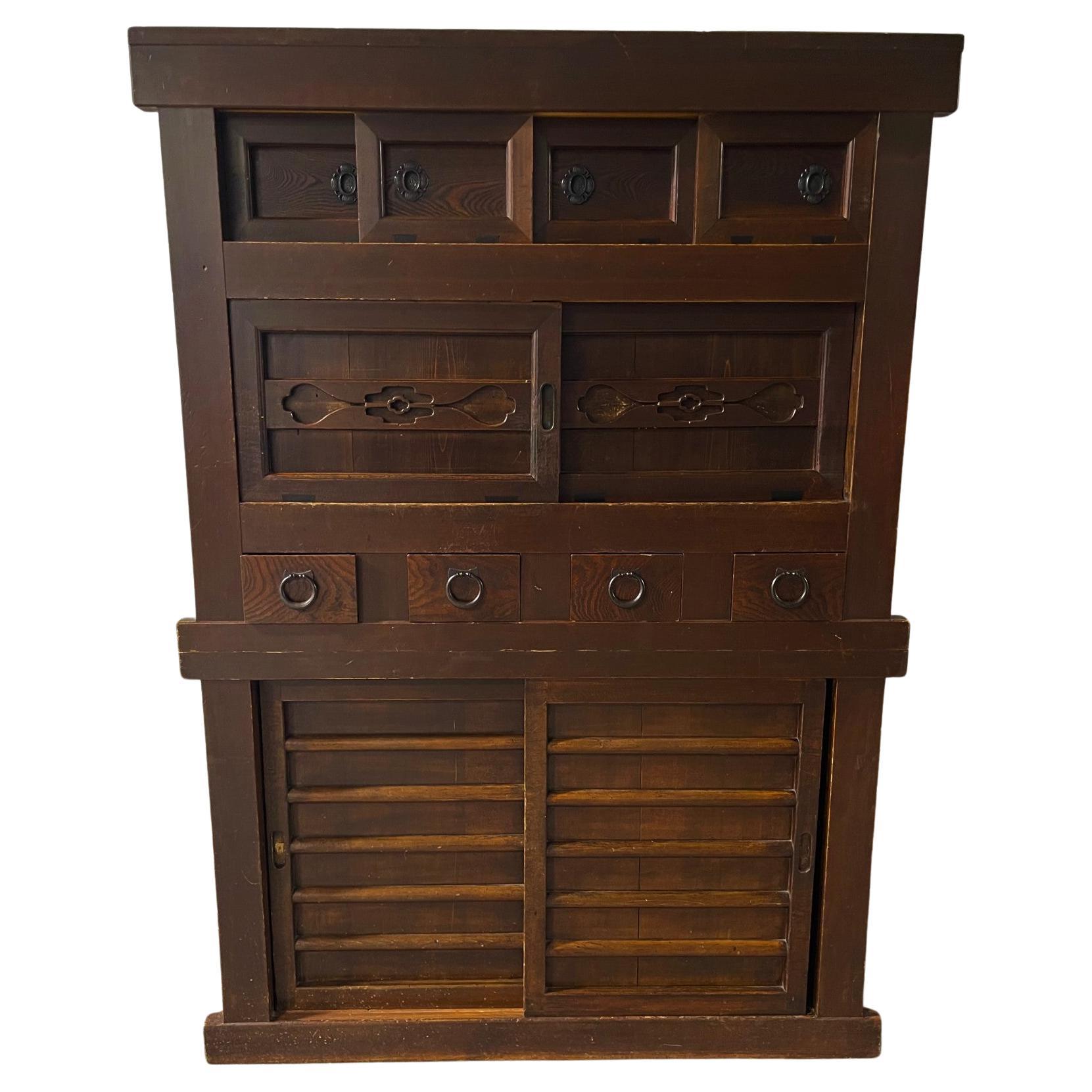
This Japanese antique storage cabinet features traditional flap-front doors, commonly known as pata-pata doors, and dates to the Meiji period (late 19th–early 20th century).
The most distinctive feature of this piece is the handwritten kanji found on the doors. They read “No. 1,” “No. 2,” “No. 3,” and so on, written in old-form kanji. Notably, the character used for “number” is a now-obsolete kanji that specifically denotes rank or grade, rather than simple numerical order. This character is no longer used in modern Japanese, and even among native Japanese speakers today, few can readily read it or immediately grasp its meaning. Its presence reflects a historical system of classification once familiar in everyday life, but now largely forgotten.
The fourth tier bears no marking. In traditional Japanese culture, the number four shares its pronunciation with the word for “death” and was therefore considered inauspicious. The deliberate omission of this number offers a subtle yet telling glimpse into the beliefs and daily sensibilities of the time—customs that are rarely observed in contemporary Japan.
At the lower section, the sliding doors are marked with the characters for “left” and “right.” While their exact purpose remains unclear, these markings suggest practical use in a workshop or production environment, where materials or components needed to be sorted and stored according to specific positions or categories.
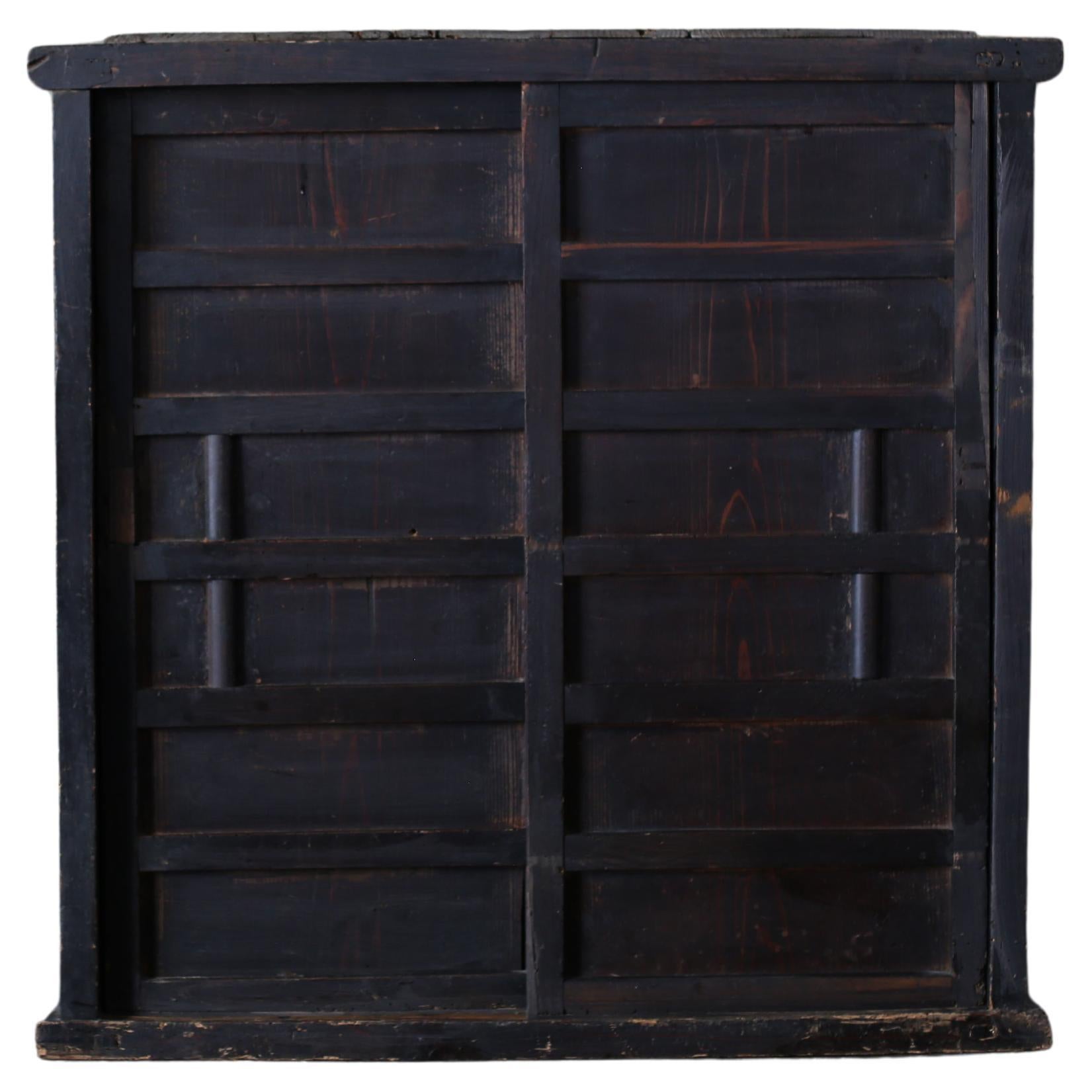
The cabinet is crafted from Japanese cedar. The door frames are finished in black urushi lacquer, now gently worn, thinned, and partially rubbed away through decades of use. Other surfaces are finished with traditional kakishibu (persimmon tannin) and pine soot. Areas with a subtle reddish tone derive from bengara (red iron oxide), later overcoated with pine soot, resulting in a deep, layered surface that has matured naturally over time. These variations are not decorative effects, but traces of use and age that give the piece its quiet depth.
The door handles are made of antimony and formed in a delicate flower-petal shape—an exceptionally rare detail for utilitarian storage furniture. Only the handle corresponding to the now-lost “No. 5” door has been replaced with a brass handle, reflecting a practical repair made during the cabinet’s long working life.
Rather than presenting a fixed or restored ideal, this cabinet retains the marks of use, belief, and adaptation accumulated over time. It stands as a material record of everyday craftsmanship, shaped by function and quietly enriched by age—an embodiment of the wabi-sabi sensibility found in authentic Japanese antiques.
Condition Notes:
- Structure is sound and stable with no structural issues
- All flap-front (pata-pata) doors and lower sliding doors operate smoothly
- A visible age-related crack is present in the panel of one sliding door, caused by natural wood movement over time; this does not affect stability or use.
- Surface shows age-related wear including scratches, rubbing, thinning lacquer, and areas of loss consistent with long-term use
- Black urushi lacquer on the door frames shows wear and fading from age and handling
- Variations in color and finish are present, including darker areas and subtle reddish undertones from traditional finishes
- Handwritten kanji markings show fading and wear consistent with age
- Most original antimony flower-shaped handles remain intact
- One handle, corresponding to the missing “No. 5” door, has been replaced with a brass handle; replacement is stable and functional
Cleaned gently with water only.
As an authentic Late Meiji–period piece, this cabinet shows natural signs of age and use consistent with Japanese antiques. Surface wear, wood movement, small marks, and past repairs are part of its history and character, not defects. Please review all photos carefully before purchasing.
Interior dimensions:
Flap-front compartments: W 29.9" × D 11.2" × H 7.1" (76.0 × 28.5 × 18.0 cm)
Sliding-door compartment: W 29.9" × D 10.0" × H 14.4" (76.0 × 25.5 × 36.5 cm)
Weight:
52.5 lbs (23.8 kg)
Shipping Information:
We ship from Japan. I will provide my own shipping quote. Please ask.
Import duties, taxes, and customs fees are the responsibility of the buyer.
Approach to Selection and Restoration:
Each piece is individually selected through our own eye, then restored to reveal its most compelling state. Movement, stability, and surface are considered as one—shaped through practice to be lived with naturally, honoring the wood’s natural patina while avoiding environmentally harsh chemical strippers or forceful abrasion.
- Maße:Höhe: 149 cm (58,67 in)Breite: 81,5 cm (32,09 in)Tiefe: 31,5 cm (12,41 in)
- Stil:Meiji-Periode (Aus dem Zeitalter)
- Materialien und Methoden:
- Herkunftsort:
- Zeitalter:
- Herstellungsjahr:Late Meiji Era (circa 1900–1912)
- Zustand:Abnutzung dem Alter und der Nutzung entsprechend. Cleaned gently with water only. Doors and sliding doors operate smoothly. The structure is sound with no structural issues. The piece has been carefully inspected, and no issues were found beyond those noted above.
- Anbieterstandort:Hitachiomiya-shi, JP
- Referenznummer:1stDibs: LU7430248098762
Anbieterinformationen
5,0
Platin-Anbieter*in
Premium-Anbieter*innen mit einer Bewertung über 4,7 und 24 Stunden Reaktionszeit
Gründungsjahr 2019
1stDibs-Anbieter*in seit 2022
83 Verkäufe auf 1stDibs
Typische Antwortzeit: 1 Stunde
- VersandAngebot wird abgerufen …Versand von: Hitachiomiya, Japan
- Rückgabebedingungen
Einige Inhalte dieser Seite wurden automatisch übersetzt. Daher kann 1stDibs nicht die Richtigkeit der Übersetzungen garantieren. Englisch ist die Standardsprache dieser Website.
Mehr von diesem*dieser Anbieter*in
Alle anzeigenJapanischer Vintage-Schrank mit Schiebetür (Cha Tansu), frühe Showa-Ära, Wabi Sabi
Dieser japanische Schiebetürenschrank (cha tansu) wurde in der frühen Showa-Periode (1926-1945) aus Hinoki-Zypresse gefertigt, einem Holz, das für seine feine Maserung, seine Haltbar...
Kategorie
Mitte des 20. Jahrhunderts, Japanisch, Showa, Schränke
Materialien
Zypressenholz, Holz
Japanische antike große Tansu, Paneeltüren, Meiji-Ära 1868-1912, Wabi Sabi
Diese antike große Mizuya-Tansu wurde in der Meiji-Ära (1868-1912) hergestellt.
Seine schlichten Schiebetüren und die dunkle, abgenutzte Oberfläche spiegeln die stille Schönheit des...
Kategorie
Antik, Mittleres 19. Jahrhundert, Japanisch, Meiji-Periode, Schränke
Materialien
Zedernholz
Japanische antike kleine Kommode, Keio-Ära (Edo-Periode, 1867), Wabi Sabi
Diese antike kleine Kommode wurde in der Keio-Ära (1867) hergestellt.
Die aus japanischem Zedernholz gefertigte und mit traditionellem japanischem Lack (urushi) veredelte Oberfläche...
Kategorie
Antik, Mittleres 19. Jahrhundert, Japanisch, Edo, Kommoden
Materialien
Zedernholz
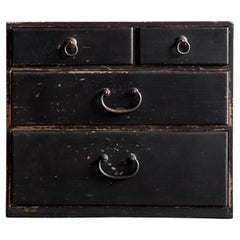
Antiker japanischer Schiebetürenschrank (Cha Tansu), Taisho-Ära (1912-1926), Wabi
Dieser japanische Schiebetürenschrank (cha tansu) wurde in der Taisho-Periode (1912-1926) unter Verwendung einer durchdachten Kombination von Hölzern hergestellt: kiri (Paulownia) fü...
Kategorie
Frühes 20. Jahrhundert, Japanisch, Taisho, Schränke
Materialien
Holz, Zedernholz
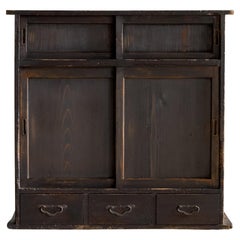
Antike japanische Kommoden, Meiji-Ära
1868-1912
Wabi Sabi
Diese antike Kommode wurde in der späten Meiji-Ära (1868-1912) hergestellt.
Diese japanische Kommode aus der Meiji-Ära ist ein zeitloses Stück, das eine Geschichte von historischer ...
Kategorie
Antik, Spätes 19. Jahrhundert, Japanisch, Meiji-Periode, Kommoden
Materialien
Holz

1.386 € Verkaufspreis
36 % Rabatt
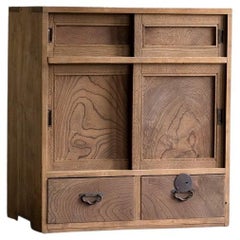
Japanischer antiker kleiner Schrank mit Holztür, Taisho-Ära
1912-1926
Wabi Sabi
Dieses antike Schränkchen wurde in der Taisho-Ära (1912-1926) hergestellt und spiegelt die außergewöhnliche Handwerkskunst dieser Zeit wider. Die Frontplatte ist aus edlem Keyaki-Hol...
Kategorie
Frühes 20. Jahrhundert, Japanisch, Taisho, Schränke
Materialien
Holz
Das könnte Ihnen auch gefallen
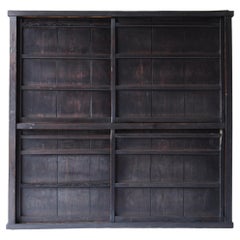
Japanese Antique Massive Tansu Chest 1860s-1900s / Cabinet Cupboard Wabi Sabi
This is a large, old black tansu chest made in Japan, dating to the Meiji period (1860s–1900s). Crafted from Japanese cedar, it is substantial in scale yet maintains a calm, restrain...
Kategorie
Frühes 20. Jahrhundert, Japanisch, Meiji-Periode, Schränke
Materialien
Zedernholz
Japanischer Tansu-Aufbewahrungsschrank mit Schiebetüren, Meiji-Periode, 19. Jahrhundert
Großer zweiteiliger japanischer Küchen-Tansu, spätes 19. Jahrhundert. Der untere Teil des Innenraums wurde für die Unterbringung eines Fernsehers umgebaut. Ein Teil des hinteren Bode...
Kategorie
Antik, Spätes 19. Jahrhundert, Japanisch, Meiji-Periode, Schränke
Materialien
Ulmenholz
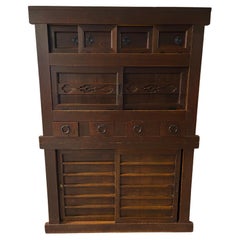
Japanische Antiquität BK Tansu 1860er-1900er Jahre ③ / Schrank Anrichte Wabi Sabi
Diese Kommode ist eine von drei, die in demselben alten japanischen Haus verwendet wurden.
Seinem jetzigen Zustand nach zu urteilen, scheint er ziemlich alt zu sein. Es ist in vollem...
Kategorie
Frühes 20. Jahrhundert, Japanisch, Edo, Schränke
Materialien
Zedernholz
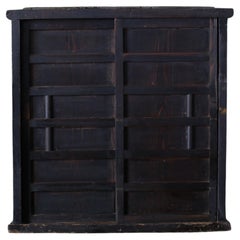
Großer japanischer Tansu Sabi-Schrank mit zwei Abschnitten aus der späten Edo-Periode, Wabi Sabi
Eine hohe zweiteilige japanische Tansu aus der Mitte des 19. Jahrhunderts.
Schön patiniertes Zedernholz mit mehreren Schubladen, Schiebetüren und Eisenbeschlägen.
Starkes utili...
Kategorie
Antik, Mittleres 19. Jahrhundert, Japanisch, Schränke
Materialien
Eisen
6.842 €
Kostenloser Versand
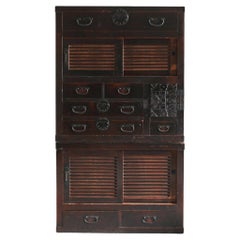
Japanische Tansu-Händler-Truhe aus der Meiji-Ära des 19.
Diese aus Zypresse und Ulme gefertigte Kaufmannstruhe verfügt über geschwärzte Eisenbeschläge und zwei dicke Griffe an der Oberseite, die den Transport erleichtern. Er verfügt über 8...
Kategorie
Antik, Spätes 19. Jahrhundert, Japanisch, Meiji-Periode, Schränke
Materialien
Eisen
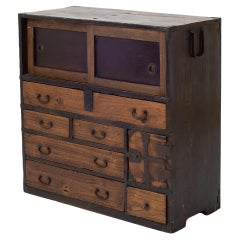
Antiker japanischer Tansu-Schrank mit Schubladenschrank / 1868-1912er Jahre / Wabi-Sabi Mingei
Dies ist eine alte japanische Schublade.
Es wurde seit der Edo-Zeit in der Tohoku-Region in Geschäften verwendet, und man schätzt, dass es um die Meiji-Zeit herum hergestellt wurde....
Kategorie
Antik, Spätes 19. Jahrhundert, Japanisch, Meiji-Periode, Kommoden
Materialien
Eisen