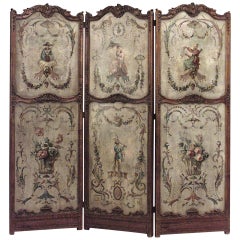
Objekte ähnlich wie An exceptional documented folding screen by T. Robertson and Sons of Alnwick
Möchten Sie mehr Bilder oder Videos?
Zusätzliche Bilder oder Videos von dem*der Anbieter*in anfordern
1 von 20
An exceptional documented folding screen by T. Robertson and Sons of Alnwick
42.893,38 €
Angaben zum Objekt
An exceptional documented folding screen made by T. Robertson and Sons of Alnwick in 1877 with paintings of Northumberland castles by Thomas Henry Gibb
This truly exceptional screen has been in some very famous 20th century collections, including that of Mrs John Hay Whitney, but, until now, the early provenance of the piece had not been established. We are delighted to report that research in the newspaper archives has revealed not only the maker of the piece and its date of manufacture but also the castle in which the piece was located prior to 1925.
The screen consists of an ebonised and gilt framework with panels of paintings of Northumbrian castles. Between these paintings are borders of Vitruvian scroll decoration. It is now possible to state with certainty that the piece was made in 1876-77 by Thomas Robertson and Sons, a firm with premises in Alnwick and London that styled itself as, according to BIFMO, ‘cabinet makers, upholders, house furnishers, timber merchants, auctioneers and joiners’. The firm was a highly interesting one with clients including the New School of Art in Chiswick and Alnwick Castle whilst also being known to have supplied other retailers such as Shoolbred with pieces for stock. It is an article from the Alnwick Mercury, 7th of April 1877, that has proved crucial in terms of our research. The article is quoted below in full. Circa 1875.
Provenance
Made by T. Robertson and Sons of Alnwick, with paintings by Thomas Henry Gibb, and exhibited in their windows in 1877
Acquired for Callaly Castle, Whittingham, Northumberland
Sold from Callaly Castle by auction on the 14th of September 1925 for £16 10s
Collection of G. K. S. Bush, Washington D. C.
Collection of Mrs John Hay Whitney
Another private American collection
‘WORK OF ART: A beautiful local work of art is now being exhibited in the shop window of Messrs T. Robertson and Sons, Narrowgate. It consists of a screen displaying pictures of the principal castles of Northumberland, painted by the skilful hand of Mr. T. H. Gibb, artist, of this town. The screen has four folds, each having painted on it three main views on the three panels into which it is divided, with four smaller views in the spandrels of each centre panel, making twenty eight views in all. In the first fold-Bamburgh Castle, from near the Stag rocks, occupies the top panel of the fold; the centre pictures being Warkworth Castle, on each side of which in the spandrels, are the rugged walls of Harbottle Castle; the ruins of Mitford; Bywell-on-the-Tyne, and Langley on the Dilston estate. The bottom picture is Beaufront-on-the-Tyne. In the second fold, Kielder in the north Tyne is placed on the top panel, surrounding which is Prudhoe Castle on the north Tyne, Haughton, Holy Island by moonlight, and the ruins of Edlingham, under a similar aspect: the bottom panel being filled by Etal on the Till. In the top panel of the third fold, Holy Island with Lindisfarne Priory in the distance is placed. The centre view being Alnwick Castle from the Lion Bridge, surrounded by the draw-well and the Norman arch within its precincts; the court yard of Chillingham Castle; the ruins of Ayden, as seen through the entrance gate; Thirlwell on the borders of Cumberland, enwrapped in snow; Norham castle in the evening being seen in the panel underneath. The fourth fold-Dilston-once the seat of the unfortunate Earl of Derwentwater, is placed at the top; Bothal, on Wansbeck, in the centre; on either side of which is Chipchase; Walton, with part of the vicarage and churchyard; Longlangton in winter; and Coupland as seen from the Till. The last view at the bottom of this fold being Ford Castle, bringing in the tower in which it is said King James of Scotland slept the night before the disastrous Battle of Flodden, where the flower and chivalry of the Scottish army were dismounted. All these views are executed in a bold and picturesque style, showing in the artist a decided talent for depicting scenery; and the effect of the whole is very beautiful. The framework of the screen, in which these gems is set, is of black and gold, designed and executed by Messrs Robertson
Son, and is another example of the beautiful workmanship this firm can turn out. Everyone should take an opportunity of seeing this fine work of art whilst it remains for exhibition in its present place’.
The Callaly Castle Provenance
If the above information was not fascinating enough, another reference in the newspapers, this time in the Berwickshire News, 15th of September 1925, has allowed us to establish that this wonderful screen must have been purchased from Robertsons by a member of the Browne family. A military family, the Brownes had lived at Callaly Castle in Whittingham for two generations at this point. The Browne family bought the estate in 1877 from the Calverley family and obviously given the display of the screen at Robertsons in the same year they must have been united at this point. In 1925 Major Alex Browne, son of Major Alex Henry Browne, made the decision to sell the contents of the castle and in a report of the sale the newspaper mentions that the present screen was amongst the items dispersed. The screen is referenced as follows:
‘ebonised and gilt four-fold draught screen inset with 28 oil paintings of Northumbrian castles by T. H. Gibb, £16 10s’.
Surviving photographs showing the interiors of Callaly at this point demonstrate the importance of the collections in the Castle. The screen must have been utterly at home in such distinguished surroundings.
Height 81 ½ Inches Width 27 Inches Depth 1 (Each panel)
- Maße:Höhe: 207,01 cm (81,5 in)Breite: 68,58 cm (27 in)Tiefe: 2,54 cm (1 in)
- Materialien und Methoden:
- Herkunftsort:
- Zeitalter:
- Herstellungsjahr:1877
- Zustand:Abnutzung dem Alter und der Nutzung entsprechend. Good.
- Anbieterstandort:Lymington, GB
- Referenznummer:1stDibs: LU973047853222
Anbieterinformationen
5,0
Anerkannte Anbieter*innen
Diese renommierten Anbieter*innen sind führend in der Branche und repräsentieren die höchste Klasse in Sachen Qualität und Design.
Gründungsjahr 1982
1stDibs-Anbieter*in seit 2013
140 Verkäufe auf 1stDibs
Typische Antwortzeit: <1 Stunde
Verbände
LAPADA - The Association of Arts
Antiques Dealers
- VersandAngebot wird abgerufen …Versand von: Lymington, Vereinigtes Königreich
- Rückgabebedingungen
Einige Inhalte dieser Seite wurden automatisch übersetzt. Daher kann 1stDibs nicht die Richtigkeit der Übersetzungen garantieren. Englisch ist die Standardsprache dieser Website.
Mehr von diesem*dieser Anbieter*in
Alle anzeigenEin spätviktorianischer Raumteiler mit vierfachen Einlegearbeiten, Hicks of Dublin zugeschrieben
Von Hicks of Dublin
Ein sehr schöner spätviktorianischer, vierfach gefalteter Zugluftschirm aus Mahagoni, der Hicks aus Dublin zugeschrieben wird. Jedes hohe, rechteckige Blatt ist in drei Paneele unter...
Kategorie
Antik, Spätes 19. Jahrhundert, Englisch, Spätviktorianisch, Raumteiler
Materialien
Mahagoni, Seidenholz
Viktorianischer Mahagoni-Schrank mit einer Tür im französischen Stil
Ein viktorianischer eintüriger Mahagonischrank im französischen Geschmack, aufrechte rechteckige Form mit einer grauen Marmorplatte über einem Fries mit einer verdeckten Schublade, f...
Kategorie
Antik, 1890er, Englisch, Schränke
Materialien
Glas, Mahagoni
Englischer viktorianischer Schrank in Ausstellungsqualität im orientalistischen Stil
Dieser sehr schöne Palisanderschrank hat ein verglastes Oberteil mit zwei Türen und verdeckten Friesschubladen oben und unten, das Unterteil mit zwei geformten offenen Einlegeböden, ...
Kategorie
Antik, 1870er, Englisch, Schränke
Materialien
Perlmutt, Rosenholz
Ein einzigartiger Sammlerschrank aus satiniertem Holz der späten georgianischen Epoche, bemalt mit einer maritimen Szene
Ein einzigartiger, mit maritimen Szenen bemalter Sammlerschrank aus georgianischem Satinholz in rechteckiger Form mit einer originalen Marmorplatte darüber. Die mit Leder eingefasste...
Kategorie
Antik, 18. Jahrhundert, Englisch, Georgian, Schränke
Materialien
Seidenholz

Frühes Mahagoni-Bücherregal mit Breakfront aus der William-IV-Periode, Gillows fest zugeschrieben
Eine feine frühe William IV Mahagoni breakfront Bücherregal fest zugeschrieben Gillows of Lancaster, in vier Abschnitte, die oben mit astragal verglasten Türen umschließt vier verste...
Kategorie
Antik, 1830er, Englisch, William IV., Bücherregale
Materialien
Mahagoni
Viktorianischer Beistellschrank aus Seidenholz mit Breakfront, Dyer und Watts zugeschrieben
Ein viktorianischer Beistellschrank aus Satinholz mit Wedgwood-Plaketten, die Dyer und Watts zugeschrieben werden. Die geformte Oberseite über einer zentralen Tür wird von zwei vergl...
Kategorie
Antik, 19. Jahrhundert, Englisch, Viktorianisch, Schränke
Materialien
Goldbronze
Das könnte Ihnen auch gefallen
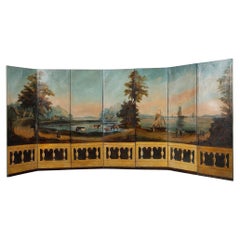
Klappbarer Siebdruck aus gemalter Leinwand, französisches Werk, 1830
Leinwand mit sieben Blättern, die ein Seeufer mit einigen Segelbooten auf dem Wasser, einen von Figuren belebten Waldweg, einen Reiter, der über eine Kuhherde beim Trinken wacht, und...
Kategorie
Antik, 1830er, Französisch, Raumteiler
Materialien
Leinwand
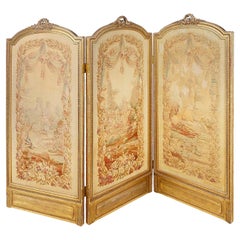
Französischer Aubusson-Bildschirm des 19. Jahrhunderts.
Eine gute Qualität 19. Jahrhundert Französisch geschnitzt vergoldetem Holz gerahmt, drei Falten Französisch Aubusson Wandteppich Bildschirm. Darstellung klassischer romantischer länd...
Kategorie
Antik, 19. Jahrhundert, Französisch, Gemälde, Leinwände und Raumteiler
Materialien
Wandteppich, Vergoldetes Holz
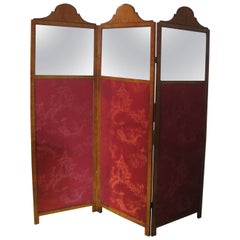
Klappbarer Raumteiler aus edwardianischem Seidenholz
Edwardianisches, furniertes Satinholz, abgeschrägtes Glas und orientalische Seide als Paravent.
Kategorie
Antik, Frühes 20. Jhdt., Englisch, Edwardian, Raumteiler
Materialien
Stoff, Glas, Holz
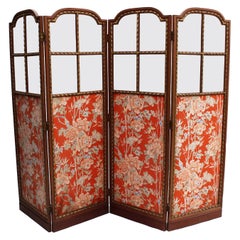
Ein feiner französischer 1920er 4-Panel-Faltwand-Raumteiler
Ein feiner französischer Paravent aus dem frühen 20. Jahrhundert mit vier Mahagoni-Paneelen, die mit kleinen Fenstern, vergoldeten Lackleisten und floralem Stoff verziert sind.
Jede ...
Kategorie
Vintage, 1920er, Französisch, Neoklassisch, Raumteiler
Materialien
Stoff, Glas, Mahagoni
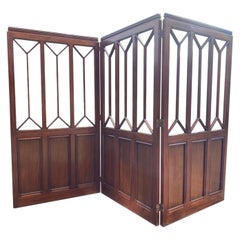
19. Jahrhundert erstaunliche Qualität drei Panel Folding Bildschirm
Eine erstaunliche Qualität 19. Jahrhundert Mahagoni faltenden drei Panel Dressing Bildschirm oder Raumteiler, mit schönen Mahagoni-Panels unten und astragal Öffnungen zum oberen Teil...
Kategorie
Antik, Mittleres 19. Jahrhundert, Britisch, Viktorianisch, Raumteiler
Materialien
Holz
19. Jahrhundert. Französischer bemalter Raumteiler im Regence-Stil
Neunzehntes Jahrhundert Französisch Regence-Stil drei Falten-Bildschirm von sechs Eiche gerahmt ölgemalten Tafeln, die Western und Chinoiserie Figuren umgeben von swag Girlanden und ...
Kategorie
Antik, 19. Jahrhundert, Französisch, Raumteiler
Materialien
Eichenholz