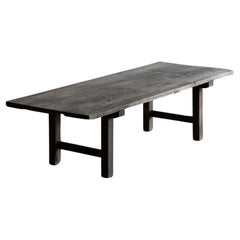
Objekte ähnlich wie Japanese Antique Large Low Table 1860s-1920s / Sofa Table Dining Table Wabisabi
Möchten Sie mehr Bilder oder Videos?
Zusätzliche Bilder oder Videos von dem*der Anbieter*in anfordern
1 von 21
Japanese Antique Large Low Table 1860s-1920s / Sofa Table Dining Table Wabisabi
3.906 €
Angaben zum Objekt
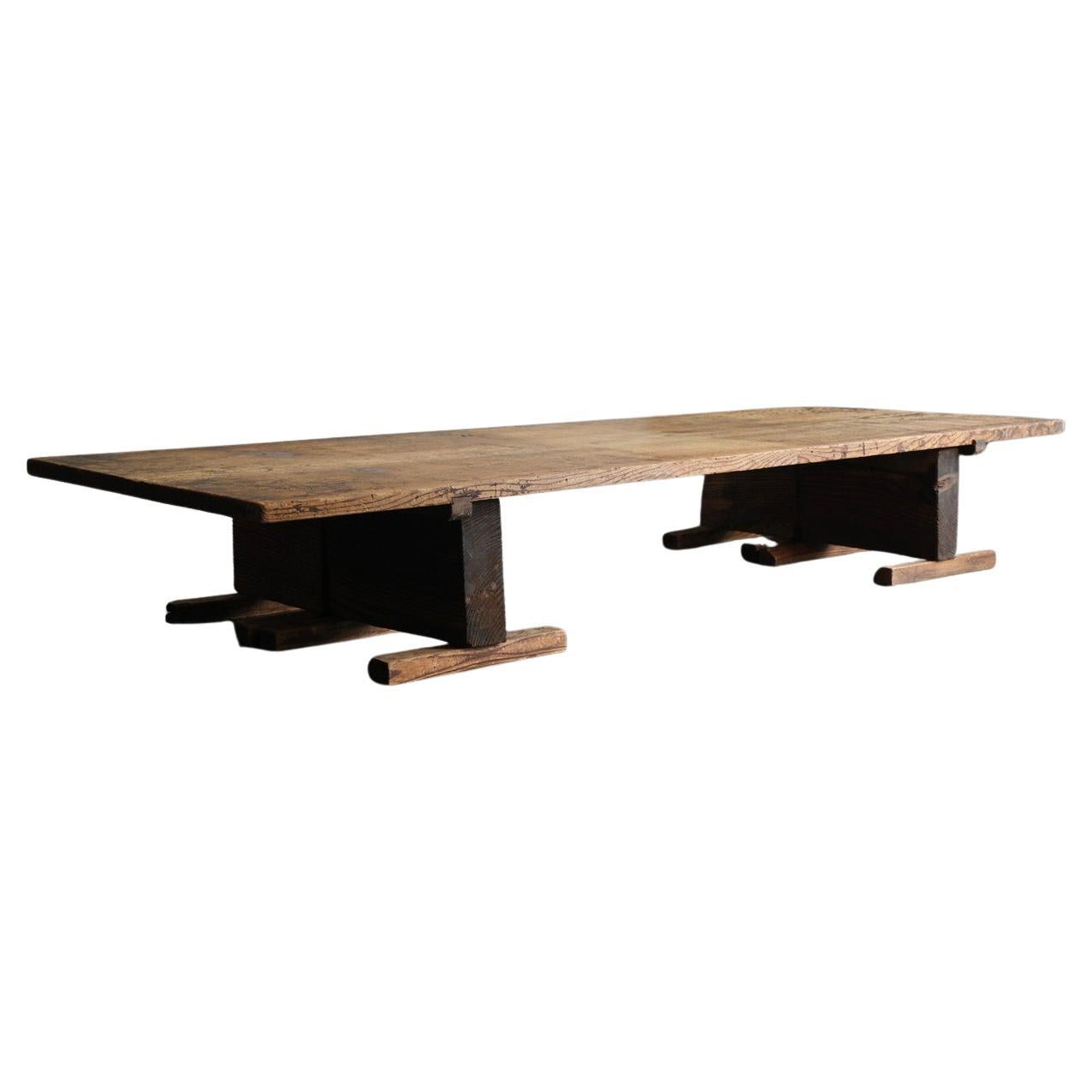
This is a large, old low table made in Japan, dating from the Meiji to Taishō period (1860s–1920s). It is a fine example that strongly reflects the woodworking techniques and aesthetic sensibilities of Japan at the time. The tabletop and legs are constructed as separate components, making the piece relatively easy to move and install.
The first element that draws the eye is the tabletop, crafted from a single solid slab of horse chestnut (tochi). The gently flowing grain resembles rippling water, with deep variations in tone that overlap and merge, creating an expression reminiscent of an abstract painting formed by nature itself. Remarkably, there is almost no warping or distortion, an exceptional condition for tochi wood of this age. Today, it is extremely difficult to obtain a single slab of horse chestnut of this size and beauty, underscoring the table’s outstanding material and historical value.
The legs are made of Japanese cedar, offering a simple yet richly textured presence. Their robust, unrefined form—still bearing visible tool marks—provides a quiet counterbalance to the commanding presence of the tabletop, subtly enhancing its beauty rather than competing with it. The harmony between the different wood species feels natural, as if they have learned to breathe together over time.
The table is completely stable, with no wobbling at all, and remains highly functional despite its long history. Rather than diminishing with age, its presence has grown deeper and more mature. The condition is excellent, and it can be confidently recommended both as a functional piece of furniture and as an art object.
Its versatility is another strong appeal. It can be used as a low dining table, sofa table, display platform, or gallery fixture, adapting seamlessly to a wide range of spaces. Its low, grounded proportions create a sense of calm openness, while its presence quietly anchors and defines the room.
This table embodies the inherent beauty of natural materials combined with the depth created by the accumulation of time. It is a piece that fully expresses the spirit of wabi-sabi, balancing stillness with a powerful sense of presence.
Weight:
Tabletop: 26.5 kg
Legs (2 pieces): 3.5 kg
_________________________
Our Philosophy
Objects always tell the truth.
All I can do is just to face with them sincerely and give
them deep affection as much as I can.
There is no boundary of nationalities and of eras in beauty.
But I think now is the time we choose 'Japanese style' and it
will be the best way to remind us of what we are losing
today and to question us about an essence of beauty again.
I hope that you can touch the memories which the objects here have,
feel and think of something invisible but exists undoubtedly.
- Maße:Höhe: 18 cm (7,09 in)Breite: 169 cm (66,54 in)Tiefe: 94 cm (37,01 in)
- Stil:Taisho (Aus dem Zeitalter)
- Materialien und Methoden:
- Herkunftsort:
- Zeitalter:
- Herstellungsjahr:1860s-1920s
- Zustand:Abnutzung dem Alter und der Nutzung entsprechend.
- Anbieterstandort:Chōsei District Nagara, JP
- Referenznummer:1stDibs: LU10403247991082
Anbieterinformationen
4,8
Platin-Anbieter*in
Premium-Anbieter*innen mit einer Bewertung über 4,7 und 24 Stunden Reaktionszeit
Gründungsjahr 2017
1stDibs-Anbieter*in seit 2025
65 Verkäufe auf 1stDibs
Typische Antwortzeit: 3 Stunde
- VersandAngebot wird abgerufen …Versand von: Chōsei District Nagara, Japan
- Rückgabebedingungen
Einige Inhalte dieser Seite wurden automatisch übersetzt. Daher kann 1stDibs nicht die Richtigkeit der Übersetzungen garantieren. Englisch ist die Standardsprache dieser Website.
Mehr von diesem*dieser Anbieter*in
Alle anzeigenJapanischer antiker Wabi-Sabi Tisch Edo Periode 1800-1860s / Beistelltisch
Dies ist ein alter japanischer niedriger Tisch, der in der Edo-Zeit (1800-1860) hergestellt wurde. Es handelt sich um ein seltenes Möbelstück, das die Jahrhunderte bis heute überlebt...
Kategorie
Antik, Mittleres 19. Jahrhundert, Japanisch, Edo, Beistelltische
Materialien
Zedernholz
Japanischer antiker niedriger Tisch 1860er-1900er Jahre / Beistelltisch Sofatisch Wabisabi
Von Axel Vervoordt
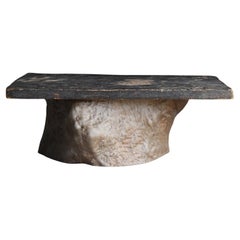
Es handelt sich um einen alten japanischen niedrigen Tisch im primitiven Stil, der einfach aus einem gealterten Holzbrett auf einem natürlichen Baumstumpf hergestellt wurde.
Trotz se...
Kategorie
Frühes 20. Jahrhundert, Japanisch, Primitiv, Sofatische
Materialien
Holz
Japanischer antiker niedriger Tisch 1900-1940er Jahre / Sofa Tisch Display Tisch Wabi Sabi
Dies ist ein alter japanischer niedriger Tisch aus der frühen Showa-Periode (1900-1940er Jahre), der in einem alten Bauernhaus entdeckt wurde.
Die zweiteilige Struktur ist sowohl pra...
Kategorie
Mitte des 20. Jahrhunderts, Japanisch, Showa, Beistelltische
Materialien
Zedernholz

Japanischer antiker primitiver Beistelltisch 1860er-1900er Jahre / Couchtisch Wabi Sabi
Von Axel Vervoordt
Dies ist ein alter japanischer Beistelltisch im primitiven Stil aus der Meiji-Zeit (1860-1900).
Ursprünglich in einem Bauernhaus verwendet, strahlt das Stück auch nach mehr als einem...
Kategorie
Frühes 20. Jahrhundert, Japanisch, Primitiv, Beistelltische
Materialien
Holz

Japanischer antiker Beistelltisch oder Bank 1860er-1920er Jahre / Display Stand Wabisabi
Dies ist ein alter japanischer Beistelltisch oder eine Bank.
Es wurde in der Meiji- und Taisho-Periode (1860er-1920er Jahre) hergestellt und besteht aus Zedernholz mit einer schönen ...
Kategorie
Frühes 20. Jahrhundert, Japanisch, Meiji-Periode, Beistelltische
Materialien
Zedernholz
694 € Verkaufspreis
33 % Rabatt
Antiker japanischer primitiver Couchtisch 1860er-1900er Jahre/Beistelltisch Wabisabi
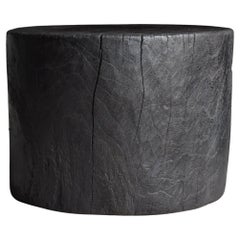
Dies ist ein antiker japanischer Couchtisch im primitiven Stil, der vermutlich in der Meiji-Zeit (1860-1900) hergestellt wurde. Auch nach mehr als einem Jahrhundert ist sie noch imme...
Kategorie
Frühes 20. Jahrhundert, Japanisch, Primitiv, Couch- und Cocktailtische
Materialien
Holz
Das könnte Ihnen auch gefallen
Antiker japanischer Couchtisch aus Holz /Frühes 20. Jahrhundert / Wabi-sabi Sofatisch
Dieser niedrige Tisch kombiniert eine traditionelle japanische Holzplatte und Beine. Die Platte ist aus einem einzigen Stück luxuriöser Zeder gefertigt und umhüllt das gesamte Stück ...
Kategorie
Frühes 20. Jahrhundert, Japanisch, Taisho, Sofatische
Materialien
Zedernholz
Japanischer antiker großer niedriger Tisch / Sofatisch Mitteltisch / Wabi-Sabi Primitiv
Von Axel Vervoordt
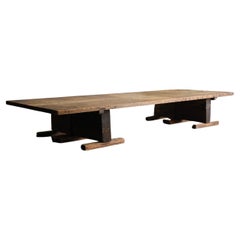
Dies ist ein großer, niedriger Tisch aus altem japanischem Holz.
Die Tischplatte ist ein sehr großes, schweres Brett, dessen Oberfläche im Laufe der Jahre eine natürliche, primitive...
Kategorie
Frühes 20. Jahrhundert, Japanisch, Primitiv, Ess- und Wohnzimmertische
Materialien
Hartholz, Zedernholz
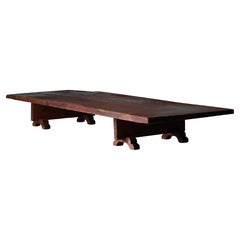
Japanischer antiker langer niedriger Holztisch/1868-1920/einfacher Sofatisch
Dies ist eine hölzerne Werkbank aus der ersten Hälfte des 20. Jahrhunderts in Japan, ein Stück mit einer stattlichen Konstruktion und einer langen Geschichte. Für die Deckplatte wird...
Kategorie
Antik, Spätes 19. Jahrhundert, Japanisch, Showa, Sofatische
Materialien
Holz
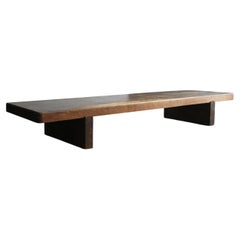
Japanischer antiker hölzerner Sofatisch/letztes 19. Jahrhundert/Wabi-sabi niedriger Tisch
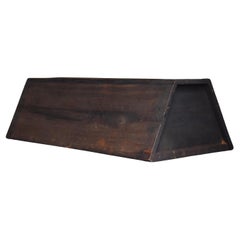
Es handelt sich um ein Brett und eine Holzkiste, die in Japan von der Meiji- bis zur frühen Showa-Periode verwendet wurden.
Diese beiden lassen sich zu einem niedrigen Tisch kombinie...
Kategorie
Antik, Spätes 19. Jahrhundert, Japanisch, Meiji-Periode, Sofatische
Materialien
Zedernholz
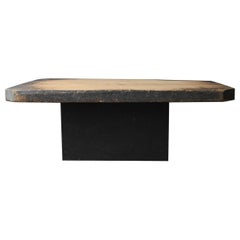
Kleiner japanischer antiker niedriger japanischer antiker Holztisch/1868-1920/Kaffeetisch
Dies ist ein antiker, niedriger Holztisch, der in ländlichen Gebieten und Geschäften in Japan verwendet wurde.
Auf Japanisch nennt man das "fu-zukue".
Die Landwirte nutzten es zum Le...
Kategorie
Antik, Spätes 19. Jahrhundert, Japanisch, Meiji-Periode, Tische
Materialien
Holz
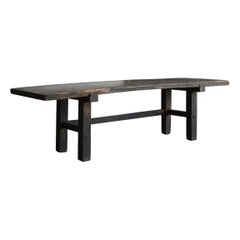
Antiker japanischer Beistelltisch, späte Meiji-Ära
1868-1912
, Wabi Sabi
Dieser antike Beistelltisch wurde in der späten Meiji-Ära (1868-1912) hergestellt.
Die Platte ist aus massivem Zelkova-Holz (Keyaki) gefertigt, die Beine sind aus Zedernholz. Die Obe...
Kategorie
Frühes 20. Jahrhundert, Japanisch, Meiji-Periode, Beistelltische
Materialien
Zedernholz