A.B. Levy s Collectibles and Curiosities
to
2
2
1
1
2
2
2
2
1
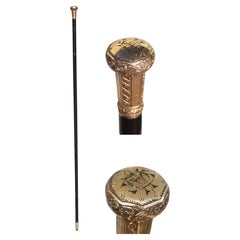
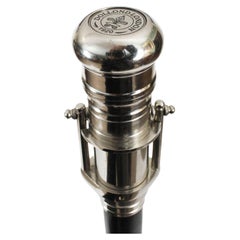
English Gold Plated Gentlemen Walking Stick
Located in West Palm Beach, FL
English Gold Plated Gentlemen Walking Stick
Circa 1890, R.F. Simmons & Co. Marked R.F.S. & Co. The knob handhold chased with foliage and panels, monogramed, AVSW (?), on an ebony sh...
Category
20th Century Historical Memorabilia
Materials
Wood
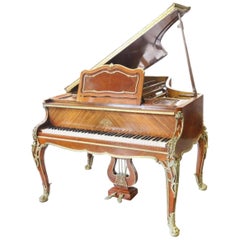
Very Fine Louis XV Style Piano by Francois Linke, Signed., Stamped by Zwiener
By François Linke
Located in West Palm Beach, FL
Francois Linke (1855-1946)
A very fine Louis XV style gilt bronze mounted kingwood piano,late 19th century , signed Francois Linke, stamped Joseph-Emmanuel Zwiener,
movement by E...
Category
Antique Late 19th Century Musical Instruments
Materials
Wood
Related Items
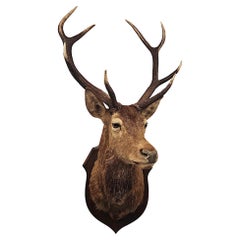
A Very Fine Taxidermy Stags Head
Located in Dublin, IE
A very fine and beautifully detailed taxidermy stags head mounted on a well figured oak shield plaque.
Category
20th Century English Taxidermy
Materials
Oak

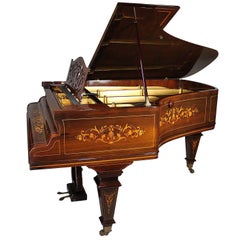
19th Century Louis XIV Style Marquetry Baby Grand Piano by Collard
Collard
By Collard
Collard
Located in Los Angeles, CA
A very fine Anglo-French 19th century rosewood, palisander, amboyna and satinwood marquetry (inlaid) art-case baby grand piano, the works by "Collard & Collard". The intricately deco...
Category
Antique Late 19th Century English Neoclassical Revival Musical Instruments
Materials
Bronze
$75,600 Sale Price
20% Off
H 40.25 in W 72 in D 55.5 in
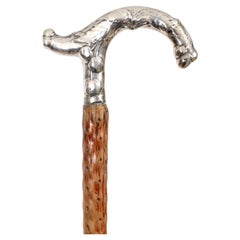
Antique Victorian Silver Plated Child
s Walking Stick Cane 19th Century
Located in London, GB
This is a beautiful antique Victorian silver plated child's walking stick, circa 1890 in date
The striking stick features an ornate silver crutch handle having a profusely embossed ...
Category
Antique 1890s English Victorian Sports Equipment and Memorabilia
Materials
Silver Plate
$341
H 26.78 in W 3.55 in D 0.79 in
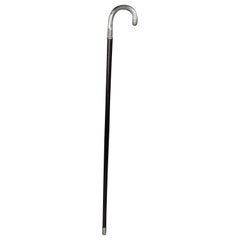
Old Walking Stick / Strolling Stick, Silver Mount, Silver V-177
Located in Berlin, DE
Solid wood ebonized stick with 835 silver mount, circa 1900. Very noble and high quality silver mount. Age-appropriate condition.
(V - 177).
Category
Antique Early 1900s Sports Equipment and Memorabilia
Materials
Silver
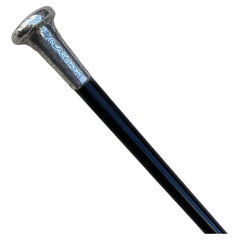
Antique Vintage Wooden English Walking Stick Dress Cane Sterling Silver 1923
Located in Dublin, Ireland
Fine Quality French polished Ebony Lady’s or Gentleman’s Walking Cane with a highly decorative embossed Sterling Silver Grip.
First quarter of the Twentieth Century.
The Sterling Silver knopped grip above a tapering polished ebony shaft with original polished brass ferrule.
Kendall and Sons...
Category
Early 20th Century British Art Deco Sports Equipment and Memorabilia
Materials
Sterling Silver
$567
H 35.5 in W 35.5 in D 35.5 in
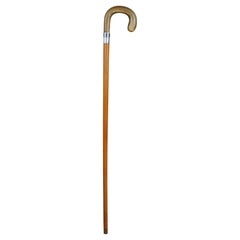
Extraordinary Walking Stick Horn Handle Silver
Located in Berlin, DE
massiv horn handle
silver shaft
robust stick
(V-215).
Category
Vintage 1920s Sports Equipment and Memorabilia
Materials
Horn
Vintage English Telescope Walking Stick Cane Dolland 20th Century
By Dolland
Located in London, GB
This is a beautiful vintage telescope walking stick by Dolland London, late 20th century in date.
The striking stick features a chrome cap unscrewing to reveal a small telescope wit...
Category
Late 20th Century English Sports Equipment and Memorabilia
Materials
Chrome
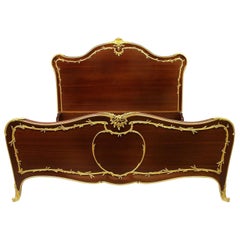
Early 20th Century Gilt Bronze-Mounted Mahogany King Size Bed by François Linke
By François Linke
Located in Long Island City, NY
A wonderful early 20th century gilt bronze mounted king size mahogany bed
By François Linke
With cartouche-shaped headboard, footboard and se...
Category
Early 20th Century French Belle Époque Beds and Bed Frames
Materials
Bronze, Ormolu
$95,000
H 60 in W 80.5 in D 91 in
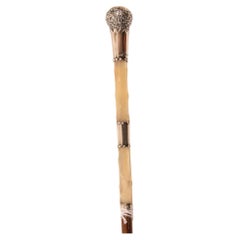
Antique English Walking Stick
Located in Alessandria, Piemonte
Antique English walking stick with silver handle and mother of pearl, from late nineteenth or early twentieth century. The city stamps and the date are not well legible: may be Birmi...
Category
Early 20th Century English Other Sports Equipment and Memorabilia
Materials
Silver
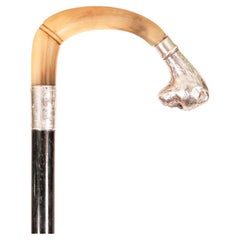
Antique English Boxer Dogs Head Walking Cane Stick 20th Century
Located in London, GB
This is a fantastic antique silver boxer dog head walking stick, bearing hallmarks for London 1900.
It has a very decorative carved bone croo...
Category
Early 20th Century English Sports Equipment and Memorabilia
Materials
Silver, Brass
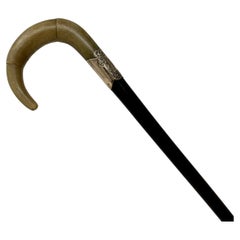
Antique Vintage English Walking Stick Cane Wooden Gold Plated Cow Horn Handle
Located in Dublin, Ireland
Very Stylish Fine Quality Polished Rosewood Wooden Lady’s or Gentleman’s Walking Cane of substantial quality and good weight very suitable to use as an everyday stick, with an elegant decoratively carved classical Cow Horn L shaped handle above a finely repousse chased gold plated collar with a cartouche engraved with H C. Last quarter of the Nineteenth Century, of English origin
Condition: Good condition with nice patination, few small character dents to gilt mounts, complete with its original firm fitting solid steel and polished brass ferrule which is slightly worn. Nice straight stick in wonderful condition.
Length: 32.75" (89cm) Width of handle: 4.25" (10.75cms).
Location: Dublin City, Ireland.
Affordable fixed price Worldwide Store to door Shipping offered by Seller.
*TIP: When deciding to purchase a Walking Stick on-line, always check the dimensions especially its length. Many antique sticks...
Category
Antique Late 19th Century British Victorian Sports Equipment and Memorab...
Materials
Sterling Silver
$508
H 32.75 in W 4.25 in D 32.75 in
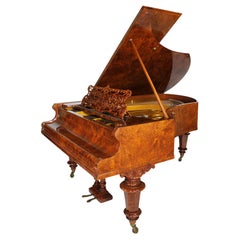
A German 19th Century Louis XVI Style Burr Walnut Bechstein Concert Grand Piano
By Bechstein Piano Company
Located in Los Angeles, CA
A Very Fine German 19th Century Louis XVI Style Burr Walnut Bechstein Concert Grand Piano, Serial No. 5655. The beautifully crafted Grand piano, raised on three tapered barrel shaped legs, with an intricately carved ornate music desk and original keys. Circa: 1872.
Length: 80 inches (203.2 cm)
Width: 59 inches: (149.9 cm)
Height (top closed): 38 5/8 inches (98.1 cm)
C. Bechstein Pianofortefabrik
C. Bechstein Pianofortefabrik AG (also known as Bechstein) is a German manufacturer of pianos, established in 1853 by Carl Bechstein.
Before Bechstein
Young Carl Bechstein studied and worked in France and England as a piano craftsman, before he became an independent piano maker. His first pianos were made for other companies.
C. Bechstein
C. Bechstein piano factory was founded on 1 October 1853 by Carl Bechstein in Berlin, Germany.
Carl Bechstein set out to manufacture a piano able to withstand the great demands imposed on the instrument by the virtuosi of the time, such as Franz Liszt. In 1857, Hans von Bülow (Liszt's son-in-law) gave the first public performance on a Bechstein grand piano by performing Liszt's Piano Sonata in B minor in Berlin
By 1870, with endorsements from Franz Liszt and Hans von Bülow, Bechstein pianos had become a staple in many concert halls and private mansions. By that time three piano makers, all of which were founded in 1853, became established as the industry leaders across the world: Bechstein, Blüthner and Steinway & Sons.
In 1881 Bechstein began supplying pianos to Queen Victoria. A gilded art-case piano was delivered to Buckingham Palace, followed by several more Bechstein pianos to Windsor Castle and other royal residences. By January 1886 they were among the piano manufacturers holding a Royal Warrant as a supplier to the Queen. Several British embassies across the world acquired Bechstein pianos.
In 1885, Bechstein opened a branch in London, that eventually grew to become the largest showroom and dealership in Europe. By 1890 showrooms had been opened in Paris, Vienna, and Saint Petersburg. On 31 May 1901, Bechstein Hall, built at a cost of £100,000, was opened next to the company's London showroom at 36-40 Wigmore Street. Between 1901 and 1914, C. Bechstein was the largest piano dealership in London. At that time, Bechstein was patronized by the tsars of Russia, the royal families of Spain, Belgium, the Netherlands, Italy, Sweden, Norway, Austria and Denmark, and other royalty and aristocracy. The list of royal clients of Bechstein may be found on the soundboard of vintage Bechstein pianos made before the Second World War. The list is part of the original Bechstein trademark logo; it can be seen under the strings in the center of a piano's soundboard.
The signature of Carl Bechstein
The years from the 1870s through 1914 brought Bechstein their most dramatic increase in sales. In 1880 a second Bechstein factory was opened in Berlin, and the third factory was opened in 1897 in Berlin-Kreuzberg. Production reached 3,700 pianos annually in 1900, and 4,600 in 1910, making Bechstein the largest German manufacturer of high-end pianos. At that time, about three quarters of production went to international markets, especially Britain and the Commonwealth, and Russia.
Carl Bechstein died in 1900, and the Bechstein company continued to operate under the management of his sons.
Between 1900 and 1914 C. Bechstein was one of the leading piano makers in the world, employing 1,200 craftsmen and workers by 1913 and making five thousand pianos per year.
First World War
C. Bechstein suffered huge property losses in London, Paris, and St. Petersburg during World War I. The largest loss was in London. Although the company's position in the United Kingdom was initially unaffected, with the company still listed as holding a Royal Warrant in January 1915, Warrants to both King George V, and his wife Queen Mary were cancelled on 13 April 1915. Bechstein was not the only musical concern to be affected by growing anti-German sentiment: there were earlier attempts, led by William Boosey, to boycott German music altogether. In 1915, despite being a Baronet and Privy Counsellor, Sir Edgar Speyer, who was then funding the Proms, was forced to leave the country. Following the passing of the Trading with the Enemy Amendment Act 1916 the British arm of the company was wound-up on 5 June 1916, all Bechstein property, including the concert hall and showrooms full of pianos, were seized as "enemy property" and closed. In 1916 the hall was sold as alien property at auction to Debenhams for £56,500. It was renamed Wigmore Hall, and then re-opened under the new name in 1917. All 137 Bechstein pianos at the Bechstein showrooms were confiscated too, and became property of the new owner of the Hall. After a dispute with his brother, Edwin Bechstein left the company and was paid off.
Eventually the Bechstein factory resumed full-scale production during the 1920s. At that time, technical innovations and inventions of new materials and tools, as well as improvements in piano design and construction, had allowed Bechstein to become one of the leading piano makers again.
The most successful models were the updated "A"-185 and "B"-208 grand pianos. The upright pianos became more popular after the war, and C. Bechstein were successful with its upright pianos Model-8 and Model-9, both of which have been considered the finest upright pianos.
As the company was changed into a joint-stock company 1923, Edwin Bechstein and his wife Helene, bought themselves back into the company as shareholders.
In 1930 the company collaborated with German electrical goods manufacturer Siemens under Nobel laureate Walther Nernst to produce one of the first electric pianos...
Category
Antique 19th Century German Louis XVI Musical Instruments
Materials
Bronze
$34,850 Sale Price
53% Off
H 38.63 in W 80 in D 59 in