Di Mano In Mano Coop Portrait Paintings
to
1
1
12
4
Overall Width
to
Overall Height
to
13
5
6
18
18
13
12
5
5
4
3
1
1
18
17
1
18
18
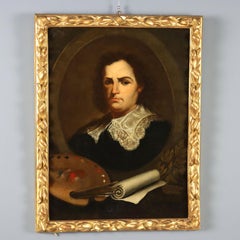
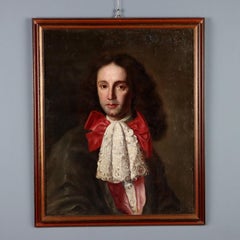
Painting Portrait of a Painter 18th century
Located in Milan, IT
Oil on Canvas. On the back is a pencil inscription identifying the painter portrayed as "Joseph Moreno espagnol 1662."
The face framed in an oval is accompanied at the base by the pa...
Category
18th Century Other Art Style Portrait Paintings
Materials
Oil
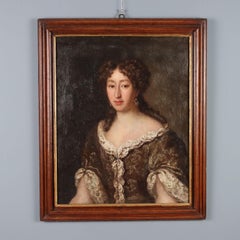
Dipinto Ritratto Femminile nello Stile di Jakob Ferdinand Voet fine 600
Located in Milan, IT
Olio su tela.
L'opera riprende i modi diffusi in tutta Europa da Jakob Ferdinand Voet, pittore fiammingo affermatosi soprattutto come ritrattista, che ebbe ampio seguito sia negli a...
Category
17th Century Other Art Style Portrait Paintings
Materials
Oil
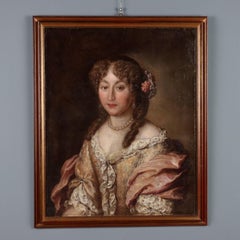
Painted Portrait of a Woman in the Style of Jakob Ferdinand Voet late600s early700s
Located in Milan, IT
Oil on Canvas.
L'opera riprende i modi diffusi in tutta Europa da Jakob Ferdinand Voet, pittore fiammingo affermatosi soprattutto come ritrattista, che ebbe ampio seguito sia negli ...
Category
Late 17th Century Other Art Style Portrait Paintings
Materials
Oil
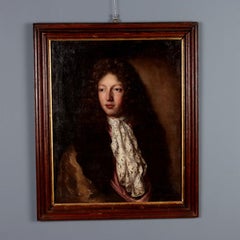
Painting Male Portrait In the Style of Jakob Ferdinand Voet late 1600s early 1700s
Located in Milan, IT
Oil on Canvas.
L'opera riprende i modi diffusi in tutta Europa da Jakob Ferdinand Voet, pittore fiammingo affermatosi soprattutto come ritrattista, che ebbe ampio seguito sia negli ...
Category
17th Century Other Art Style Portrait Paintings
Materials
Oil
Painting Male Portrait in the Style of Jakob Ferdinand Voet late 1600s early 1700s
Located in Milan, IT
Oil on Canvas.
L'opera riprende i modi diffusi in tutta Europa da Jakob Ferdinand Voet, pittore fiammingo affermatosi soprattutto come ritrattista, che ebbe ampio seguito sia negli a...
Category
Late 17th Century Other Art Style Portrait Paintings
Materials
Oil
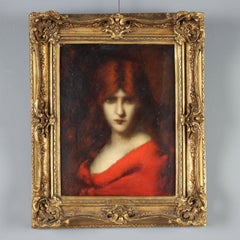
Female Portrait in Red Dress 19th century
By Jean-Jacques Henner
Located in Milan, IT
Oil on Canvas.
The work offers a half-length close-up of a female figure, corresponding to the red-haired model repeatedly portrayed by Jean-Jacques Henner, the French painter to who...
Category
19th Century Other Art Style Portrait Paintings
Materials
Oil
Dipinto Ritratto di Nobildonna XVIII secolo
Located in Milan, IT
Olio su tela.
La nobildonna è riccamente abbigliata in un abito da sera in velluto scuro e volants bianchi, con inserti di perle e un mantello di raso rosso drappeggiato morbidament...
Category
18th Century Other Art Style Portrait Paintings
Materials
Oil
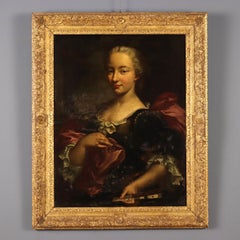
Painting Portrait of a Noblewoman 18th century
Located in Milan, IT
Oil on Canvas.
The noblewoman is richly attired, with an elegant red cape resting on her shoulders, leaving her lace-trimmed dress uncovered; her hairstyle is embellished with pearls...
Category
18th Century Other Art Style Portrait Paintings
Materials
Oil

The Drinker, Painting by Follower of James Francis Cipper, 18th century
Located in Milan, IT
Oil on Canvas.
The painting refers in pictorial manner and subject matter to the production of Giacomo Francesco Cipper known as the Todeschini, an artist of Austrian origin but esta...
Category
18th Century Other Art Style Portrait Paintings
Materials
Oil
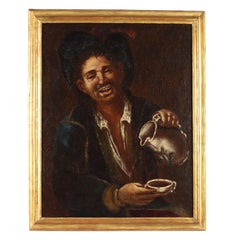
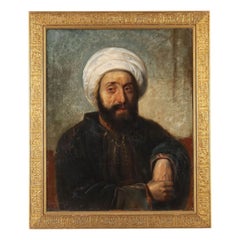
Painting Portrait of Arab with Turban 19th century
Located in Milan, IT
Oil on Canvas. 2nd half 19th century.
Intense close-up portrait of probably North African man, which falls within the artistic period defined orientalist, that is, in that artistic ...
Category
19th Century Other Art Style Portrait Paintings
Materials
Oil
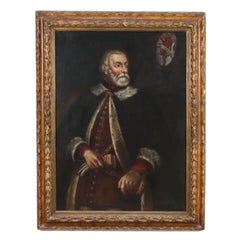
Portrait of a Noble 17th Century
Located in Milan, IT
Oil on Canvas.
Portrait of a nobleman, proud with his hand resting on the 'hilt of his sword and dressed in an ermine-edged cloak. On the upper right appears the coat of arms of his ...
Category
17th Century Other Art Style Portrait Paintings
Materials
Oil
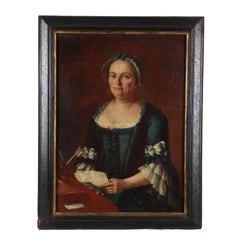
Painting Female Portrait 18th century
Located in Milan, IT
Oil on Canvas. Central European school of the 18th century.
The distinguished lady, flaunting a dress embellished with bows and lace, is seated at her desk and holding a letter; in t...
Category
18th Century Other Art Style Portrait Paintings
Materials
Oil
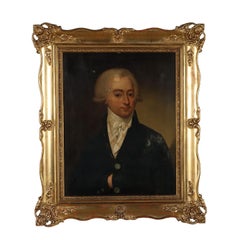
Painting Male Portrait 19thC
Located in Milan, IT
Oil on Canvas. French school of the late 1700s-early 1800s.
Portrait of a gentleman in elegant bourgeois dress.
The canvas has slight tears and is in need of cleaning.
It is presente...
Category
19th Century Other Art Style Portrait Paintings
Materials
Oil
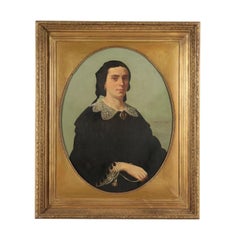
Female Portrait 19th century
Located in Milan, IT
Oil on Canvas. Signed at right, mid-canvas.
It is a portrait of a mourning woman, a young widow, as can be inferred, not only from the black dress, but rather from the headdress and...
Category
19th Century Other Art Style Portrait Paintings
Materials
Oil
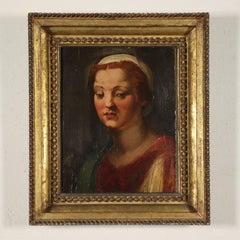
Female Head, Andrea del Sarto, Sphere of, post 1522
Located in Milan, IT
Tempera on wood depicting a half-length female figure;
she wears a red dress over a light-colored tunic, while a
green drape rests on her right shoulder. The red hair is
tied up with a central parting and is partly covered by a
white headdress; the full face has an absorbed
expression: a thoughtful gaze, arched eyebrows and
slightly furrowed lips.
Presented in a frame made with parts of an ancient
larger frame.
Historical-critical analysis:
Our table in question is one of the numerous derivations
from a lost fresco by Andrea del Sarto...
Category
16th Century Other Art Style Portrait Paintings
Materials
Tempera
Portrait Of A Scottish Monarch Oil On Canvas 19th Century
Located in Milan, IT
Oil on canvas. Intense and high quality, the painting depicts a monarch of the royal house of Scotland.
Around the portrait, in a painted oval frame, there are some writings: the name Rober(t) appears at the top left, the title Rex at the bottom left and the abbreviation Scot, which stands for Scotorum, on the right; the writing at the top right is not identifiable, but it seems to be an acronym.
The man portrayed wears a hat and a coat adorned with ermine fur, which is considered the noblest fur, reserved for royalty. He wears a golden pendant around his neck, which depicts two leaves with the fruit of the thistle, which, in heraldry, symbolizes Scotland.
The writing and the pendant therefore refer to a Robert of Scotland, probably from the dynasty that reigned in the fourteenth century.
The portrait was however executed in the romantic nineteenth-century period, probably using some ancient engravings...
Category
19th Century Other Art Style Portrait Paintings
Materials
Oil

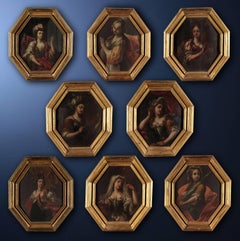
Gruppo 8 dipinti Eroine dell’antichità, Francesco Conti, XVIII secolo
Located in Milan, IT
Oil on gattice wood in octagon. Il gruppo di otto dipinti in oggetto (figg. 1-8) rappresenta, nel classico formato fiorentino dell’ottagono, una serie di effigi femminili a mezza figura.
Più precisamente, si tratta di giovani fanciulle elegantemente vestite, disposte in varie attitudini ma accomunate, ad eccezione di due esemplari sui quali ci soffermeremo in seguito, dall’accento sulla ricchezza, evidenziata sia da particolari di fastose console e drappeggi, sia da collane di perle o tessuti preziosi che le donne talvolta maneggiano, ponendovi così l’accento.
Una delle figure porta in testa una corona reale, altre dei turbanti o inconsueti copricapi. Questi dettagli conferiscono ai personaggi un aspetto principesco, talvolta abbinato a richiami orientaleggianti.
Una formula che riporta alla mente il caso di un dipinto da poco riscoperto nella sua vera identità, il “Ritratto fino a mezzo busto di Regina Armena” di Mario Balassi, seducente connubio di recuperi alloriani ed elementi di fantasia conservato alle Gallerie degli Uffizi (vedi F. Berti, Da ritratto mediceo di Jacopo Ligozzi...
Category
17th Century Other Art Style Portrait Paintings
Materials
Oil
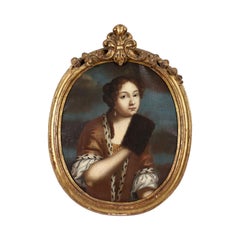
Portrait of Woman with Muff, XVIIIth century
Located in Milan, IT
Oil painting on canvas. Venetian school of the eighteenth century. The portrait proposes the figure of a young woman wearing an everyday dress, but embellished with spotted fur...
Category
18th Century Other Art Style Portrait Paintings
Materials
Oil
Related Items
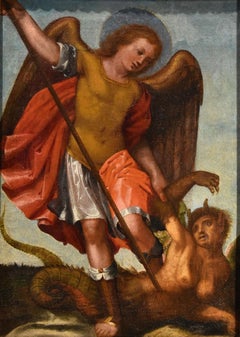
Saint Michael Archangel Tuscany school 16th Century Paint Oil on canvas Italy
Located in Riva del Garda, IT
Saint Michael the Archangel victorious over the Devil
Tuscany - 16th century
Oil on canvas
68 x 52 cm. - In frame 97 x 78 cm.
Of great character is this interesting St. Michael the...
Category
16th Century Old Masters Paintings
Materials
Oil

$9,237 Sale Price
20% Off
H 38.19 in W 30.71 in
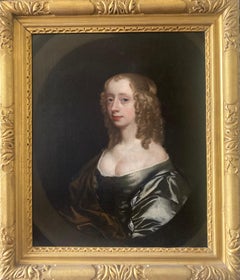
English 17th century portrait of a lady
By Sir Peter Lely
Located in Bath, Somerset
A 17th century English portrait of a lady by Sir Peter Lely (1618-1680), half-length in a painted feigned oval, wearing a green silk gown with chestnut coloured cloak over one shoulder, her fair hair curled in the fashionable ringlet style of the period. Oil on canvas in an English giltwood 'Lely' frame.
We are grateful to Diana Dethloff and Catharine MacLeod (who are currently working on a Lely catalogue raisonné) for their confirmation of Lely as the artist from photograph analysis of this previously unidentified early work.
Provenance:
Private collection Nottingham until 2021
Mellors and Kirk sale December 2000, lot 1173
The sitter is likely to have been from an upper class or aristocratic family in court circles, who were the main source of Lely`s patronage. The simple composition serves to highlight the beauty of the sitter through portraying her pale decolletage and complexion, set against the gentle gaze of her blue eyes, the soft blush of her cheeks and her full red lips.
Peter Lely (1618-1680) was originally of dutch origin and became Principle Painter to the King in 1661, following in the footsteps of Van Dyck who had died in 1641. He dominated the portrait painting scene in England for over 20 years, creating a distinctive 'court look' in his work which had a strong influence on many other artists. He had an extremely successful and popular portrait practice which meant that he soon had to develop production methods that could accommodate the high demand for portraits, and also for copies and versions of them which were given as gifts to family and courtiers. The use of studio assistants was a common practice for busy artists and as with Van Dyck, Lely is known to have used specialist assistants to execute particular parts of his paintings. Artists who worked in Lely`s studio included John Baptist Gaspars who specialised in drapery painting, William Wissing, John Greenhill...
Category
17th Century Baroque Portrait Paintings
Materials
Canvas, Oil
$24,023 Sale Price
20% Off
H 37.8 in W 32.68 in
Modern British portrait of a Bassett Hound in oils
Located in Woodbury, CT
Wonderful late 20th century portrait of a Bassett Hound dog.
Painted in England circa 1996 the artist was capable of painting the most amazing character in this portrait.
Oils on...
Category
1990s Modern Animal Paintings
Materials
Oil, Board

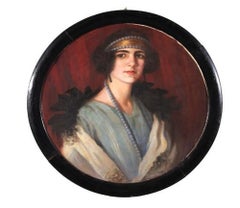
Portrait of Noblewoman - Oil on Canvas by Anonymous Master Early 20th Century
Located in Roma, IT
Beautiful circular oil on canvas representing the portrait of a Noblewoman dressed in Art Nouveau Style.
It includes a contemporary black wooden frame.
Very good conditions.
Category
Early 20th Century Art Nouveau Portrait Paintings
Materials
Oil
$2,958
H 10.24 in Dm 10.24 in
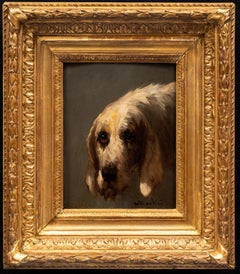
Dog Portrait of a Grand Vendéen Hunting Dog Jules Chardigny (1849-1892) ca 1870s
Located in SANTA FE, NM
Dog Portrait of a Grand Vendéen Hunting Dog
Jules Chardigny (1849-1892)
Signed lower right
Circa 1870
Oil on wood panel
Housed within its beautiful and original ornate original gil...
Category
Mid-19th Century Realist Animal Paintings
Materials
Oil, Wood Panel
$5,700
H 16.5 in W 14.5 in
Portrait of a lady.
By Auguste Serrure
Located in Douglas, Isle of Man
Auguste Serrure 1825 - 1903, was a Flemish born painter. The description of his birthplace is generally described as Belgium, however the Flemish nationality became Belgian in 1830 a...
Category
Late 19th Century Portrait Paintings
Materials
Oil, Panel
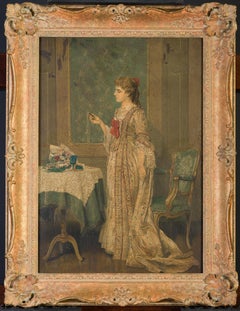
[Bruce Sargeant (1898-1938)] Winter Sport Athletes
By Mark Beard
Located in New York, NY
Signed in red, u.l.
Oil on canvas mounted to Masonite
Price includes $650 additional cost of framing.
This work is offered by ClampArt in New York City
Category
2010s Contemporary Paintings
Materials
Canvas, Masonite, Oil
![[Bruce Sargeant (1898-1938)] Winter Sport Athletes](https://a.1stdibscdn.com/mark-beard-paintings-bruce-sargeant-1898-1938-winter-sport-athletes-for-sale/a_9323/1616513671128/Beard_Sargeant_Winter_Sports_Athletes_master.jpg?width=240 "mark beard abercrombie")
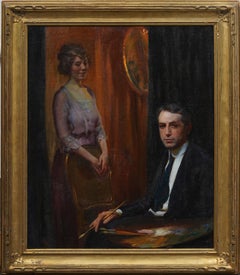
Antique American Realist Interior Portrait Signed Framed Original Oil Painting
By Charles Courtney Curran
Located in Buffalo, NY
Vintage American modernist abstract landscape oil painting by Charles Courtney Curran (1861 - 1942) . Oil on canvas, lain to board. Framed. Measuring: 23 by 27 inches overall, and 18...
Category
1920s Realist Portrait Paintings
Materials
Oil, Board
$4,750
H 27 in W 23 in D 2 in
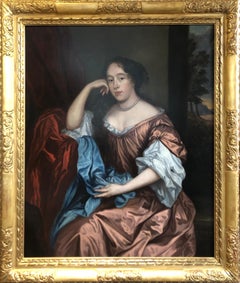
Portrait of a Lady, After Sir Peter Lely (1610-1680) Oil Painting
By After Sir Peter Lely
Located in Uppingham, GB
Oil Painting After Sir Peter Lely (1610-1680) Portrait of a Lady
Housed in a Lely gold Leaf Frame.
Peter Lely:
In 1647 he became a member of the Pain...
Category
17th Century Old Masters Portrait Paintings
Materials
Oil
$17,062
H 57 in W 47 in D 4 in
“North African Man, c. 1916-21” by Caleb Arnold Slade, American Portrait Oil
By Caleb Arnold Slade
Located in Yardley, PA
“North African Man, c. 1916-21” by Caleb Arnold Slade (American, 1882-1961)
Inspired by Slade’s travels in Algeria and Tunisia, this remarkable portrait depicts a young man standing...
Category
Early 20th Century American Impressionist Portrait Paintings
Materials
Canvas, Oil

$9,500
H 47.5 in W 40.25 in D 1.5 in
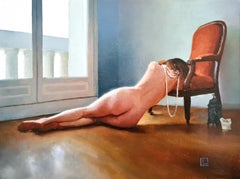
"The Orange Voltaire II" by Linda Delahaye, Original Oil Painting, Female Nude
By Linda Delahaye
Located in Denver, CO
"The Orange Voltaire II" by Linda Delahaye (France based) is an original oil on panel depicting a graceful female nude bathed in sunlight.
Born: 1980, Cana...
Category
21st Century and Contemporary Portrait Paintings
Materials
Oil, Panel
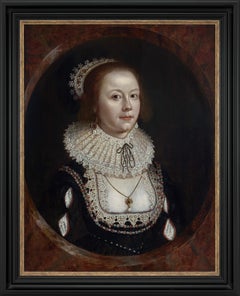
Portrait of lady, Mary Hammond in Rich Attire, Jewels, Lace c.1618-22 Historical
By Cornelius Johnson
Located in London, GB
Portrait of Mary Hammond in Sumptuous Attire, Jewels and Lace c.1618-22
Circle of Cornelius Johnson (1593-1661)
This portrait of a lady, presented by Titan Fine Art, is an exquisite example of early seventeenth-century portraiture, remarkable both for the lavishness of its subject’s attire and for the distinguished provenance that has accompanied it across four centuries that adds a rich layer of historical significance. It was once part of the notable collection of Sir William Temple, 1st Baronet (1628–1699) at Moor Park, a stately mansion in Hertfordshire. Temple was a diplomat, essayist, philosopher, and the patron of Jonathan Swift. He was a key participate at an important period in English history, helping not only to negotiate the Triple Alliance, but also the marriage between William of Orange and Princess Mary. His collection at Moor Park was well known in its day, reflecting both his cultivated taste in art and literature and his international connections.
Its fabulous attire, rendered with almost microscopic attention, is not merely decorative but emblematic of a world in which visual display was a language of power. Its provenance, stretching from the English country house and Enlightenment scholarship to modernist circles, forms a microcosm of cultural exchange across four centuries. Thus, the portrait of Mary Hammond stands as both a masterpiece of early seventeenth-century craftsmanship and a witness to the grand narrative of collecting and connoisseurship—a testament to the enduring fascination of beauty, status, and history intertwined.
By tradition the portrait depicts Mary Hammond (born c.1602), who was Sir William Temple’s mother, and the daughter of the royal physician who served James I, Dr John Hammond (c.1555–1617) and whose family owned Chertsey Abbey in Surrey. The woman appears between 18 and 25 years old, and Mary would be about 18–20 when the portrait was painted circa 1620, therefore this matches the apparent age of the sitter and the fashion perfectly.
Mary stood at the intersection of learned/courtly and gentry worlds. On 22 June 1627 she married her first cousin (a common practice for consolidating family wealth and influence during that era.) Sir John Temple (1600-1677) at St Michael, Cornhill in the City of London. The couple resided nearby, at Blackfriars. Her marriage to Sir Temple placed her at the heart of the social and political circles that shaped British history.
The couple had at least five children, and they became highly significant historical figures:
The eldest son, Sir William Temple, 1st Baronet, became a distinguished diplomat, statesman, and essayist, famous for his role in the Triple Alliance and as a patron and mentor to the writer Jonathan Swift – our portrait was in his collection. Their daughter, Martha Temple, later Lady Giffard, was a notable figure in her own right. She became her brother William's first biographer and a respected letter-writer, providing a rare female perspective on the events and high society of the time. Another son, also named Sir John Temple, became Attorney General for Ireland and was involved in the turbulent politics surrounding the English Civil War and the Act of Settlement in Ireland.
Mary died in November 1638 after giving birth to twins and was buried at Penshurst, Kent. The family's connection to Penshurst Place is a major point of interest as this historic manor was the seat of the Sidney family, a major aristocratic and literary dynasty.
The portrait was in the collection of the Mary’s son, Sir William Temple. From there it descended to his daughter, and then to her nephew, the Reverend Nicholas Bacon of Spixworth Park, Norfolk (his mother was Dorothy Temple who died in 1758). Indeed, by this time, many Temple relics were in the collection at Spixworth including the engagement ring of the illustrious Dorothy Osborne, Lady Temple, wife of Sir William Temple. The portrait thus linked two prominent English families—the Temples and the Bacons—for generations. It is listed in a Spixworth Park inventory of 27 October 1910 by the local collector and art historian, Prince Duleep Singh. He described it with characteristic precision as: “No. 69. Lady Half Length, body and face turned towards the sinister, hazel eyes upwards to the dexter, red hair dressed low and over the ears, a jewelled coronet behind, pearl ear-rings tied with black strings. Dress: black, bodice cut low and square, with lace all round the opening and over shoulders, sleeves with double slashes showing red lining and lace under, falling thin pleated lace collar, black strings tied behind it, a jewel suspended on a black string round the neck, and a double row of agate and silver beads all round to the shoulders. M. In brown veined stone frame. Age 30. Date c.1620. It is called ‘Dutch portrait from Moor Park, mentioned by Nicholas Bacon of Coddenham and Shrubland as a very valuable painting.’
A few years later, when Robert Bacon Longe’s executors sold the contents of Spixworth Park (19–22 May 1912), the portrait appeared as lot 262, described as: “A very valuable half-length portrait on panel, ‘Dutch Lady, with deep lace collar and pearl and amethyst necklace, pendant, and ear-rings, and auburn hair, with coronet’ Early Dutch School 1620.” Following this sale the painting entered the collection of David and Constance Garnett, prominent literary figures of the early twentieth century, before being gifted to Andre Vladimervitch Tchernavin by 1949, and subsequently passed by him to the present owners in 1994.
The two great houses associated with the painting, Moor Park and Spixworth Park, further underscore its pedigree. Moor Park, in Hertfordshire, was among the grandest country estates of seventeenth-century England—its gardens famously redesigned by Sir William Temple himself and later influencing landscape design across Europe. Sir William's Temple's secretary was Jonathan Swift, who lived at Moor Park between 1689 and 1699. Swift began to write "A Tale of the Tub" and "The Battle of the Books" at Moor Park.
Spixworth Park, near Norwich, was an Elizabethan country house in Spixworth, Norfolk, located just north of the city of Norwich. It was home to successive generations of the Bacon family, one of Norfolk’s most distinguished dynasties (later, the Bacon Longe family), who were considerable land owners (owning Reymerston Hall, Norfolk, Hingham Hall, Norfolk, Dunston Hall, Norfolk, Abbot's Hall, Stowmarket, and Yelverton Hall, Norfolk). Spixworth Hall and the surrounding parkland remained in the Longe family for 257 years until 1952, when it was demolished.
Rendered with meticulous precision and sumptuous detail, the painting depicts an elegantly dressed woman—her poise, costume, and jewels all communicating a message of wealth, refinement, and social rank. Every brushstroke conveys an artist deeply attuned to the textures of luxury and the nuances of feminine dignity.
The sitter’s attire is nothing short of magnificent. Her bodice and sleeves are fashioned from the finest black silk or satin, the fabric absorbing and reflecting light in equal measure, suggesting both depth and lustre. Around her shoulders lies an opulent lace ruff—a deep, radiating lace collar worked in such intricate detail that it testifies to both the artist’s technical skill and the sitter’s extravagant taste. Lace of this quality, especially Venetian or Flemish bobbin lace, was one of the costliest materials available in early seventeenth-century Europe, its weight worth more than gold, and was a marker of prestige that rivalled jewels in value. The painter has taken great care to delineate every loop and scallop of the lace, achieving an almost tactile realism. Pale skin was also a desired beauty standard, sometimes accentuated with contrasting black ribbons or strings.
Her jewels amplify this display of affluence. Matching earrings and a delicate coronet or jewelled hair ornament with a feather adorn her hair, which is styled in the modest yet fashionable manner of the time. These details are far from decorative excess—they serve as visual emblems of social standing, refinement, and lineage. Portraits of this kind were statements of both identity and aspiration, intended to project a family’s prosperity and moral virtue to posterity.
The portrait was most likely painted in London around 1618-1622. The low-cut, décolletage-revealing neckline was fashionable in the courts of England and France during the late Elizabethan and Jacobean eras (c. 1590s-1610s), this style did not prevail in the public fashion of the Low Countries at this time. This style of lace ruff — delicate needle lace with geometric openwork — was fashionable from c.1615 to 1622, and the jewelled caul (hair net) and lace edging over a stiffened coif are consistent with high-status English women’s portraiture between 1610–1620. The puffed sleeve slash and the use of pink satin beneath black velvet belong squarely to the late Jacobean...
Category
17th Century Old Masters Portrait Paintings
Materials
Oil, Panel
$19,597
H 33.47 in W 27.17 in D 2.37 in