Antique Resources More Furniture and Collectibles
to
7
7
4
3
3
4
4
5
5
5
4
4
6
4
2
2
1
7
7
7
4
Early 20th Century Louis Vuitton Monogram Twelve Shoe Case
By Louis Vuitton
Located in Chicago, IL
This Louis Vuitton shoe case, dating from 1910 to 1930, exemplifies the brand's innovative craftsmanship. It features hand-painted canvas monog...
Category
Early 20th Century French Art Deco Trunks and Luggage
Materials
Brass
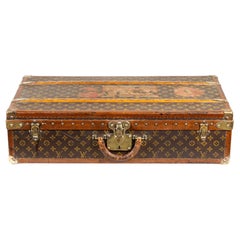
Early 20th Century Louis Vuitton Monogram Bisten Case
By Louis Vuitton
Located in Chicago, IL
This Louis Vuitton Bisten case, dating from 1910 to 1930, exemplifies the brand's innovative craftsmanship. It features hand-painted canvas monogram, solid brass hardware, and reinfo...
Category
Early 20th Century French Art Deco Trunks and Luggage
Materials
Brass
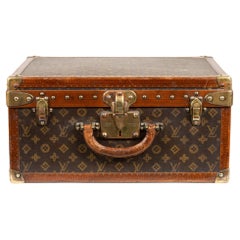
Early 20th Century Louis Vuitton Monogram Wardrobe Trunk with Fourteen Hangers
By Louis Vuitton
Located in Chicago, IL
This Louis Vuitton upright wardrobe trunk, dating from 1910 to 1930, exemplifies the elegance of the clear lozine series, known as the 1st series after 1914. Designed for organized packing, this trunk is ideal for suits and soft dresses, ensuring they remain wrinkle-free during travel. The trunk features a vertical opening that reveals six drawers, each having a canvas exterior with a linen interior. It includes a trinket drawer with an organizer, four drawers with fabric covers, and a hat drawer equipped with a ribbon cage. A pullout mechanism holds 14 original hangers, while a leather strap secures additional items in the lower section.
Externally, the trunk showcases a hand-painted monogram canvas, wooden slat reinforcements, solid brass hardware, and leather handles, with reinforced corners embossed with the LV initials. The iconic monogram design features interlocking L and V letters. The center clasp utilizes a v-lock design with a serial number for authenticity, and inside, the authentic Louis Vuitton plate...
Category
Early 20th Century French Art Deco Trunks and Luggage
Materials
Brass
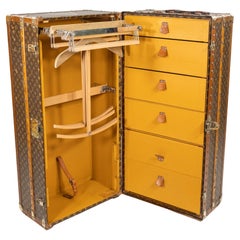
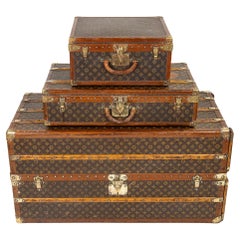
Set of Three Early 20th Century Louis Vuitton Luggage
By Louis Vuitton
Located in Chicago, IL
This exquisite set of Louis Vuitton luggage, dating from 1910 to 1930, represents the pinnacle of luxury travel and showcases the brand's renowned craftsmanship, making it a must-have for discerning collectors.
Each piece features a hand-painted canvas monogram exterior embellished with interlocking L and V initials, quatrefoils, and flowers against a rich brown background. Solid brass hardware, reinforced corners adorned with embossed lozine trim. Each exterior and interior component is marked "Louis Vuitton” or “LV”. Each case has a label inside, a serial number on the inside, and a number stamped onto the lock outside.
The Louis Vuitton shoe case...
Category
Early 20th Century French Art Deco Trunks and Luggage
Materials
Brass

$105,000 / set
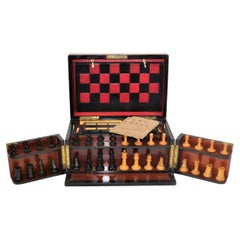
Mid 19th Century English Games Compendium
Located in Chicago, IL
This beautiful maple and ebony compendium box has a hinged lid and a pair of front doors that swing open to reveal the boxwood and ebony hand-carved chess pieces. Each chess piece si...
Category
Antique Late 19th Century English Victorian Historical Memorabilia
Materials
Bone, Boxwood, Ebony, Maple
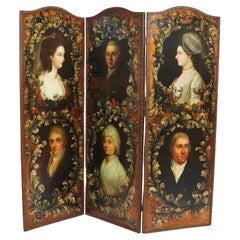
19th Century Hand Painted Floor Screen with Six Portraits
Located in Chicago, IL
This is a rich-looking 19th-century hand-painted floor screen with a portrait gallery. The materials make it 19th-century, but the subjects are dr...
Category
Antique 19th Century American Victorian Screens and Room Dividers
Materials
Leather, Canvas, Wood
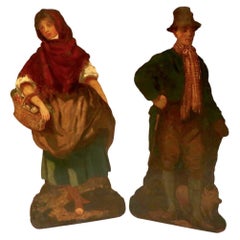
Pair of Early 19th Century Georgian Pinewood Oil-Painted Dummy Boards
Located in Chicago, IL
Early 19th Century Georgian Pair of Dummy Boards. Pinewood with oil-painted fine details. Charming and scarce pieces, it took the owner a couple of years to find them. There is no ag...
Category
Antique Early 19th Century English Early Victorian Historical Memorabilia
Materials
Pine, Paint
Related Items
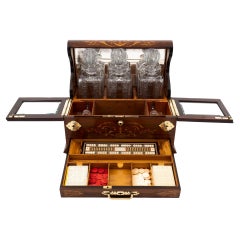
Antique English Victorian Decanter Humidor Games Box Compendium
Located in Northampton, GB
Dating to the late 19th Century Circa 1900
From our Games Boxes collection, we are delighted to offer this Victorian Entertainment Compendium. The Compendiu...
Category
Early 20th Century British Victorian Games
Materials
Mahogany, Cedar
$5,439
H 14.18 in W 16.15 in D 11.42 in
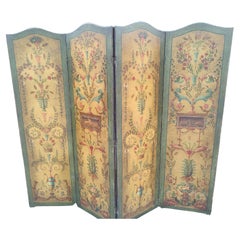
19th Century French Hand Painted Room Divider 4 Panel Leather Screen
Located in Port Jervis, NY
Fantastic leather four panel room divider hand painted and hand crafted screen from the latter part of the 19th century France. Hand painted cherubs with floral accents in outstandin...
Category
Antique 1870s French Empire Screens and Room Dividers
Materials
Brass
Rare 19th Century English Tunbridgeware Hair Pin or Slide
Located in Dallas, TX
PRESENTING an EXTREMELY UNIQUE and RARE 19C British Tunbridgeware Hair Pin/Bobbin or Slide.
This slide is unlike any of it’s kind we have seen before, it is a VERY RARE survivor.
From circa 1860 – 80 and made in Tunbridge Wells, England.
Made of walnut with gorgeous marquetry inlay on the entirety of the front with classic Tunbridgeware micro-mosaic all over the front. The rear is walnut.
The marquetry inlay appears to be various different woods, namely, maple, walnut and satinwood.
Would have been worn in a Lady’s hair bun with the micro-mosaic facing forward.
This would have belonged to a VERY ELEGANT LADY in the mid to late 19th Century.
Tunbridge ware is a form of decoratively inlaid woodwork, typically in the form of boxes, that is characteristic of Tonbridge and the spa town of Royal Tunbridge Wells in Kent in the 18th and 19th centuries. The decoration typically consists of a mosaic of many very small pieces of different coloured woods that form a pictorial vignette. Shaped rods and slivers of wood were first carefully glued together, then cut into many thin slices of identical pictorial veneer with a fine saw. Elaborately striped and feathered bandings for framing were pre-formed in a similar fashion.
There is a collection of Tunbridge ware in the Tunbridge Wells Museum and Art Gallery in Tunbridge Wells.
The famous makers of Tunbridge ware were in the Tunbridge Wells area of Kent; their most notable work was from circa 1830-1900.
Early makers of Tunbridge ware, in Tunbridge Wells in the mid-18th century, were the Burrows family, and Fenner and Co. In the 19th century, around 1830, James Burrows invented a technique of creating mosaics from wooden tesserae. Henry Hollamby, apprenticed to the Burrows family, set up on his own in 1842 and became an important manufacturer of Tunbridge ware, employing about 40 people.
Edmund Nye (1797–1863) and his father took over the Fenner company when William Fenner retired in 1840, after 30 years in partnership with him. Thomas Barton (1819–1903), previously apprenticed at the Wise factory, joined the Nyes in 1836, and worked as Nye’s designer; he took over the business in 1863 and continued there until his death.
In Tonbridge (near to Tunbridge Wells), George Wise (1703–1779) is known to have had a business in 1746. It continued with his son Thomas, and Thomas’s nephew George (1779–1869), who took over in 1806. In its early years the company made articles such as workboxes and tea caddies with prints of popular views; later items had pictures created from mosaics. Their workshop in Tonbridge, Wise’s Tunbridge Ware Manufactory, was next to the Big Bridge over the Medway; the building was demolished in 1886 to widen the approach to the bridge.
Tunbridge ware became popular with visitors to the spa town of Tunbridge Wells, who bought them as souvenirs and gifts. Articles included cribbage boards, paperweights, writing slopes, snuffboxes and glove boxes.
At the Great Exhibition of 1851, Tunbridge ware by Edmund Nye, Robert Russell and Henry Hollamby was shown; Edmund Nye received a commendation from the judges for his work. He exhibited a table depicting a mosaic of a ship at sea; 110,800 tesserae were used in making the picture.
The manufacturers of Tunbridge ware were cottage industries, and they were no more than nine in Tunbridge Wells and one in Tonbridge. The number declined in the 1880s; competent craftsmen were hard to find, and public tastes changed. After the death of Thomas Barton in 1903 the only surviving firm was Boyce, Brown and Kemp, which closed in 1927.
Marquetry was an old technique which was continued by Nye and Barton to create images such as birds or butterflies.
‘Green Oak’ as caused by the fungus Chlorociboria aeruginascens.
Stickware and half-square mosaic was invented by James Burrows in about 1830: a bunch of wooden sticks of different colours, each having triangular or diamond-shaped cross section, were tightly glued together; in the case of stickware, the resulting block was dried, then turned to form an article such as the base of a pincushion. For half-square mosaic, thin slices were taken from the composite block, and applied to a surface.
Tesselated mosaic, was a development by James Burrows of half-square mosaic; it was adopted by George Wise and Edmund Nye. Minute tesserae were used to form a wide variety of geometric and pictorial designs.
Many sorts of wood were used for the various colours; about 40 were in regular use. Only natural colors were used; green was provided by “green oak”, produced by the action of fungus on fallen oak. Designs for articles were often taken from designs of Berlin wool work.
Category
Antique Late 19th Century English High Victorian Collectible Jewelry
Materials
Satinwood, Walnut
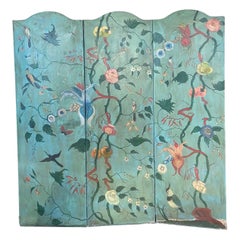
19th Century French Large Screen with Three Leaves in Hand Painted Canvas
Located in Sofia, BG
Lovely large French room divider or screen with three leaves in canvas hand painted in vivid colors with birds and foliage scrolls on blue base, after a pattern from a wall canvas pr...
Category
Antique Mid-19th Century French Screens and Room Dividers
Materials
Canvas
$4,039 Sale Price
55% Off
H 62.21 in W 59.06 in D 2.76 in
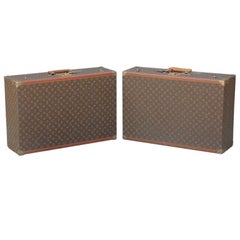
Pair of Authentic Louis Vuitton Luggage Pieces
By Louis Vuitton
Located in Los Angeles, CA
Pair of authentic Louis Vuitton luggage pieces.
Individually numbered, pair of brass numbered keys included with both pieces.
Can be moun...
Category
Vintage 1960s French Trunks and Luggage
Materials
Brass
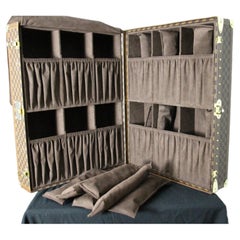
Louis Vuitton Damier Ebene Shoe Trunk, Louis Vuitton Shoe Case, Vuitton Trunk
By Louis Vuitton
Located in Saint-Ouen, FR
This trunk was a special order made in 2000's. It features checkers canvas, or damier ébène and stamped LV solid brass locks, corners and studs. On the top is the leather handle, Lou...
Category
21st Century and Contemporary French Trunks and Luggage
Materials
Brass
$15,865
H 27.56 in W 20.87 in D 9.06 in
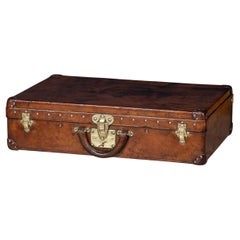
20th Century Louis Vuitton Suitcase In Natural Cow Hide, France c.1910
By Louis Vuitton
Located in Royal Tunbridge Wells, Kent
A highly unusual and exceptionally rare Louis Vuitton suitcase, originating from the early years of the 20th century, distinguishes itself not with the globally renowned monogram canvas but with a distinctive covering crafted from a singular piece of cowhide. This unique piece represents a special order from Louis Vuitton, showcasing the brand's historical commitment to utilising only the finest hides available.
Unlike many of its counterparts, leather trunks and cases of this era often struggle to withstand the test of time, requiring regular treatments to prevent drying and disintegration. Remarkably, this particular example defies the odds, retaining the same supple quality it possessed on the day it first graced the shop floor. This suitcase belongs to Louis Vuitton's collection of "speciality materials," which encompasses a diverse range, including, but not limited to, zinc, copper, crocodile leather, and cow leather.
A brief history about Louis Vuitton trunks: Louis Vuitton was born in 1821 to a farmer and milliner and came from a long-established working-class family in eastern France. Vuitton grew up understanding the effects of perseverance and a strong work ethic from watching his family. At the age of 16, he made the decision to walk 292 miles from his hometown to Paris to try and make a new life for himself. When he arrived the city was in the midst of industrialization with current modes of transportation evolving quickly allowing for longer journeys. With this came the need for sturdy travel pieces.
Vuitton was taken as an apprentice for a successful box maker and packer named Monsieur Marechal. He learned to craft durable containers and how to pack them properly – a well-respected profession at the time.In 1854, years after he had mastered his craft and became well respected for it, Vuitton ventured out on his own to open a shop on Rue Neuve des Capucines. It was here that he began to establish himself as a luggage maker. Then, in 1858, Vuitton designed the first Louis Vuitton steamer trunk. At the time trunks had rounded tops to allow for water to run off but this did not allow for convenient stowage. Vuitton introduced a flat, yet waterproof, trunk that was easily stackable. The first of his trunks were outfitted with a grey canvas referred to as Trianon – it wouldn’t be until several decades later that the signature monogram would be introduced.
With a burgeoning business, Vuitton moved his family and workplace to Asniere, where he employed twenty workers to craft his trunks. By 1900 he would have 100 employees, and in 1914 the company would more than double in size. After years of success, Vuitton began to experiment with the design of his luggage by introducing a new striped canvas pattern (1876) and later the still well-known Damier print (1888). The hand-painted patterns were developed to prevent counterfeits. Even in the late 1800s, Louis Vuitton was enough of a status symbol to warrant counterfeiting. In 1886, his son George invented and patented an ingenious locking system that made it impossible to pick the lock of their trunks. This lock is still used today.
1892 would prove to be a time of mourning for the family as Louis Vuitton passed...
Category
20th Century French Other Trunks and Luggage
Materials
Brass
$4,399
H 6.7 in W 25.99 in D 16.93 in
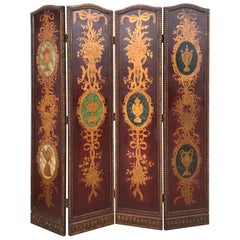
20th Century Four Panel Hand Painted Screen
Located in Miami, FL
An Italian hand painted wood room divider from the 20th century. This antique accordion style folding screen from Italy features 4 connected panels, ...
Category
Mid-20th Century Italian Art Nouveau Screens and Room Dividers
Materials
Wood
Victorian Coromandel Games Compendium c1880
Located in Tunbridge Wells, GB
Heading : Victorian coromandel games compendium
Date : c1880
Period : Victoria
Origin : England
Decoration : Contains: Chess, Draughts and Backgammon board, all chess pieces mounted ...
Category
Antique 1880s British Victorian Games
Materials
Wood

20th Century Louis Vuitton Suitcase Alzer 80, 1970
By Louis Vuitton
Located in Epfach, DE
909481 Alzer 80 80 cm x 26 cm 52.5 cm with removable tray
Louis Vuitton suitcase, Alzer 80 with removable tray, in wonderful, well-kept condition with origin...
Category
20th Century French Trunks and Luggage
Materials
Leather
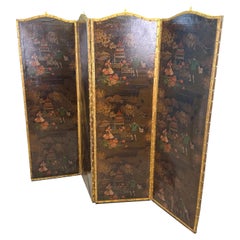
Four Fold 19th Century Chinoiserie Leather Screen
Located in Bedfordshire, GB
An Attractive Late 19th Century Four Fold Leather Room Dividing Screen, With Extremely Attractive Chinoiserie Decoration To Panels, Incorporating People, Pagodas And Trees, With Gilt...
Category
Antique Late 19th Century English Victorian Screens and Room Dividers
Materials
Leather, Oak
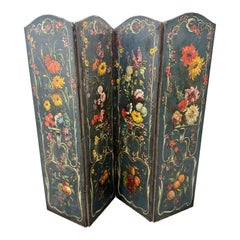
19th Century Rococo Floral Painted Four Panel Dressing Screen
Located in Haddonfield, NJ
An impressive four panel painted folding screen featuring a variety of flowers. Each panel is delicately painted in black, reds, oranges, yellows, pinks and blues. Originally used a...
Category
Antique Mid-19th Century Danish Rococo Screens and Room Dividers
Materials
Wood, Paint, Canvas