Antique Resources Collectibles and Curiosities
to
2
2
2
2
2
1
1
1
1
2
2
2
2
2
2
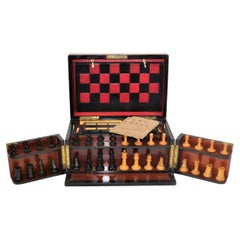
Mid 19th Century English Games Compendium
Located in Chicago, IL
This beautiful maple and ebony compendium box has a hinged lid and a pair of front doors that swing open to reveal the boxwood and ebony hand-carved chess pieces. Each chess piece si...
Category
Antique Late 19th Century English Victorian Historical Memorabilia
Materials
Bone, Boxwood, Ebony, Maple
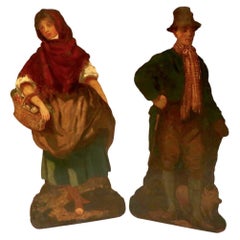
Pair of Early 19th Century Georgian Pinewood Oil-Painted Dummy Boards
Located in Chicago, IL
Early 19th Century Georgian Pair of Dummy Boards. Pinewood with oil-painted fine details. Charming and scarce pieces, it took the owner a couple of years to find them. There is no ag...
Category
Antique Early 19th Century English Early Victorian Historical Memorabilia
Materials
Pine, Paint
Related Items
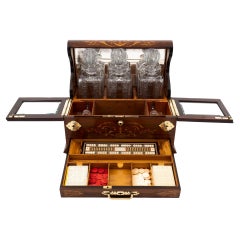
Antique English Victorian Decanter Humidor Games Box Compendium
Located in Northampton, GB
Dating to the late 19th Century Circa 1900
From our Games Boxes collection, we are delighted to offer this Victorian Entertainment Compendium. The Compendiu...
Category
Early 20th Century British Victorian Games
Materials
Mahogany, Cedar

$5,439
H 14.18 in W 16.15 in D 11.42 in
Rare 19th Century English Tunbridgeware Hair Pin or Slide
Located in Dallas, TX
PRESENTING an EXTREMELY UNIQUE and RARE 19C British Tunbridgeware Hair Pin/Bobbin or Slide.
This slide is unlike any of it’s kind we have seen before, it is a VERY RARE survivor.
From circa 1860 – 80 and made in Tunbridge Wells, England.
Made of walnut with gorgeous marquetry inlay on the entirety of the front with classic Tunbridgeware micro-mosaic all over the front. The rear is walnut.
The marquetry inlay appears to be various different woods, namely, maple, walnut and satinwood.
Would have been worn in a Lady’s hair bun with the micro-mosaic facing forward.
This would have belonged to a VERY ELEGANT LADY in the mid to late 19th Century.
Tunbridge ware is a form of decoratively inlaid woodwork, typically in the form of boxes, that is characteristic of Tonbridge and the spa town of Royal Tunbridge Wells in Kent in the 18th and 19th centuries. The decoration typically consists of a mosaic of many very small pieces of different coloured woods that form a pictorial vignette. Shaped rods and slivers of wood were first carefully glued together, then cut into many thin slices of identical pictorial veneer with a fine saw. Elaborately striped and feathered bandings for framing were pre-formed in a similar fashion.
There is a collection of Tunbridge ware in the Tunbridge Wells Museum and Art Gallery in Tunbridge Wells.
The famous makers of Tunbridge ware were in the Tunbridge Wells area of Kent; their most notable work was from circa 1830-1900.
Early makers of Tunbridge ware, in Tunbridge Wells in the mid-18th century, were the Burrows family, and Fenner and Co. In the 19th century, around 1830, James Burrows invented a technique of creating mosaics from wooden tesserae. Henry Hollamby, apprenticed to the Burrows family, set up on his own in 1842 and became an important manufacturer of Tunbridge ware, employing about 40 people.
Edmund Nye (1797–1863) and his father took over the Fenner company when William Fenner retired in 1840, after 30 years in partnership with him. Thomas Barton (1819–1903), previously apprenticed at the Wise factory, joined the Nyes in 1836, and worked as Nye’s designer; he took over the business in 1863 and continued there until his death.
In Tonbridge (near to Tunbridge Wells), George Wise (1703–1779) is known to have had a business in 1746. It continued with his son Thomas, and Thomas’s nephew George (1779–1869), who took over in 1806. In its early years the company made articles such as workboxes and tea caddies with prints of popular views; later items had pictures created from mosaics. Their workshop in Tonbridge, Wise’s Tunbridge Ware Manufactory, was next to the Big Bridge over the Medway; the building was demolished in 1886 to widen the approach to the bridge.
Tunbridge ware became popular with visitors to the spa town of Tunbridge Wells, who bought them as souvenirs and gifts. Articles included cribbage boards, paperweights, writing slopes, snuffboxes and glove boxes.
At the Great Exhibition of 1851, Tunbridge ware by Edmund Nye, Robert Russell and Henry Hollamby was shown; Edmund Nye received a commendation from the judges for his work. He exhibited a table depicting a mosaic of a ship at sea; 110,800 tesserae were used in making the picture.
The manufacturers of Tunbridge ware were cottage industries, and they were no more than nine in Tunbridge Wells and one in Tonbridge. The number declined in the 1880s; competent craftsmen were hard to find, and public tastes changed. After the death of Thomas Barton in 1903 the only surviving firm was Boyce, Brown and Kemp, which closed in 1927.
Marquetry was an old technique which was continued by Nye and Barton to create images such as birds or butterflies.
‘Green Oak’ as caused by the fungus Chlorociboria aeruginascens.
Stickware and half-square mosaic was invented by James Burrows in about 1830: a bunch of wooden sticks of different colours, each having triangular or diamond-shaped cross section, were tightly glued together; in the case of stickware, the resulting block was dried, then turned to form an article such as the base of a pincushion. For half-square mosaic, thin slices were taken from the composite block, and applied to a surface.
Tesselated mosaic, was a development by James Burrows of half-square mosaic; it was adopted by George Wise and Edmund Nye. Minute tesserae were used to form a wide variety of geometric and pictorial designs.
Many sorts of wood were used for the various colours; about 40 were in regular use. Only natural colors were used; green was provided by “green oak”, produced by the action of fungus on fallen oak. Designs for articles were often taken from designs of Berlin wool work.
Category
Antique Late 19th Century English High Victorian Collectible Jewelry
Materials
Satinwood, Walnut
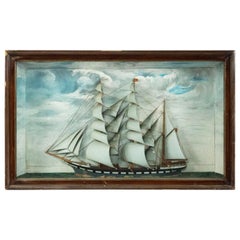
Late 19th Century English Diorama Clipper Ship Shadowbox
Located in Queens, NY
Late 19th century English Victorian painted diorama wall plaque of clipper ship with red flag painted in cloudy sky in mahogany frame.
Category
Antique Late 19th Century British Victorian Nautical Objects
Materials
Mahogany
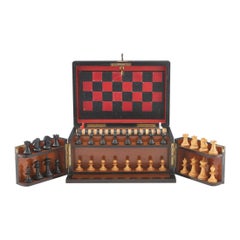
Victorian Coromandel Games Compendium c1880
Located in Tunbridge Wells, GB
Heading : Victorian coromandel games compendium
Date : c1880
Period : Victoria
Origin : England
Decoration : Contains: Chess, Draughts and Backgammon board, all chess pieces mounted ...
Category
Antique 1880s British Victorian Games
Materials
Wood
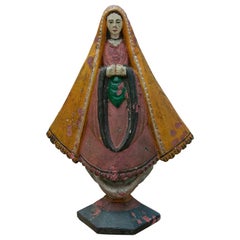
19th Century Mexican Wooden Hand-Painted Virgin with Child in Arms
Located in Marbella, ES
19th century Mexican wooden hand-painted virgin with child in arms.
Category
Late 20th Century Mexican Figurative Sculptures
Materials
Wood
$1,923
H 11.03 in W 8.27 in D 3.15 in
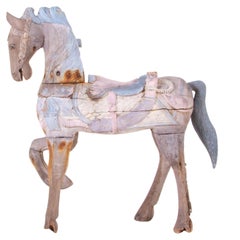
19th Century Italian Hand Carved Rocking Horse Still Wearing Authentic Paint
Located in Sofia, BG
Extraordinary hand carved rocking horse made in Italy at the end of 19th century. The piece is still wearing its authentic paint in light blu...
Category
Antique Late 19th Century Italian Toys and Dolls
Materials
Wood
$3,329
H 36.62 in W 32.29 in D 9.45 in
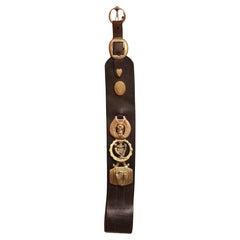
Late 19th Century English Long Leather Horse Strap
Located in Chapel Hill, NC
Late 19th century English long leather horse strap. Straight leather strap with rounded top adorned with heart & oval boss above the horse brasses of a horse bust in horseshoe, the s...
Category
Antique Late 19th Century English Late Victorian Historical Memorabilia
Materials
Brass
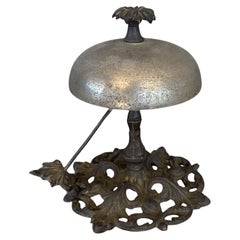
Antique English Brass reception bell 19th Century
Located in Chonburi, TH
Antique English Bronze reception bell with original patina. The bell still works great!
Category
Antique 19th Century English Late Victorian Musical Instruments
Materials
Bronze
Pair of Obelisks, Red Serpentine, Cornwall England 19th Century
Located in Greding, DE
Pair of small obelisks out of red serpentine with hieroglyph decor (North side Cleopatra's Needle, today Central Park, NY - and Lateranobelisk situated o...
Category
Antique 19th Century English Egyptian Revival Abstract Sculptures
Materials
Serpentine

$3,653 Sale Price / set
20% Off
H 11.42 in W 3.55 in D 3.55 in
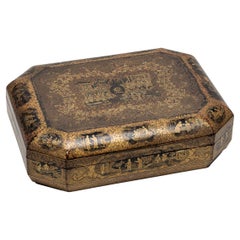
Antique 19th Century Chinese Lacquered Games Box c.1890
Located in Royal Tunbridge Wells, Kent
A superb and very rare 19th Century Chinese lacquered games box, dating to around 1890. Decorated with intricate traditional scenes and a fin...
Category
Antique 19th Century Chinese Other Games
Materials
Lacquer
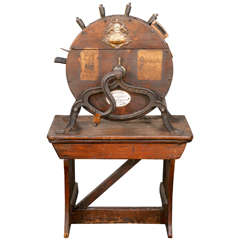
19th Century English Knife Sharpener
Located in Los Angeles, CA
19th c. English Knife Sharpener in Oak and Pine
Category
Antique 19th Century English More Furniture and Collectibles
Materials
Oak, Pine
Pair of 19th Century Brass Parabolic Reflectors
Located in Chicago, IL
In the 19th century, parabolic reflectors such as these were employed in scientific experiments to study the behavior of light, heat, and sound. These brass parabolic mirrors, when p...
Category
Antique 19th Century American Victorian Scientific Instruments
Materials
Brass
