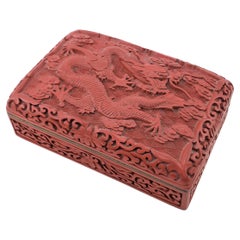
Antique Revival Sculptures and Carvings
to
7
7
7
7
6
6
4
2
2
2
7
6
5
1
7
7
7
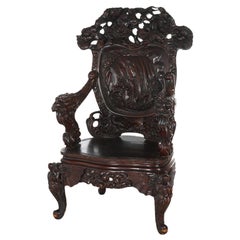
Antique Chinese Deep Carved Rosewood Figural King Throne Chair with Dragons 1920
Located in Big Flats, NY
Antique Chinese Deeply Carved Rosewood Figural King Throne Chair with Dragons C1920
Measures - 48.25"H x 29"W x 25"D
An exquisite antique Chinese thr...
Category
Early 20th Century Chinese Sculptures and Carvings
Materials
Rosewood

$2,600 Sale Price
20% Off
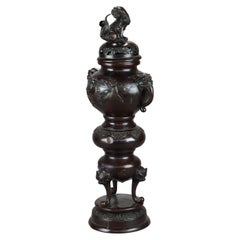
Antique Japanese Bronze Meiji Footed Censer with Figural Foo Dogs
Birds, 1900
Located in Big Flats, NY
An antique Japanese Meiji censer offers cast bronze construction with foo dog lid over bulbous vessel having band with birds and flanking handles with foo ...
Category
Early 20th Century Japanese Metalwork
Materials
Bronze
$960 Sale Price
20% Off
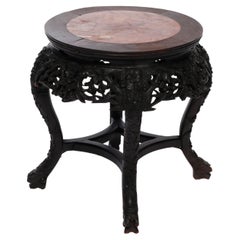
Antique Chinese Carved Hardwood Marble Top Plant Stand, Circa 1920
Located in Big Flats, NY
An antique Chinese plant stand offers inset marble top over hardwood base having pierced and carved foliate skirt, raised on cabriole legs ...
Category
Early 20th Century Chinese Furniture
Materials
Marble
$760 Sale Price
20% Off
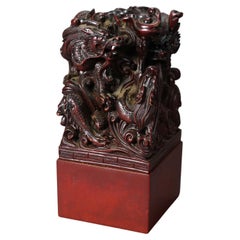
Antique Chinese Carved Hardwood Figural Group with Dragons, circa 1920
Located in Big Flats, NY
An antique Chinese figural group offers carved hardwood sculpture of intertwined dragons, circa 1920.
Measures - 5.5"h x 2.75"w x 2.75"d
A finely carved hardwood figural group depict...
Category
Early 20th Century Chinese Sculptures and Carvings
Materials
Hardwood
$960 Sale Price
20% Off
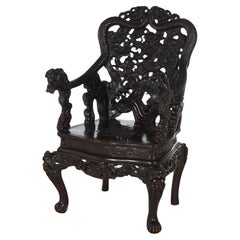
Antique Chinese Deeply Carved Rosewood Figural Queen Chair with Dragons C1920
Located in Big Flats, NY
Antique Chinese Deeply Carved Rosewood Figural Queen Throne Chair with Dragons C1920
Measures - 43.5"H x 28.5"W x 25"D
This striking antique Chinese...
Category
Early 20th Century Chinese Sculptures and Carvings
Materials
Rosewood
$2,120 Sale Price
20% Off
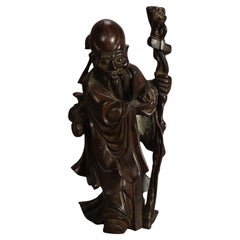
Asian Carved Rosewood Standing Buddha or Wise Man Figure C1940
Located in Big Flats, NY
Asian Hand-Carved Rosewood Standing Buddha or Wise Man Figure C1940
Measures - 16.75"H x 7"W x 6.75"D
A finely carved rosewood figure depicting a standing Buddha or wise man, dating ...
Category
Early 20th Century Asian Sculptures and Carvings
Materials
Rosewood
$440 Sale Price
20% Off
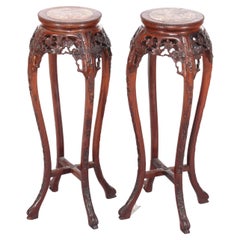
Pair of Antique Chinese Carved Rosewood
Rouge Marble Sculpture Stands C1920
Located in Big Flats, NY
***Reduced In-House Delivery Rates - Click on “Ask Seller” to Request a Quote***
Pair of Antique Chinese Floral Carved Rosewood & Rouge Marble Sculpture Stands C1920.
Measures - 3...
Category
20th Century Chinese Sculptures and Carvings
Materials
Marble
$1,440 Sale Price / set
20% Off
Related Items
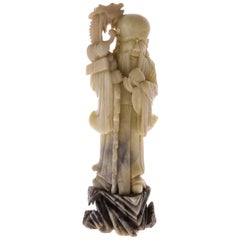
Chinese Carved Soap Stone Sculpture of a Wise Ancient with Dragon
Located in Frankfurt am Main, DE
A finely carved soap stone sculpture of a wise ancient with a dragon on his shoulder standing on a braun soap stone base. In fine original conditi...
Category
Early 20th Century Chinese Figurative Sculptures
Materials
Stone
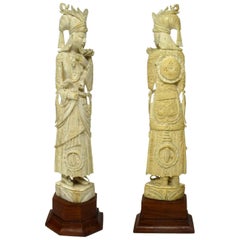
Antique Bone Figure of Indochina Male Dignitary Hardwood 19th Century Chinese
Located in Dublin, Ireland
An exquisitely hand carved bone Chinese dignitary standing figure portraying a lavishly dressed bearded male.
Difficult to date, in our opinion last quarter of the 19th century.
...
Category
Antique 19th Century Chinese Late Victorian Sculptures and Carvings
Materials
Hardwood, Bone
$492
H 9.75 in W 2.75 in D 1.75 in
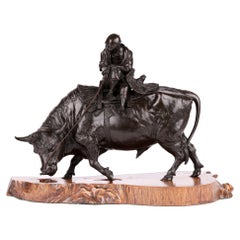
Genryusai Seiya Japanese Meiji Man
Water Buffalo Sculpture on Stand
Located in Bishop
s Stortford, Hertfordshire
An exceptional Japanese Meiji bronze sculpture of a man and water buffalo on a natural polished oak stand by renowned Japanese master craftsman Genryusai Seiya and dating from around 1880/90. The large bronze depicts an elderly man holding a pipe and tobacco pouch...
Category
Antique 1880s Japanese Anglo-Japanese Sculptures and Carvings
Materials
Bronze
$23,202
H 13.78 in W 17.33 in D 5.52 in
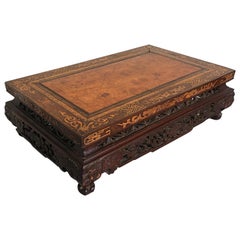
Straits Chinese Carved Hardwood Bamboo Inlay Display Stand, circa 1900
Located in Austin, TX
A remarkable straits Chinese (also known as Peranakan or Nyonya) carved hardwood and bamboo inlaid and embellished table-form stand, originally for dis...
Category
Early 20th Century Indonesian Qing Scholar s Objects
Materials
Lacquer, Bamboo, Hardwood
$6,000
H 5.25 in W 18.5 in D 12 in
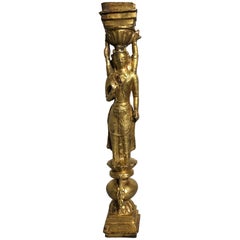
Densatil Gilt Bronze Caryatid Figure, Tibet, 15th Century
Located in Austin, TX
A heavy and solidly cast, richly gilt, bronze caryatid figure from Densatil Monastery, Central Tibet, early 15th century or earlier.
Cast in the form of two four armed figures standing back to back in tribhanga (thrice bent position) on a lotus platform, this piece would originally have served as a pillar for a larger seated deity...
Category
Antique 15th Century and Earlier Tibetan Tibetan Sculptures and Carvings
Materials
Bronze
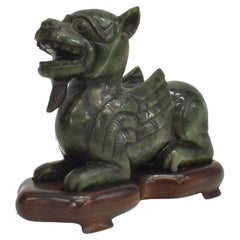
Qing Dynasty Chinese Carved Green Jade Chilong Dragon Sculpture
Located in Forney, TX
A magnificent Chinese carved spinach green jade chilong dragon sculpture, resting on fitted hardwood stand.
Rich deep bright green color with molten shades of lighter pale green, exceptionally carved, with intricate detail throughout. The mythical beast lying ready on all four, head raised, mouth ajar with teeth exposed, wings by its side, spiral scroll incised on hind legs.
Provenance:
Estate of Ali A. Abssi (1934-2020) and Florence Hall Abssi (1919-2014), founders of the Ishtar Gate...
Category
Antique 19th Century Sculptures and Carvings
Materials
Jade
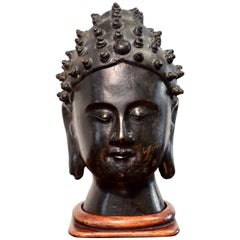
Southeast Asian Style Sculpture of a Buddha
Located in CH
Southeast Asian Style Bronze Sculpture of a Buddha
A finely cast bronze sculpture in the Southeast Asian style, depicting the Buddha in a serene...
Category
Mid-20th Century Southeast Asian Sculptures and Carvings
Materials
Bronze
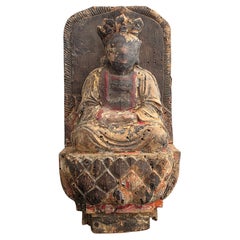
Antique Chinese Carved Bodhisattva Figure Lotus Throne Architectural Fragment
Located in Forney, TX
This richly sculpted hand carved and gilded Bodhisattva sculpture is almost certainly a fragment of a larger structure, likely an architectural ornament from an East Asian Buddhist t...
Category
Antique 17th Century Chinese Ming Sculptures and Carvings
Materials
Wood, Giltwood, Lacquer
$750
H 9 in W 5 in D 3 in
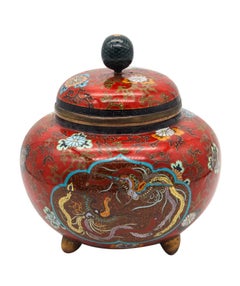
JAPAN IMPERIAL 1900 Meiji Period Tripode Koro Censer In Cloisonné Enamel With
Located in Miami, FL
Japanese tripod Koro from the Meiji Period (1868-1912).
This is a rare and beautiful antique koro censer, created in the imperial Japan during the Meiji period (1868-1912), circa 1900. It was carefully crafted in solid bronze and copper with silver wires and embellished with applications of polychromatic Cloisonné enamels and aventurine. The designs depict organics and natural motifs such mythological animals and flowers.
The Chrysanthemum Symbol
In Imperial Japan, the chrysanthemum (Kiku) was a potent symbol of the imperial family and the emperor himself, representing longevity, royalty, and divine power. The 16-petaled chrysanthemum is the Imperial Seal and crest, found on passports, coins, and the Chrysanthemum Throne. This association dates back to the Kamakura period (1185–1333), particularly with Emperor Go-Toba's fondness for the flower, establishing its link to imperial authority and lineage. The connection between the chrysanthemum and the imperial family began when Emperor Go-Toba adopted it as a personal emblem, aligning it with the strength and refinement of the emperor's rule. During the Meiji Period, the 16-petaled chrysanthemum crest, solidifying the association with the imperial family, was established during this time.
The Meiji Imperial Period
This is an era of Japanese history that extended from October 23, 1868 to July 30, 1912.The Meiji era was the first half of the Empire of Japan, when the Japanese people moved from being an isolated feudal society at risk of colonization by Western powers to the new paradigm of a modern, industrialized nation state and emergent great power, influenced by Western scientific, technological, philosophical, political, legal, and aesthetic ideas. As a result of such wholesale adoption of radically different ideas, the changes to Japan were profound, and affected its social structure, internal politics, economy, military, and foreign relations. The period corresponded to the reign of Emperor Meiji. It was preceded by the Keiō era and was succeeded by the Taishō era, upon the accession of Emperor Taishō.
Country: Imperial Japan.
Period: Meiji, 1890-1910.
Technique: Silver Wire Cloisonné over copper and bronze.
Weight: 416.80 Grams, (0.417 Kg).
Measurements:118 mm by 115 mm (4.65 x 4.52 Inches).
Koro
This term refers to a Japanese censer, incense burner, perfume burner or pastille burner is a vessel made for burning incense or perfume in some solid form. They vary greatly in size, form, and material of construction, and have been in use since ancient times throughout the world. They may consist of simple earthenware bowls or fire pots to intricately carved silver or gold vessels, small tabletop objects a few centimeters tall to as many as several meters high. Many designs use openwork to allow a flow of air. In many cultures, burning incense has spiritual and religious connotations, and this influences the design and decoration of the censer.
Cloisonné
This is an enameling technique in which the pattern is formed by wires soldered to the surface of the object to be decorated, which is usually made from copper, forming cells or cloisons, each of which holds a single colour of enamel paste which is then fired, and ground and polished. The champleve technique also uses an enameling technique, but the cells are formed by carving into the surface of the object, or in the casting. The cloisonne technique has been in use since the 12th century BC in the west, but the technique did not reach China until the 13th or 14th century. It became popular in China in the 18th century. Initially bronze or brass bodies were used, and in the 19th century copper, at which time the quality of the items produced began to decline. Chinese cloisonné is the best-known enamel cloisonné, though the Japanese produced large quantities from the mid-19th century, of very high technical quality. In the west the cloisonne technique was revived in the mid-19th century following imports from China, and its use continued in the Art Nouveau and Art Deco periods.
Condition: Basically, is in great antique condition, near mint, with insignificant and minimal usage, in great condition. All parts are secured in the settings. This Japanese Meiji Koro...
Category
Antique Early 1900s Japanese Meiji Metalwork
Materials
Silver, Bronze, Copper, Enamel
$1,398 Sale Price
30% Off
H 4.65 in Dm 4.52 in
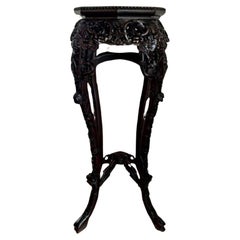
Quality antique carved hardwood Chinese stand
Located in Ipswich, GB
Quality antique carved hardwood Chinese stand having a marble top with a hardwood carved edge, outstanding quality carved frieze standing on shaped carved cabriole legs with scroll f...
Category
Antique Early 19th Century Chinese Furniture
Materials
Marble
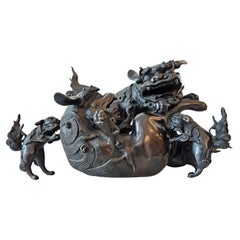
19th Century Japanese Meiji Era Patinated Bronze Foo Dog Lion Group Censer
Located in Forney, TX
A large and impressive Japanese Meiji period (1852-1912) patinated bronze guardian lion censer.
Late 19th century, Japan, exceptionally executed, the group consisting of four shishi...
Category
Antique Late 19th Century Japanese Meiji Metalwork
Materials
Bronze
$3,500
H 10 in W 15.5 in D 9 in
Antique Chinese Carved Cinnabar
Enamelled Box with Imperial Dragon Top
Located in Hamilton, Ontario
This antique decorative box is unsigned, but presumed to have originated from China, and date to approximately 1920 and done in a period Chinese...
Category
Early 20th Century Chinese Chinese Export Decorative Boxes
Materials
Brass