Arcadia Art Landscape Paintings
to
3
2
1
Overall Width
to
Overall Height
to
1
1
4
3
1
1
4
4
2
4
3
3
3
2
2
2
2
1
1
1
1
1
1
1
4
3
2
2
1
1
1
6
6
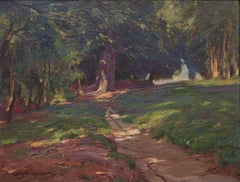
Forest landscape bathed in sunlight / - The Monumentality of the Forest -
Located in Berlin, DE
Wilhelm Feldmann (1859 Lüneburg - 1932 Lübeck), Sunny forest landscape, c. 1900. Oil on canvas, marouflaged on wood, 37 cm x 48 cm (inside dimensions), 42.5 cm x 53.5 cm (frame), sig...
Category
Early 1900s Impressionist Landscape Paintings
Materials
Oil
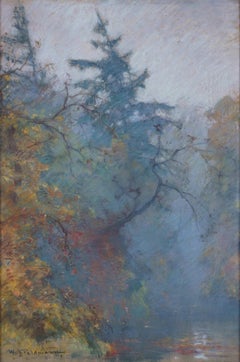
Impressionist Autumn Landscape with Lake / - Diffuse Concretion -
Located in Berlin, DE
Wilhelm Feldmann (1859 Lüneburg - 1932 Lübeck), Impressionist autumn landscape with lake, around 1905. Pastel on cardboard, 46 cm x 31 cm (inside dimension), 52 cm x 37 cm (frame), s...
Category
Early 1900s Impressionist Landscape Paintings
Materials
Gouache
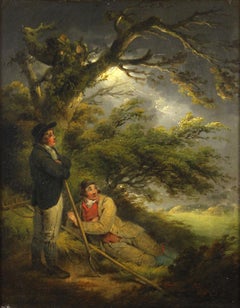
Sheltering from the storm / - Romantic landscape illuminated by lightning bolt -
By George Morland
Located in Berlin, DE
George Morland (1763 London - 1804 Brighton). Sheltering from the Storm. Oil on canvas, relined, 37.5 x 29.5 cm (visible size), 53.5 x 45.5 cm (...
Category
1790s Romantic Landscape Paintings
Materials
Oil
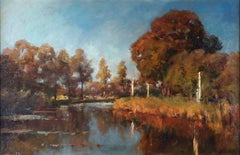
Late Summer River Landscape / - Realistic Impression -
By Jan Hillebrand Wijsmüller
Located in Berlin, DE
Jan Hillebrand Wijsmuller (1855 Amsterdam - 1925 ibid.), Late Summer River Landscape, oil on canvas, relined, 34 x 56 cm (inside measurement), 43 x 64 cm (frame), signed J[an] H[illebrand] Wijsmuller at lower right.
- in good condition, the frame with isolated bumped spots
- Realistic Impression -
About the artwork
The panoramic landscape format shows a river landscape, with the course of the river, which curves to the right, leading the eye into the depths of the picture and tempting it to continue the landscape in the imagination beyond the visible area. At the same time, however, the fact that the landscape is not visible through the bend in the river focuses our gaze on the entirety of the landscape depicted, without prompting us to focus on distant details. Accordingly, the brushstroke is not designed to render details with realistic precision. In the front left area of the river there is even a completely free brushwork, trained by Impressionism, which nevertheless remains committed to representational and convincingly suggests the movement of the water.
Regardless of the distance of the observer, the entire picture is painted with the same broad brushstroke, so that the landscape is given as an impression. And yet this impression is not ephemeral, as in the case of French Impressionism, to put it exaggeratedly, but reveals to us the essence of the landscape in all its richness. This is why the Dutch variant of Impressionism is always also a realism, although the pictures appear less progressive, but still contain a dimension of landscape painting that is lost with progress.
In the impression, the reality of the landscape is revealed, and this happens as we experience the landscape in the visual impression. Wijsmuller does not depict houses or people in order to allow the experience of the landscape to fully unfold. The experience is determined first and foremost by the river, which does not flow into the picture from our point of view, but towards us. Where the river begins to bend, the water is churned by a rapids. Toward us, the riverbed widens and the water comes to rest, covering the entire width of the foreground like a mirror.
The stillness of the water corresponds to the evening mood of the late summer landscape, in which the warm tones of the evening light blend with the yellow and brown tones of the plants. A gentle, almost idyllic reality, carried by the brushstroke, yet animated by a liveliness that is also made visible by the brushstroke. The broad, dynamically placed brushstrokes evoke the movement of the treetops and animate even the immobile reeds, while the trunks on the right bank, executed in virtuoso white strokes that seem like markings, make the sunlight shine. On the other bank, a carpet of light also spreads out, its energetic effect again expressed in the brushstroke. The dynamic of the landscape is further enhanced by the complementary color contrasts between the greens, yellows, and browns on the one hand and the blue of the all-encompassing sky on the other. A contrast that is intensified by the reflection in the water.
The evening coming to rest of the landscape is thus at the same time an all-encompassing contrasting and yet in itself harmonious movement. This reality becomes accessible to us as an experience in the impression of the landscape.
About the artist
Jan Hillebrand Wijsmuller entered the Royal Academy of Arts in Amsterdam in 1876 and studied under the innovative Professor August Allebé, who was famous for the Amsterdam Impressionism, also known as the Allebé School.
In 1877, Wijsmuller transferred to the Hague Academy of Art, and thus to the Hague School, and then completed his studies at the Brussels Academy of Art. Returning to the Netherlands, Wijsmuller opened his own studio in Amsterdam.
In 1883 he won the prestigious Young Artist Award, donated by Willink van Collen, which made Wijsmuller a well-known and sought-after artist.
Wijsmuller was a member of the Societät Arti et Amicitiae Amsterdam and the Pulchri Studio in The Hague.
Wijsmuller belongs to the second generation of the Hague School. While Vincent van Gogh described the protagonists of the first generation to his brother Theo as "the great gray people," the second generation, and Wijsmuller in particular, used a much more colorful palette. His oeuvre makes him a major player in Dutch Impressionism...
Category
1890s Impressionist Landscape Paintings
Materials
Canvas
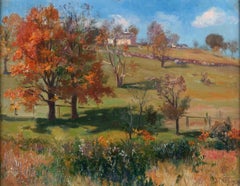
Autumn Landscape in Sunlight - Indian Summer -
Located in Berlin, DE
Frederick Vezin (1859 Torresdale Philadelphia - 1933 Düsseldorf), Autumn Landscape in the Sunlight, oil on canvas, mounted on cardboard, 32 x 41 cm (inside measurement), 44 x 51 cm (frame), signed and dates lower right "F. Vezin. [19]05".
- Cardboard slightly curved, small inconspicuous retouch at the centre of the upper edge of the picture.
About the artwork
Although the painting appears to be a sketch, Frederick Vezin considered it to be a finished work of art, as evidenced by his signature on the lower right. And it is precisely this sketchy quality that leads to an understanding of the painting, which was certainly created in the landscape itself: the natural phenomena were to be depicted artistically at the moment of their observation. This is not done by meticulously sketching nature, but - and here Vezin follows the teaching of French Impressionism - by illustrating nature in its visual fullness. The artist's eye is, as it were, immersed in the visuality of nature, which is made visible by his hand. The painting is therefore not a reflection of the landscape, but its artistic intensification.
This intensification also includes the fact that the foreground of the painting - corresponding to the field of vision - eludes a detail-oriented close-up view. Instead, the spatula-like application of paint, the vertical structure of which corresponds to the structure of the floral growth, has the effect of making nature tangible in its colourful substance.
At the same time, the foreground, which remains indeterminate in its concrete objectivity, creates an atmospheric space that connects with the actual protagonist of the picture, the group of trees, which flares up in shades of red and brown. Here, too, the leaves are more speckled than clearly outlined. It is precisely this 'sketchiness' that opens up a visual experience that makes the landscape accessible in its visual fullness, thus revealing its essence.
In addition to this abundance, the landscape is presented as a structure of order in that the composition of the picture makes the composition of the landscape visible. For example, the group of trees forms a distinct dark green shadow, which is repeated in the shadows cast by the trees behind it. A patterned diagonal axis is created in the picture, which is composed in this way by the landscape itself.
Strictly speaking, this is a cultivated landscape: a fence at the bottom and a low stone wall at the top, running from left to right, are two elements that also have a strong compositional effect. And on the top of the hill, a stone house is embedded in the landscape as the brightest surface in the picture. Nature and culture here form a harmonious synthesis, giving the painting an Arcadian touch.
In order to give the landscape as much space as possible, the horizon line is raised, but the design of the sky is also crucial. The clouds, combined with the shapes of the trees, create a bright blue sky. To the European eye, such a sky is reminiscent of a summer landscape. Accordingly, within the seasonal cycle, the blue sky is reserved for summer, and French Impressionism is also primarily an ode to summer. In Vezin's painting, however, the brilliant blue sky stands above an autumnal landscape, some of the trees even defoliated. It can therefore be assumed that the painting was made not in Europe but in the United States, and that it illustrates the proverbial Indian summer, making Frederick Vezin a pioneer of American landscape painting.
About the artist
Frederick Vezin was the son of a French immigrant to the United States and a German-born mother. This predestined him to promote artistic exchange between the old and new worlds. Having spent part of his schooling in Germany, in 1876, at the age of 20, he enrolled at the Düsseldorf Academy of Art, where he studied with Peter Janssen the Elder, Eduard von Gebhardt and Wilhelm Sohn, among others. He graduated in 1883, settled in Munich and returned to Düsseldorf in 1895, where he lived until his death in 1933.
A native of the United States, he travelled to the country frequently and became a popular portrait and society painter. His artistic talent, however, was most evident in his landscape paintings. Trained in French Impressionism, he developed a virtuoso use of colour and a free brushwork that remained tied to the landscape motif, opening up the landscape itself in a new way. Frederick Vezin turned his attention primarily to the landscape of his homeland, becoming a pioneer of modern American landscape...
Category
Early 1900s Impressionist Landscape Paintings
Materials
Oil, Cardboard
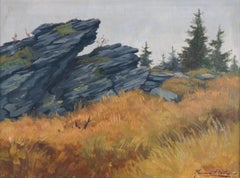
Low Mountain Landscape with Rocks - The mystery of an inconspicuous place -
Located in Berlin, DE
Heinz Roder (1895-1965), Low Mountain Landscape with Rocks, oil on painting cardboard, 30 x 40 cm (visual size), 40 x 50 cm (frame), signed and dated "[19]34" at lower right. In a de...
Category
1930s Landscape Paintings
Materials
Cardboard
Related Items
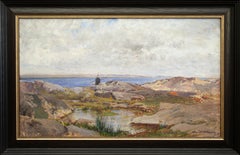
Summer Day on the West Coast of Sweden by Swedish Impressionist Alfred Wahlberg
Located in Stockholm, SE
Alfred Wahlberg was a distinguished Swedish landscape painter whose career spanned Germany, France, and Sweden. During his early years, he resided in D...
Category
Late 19th Century Impressionist Landscape Paintings
Materials
Canvas, Oil

$2,694 Sale Price
20% Off
H 21.26 in W 32.68 in
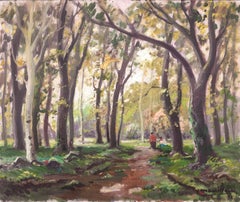
Landscape with characters spanish original oil on canvas painting
By Joaquim Marsillach i Codony
Located in Sitges, Barcelona
Joaquim Marsillach i Codony (1905-1986) - Landscape with characters
Oil on canvas
Oil measures 46x55 cm.
Frame measures 69x78 cm.
Marsillach Codony...
Category
1950s Impressionist Landscape Paintings
Materials
Oil, Canvas
Joaquim Marsillach i CodonyLandscape with characters spanish original oil on canvas painting, c.1960
$1,034
H 18.12 in W 21.66 in
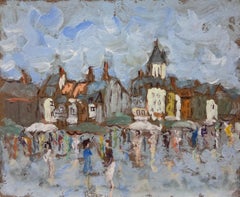
Figures In The Rain in Charming Village Original French Painting
By Fanch Lel
Located in Cirencester, Gloucestershire
Village Life
by Fanch Lel (French b. 1930)
size: 9 x 10.75 inches
gouache painting on board, unframed
condition: the painting is in very good condition. It has previously been stored...
Category
20th Century Impressionist Figurative Paintings
Materials
Gouache
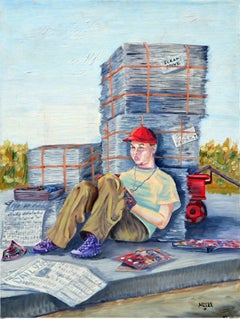
Early 20th Century Figurative -- The Paper Boy and His Comics
By Louise Miller Clark
Located in Soquel, CA
Wonderful 1940s figurative of paper boy reading the comics by Louise Miller Clark (American, 20th Century). Signed "Louise Miller" lower right. Unframed. Im...
Category
1940s American Impressionist Figurative Paintings
Materials
Canvas, Oil, Cardboard
$3,800
H 24 in W 18 in D 1 in
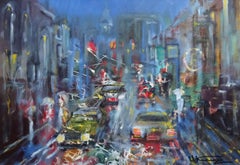
Night city. Oil on cardboard, 44, 5x64 cm
Located in Riga, LV
Night city. Oil on cardboard, 44,5x64 cm
Category
Early 2000s Impressionist Landscape Paintings
Materials
Oil, Cardboard
$461 Sale Price
20% Off
H 17.52 in W 25.2 in D 0.04 in
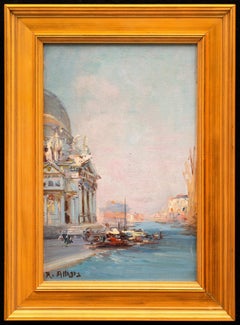
"Basilica di Santa Maria della Salute, Venice" Raymond Allègre (1857-1933)
By Allegre Raymond
Located in SANTA FE, NM
"Basilica di Santa Maria della Salute, Venice"
Raymond Allègre (France, 1857-1933)
Circa 1900
Oil on wood panel
Signed lower left
13 1/2 x 9 (22 1/2 x 17 frame) inches
The saturate...
Category
1890s Impressionist Landscape Paintings
Materials
Oil, Wood Panel
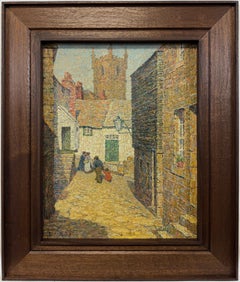
“Village Street” by Mary Nicholena MacCord, American Impressionist European Town
By Mary Nicholena MacCord
Located in Yardley, PA
A wonderful view of a charming European town. This work captures the quiet intimacy of a cobbled lane, its golden stones leading the viewer toward a cluster of whitewashed and brick ...
Category
Early 20th Century American Impressionist Landscape Paintings
Materials
Canvas, Oil, Board
$2,750
H 26.75 in W 22.75 in D 1.25 in
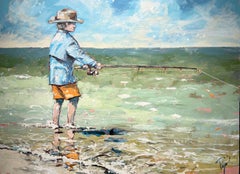
Trip Park, "Fishin
Solo", 36x48 Colorful Fisherman Beach Oil Painting on Canvas
Located in Saratoga Springs, NY
This piece, "Fishin' Solo" is a 36x48 oil painting on canvas by artist Trip Park featuring a man in orange shorts, blue shirt and cowboy hat fishing on the edge of the water. The wat...
Category
2010s Impressionist Landscape Paintings
Materials
Canvas, Oil
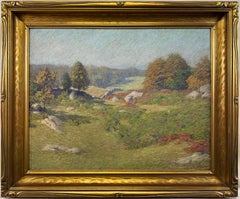
“Autumn Landscape, c. 1910” American Impressionist New England Fall Oil Signed
Located in Yardley, PA
Warm air seems to move through this scene as the eye wanders along a gentle swale dotted with granite boulders, low stone walls and scrubby autumn color. A ribbon of meadow pulls us ...
Category
Early 20th Century American Impressionist Landscape Paintings
Materials
Canvas, Oil
$3,500
H 29.5 in W 35.5 in D 2.5 in
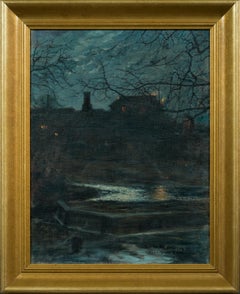
The Glow of the Past: Lundström’s Stockholm with a Touch of Mystery
Located in Stockholm, SE
We are pleased to present this painting by Ernst Lundström, dedicated to the esteemed sculptor Per Hasselberg. The dedication on the front of the painting makes this piece particular...
Category
1880s Romantic Landscape Paintings
Materials
Canvas, Oil
$3,488
H 21.07 in W 17.13 in
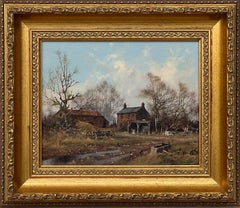
Painting of Farm with Geese in the English Countryside by 20th Century Artist
By James Wright
Located in Preston, GB
Painting of Farm with Geese in the English Countryside by 20th Century British Artist, James Wright
Signed, Original, Oil on Canvas, housed in a beautiful ornate gold frame.
Provenance: Part of the English Heritage Series No.111
Art measures 10 x 8 inches (approx.)
Frame measures 15 x 13 inches (approx.)
James Wright was born in Peterborough in 1935 and now lives in Lincolnshire. James is a self-taught artist and a leading exponent of the traditional English landscape style. His early work concentrated on the busy fishing villages around the coast of Norfolk, Cornwall and Sussex. More recently, his traditional landscapes mainly feature the East Anglian and Lincolnshire countryside.
About the English Heritage Collection
From the most powerful to the most humble, from Bronze Age axes...
Category
1990s Romantic Landscape Paintings
Materials
Oil, Canvas
$1,598 Sale Price
20% Off
H 13 in W 15 in D 2.5 in
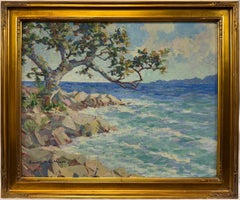
“Bermuda Coast” Henrietta Dunn Mears American Impressionist Oil on Board Signed
By Henrietta Dunn Mears
Located in Yardley, PA
A vibrant Bermuda seascape depicting the rocky shoreline with turquoise waters breaking against sunlit boulders beneath a sweeping tree. Mears uses bold, textured brushstrokes and a ...
Category
20th Century American Impressionist Landscape Paintings
Materials
Oil, Board
$1,950
H 19.5 in W 23.5 in D 1 in