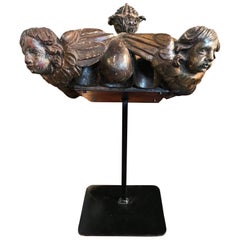
Ars Antiqua Abstract Sculptures
to
2
1
1
1
1
1
1
2
2
2
Height
to
Width
to
2
2
2
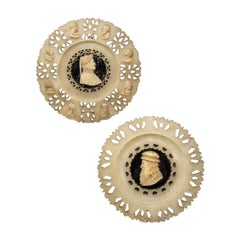
19th Century Pair of Desks with portraits of Petrarch and Leonardo Alabaster
Located in Milan, IT
19th century
Pair of desks with portraits of Petrarch and Leonardo
(2) Alabaster, 34 and 35 cm diam
The pair of alabaster discs features a central cameo with the effigy of Petrarch and Leonardo, probably part of a larger series that featured illustrious characters from Italian history. On the openwork frame of Petrarch there are portraits of some characters who face each other, combined for centuries, as can be seen from the shapes of the garments that span several centuries: from the thirteenth century, in which men wear long-tipped bonnets, to the fifteenth century and Sixteenth century, the two characters at the top, in the seventeenth century, with wide collars, up to the eighteenth century.
Francesco Petrarca (1304-1374) embodies the figure of the humanist intellectual par excellence, entirely dedicated to the study of Latin conceived as the only form of expression worthy of a man of letters, so as to serve any form of written communication, including letters and the reflection on himself witnessed in the Secretum. A personality made more complex by obsessive perfectionism, which led him to a continuous and infinite editing of the work which he also flaunted to consider as minor and which instead ensured him an undying fame among posterity, the Canzoniere. But the only aspect fixed in the collective imagination is that of the lover who idolizes the places where his ideal love blossomed...
Category
Antique 19th Century Italian Abstract Sculptures
Materials
Alabaster
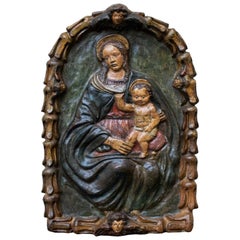
17th Century Madonna with Child from the Impruneta Tondo Polychrome Terracotta
Located in Milan, IT
Tuscan school, 17th century
Madonna with Child - from the Impruneta Tondo
Measures: Polychrome terracotta, 65 x 46 x 10 cm
This polychrome terracotta relief, gently jutting...
Category
Antique 17th Century Italian Abstract Sculptures
Materials
Terracotta
Related Items
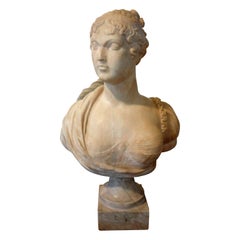
19th Century Italian Alabaster Bust
Located in Houston, TX
19th century Italian alabaster bust.
Well sculpted antique Italian alabaster or marble bust of a classical female mounted on a plinth. This is a beautifully detailed antique alabaster bust...
Category
Antique 1860s Italian Classical Roman Busts
Materials
Alabaster

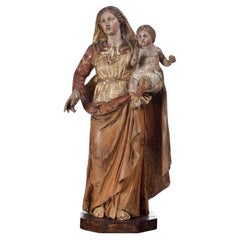
Wooden Madonna with Child Baroque Art Italy 17th Century with Export Certificate
Located in Madrid, ES
A Wooden Madonna with child Baroque art, Southern Italy, 17th century.
Measure: H: 71cm
Good condition for the time.
With Export Certificate to USA.
Category
Antique Early 17th Century Italian Baroque Figurative Sculptures
Materials
Wood
$5,893
H 27.96 in Dm 7.09 in
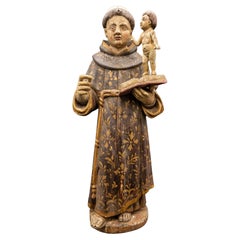
Spanish Sculpture of the 17th Century "Saint Antony and the Child Jesus"
Located in Madrid, ES
Spanish Sculpture of the 17th century "Saint Antony and the Child Jesus"
Measures: H: 61cm,
polychrome and gilded wood.
Good condition.
Category
Antique 17th Century Spanish Baroque Figurative Sculptures
Materials
Wood
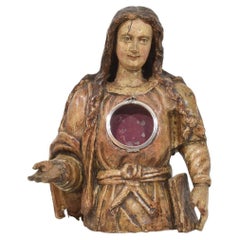
17th-18th Century Italian Wooden Reliquary Bust of a Madonna
Located in Buisson, FR
Spectacular and very decorative piece. Large carved wooden reliquary bust of a Madonna. Beautiful traces of color. Small losses and without the relics. Silver/silvered central piece ...
Category
Antique 17th Century Italian Baroque Busts
Materials
Wood
$4,750 Sale Price
41% Off
H 16.93 in W 13.39 in D 7.88 in
Buddha Statue 19th Century Alabaster
Located in New York, NY
18th/19th century Buddha Statue carved of Alabaster. Burmese Shan Buddha Statue 1800ca, collected in Myanmar Shan State 1998. Legs crossed, the left hand in the lap, and the right ha...
Category
Antique Early 1800s Burmese Figurative Sculptures
Materials
Alabaster

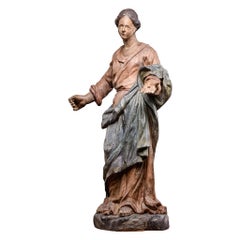
17th C Polychromed Fruitwood Carved Statue Depicting Madonna, France
Located in Leuven , BE
An exceptionally beautiful antique French wood carving, made in the 17th century. It depicts Madonna standing with open offering arms .The...
Category
Antique 17th Century Belgian Figurative Sculptures
Materials
Wood
$4,570
H 27.56 in W 13 in D 8.67 in
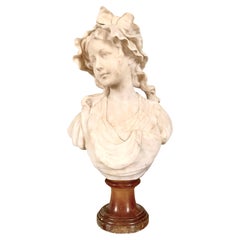
Woman Bust, Alabaster, 19th Century
Located in Beuzevillette, FR
Charming alabaster bust of a young woman. Her head is covered with a small peasant bonnet. On this bonnet, a pretty bow is perfectly sculpted. A few strands of wavy hair are escaping...
Category
Antique 19th Century French Figurative Sculptures
Materials
Alabaster
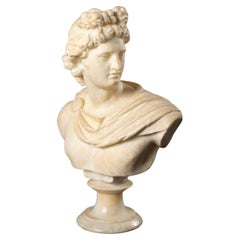
Alabaster Bust of Apollo, Italian 19th Century
Located in Bradenton, FL
19th century Italian Sculpted Alabaster Bust Of Apollo, the Greek god of art, medicine and music. White alabaster bust is intricately sculpted with the Greek god peering to his left,...
Category
Antique 19th Century Italian Neoclassical Figurative Sculptures
Materials
Marble
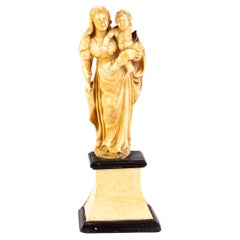
17th Century Flemisch Madonna
Child Bone Carving
Located in Nottingham, GB
In good condition
From a private collection
Free international shipping
17th Century Flemisch Madonna & Child Bone Carving
Category
Antique 17th Century Figurative Sculptures
Materials
Antler
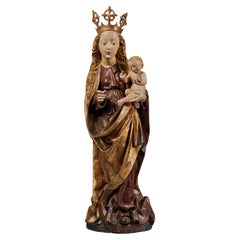
Polychrome carved wood Virgin and Child from the 15th Century
Located in Saint-Ouen, FR
POLYCHROME CARVED WOOD VIRGIN AND CHILD FROM THE 15TH CENTURY
ORIGIN: SOUTH GERMANY, SWABIA, NUREMBERG REGION
PERIOD: 15th CENTURY
Height: 94,6cm
Width : 28 cm
Depth : 18 cm
Lime wood
Original Polychromy
Good state of conservation
From 1430 onwards, sculpture underwent a profound stylistic renewal which continued until 1530, the so-called late Gothic period. In the Germanic countries, original sculptures flourished in an expressive and sensitive vein.
This renewal was inspired by the art of Nicholas of Leiden, who was active in Strasbourg in the 1460's. His style broke with the refined and delicate art of the international Gothic style in force throughout Europe around 1400. The figures became more authentic and realistic. The bodies became denser. Clothes are animated by deep, broken folds, the fabrics are heavy and have a great decorative value. In addition, the polychromy is intended to be illusionistic. The painting makes it possible to restore the texture of the materials, the richness of the textiles and the natural skin tone of the characters.
The dissemination of images through engraving and the great mobility of the artists led to the success of this style, which conquered the Upper Rhine, Swabian, Tyrolean and Franconian regions, contributing to the formation of a common stylistic identity in these regions. The economic boom in the flourishing German cities was conducive to the development of original production. Attracted by this prosperity, numerous workshops were set up in order to meet the orders of religious communities, the Church and the laity, including a clientele of middle-class rockers.
This precious Virgin and Child is depicted standing on a crescent moon, her head encircled by a crown of tall flowers. Her long wavy hair spreads over her shoulders, framing her beautiful oval face. Under fine eyebrows drawn with a brushstroke, her almond-shaped, slightly drooping eyes look at the Child with infinite softness. She is dressed in a long red dress with a rounded neckline, belted under the chest. The heavy fabric of her dress spreads out in broken folds at her feet. On her shoulders she wears a golden cloak. The drapery has deep folds. She holds out her right hand while she holds the Christ Child with her left.
Christ, with his well-defined hair, is naked. His cheeks are highlighted with red, he holds an apple in his left hand and with the other hand makes a sign of blessing towards the faithful.
Virgins with Child on a crescent moon were very popular in the second half of the 15th century, especially as the central subject of altarpieces in southern Germany and Austria. The crescent moon on which Mary is standing is reminiscent of the Woman of the Apocalypse. Often equated with the Virgin Mary.
This episode is taken from the Book of Revelation (12:1-6)
1 Then a great sign appeared in heaven: a woman clothed with the sun, with the moon under her feet and a crown of twelve stars on her head. ; 2 She was pregnant, and she cried out because she was in labor, in pain from giving birth. ; 3 Then another sign appeared in heaven: it was a great fiery red dragon, with seven heads and ten horns, and seven royal crowns on his heads. ; 4 His tail swept down a third of heaven's stars and threw them to the earth. The dragon stood in front of the woman who was about to give birth so that when she gave birth, he might devour her child. ; 5 She gave birth to a son, a male child who is to rule all the nations with an iron rod. Her child was snatched up to God and his throne. ; 6 Then the woman fled into the desert, where God has prepared a place for her. There she will be taken care of for one thousand two hundred sixty days.
Some theologians see in this woman a reference to the Virgin Mary and in the child, Jesus.
This remarkable work is a very fine example of sculpture from Swabian workshops in the last decades of the 15th century. It presents all the characteristic stylistic elements: a highly girdled silhouette, an abundant drapery with angular folds, but also a great physical presence accentuated by the polychromy that restores the anatomical details. This group is made of a wooden log. The deep folds of the drapery highlight the movement of the Virgin holding the child.
Bibliography :
Sophie Guillot de Suduiraut, Dévotion et Séduction, Sculptures souabes des musées de France, vers 1460-1530, Paris musée du Louvre-Éditions somogy, 2015
“Revelation 12 - Common English Bible...
Category
Antique 15th Century and Earlier German Gothic Figurative Sculptures
Materials
Wood
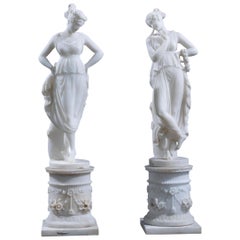
Pair of 19th Century Italian Alabaster Classical Figures of Muses
Located in London, GB
A pair of very finely carved 19th century alabaster figures of muses, in classical dress, each standing on circular pedestals intricately carved with flowers and beading, Italian, c....
Category
Antique Mid-19th Century Italian Neoclassical Figurative Sculptures
Materials
Alabaster
$4,631
H 19.69 in W 3.94 in D 3.94 in
Italian 17th Century Polychromed Fragment of Charming Putti
Located in Round Top, TX
A delightful 17th century Northern Italian "Haut De Chapiteau" - architectural fragment - beautifully carved from polychromed wood and presented on its iron stand. Wonderfully decora...
Category
Antique 17th Century Italian Figurative Sculptures
Materials
Wood