Art In The Fields Gallery Figurative Prints
to
1
Overall Width
to
Overall Height
to
1
1
1
1
1
1
1
1
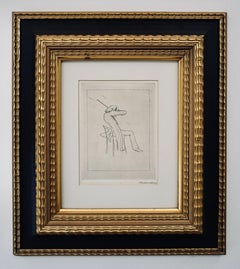
Violinist
Located in Berlin, MD
Engelina (Engelien) Reitsma-Valença (3 May 1889 - 11 July 1981) Amsterdam, Netherland. The portrait is of a violinist playing what appears to be an enervating piece. An engraver, st...
Category
Early 20th Century Art Deco Figurative Prints
Materials
Woodcut
Related Items
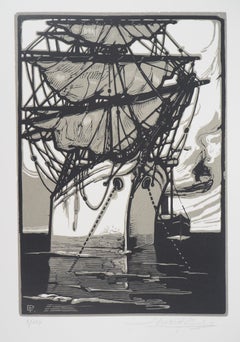
The Sailboat - Original woodcut, Handsigned
Located in Paris, IDF
Edward PELLENS
The Sailboat, 1922
Original woodcut
Handsigned in pencil
Numbered /154
On vellum 32.5 x 25.5 cm (c. 13 x 10 in)
Bears the blind stamp of t...
Category
1920s Art Deco Figurative Prints
Materials
Woodcut

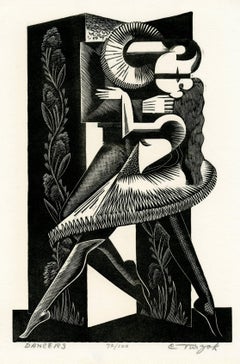
Dancers
— 1930s American Modernism
By Charles Turzak
Located in Myrtle Beach, SC
Charles Turzak, 'Dancers', 1939, wood engraving, edition 100. Signed, titled, and numbered 72/100 in pencil. A fine, richly-inked impression, on off-white Japan paper, with full marg...
Category
Mid-20th Century Art Deco Figurative Prints
Materials
Woodcut
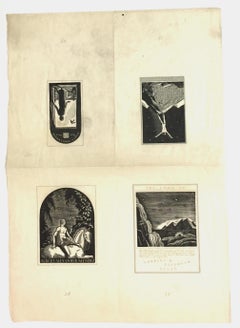
Rockwell Kent, Four Bookplates (on one sheet)
By Rockwell Kent
Located in New York, NY
Proof sheet with four wood engraved book plates by Rockwell Kent. Possibly for a book on this subject published in 1937. There are pencil numbers under each image that probably indic...
Category
Early 20th Century Art Deco Figurative Prints
Materials
Woodcut
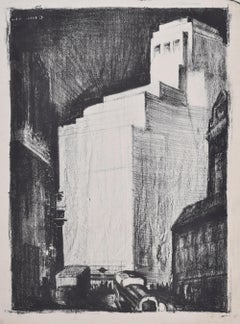
Art Deco City Scene with Motor Car print by Gerald Mac Spink
By Gerald Mac Spink
Located in London, GB
To see our other Modern British Art, scroll down to "More from this Seller" and below it click on "See all from this Seller" - or send us a message if you cannot find the artist you ...
Category
Early 20th Century Art Deco Landscape Prints
Materials
Woodcut
$539
H 16.15 in W 11.42 in
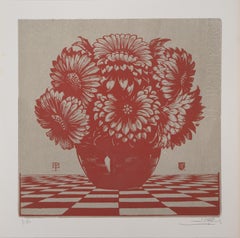
Red Bouquet of Flowers - Original woodcut, Handsigned
Located in Paris, IDF
Edward PELLENS
Red Bouquet of Flowers, 1929
Original woodcut
Handsigned in pencil
Numbered /160
On vellum 32.5 x 25.5 cm (c. 13 x 10 in)
Bears the blind stamp of the editor 'Imagier...
Category
1920s Art Deco Figurative Prints
Materials
Woodcut
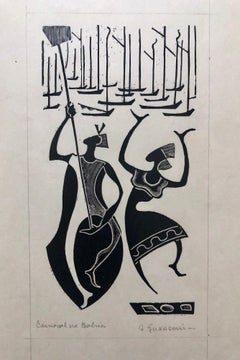
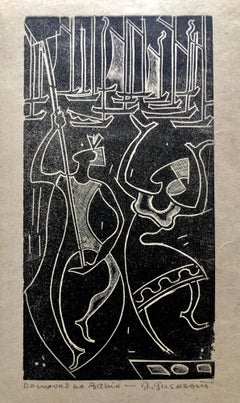
1945 Brazilian Master, Art Deco Nudes Serigraph Woodcut Carnaval Bahia
By Odetto Guersoni
Located in Surfside, FL
Genre: Brazilian Art Deco, African Diaspora
Bahian Carnival
Subject: Abstract
Medium: Print
Surface: Paper
Country: Brazil
Dimensions of overall paper are listed.
This is from a series of work he did in the 1940's, we sold one called Ritmo Negro, they are about Afro-Brazilian jazz, dance and music.
Odetto Guersoni was born in the city of Jaboticabal, State of São Paulo, in 1924. From 1936 to 1941 he attended the Liceu de Artes de Ofícios in São Paulo, beginning his artistic career in 1945, when he exhibited paintings in the Hall of the Plastic Artists Union . Two years later he was part of the collective group of 19, alongside Aldemir, Charoux, Otavio Araújo, Grassmann, Maria Leontina and several other artists that time would make famous. He then practiced a figurative painting of accentuated Expressionist lauds, characterized by deformation and coloring, raw and Satirical- as, moreover, so many of his fellow exhibitors at the time. As a French government scholar, Odette Guerzoni went to Paris in 1947 and the following year took part in the Peintres et Graveurs Etrangers and Art Libre exhibitions. Student of engraving by Renê Cottet, gradually transformed this expressive medium into his favorite, to the detriment of painting, which he practically abandoned soon after.
In 1947, he participated in the 19 Painters exhibition at the Prestes Maia Gallery together with Lothar Charoux, Maria Leontina,Grassmann, Aldemir Martins, Luiz Sacilotto and hiró. Guersoni was awarded a scholarship by the French government, and traveled to Paris, where he began work in engraving. Back in Brazil, in 1951, he founded the Art Workshop, in São Paulo. In 1954, he returned to Europe for a year, financed by the International Labor Organization (ILO). In Geneva, he studied engraving with René Cottet (1902 - 1992) and worked in Stanley william Hayter's studio, Atelier 17, in Paris (1901 - 1988). From 1956 to 1957, he became director of the Union of Plastic Artists of São Paulo. From 1960, he attended, as a trainee, some art schools in the United States and Japan such as The New York School of Printing and Osaka University. In 1971, also in Japan, he attended the workshop of I. Jokuriti. Two years later, he was voted Best Recorder of the Year by the Paulista Association of Art Critics - APCA. He took part in a special room at the Ibero-American Biennial in Montevideo in 1983. The Pinacoteca do Estado de São Paulo - Pesp presents a retrospective of his work in 1994.
Odetto Guersoni explores the wide spectrum of possibilities of the engraving. In addition to using techniques such as metal etching, lithograph, serigraph, linocut and, especially, woodcut he developed, in the 1950s, the philigraphy, in which the forms he developed gained points of embroidery made by Bonadei (1906 - 1974) . And, in the 1960s, the plastigraphy, in which he makes engravings on pasty surfaces, obtained from gypsum or other soft material. In the 1970s, technical investigations were associated with pictographic, ideographic, archaic symbol searches, Brazilian cave paintings and plant forms. The drawings are reduced to stylized, geometric shapes and transformed into abstract graphic elements. The artist works with few matrices, which, organized in rectangles, squares or circles, become modules to be combined. Guersoni juxtaposes them, adds, changes colors, and thereby composes colorful mandalas and structural geometries. Based on concise compositions, it produces color vibrations through optical illusions. In many of his woodcut works of the 1980s he uses smooth wood, knives, saws, gouges, punches, avoiding the natural textures of wood. In printing, it leaves the vibrant color and employs dosed inks with colorless masses, obtaining transparencies by superpositions. New journeys of study and specialization in engraving techniques took him in 1954 to Switzerland, 1960 to the United States, and in 1966 to Germany and Austria. Today, after having performed more than 40 individuals including 16 abroad and having participated in more than 50 collectives in several countries, Guersoni is considered one of the most notable Brazilian engravers. Conquered awards in several shows.
CHRONOLOGY
Individual exhibitions
1946 - Sao Paulo SP - 10th Salon of the Artists' Union, at the Prestes Maia Gallery
1947 - São Paulo SP - 19 Painters, at the Prestes Maia Gallery
1948 - Paris France - Peintres et Graveurs Etrangers at the École des Beaux-Arts
1949 - São Paulo SP - 13th Salon of the Artists' Union, at the Prestes Maia Gallery
1951 - São Paulo SP - 1st Paulista Salon of Modern Art, at Prestes Maia Gallery - silver medal
1953 - São Paulo SP - 2nd International Biennial of São Paulo, at MAM / SP
1954 - São Paulo SP - 3rd Paulista Salon of Modern Art, in the Prestes Maia Gallery
1955 - Rio de Janeiro RJ - 4th National Salon of Modern Art
1955 - Salvador BA - 5th Baiano Salon of Fine Arts, in Belvedere da Sé - honorable mention
1962 - São Paulo SP - Leirner Prize for Contemporary Art at the Folha Art Gallery - 1st printing award
1963 - Curitiba PR - 20th Salão Paranaense de Belas Artes, at the Public Library of Paraná
1963 - Rio de Janeiro RJ - Individual, no MAM / RJ
1968 - Bradford England - First International Print Biennale
1970 - São Paulo SP - Antonio Henrique Amaral, Odetto Guersoni, Tomie Ohtake, Pedro Tort and Gerda Brentani, in the Alberto Bonfiglioli Gallery
1971 - São Paulo SP - 11th International Biennial of São Paulo, at the Biennial Foundation - acquisition award
1973 - Punta del Este Uruguay - 1st Engraving Meeting of the Prata Basin Countries - International Prize
1977 - São Paulo SP - The Groups: the 40's, at the Lasar Segall Museum
1982 - São Paulo SP - Ismenia Coaracy, Odetto Guersoni and Alice Brill...
Category
1940s Art Deco Nude Prints
Materials
Woodcut
$600
H 8.5 in W 12 in D 0.1 in
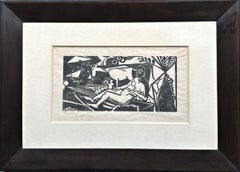
Liegender Weiblicher Akt Mit Kuh Und Ziege Expressionist Woodcut
By Heinrich Campendonk
Located in Eltville am Rhein, DE
Heinrich Campendonk
Krefeld 1889 - 1957 Amsterdam
Reclining female nude with cow and goat, 1918
Woodcut on Japanese paper
Signed and dedicated in pencil lower left "for Lasar Segall ...
Category
1910s Blue Rider Figurative Prints
Materials
Woodcut
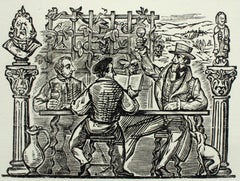
Lord on the Sand Castle - XX century Black
White Woodcut Print
By Franciszek Bunsch
Located in Warsaw, PL
Illustration for Jules de la Medelen's "Lord on the Sand Castle" ("Le Marquis Des Saffras")
FRANCISZEK BUNSCH (born in 1926) Franciszek Bunsch was born in Bielsko in 1926. He studie...
Category
1950s Contemporary Portrait Prints
Materials
Paper, Woodcut
$322
H 2.56 in W 3.94 in
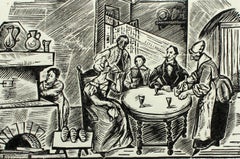
Lord on the Sand Castle - XX century Black
White Woodcut Print
By Franciszek Bunsch
Located in Warsaw, PL
Illustration for Jules de la Medelen's "Lord on the Sand Castle" ("Le Marquis Des Saffras")
FRANCISZEK BUNSCH (born in 1926) Franciszek Bunsch was born in Bielsko in 1926. He studie...
Category
1950s Contemporary Portrait Prints
Materials
Paper, Woodcut
$322
H 3.15 in W 4.14 in
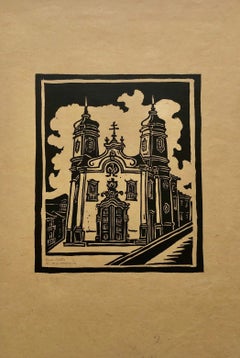
1945 Brazilian Master, Art Deco Serigraph Woodcut Colonial Architecture Mission
By Odetto Guersoni
Located in Surfside, FL
Genre: Brazilian Art Deco, African Diaspora
Bahian Carnival
Subject: Abstract
Medium: Print
Surface: Paper
Country: Brazil
Dimensions of overall paper are listed.
This is from a series of work he did in the 1940's, we sold one called Ritmo Negro, they are about Afro-Brazilian jazz, dance and music.
Odetto Guersoni was born in the city of Jaboticabal, State of São Paulo, in 1924. From 1936 to 1941 he attended the Liceu de Artes de Ofícios in São Paulo, beginning his artistic career in 1945, when he exhibited paintings in the Hall of the Plastic Artists Union . Two years later he was part of the collective group of 19, alongside Aldemir, Charoux, Otavio Araújo, Grassmann, Maria Leontina and several other artists that time would make famous. He then practiced a figurative painting of accentuated Expressionist lauds, characterized by deformation and coloring, raw and Satirical- as, moreover, so many of his fellow exhibitors at the time. As a French government scholar, Odette Guerzoni went to Paris in 1947 and the following year took part in the Peintres et Graveurs Etrangers and Art Libre exhibitions. Student of engraving by Renê Cottet, gradually transformed this expressive medium into his favorite, to the detriment of painting, which he practically abandoned soon after.
In 1947, he participated in the 19 Painters exhibition at the Prestes Maia Gallery together with Lothar Charoux, Maria Leontina,Grassmann, Aldemir Martins, Luiz Sacilotto and hiró. Guersoni was awarded a scholarship by the French government, and traveled to Paris, where he began work in engraving. Back in Brazil, in 1951, he founded the Art Workshop, in São Paulo. In 1954, he returned to Europe for a year, financed by the International Labor Organization (ILO). In Geneva, he studied engraving with René Cottet (1902 - 1992) and worked in Stanley william Hayter's studio, Atelier 17, in Paris (1901 - 1988). From 1956 to 1957, he became director of the Union of Plastic Artists of São Paulo. From 1960, he attended, as a trainee, some art schools in the United States and Japan such as The New York School of Printing and Osaka University. In 1971, also in Japan, he attended the workshop of I. Jokuriti. Two years later, he was voted Best Recorder of the Year by the Paulista Association of Art Critics - APCA. He took part in a special room at the Ibero-American Biennial in Montevideo in 1983. The Pinacoteca do Estado de São Paulo - Pesp presents a retrospective of his work in 1994.
Odetto Guersoni explores the wide spectrum of possibilities of the engraving. In addition to using techniques such as metal etching, lithograph, serigraph, linocut and, especially, woodcut he developed, in the 1950s, the philigraphy, in which the forms he developed gained points of embroidery made by Bonadei (1906 - 1974) . And, in the 1960s, the plastigraphy, in which he makes engravings on pasty surfaces, obtained from gypsum or other soft material. In the 1970s, technical investigations were associated with pictographic, ideographic, archaic symbol searches, Brazilian cave paintings and plant forms. The drawings are reduced to stylized, geometric shapes and transformed into abstract graphic elements. The artist works with few matrices, which, organized in rectangles, squares or circles, become modules to be combined. Guersoni juxtaposes them, adds, changes colors, and thereby composes colorful mandalas and structural geometries. Based on concise compositions, it produces color vibrations through optical illusions. In many of his woodcut works of the 1980s he uses smooth wood, knives, saws, gouges, punches, avoiding the natural textures of wood. In printing, it leaves the vibrant color and employs dosed inks with colorless masses, obtaining transparencies by superpositions. New journeys of study and specialization in engraving techniques took him in 1954 to Switzerland, 1960 to the United States, and in 1966 to Germany and Austria. Today, after having performed more than 40 individuals including 16 abroad and having participated in more than 50 collectives in several countries, Guersoni is considered one of the most notable Brazilian engravers. Conquered awards in several shows.
CHRONOLOGY
Individual exhibitions
1946 - Sao Paulo SP - 10th Salon of the Artists' Union, at the Prestes Maia Gallery
1947 - São Paulo SP - 19 Painters, at the Prestes Maia Gallery
1948 - Paris France - Peintres et Graveurs Etrangers at the École des Beaux-Arts
1949 - São Paulo SP - 13th Salon of the Artists' Union, at the Prestes Maia Gallery
1951 - São Paulo SP - 1st Paulista Salon of Modern Art, at Prestes Maia Gallery - silver medal
1953 - São Paulo SP - 2nd International Biennial of São Paulo, at MAM / SP
1954 - São Paulo SP - 3rd Paulista Salon of Modern Art, in the Prestes Maia Gallery
1955 - Rio de Janeiro RJ - 4th National Salon of Modern Art
1955 - Salvador BA - 5th Baiano Salon of Fine Arts, in Belvedere da Sé - honorable mention
1962 - São Paulo SP - Leirner Prize for Contemporary Art at the Folha Art Gallery - 1st printing award
1963 - Curitiba PR - 20th Salão Paranaense de Belas Artes, at the Public Library of Paraná
1963 - Rio de Janeiro RJ - Individual, no MAM / RJ
1968 - Bradford England - First International Print Biennale
1970 - São Paulo SP - Antonio Henrique Amaral, Odetto Guersoni, Tomie Ohtake, Pedro Tort and Gerda Brentani, in the Alberto Bonfiglioli Gallery
1971 - São Paulo SP - 11th International Biennial of São Paulo, at the Biennial Foundation - acquisition award
1973 - Punta del Este Uruguay - 1st Engraving Meeting of the Prata Basin Countries - International Prize
1977 - São Paulo SP - The Groups: the 40's, at the Lasar Segall Museum
1982 - São Paulo SP - Ismenia Coaracy, Odetto Guersoni and Alice Brill...
Category
1940s Art Deco Nude Prints
Materials
Woodcut
$600
H 8.25 in W 11.75 in D 0.1 in
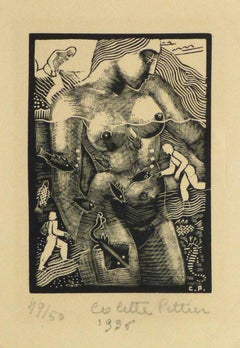
French Woodcut - La Mer et Les Fleuves
By Colette Pettier
Located in Houston, TX
Absorbing black and white woodcut of a nude female figure in the water surrounded by sea life and small figures by French artist Colette Pettier, 1936. Signed, dated and numbered 49 ...
Category
1930s Figurative Prints
Materials
Ink, Paper, Woodcut
1945 Brazilian Master, Art Deco Nudes Serigraph Woodcut Carnaval Bahia
By Odetto Guersoni
Located in Surfside, FL
Genre: Brazilian Art Deco, African Diaspora
Bahian Carnival
Subject: Abstract
Medium: Print
Surface: Paper
Country: Brazil
Dimensions of overall paper are listed.
This is from a series of work he did in the 1940's, we sold one called Ritmo Negro, they are about Afro-Brazilian jazz, dance and music.
Odetto Guersoni was born in the city of Jaboticabal, State of São Paulo, in 1924. From 1936 to 1941 he attended the Liceu de Artes de Ofícios in São Paulo, beginning his artistic career in 1945, when he exhibited paintings in the Hall of the Plastic Artists Union . Two years later he was part of the collective group of 19, alongside Aldemir, Charoux, Otavio Araújo, Grassmann, Maria Leontina and several other artists that time would make famous. He then practiced a figurative painting of accentuated Expressionist lauds, characterized by deformation and coloring, raw and Satirical- as, moreover, so many of his fellow exhibitors at the time. As a French government scholar, Odette Guerzoni went to Paris in 1947 and the following year took part in the Peintres et Graveurs Etrangers and Art Libre exhibitions. Student of engraving by Renê Cottet, gradually transformed this expressive medium into his favorite, to the detriment of painting, which he practically abandoned soon after.
In 1947, he participated in the 19 Painters exhibition at the Prestes Maia Gallery together with Lothar Charoux, Maria Leontina,Grassmann, Aldemir Martins, Luiz Sacilotto and hiró. Guersoni was awarded a scholarship by the French government, and traveled to Paris, where he began work in engraving. Back in Brazil, in 1951, he founded the Art Workshop, in São Paulo. In 1954, he returned to Europe for a year, financed by the International Labor Organization (ILO). In Geneva, he studied engraving with René Cottet (1902 - 1992) and worked in Stanley william Hayter's studio, Atelier 17, in Paris (1901 - 1988). From 1956 to 1957, he became director of the Union of Plastic Artists of São Paulo. From 1960, he attended, as a trainee, some art schools in the United States and Japan such as The New York School of Printing and Osaka University. In 1971, also in Japan, he attended the workshop of I. Jokuriti. Two years later, he was voted Best Recorder of the Year by the Paulista Association of Art Critics - APCA. He took part in a special room at the Ibero-American Biennial in Montevideo in 1983. The Pinacoteca do Estado de São Paulo - Pesp presents a retrospective of his work in 1994.
Odetto Guersoni explores the wide spectrum of possibilities of the engraving. In addition to using techniques such as metal etching, lithograph, serigraph, linocut and, especially, woodcut he developed, in the 1950s, the philigraphy, in which the forms he developed gained points of embroidery made by Bonadei (1906 - 1974) . And, in the 1960s, the plastigraphy, in which he makes engravings on pasty surfaces, obtained from gypsum or other soft material. In the 1970s, technical investigations were associated with pictographic, ideographic, archaic symbol searches, Brazilian cave paintings and plant forms. The drawings are reduced to stylized, geometric shapes and transformed into abstract graphic elements. The artist works with few matrices, which, organized in rectangles, squares or circles, become modules to be combined. Guersoni juxtaposes them, adds, changes colors, and thereby composes colorful mandalas and structural geometries. Based on concise compositions, it produces color vibrations through optical illusions. In many of his woodcut works of the 1980s he uses smooth wood, knives, saws, gouges, punches, avoiding the natural textures of wood. In printing, it leaves the vibrant color and employs dosed inks with colorless masses, obtaining transparencies by superpositions. New journeys of study and specialization in engraving techniques took him in 1954 to Switzerland, 1960 to the United States, and in 1966 to Germany and Austria. Today, after having performed more than 40 individuals including 16 abroad and having participated in more than 50 collectives in several countries, Guersoni is considered one of the most notable Brazilian engravers. Conquered awards in several shows.
CHRONOLOGY
Individual exhibitions
1946 - Sao Paulo SP - 10th Salon of the Artists' Union, at the Prestes Maia Gallery
1947 - São Paulo SP - 19 Painters, at the Prestes Maia Gallery
1948 - Paris France - Peintres et Graveurs Etrangers at the École des Beaux-Arts
1949 - São Paulo SP - 13th Salon of the Artists' Union, at the Prestes Maia Gallery
1951 - São Paulo SP - 1st Paulista Salon of Modern Art, at Prestes Maia Gallery - silver medal
1953 - São Paulo SP - 2nd International Biennial of São Paulo, at MAM / SP
1954 - São Paulo SP - 3rd Paulista Salon of Modern Art, in the Prestes Maia Gallery
1955 - Rio de Janeiro RJ - 4th National Salon of Modern Art
1955 - Salvador BA - 5th Baiano Salon of Fine Arts, in Belvedere da Sé - honorable mention
1962 - São Paulo SP - Leirner Prize for Contemporary Art at the Folha Art Gallery - 1st printing award
1963 - Curitiba PR - 20th Salão Paranaense de Belas Artes, at the Public Library of Paraná
1963 - Rio de Janeiro RJ - Individual, no MAM / RJ
1968 - Bradford England - First International Print Biennale
1970 - São Paulo SP - Antonio Henrique Amaral, Odetto Guersoni, Tomie Ohtake, Pedro Tort and Gerda Brentani, in the Alberto Bonfiglioli Gallery
1971 - São Paulo SP - 11th International Biennial of São Paulo, at the Biennial Foundation - acquisition award
1973 - Punta del Este Uruguay - 1st Engraving Meeting of the Prata Basin Countries - International Prize
1977 - São Paulo SP - The Groups: the 40's, at the Lasar Segall Museum
1982 - São Paulo SP - Ismenia Coaracy, Odetto Guersoni and Alice Brill...
Category
1940s Art Deco Nude Prints
Materials
Woodcut
$600
H 5.75 in W 8.25 in D 0.1 in