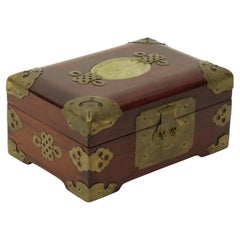
Avalon Decorative Boxes
to
5
1
1
4
1
1
1
2
2
1
3
3
2
2
2
6
3
2
1
1
1
Height
to
Width
to
6
6
6
1
Large 1980
s Dunhill Style Ribbon Mahogany Wood Humidor, Box with Brass Hinges
By Dunhill
Located in New York, NY
Large 1980's Dunhill style ribbon mahogany humidor / document / art box, with brass hinges. Fully lined with wood interior.
Category
Late 20th Century French International Style Decorative Boxes
Materials
Brass
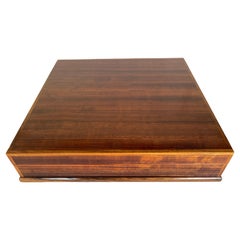
Hand Carved Lapis Lazuli Mosaic Jewelry Box with Marble Interior
Located in New York, NY
Lapis lazuli hand carved mosaic lidded box, with white marble interior.
Natural lapis stone has beautiful golden pyrite inclusions, like a sprinkling of fairy dust. The lapis mosaic...
Category
21st Century and Contemporary Italian Modern Decorative Boxes
Materials
Lapis Lazuli, Marble
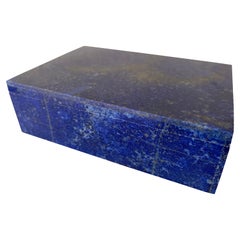
Tessellated Horn Jewelry Box with Adventurine Green Stone Border
By Maitland Smith
Located in New York, NY
Tessellated horn box with green stone border on top. Mahogany lined interior and felt bottom. Maitland Smith, 1980s.
Category
Late 20th Century American Mid-Century Modern Jewelry Boxes
Materials
Stone
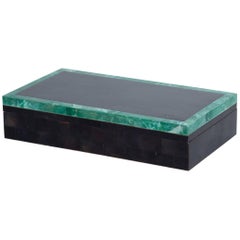
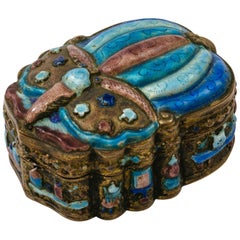
Antique Chinese Champlevé Enamel Scarab Jewelry Box
Located in New York, NY
Finely detailed champlevé scarab shape box with gilt wash interior. Traces of antique mirror on inner top. Rich colors of blue, turquoise purple finely enameled all around box.
Category
Antique 19th Century Chinese Chinoiserie Jewelry Boxes
Materials
Bronze
Anglo Indian Micro Mosaic Inlay Jewelry Box
Located in New York, NY
Exquisitely crafted early 20th century Anglo Indian micro mosaic Sadeli box with gorgeous antique Persian geometric pattern.
The finely detailed box featu...
Category
Early 20th Century Indian Anglo-Indian Jewelry Boxes
Materials
Bone, Fruitwood

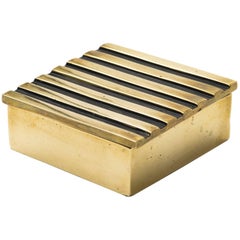
Walter Bosse Austrian Lacquered Brass Cigarette Box
By Herta Baller
Located in New York, NY
Walter Bosse for Herta Baller polished cast brass square box with patinated stripe lid, Austria, circa 1950's.
Category
Mid-20th Century Austrian Mid-Century Modern Decorative Boxes
Materials
Brass
Related Items
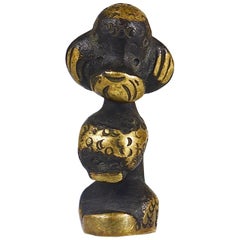
Walter Bosse Brass Poodle Figurine, Lucky Charm, Herta Baller, Austria, 1950s
By Walter Bosse, Herta Baller
Located in Vienna, AT
A charming poodle figurine, made of brass designed by Walter Bosse, executed in the 1950s by Hertha Baller, Austria. In excellent condition.
Category
Mid-20th Century Austrian Mid-Century Modern Animal Sculptures
Materials
Brass

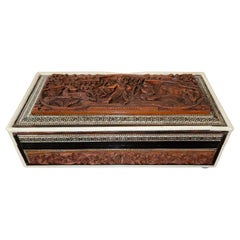
19C Anglo Indian Carved Teak Wood and Sadeli Mosaic Box
Located in Dallas, TX
PRESENTING A LOVELY 19th century Anglo-Indian Carved Teak Wood and Sadeli Mosaic Box, featuring a carving of a Hunt Scene.
Made circa 1870 in Bombay, India during the Rule of the Br...
Category
Antique Late 19th Century Indian Anglo-Indian Jewelry Boxes
Materials
Silver, Pewter
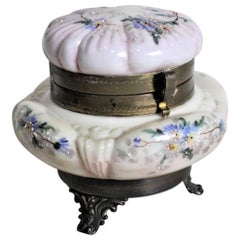
Antique American Enameled Glass Ladies Footed Dresser Jar or Jewelry Box
Located in Hamilton, Ontario
This antique pressed glass jewelry casket or jar is unsigned but presumed to have been made in the United States in circa 1880 in the period Vict...
Category
Antique Late 19th Century American Victorian Jewelry Boxes
Materials
Brass
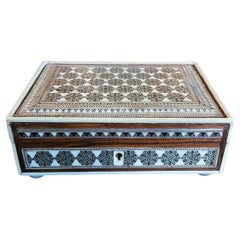
19C Anglo Indian Bombay MOP Sadeli Mosaic Trinket Box
Located in Dallas, TX
PRESENTING a LOVELY 19C Anglo Indian Bombay MOP (Mother of Pearl) Sadeli Mosaic Trinket Box from circa 1875-85.
Gorgeously detailed and hand-crafted ‘sadeli mosaic’ inlay, from the Bombay Area, with deep greens with silver, pewter, mother of pearl, bone and ebony in geometric patterns.
The box case, is made of sandalwood but completely covered in MOP, bone, faux ivory, ebony and mosaic inlay.
Edged with faux ivory and banded with a different pattern of sadeli mosaic.
Some minor damage to the top (repair is obvious in pics) and ivorine replacements to some edging, but it still a BEAUTIFUL BOX and of real QUALITY!
The mosaic work is FABULOUS!
Box opens to reveal its original blue velvet lining.
It sits on 4 (recently added) silvered button feet.
SADELI MOSAIC: “Anglo Indian boxes were made in India for the English residents from the early part of the 18th century. They were brought back or sent back to England usually by the people who had commissioned them. From the beginning of the nineteenth century they were imported more commercially, although not in any significant numbers until the middle decades. They were very highly valued, especially the early ones, to the extent that the designs were copied on late 19th and early 20th century tins.
The ancient art of Sadeli Mosaic is said to have been introduced from Shiraz in Persia via Sind to Bombay, a long time before the Anglo Indian boxes were made. It was a technique, which required a high degree of skill and patience. It was executed very lavishly, in that the frequent cuts wasted a great amount of the precious materials used. The workmanship was however more than commensurable to the value of the materials.
Ivory, silver, pewter (or other metals), wood and horn were cut into faceted rods which were bound together to form geometric patterns. When the glue has set, the rods were sliced in transverse sections. This gave the maker a number of angled circular pieces in the original pattern. Several variations of patterns could be achieved by combining the materials in different ways. The ivory was sometimes dyed green to give an extra color.
The mosaic pieces in a combination of patterns, often separated by ivory, ebony, horn or silver stringing were used to veneer sandalwood boxes. In the early boxes, which date from the turn of the 18th to the 19th century, there are large panels of mosaic covering tops and sides of boxes. It took incredible skill to cover such large areas without any shakes or wavering of the pattern. The corners and joins on these boxes are impeccably matched.
The makers (reputed to be Persian) of Sadeli mosaic made in the first two decades of the 19th century displayed a total understanding of the qualities of the different materials they used. They combined substances, which can expand and contract according to atmospheric conditions with others, which are hard and unyielding. The result was a sharp definition of the lines and patterns, which made up the whole design.
On the early boxes the designs look deceptively simple. The fact is, they emerged from a culture, which had mastered geometry and understood how to generate a pattern from a set number of points. The patterns are so harmoniously combined that their incredible complexity is not immediately apparent.
The earliest Sadeli boxes...
Category
Antique Late 19th Century Indian Anglo-Indian Jewelry Boxes
Materials
Silver
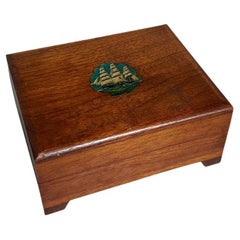
Vintage Brown Nautical Sailing Ship Wood Box with Hinged Lid
Located in Oklahoma City, OK
A vintage nautical theme jewelry or trinket box. This small rectangular brown box will be a great accent on a coffee table, dressing table, or on a bookshelf. It is created from wood...
Category
Mid-20th Century American Folk Art Decorative Boxes
Materials
Metal
$262 Sale Price
25% Off
H 2.5 in W 5.5 in D 4.5 in
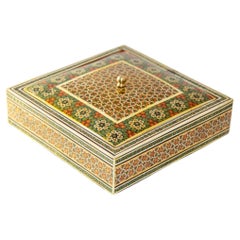
1950s Anglo Indian Micro Sadeli Mosaic Inlaid Jewelry Box
Located in Moreno Valley, CA
1950s Anglo Indian Micro Sadeli Mosaic Inlaid Jewelry Box.
DIMENSIONS: 7ʺW × 7ʺD × 2.5ʺH.
Indo Persian Moorish style micro mosaic inlaid jewelry box with lid.
Intricate inlaid Anglo ...
Category
Mid-20th Century Indian Moorish Decorative Boxes
Materials
Bone, Fruitwood
Moorish Micro Mosaic Inlaid Jewelry Box
By Rajhastani
Located in Moreno Valley, CA
Moorish style micro mosaic marquetry inlaid jewelry box with lid.
Intricate inlaid Anglo Indian box with floral and geometric Islamic
Moorish mosaic Sadeli design in a square shape form with mosaic inlay and marquetry, very fine artwork, lined in red velvet.
Museum collector piece like the one in Doris Duke Islamic Art Museum.
The repeating geometric patterns of Sadeli Mosaic are what give it beauty and richness. This decorative technique is a type of micro mosaic featuring repeating geometric patterns. A highly skilled craft, it has had a long history in India and the Middle East with early examples dating back to the 16th century. In the 1800s, it became popular as a decoration on a variety of boxes, card cases, and chess boards imported from India. Since Bombay became a center of making them, they became known as Bombay boxes...
Category
Mid-20th Century Indian Agra Jewelry Boxes
Materials
Wood
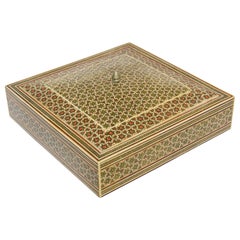
Wood Jewelry Box with Drawers Suede Interior
Located in Haddonfield, NJ
Large wood jewelry box featuring: Lift lid with full interior mirror, ten hook necklace drop,
top compartment with five sections plus ring rolls, three drawers, top drawer has ten se...
Category
21st Century and Contemporary Modern Jewelry Boxes
Materials
Metal
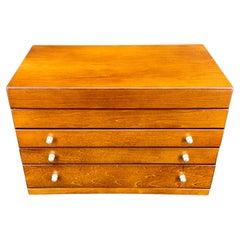
Chinese antique Wooden cat jewelry box or object holder, 1920s
Located in MIlano, IT
Chinese antique Wooden cat jewelry box or object holder, 1920s
Jewelry box with retractable compartment in the shape of a lying cat, entirely made o...
Category
Vintage 1920s Chinese Jewelry Boxes
Materials
Wood
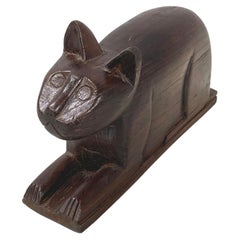
Walter Bosse Brass Cat Figurine Jewelry Ring Holder, Baller Austria, 1950s
By Herta Baller, Walter Bosse
Located in Nuernberg, DE
Classic early 1950s Austrian Bosse cat Figurine Collectible. Nice addition to your room or just for your collection of Austrian bronze items. Found at an estate sale in Vienna, Austr...
Category
Vintage 1950s Austrian Mid-Century Modern Animal Sculptures
Materials
Bronze
$360
H 7.5 in W 3.25 in D 1.13 in
Micro Mosaic Moorish Inlaid Jewelry Pen Box
Located in Moreno Valley, CA
Micro Mosaic Persian Islamic Moorish Inlaid Jewelry Pen Box.
1950s Middle Eastern Moorish Inlaid Jewelry Trinket Mosaic Box.
Handcrafted mar...
Category
Mid-20th Century Lebanese Moorish Decorative Boxes
Materials
Fruitwood
Old Chinese Jewelry Box Jewelry Box Jade Rosewood Brass
Located in Poperinge, BE
Old Chinese rosewood wooden jewelry box, jewelry box with brass fittings and a jade plaque in the center of the lid, inside a red lining with golden floral decoration, second half of...
Category
Vintage 1960s Chinese Chinoiserie Jewelry Boxes
Materials
Brass