A.W. Johnston Co. Antiques Tea Caddies
to
1
1
1
1
1
1
1
1
1
1
1
Height
to
Width
to
1
1
1
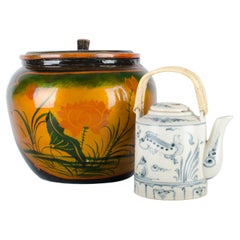
Japanese Lacquer Padded Teapot Caddy
Located in Savannah, GA
Antique Japanese hand-painted lacquer teapot caddy.
Interior is padded and fitted for blue and white porcelain teapot.
The teapot stands 4¼ inches tall and features a fish on one si...
Category
Mid-20th Century Japanese Modern Tea Caddies
Materials
Porcelain, Lacquer
Related Items
Antique Chinese Export Black Lacquer Tea Caddy
Located in Forney, TX
A stunning antique Qing Dynasty Chinese export twin canister tea caddy / decorative table box. circa 1860
Hand-crafted in China for the European market when rare and exotic oriental...
Category
Antique 19th Century Chinese Qing Tea Caddies
Materials
Pewter

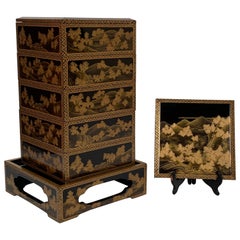
Japanese Maki-e Lacquer Stacking Box, Jubako, Meiji Period, Japan
Located in Austin, TX
A fine and impressive Japanese gold maki-e decorated black lacquer five-tier jubako with presentation tray, two lids, and the original tomobako storage box, Meiji period, late 19th c...
Category
Antique Late 19th Century Japanese Meiji Lacquer
Materials
Lacquer
19th Century Chinese Export Lacquer Tea Caddy
Located in Mt Kisco, NY
The burgundy / brown lacquer is decorated with gold depicting figures and buildings in a landscape. The caddy stands on four carved wooden feet in the shape of claws. The interior contains a single pewter canister...
Category
Antique 19th Century English Tea Caddies
Materials
Paper
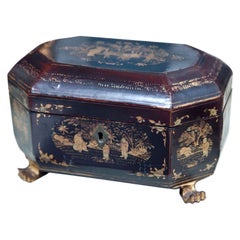
19th Century Chinese Export Lacquer Decorated Tea Caddy Box
Located in Atlanta, GA
Chinese for the English market, 19th century.
A fine quality antique Chinese export tea caddy decorated with beautiful gilding surfaces, a hinged lid which opens to reveal a tooled ...
Category
Antique 19th Century English Chinese Export Decorative Boxes
Materials
Pewter
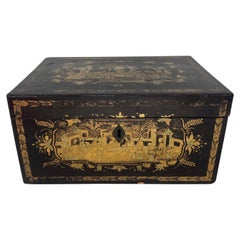
Antique Student Pencil Box Japanese Lacquer Ware Writing Japan
Located in Amsterdam, Noord Holland
A Japanese lacquer writing box 19th Century
Of rectangular shape, overall painted in famille rose colors with flowers, all on a yellow ground, the interior in red.
Additional inform...
Category
Antique 19th Century Japanese Decorative Boxes
Materials
Lacquer
$398 Sale Price
20% Off
H 1.58 in W 11.7 in D 3.67 in
1960
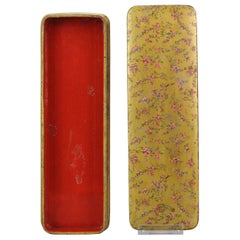
s Japanese Tea Caddy Tin Canister
Located in New York, NY
1960's tin tea caddy covered in traditional Japanese woven gold fabric with floral motif. There are two lids, inner and outer to keep tea leaves fresh.
Category
Mid-20th Century Japanese Japonisme Tea Caddies
Materials
Tin
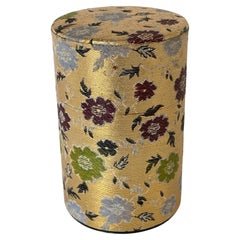
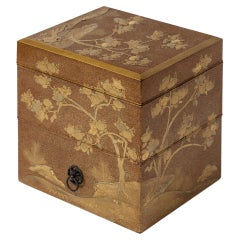
Japanese Lacquered Tebako
Box
Located in PARIS, FR
Tebako box with three compartments in golden and nashi-ji lacquer, decorated with golden, red, and kirigane lacquer, golden persimmon tree leaves, among rocks. The compartments are of increasing size from the top. The decoration is in continuity.
Persimmon has been cultivated in southern China for more than 2500 years and is believed to have been introduced to Japan in the 8th century. The veneer is a tree with very hard wood, similar to ebony. According to a legend, one specimen survived the atomic bombing of Nagasaki on August 9, 1945, close to the epicenter. It is therefore in Japan a symbol of strength and longevity. It is also the national fruit of the country. It is eaten as a traditional dish during New Year's Day celebrations.
Tebako literally means "portable box...
Category
Antique 1860s Japanese Lacquer
Materials
Lacquer
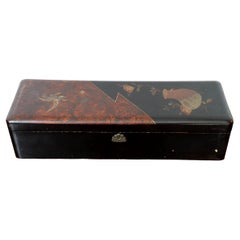
Japanese Maki-e Lacquered Box, Ric.049
Located in Norton, MA
Japan, Edo to Meiji period, a long rectangular document box with hinged cover, decorated with a bird and a floral basket,
The locker is not functioning.
Category
Antique 19th Century Japanese Decorative Boxes
Materials
Lacquer
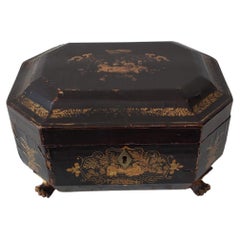
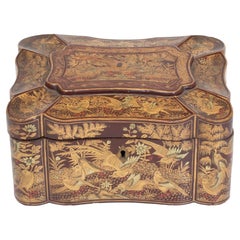
Chinese Export Antique Lacquer Tea Caddy
Located in Northampton, GB
FREE WORLDWIDE SHIPPING
Raised on Dragon Feet
From our Tea Caddy collection, we are pleased to offer this Chinese Export Lacquer Tea Caddy. The Tea Caddy of curvaceous rectangular ...
Category
Antique Mid-19th Century Chinese Chinese Export Tea Caddies
Materials
Lacquer
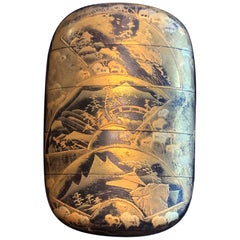
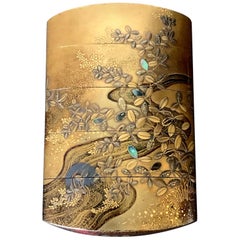
Fine Japanese Lacquered Inro with Inlays by Kajikawa
Located in Atlanta, GA
A Japanese four-case lacquer inro by a member of Kajikawa family circa 19th century (late Edo to early Meiji period). It depicts a nocturnal scenery of a meandering stream surrounded by bush clovers, where a full moon is reflected on the water. It was masterfully decorated in gold and silver maki-e using a combination of techniques including takamakie, togidashi and kirigane as well as aogai (abalone shell) inlays. The stream was set between the slightly elevated banks, adding to this piece a already strong three-dimensional composition. The interior was decorated in gold nashiji. It was signed on the bottom "Kajikawa Zou" (made by Kajikawa and a pot seal centered with "Ei" in Kanji. In one of the compartment, there is a katakana mark, appears to be a name, possibly the owner.
Kajikawa clan was one of the most famous lacquer artisanal family established in the 17th century. Many well known members over the generations produced lacquer art in a wide range of formats, but two third were signed only with the family name such as this one. It is therefore not possible to pinpoint the exact author of this piece.
Provenance: This inro was purchased as lot 349 in Christie's New York sale Japanese...
Category
Antique 19th Century Japanese Japonisme Lacquer
Materials
Shell, Wood, Lacquer
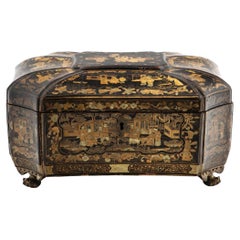
Chinese Export Tea Caddy, Lacquered Wood with Gilded Decorations
Located in Kastrup, DK
A beautifully crafted Chinese export tea caddy made of wood with black lacquer, richly adorned with gilded motifs featuring classical Chinese scenes of people, houses, and more.
The ...
Category
Antique Late 19th Century Qing Tea Caddies
Materials
Wood
$1,651 / set
H 5.32 in W 11.23 in D 7.88 in
Fine Japanese Lacquered Inro by Yutokusai
Located in Atlanta, GA
A four-case lacquered Japanese inro by Yutokusai (Gyokkei), a lacquer artist active from 1845-1900 (end of Edo to Meiji period). The slightly round inro features a very intricate design with three unfolded fans on the front and two on the back: each reveals a vignette landscape scenery, likely real places in Japan. Using a combination of hiramaki-e and slight takamaki-e, the artist deftly created the pictures with fine details, rendering the inro as a miniature artwork...
Category
Antique 19th Century Japanese Japonisme Lacquer
Materials
Wood, Lacquer