Diane Villani Editions Interior Prints
to
3
2
2
Overall Width
to
Overall Height
to
4
2
2
4
2
2
2
2
2
2
1
1
1
1
1
1
1
1
1
1
1
1
2
2
2
2
4
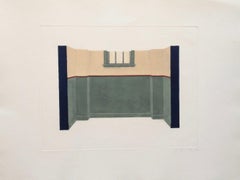
Untitled (Green Wall)
By Alan Herman
Located in New York, NY
Alan Herman is a native New Yorker who graduated with a BFA from The Philadelphia College of Art, and an MFA from Temple University. After graduation he returned to New York and desi...
Category
1980s Contemporary Interior Prints
Materials
Aquatint
$480 Sale Price
20% Off
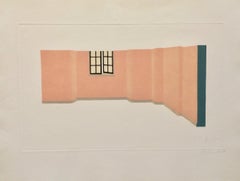
Untitled (Pink Wall)
By Alan Herman
Located in New York, NY
Alan Herman is a native New Yorker who graduated with a BFA from The Philadelphia College of Art, and an MFA from Temple University. After graduation he returned to New York and desi...
Category
1980s Contemporary Interior Prints
Materials
Aquatint
$480 Sale Price
20% Off
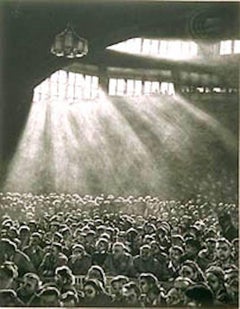
Theater
By Michele Zalopany
Located in New York, NY
Michele Zalopany was born in Detroit, Michigan. She attended the Columbus College of Art and Design from 1973 to 1974 and the Cleveland Institute of Art from 1976 to 1978. She earned her Bachelor of Fine Arts degree from the School of Visual Arts in 1981. Through her labor-intensive mezzotints, Zalopany employs realism to depict fictitious scenes, bearing witness to the disintegration of what was once the fulcrum of the American economy in Detroit.
Zalopany’s work is widely represented in many public and private collections in the United States and in Europe including The National Gallery of Art, The Yokohama Museum of Art, The Whitney Museum of American Art, The Walker Art Center, The Museum of Fine Art in Boston, The Cleveland Museum of Art, The Royal College of Art in London, and numerous others. Her work has been exhibited in galleries that include P.P.O.W., John Good...
Category
1990s Contemporary Interior Prints
Materials
Mezzotint
$720 Sale Price
52% Off
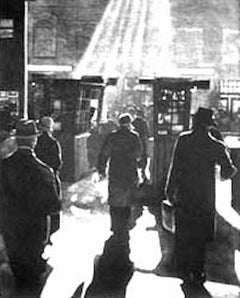
Train Station
By Michele Zalopany
Located in New York, NY
Michele Zalopany was born in Detroit, Michigan. She attended the Columbus College of Art and Design from 1973 to 1974 and the Cleveland Institute of Art from 1976 to 1978. She earned her Bachelor of Fine Arts degree from the School of Visual Arts in 1981. Through her labor-intensive mezzotints, Zalopany employs realism to depict fictitious scenes, bearing witness to the disintegration of what was once the fulcrum of the American economy in Detroit.
Zalopany’s work is widely represented in many public and private collections in the United States and in Europe including The National Gallery of Art, The Yokohama Museum of Art, The Whitney Museum of American Art, The Walker Art Center, The Museum of Fine Art in Boston, The Cleveland Museum of Art, The Royal College of Art in London, and numerous others. Her work has been exhibited in galleries that include P.P.O.W., John Good...
Category
1990s Contemporary Interior Prints
Materials
Mezzotint
Related Items
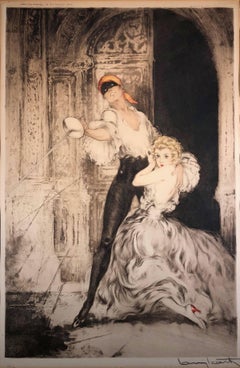
Don Juan
By Louis Icart
Located in Missouri, MO
Aquating Engraving
Image Size: approx. 20 1/4 x 13 3/8
Framed Size: 28 x 20.5 inches
Pencil Signed Lower Right
Louis Justin Laurent Icart was born in Toulouse in 1890 and died in Paris in 1950. He lived in New York City in the 1920s, where he became known for his Art-Deco color etchings of glamourous women.
He was first son of Jean and Elisabeth Icart and was officially named Louis Justin Laurent Icart. The use of his initials L.I. would be sufficient in this household. Therefore, from the moment of his birth he was dubbed 'Helli'. The Icart family lived modestly in a small brick home on rue Traversière-de-la-balance, in the culturally rich Southern French city of Toulouse, which was the home of many prominent writers and artists, the most famous being Henri de Toulouse-Lautrec.
Icart entered the l'Ecole Superieure de Commerce de Toulouse in order to continue his studies for a career in business, particularly banking (his father's profession). However, he soon discovered the play writings of Victor Hugo (1802-1885), which were to change the course of his life. Icart borrowed whatever books he could find by Hugo at the Toulouse library, devouring the tales, rich in both romantic imagery and the dilemmas of the human condition. It was through Icart's love of the theater that he developed a taste for all the arts, though the urge to paint was not as yet as strong for him as the urge to act.
It was not until his move to Paris in 1907 that Icart would concentrate on painting, drawing and the production of countless beautiful etchings, which have served (more than the other mediums) to indelibly preserve his name in twentieth century art history.
Art Deco, a term coined at the 1925 Paris Exposition des Arts Decoratifs, had taken its grip on the Paris of the 1920s. By the late 1920s Icart, working for both publications and major fashion and design studios, had become very successful, both artistically and financially. His etchings reached their height of brilliance in this era of Art Deco, and Icart had become the symbol of the epoch. Yet, although Icart has created for us a picture of Paris and New York life in the 1920s and 1930s, he worked in his own style, derived principally from the study of eighteenth-century French masters such as Jean Antoine Watteau, François Boucher and Jean Honoré Fragonard.
In Icart's drawings, one sees the Impressionists Degas...
Category
1920s Art Deco Figurative Prints
Materials
Engraving, Aquatint

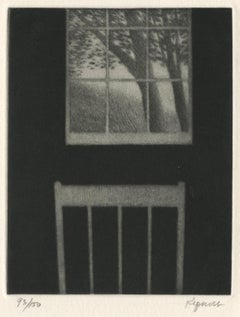
Landscape with Window and Chair
By Robert Kipniss
Located in Fairlawn, OH
Landscape with Window and Chair
Mezzotint on wove paper, 2000
Signed in pencil lower right (see photo)
Edition: 150 (93/150) (see photo)
Special Presentation Print for the Print Club...
Category
Early 2000s Contemporary Interior Prints
Materials
Mezzotint
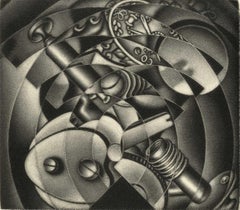
Sewing Circles
By Carol Wax
Located in New Orleans, LA
A play on words provides the title for this image -- a circle created out of the deconstructed parts of Singer IV This image is #37 from an edition of only 50, referenced as Firos 78...
Category
1990s American Modern Still-life Prints
Materials
Mezzotint
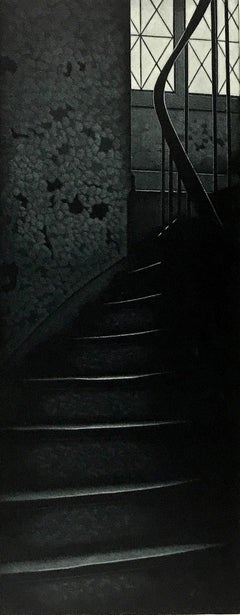
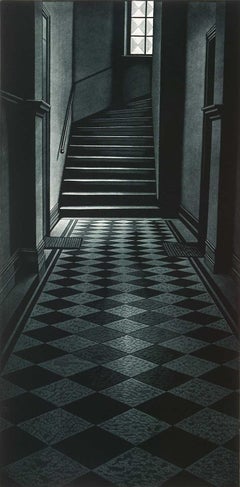
Before It Happened (A mysterious staircase offers no clues as to what happened)
By Jukka Vanttinen
Located in New Orleans, LA
This Finnish artist creates a mezzotint in black and white. This impression is #44 of 100 and is signed, dated and titled in pencil.
Jukka Vanttinen (Finn, b. 1954)
Jukka Vanttinen...
Category
Early 2000s Modern Interior Prints
Materials
Mezzotint
Days Gone
By Jukka Vanttinen
Located in New Orleans, LA
Vanttinen created this mezzotint in an edition of 100 and it is titled and signed in pencil.
Jukka Vanttinen (Finn, b. 1954)
Jukka Vanttinen was introduced to the medium of mezzoti...
Category
Early 2000s Contemporary Interior Prints
Materials
Mezzotint
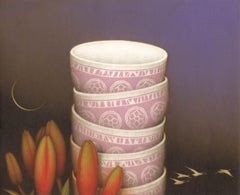
Lillies and Bowls (still life of flowers and colorful bowls)
Located in New Orleans, LA
The moon, bowls, lillies and birds are featured in this 2002 mezzotint. It is #17 from an edition of 75 and is signed, titled, dated and edition by hand by this Korean artist born i...
Category
Late 20th Century Contemporary Still-life Prints
Materials
Mezzotint
$200
H 11 in W 13.25 in
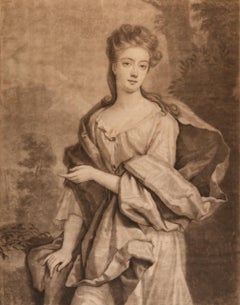
The Duchess of St. Albans: A 17th C. Portrait After a Kneller Painting
By (After) Sir Godfrey Kneller
Located in Alamo, CA
This is a 17th century engraved mezzotint portrait of the Duchess of St. Albans by John Smith, after a painting by Sir Godfrey Kneller. It was published in London by John Boydell in 1694.
The Duchess of St. Albans (1642-1712) was a woman named Diana de Vere. She was born in 1642, the daughter of Aubrey de Vere, the 20th Earl of Oxford. In 1662, she married Charles Beauclerk, the illegitimate son of King Charles II and his mistress, Nell Gwyn. As a result of her marriage, Diana became the Duchess of St. Albans, and she and Charles had several children together. Diana was known for her beauty and charm, and she was a prominent figure in the court of King Charles II. Despite her husband's illegitimate birth, Diana was highly respected in the royal court and was known for her intelligence and wit. She was a patron of the arts and supported many artists and writers of the time. Diana lived through a tumultuous period of English history, including the Great Fire of London and the Glorious Revolution, which saw King James II replaced by William of Orange. She died in 1712 at the age of 70 and was buried in Westminster Abbey. Descendants of Diana and her husband, who was an illegitimate son of King Charles II, include Diana, Princess of Wales and her son William, Duke of Cambridge.
An author wrote of her: "The line of Vere, so long renown’d in arms,
Concludes with luster in St. Albans’s charms;
Her conquering eyes have made their race complete,
It rose in valor, and in beauty set."
This striking mezzotint engraving depicts Diana, Duchess of St Albans in a three-quarter length pose, standing, wearing loose flowing dress and a wrap. She has a very serene, calm appearance as she is looking straight at the viewer. There is a landscape of trees in the background. The print is adhered in the corners to an archival backing, which is itself adhered in the upper corners to a larger backing. The print is trimmed to just beyond the plate mark. There are areas of discoloration in the margins and in the inscription area, but the print is otherwise in very good condition. The sheet measures 14.5" high and 10" wide. This mezzotint is held by multiple museums and institutions, including The British Museum, The National Portrait Gallery London, The Fine Arts Museum of Boston, The Lewis Walpole Library at Yale, The Yale Center for British Art, The Fitzwilliam Museum at Cambridge and The National Galleries of Scotland. The original Kneller painting is part of the British Royal Collection Trust and hangs in the King's Private Dining Room at Hampton Court Palace.
Sir Godfrey Kneller (1646-1723) was a leading portrait painter of his time, particularly renowned for his depictions of the British aristocracy and royalty. He was born in Lübeck, Germany, and trained in Amsterdam under the painter Ferdinand Bol...
Category
Late 17th Century Portrait Prints
Materials
Mezzotint
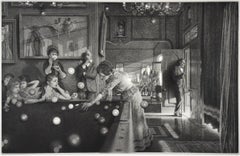
Points of Departure: Mary
s Turn, by Peter Milton
By Peter Milton
Located in Palm Springs, CA
Peter Milton’s Mary’s Turn reimagines a scene where Mary Cassatt and Edgar Degas engage in a game of billiards, reflecting their real-life friendship and rivalry. Cassatt leans forwa...
Category
1990s Contemporary Interior Prints
Materials
Engraving, Etching
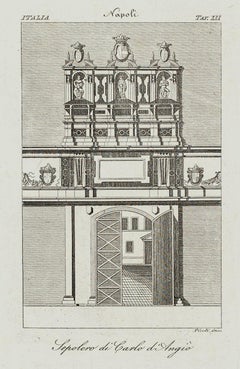
Sepulcher of Carlo di Angiò - Rome - Early 19th Century
Located in Roma, IT
Sepulcher of Carlo di Angiò is an original etching, realized by Piroli written below the image down in the XIX century, the table is XII is written at the top of the image on the rig...
Category
Early 19th Century Figurative Prints
Materials
Etching, Aquatint
$213
H 11.42 in W 8.67 in D 0.08 in
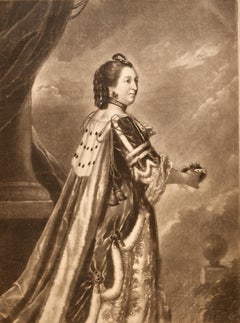
Elizabeth, Countess of Northumberland: Mezzotint After a Painting by J. Reynolds
By Joshua Reynolds
Located in Alamo, CA
This is an 18th century mezzotint portrait of Elizabeth, Countess of Northumberland, Baroness Percy by Richard Houston after a painting by Joshua Reynolds, published in London by Robert Sayer in 1763. It is a rare, full length portrait of Elizabeth, who was known as Lady Betty. Lady Betty stands, facing to the right, holding her coronet, and wearing her peeress’s ermine and velvet robes over a brocade dress. In the background are a column, a billowing drape, and the grounds of Alnwick Castle...
Category
Mid-18th Century Portrait Prints
Materials
Mezzotint
$2,575
H 17.5 in W 11.5 in
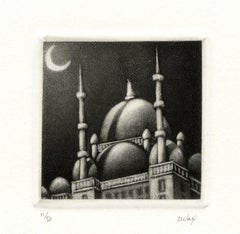
Architextures
By Carol Wax
Located in New Orleans, LA
Architextures is a suite of 8 mezzotints in an edition of 50 created in 1984:
Mosque and Mosque Interior (5.1 cm x 5.1 cm)
Dome and Dome Interior (5.7cm x 3.8 cm)
Castle and Castle ...
Category
1980s American Modern Interior Prints
Materials
Mezzotint
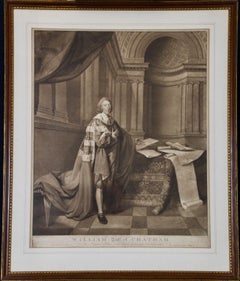
Portrait of William Pitt, Earl of Chatham: Rare Framed Mezzotint after Brompton
By Edward Fisher
Located in Alamo, CA
This is a large framed very rare hand-colored copperplate mezzotint engraved portrait of William Pitt, the Elder, 1st Earl of Chatham by Edward Fisher, published in London in 1779 after a painting by Richard Brompton. Pitt is depicted attired in a flowing regal appearing cape, standing in an ornate room with his left hand outstretched over a serious of manuscripts and scrolls that are laying on a table or desk to his left. The table is covered by a beautiful oriental carpet. The manuscripts include the Magna Carta, a map of the colonies, including Long Island and Staten Island, and papers entitled "A Plan for the Reconciliation between Great Britain and the Colonies", "A Motion Made in 1775 for the Recall of Troops from Boston", "A Provisional Act for Settling the Troubles in America Offered to the House of Lords in 1775", and "It is doing Nothing to repeal a few Scraps of Paper or Pieces of Parchment called Acts of Parliament. But our Business is to repeal the Ill-Will and the Animosity unfortunately now subsisting between Great Britain and North America". This engraving is held by the British Museum and the British Royal Collection Trust.
This large framed mezzotint engraving is presented in a brown wood frame with gold-colored beaded inner and outer trim, and a cream-colored French mat. The frame measures 31.63" high by 26.63" wide by 0.75" deep. There are three short tears along the right edge and mild creasing in the left upper, left lower and right lower corners. It is otherwise in very good condition.
William Pitt (1708-1778) was a member of the British parliament from 1735 to 1761 and prime minister from 1766 to 1768. Pitt was an advocate for the American colonies leading up to the War of Independence. He called for an amiable relationship between Great Britain and the colonies and opposed the Stamp Act and military action in America. He advocated for a withdrawal of English troops from Boston in 1775 and the settling of troubles in America, as two of his manuscripts on the table outline. Pitt's colleague, Lord Shelburne (later the Marquess of Lansdowne) shared his sympathies and after Pitt's death, signed a peace treaty with the United States in 1782.
The American city of Pittsburgh, Pennsylvania is named for William Pitt, the Elder. The name originated when the conflict between the British and French over territorial claims in the Northeast were settled in 1758. General John Forbes and his British army, supported by the American colonial troops, expelled the French from Fort Duquesne (which had been constructed by the French in 1754). Forbes re-named the site for William Pitt the Elder, who at the time was a British statesman. The earliest known reference to the new name, Pittsburgh, is in a letter sent from General John Forbes to Pitt, dated November 27, 1758. Pitt's son, William Pitt, the Younger, like his father, also served as British Prime Minister.
Edward Fisher (1730-1785) was born in Ireland in 1730. He was originally a hatter, but learned engraving in London. He became a member of the Incorporated Society of Artists in 1766, and exhibited there fourteen times between 1761 and 1776. He engraved more than sixty portraits. In addition to this portrait of William Pitt, Earl of Chatham, after Richard Brompton he engraved several portraits after Brompton, including George, Earl of Albemarle, as well as engraved portraits after paintings by Joshua Reynolds, including the Shakespearean actor David Garrick, Hugh, Earl of Northumberland, and Elizabeth, Countess of Northumberland and Laurence Sterne, and Hope Nursing Love, as well as Robert Brown, after Mason Chamberlin, Colley Cibber, after Jean-Baptiste van Loo, Christian VII of Denmark, after Nathaniel Dance, Simon, Earl Harcourt, after Hunter, Roger Long, after Benjamin Wilson...
Category
Late 18th Century Old Masters Portrait Prints
Materials
Mezzotint
$5,975
H 31.63 in W 26.63 in D 0.75 in