Earle D. Vandekar of Knightsbridge, Inc. More Dining and Entertaining
to
2
2
1
1
2
2
2
2
2
2
1
1
1
2
2
2
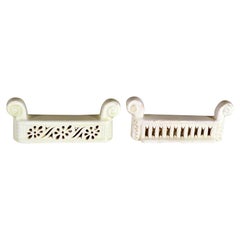
Early 19th Century Italian Creamware Knife Rests
Located in Downingtown, PA
Creamware knife rests,
Italian,
Circa 1810-1820
The two rests are of similar form with a raised scroll terminal to each end. One with pierced stylized f...
Category
Antique Early 19th Century Italian Georgian Pottery
Materials
Creamware, Pottery
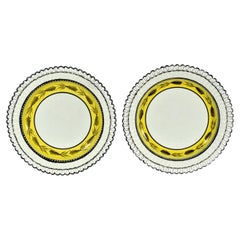
Liverpool Herculaneum Yellow-Banded Openwork Creamware Dessert Dishes
By Herculaneum Pottery
Located in Downingtown, PA
The Liverpool creamware openwork dishes were made at the Herculaneum factory. The charming dishes have an outer band of openwork attached to a bask...
Category
Antique Early 19th Century English Regency Pottery
Materials
Pottery, Creamware
Related Items
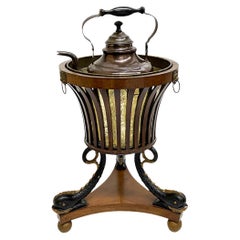
Early 19th Century Mahogany Tea Stove with 3 Dolphins
Located in Delft, NL
An early 19th century mahogany tea stove with 3 dolphins
An early 19th century Dutch mahogany tea stove with 3 dolphins on a triangle base with ball legs....
Category
Antique Early 19th Century Dutch Decorative Baskets
Materials
Copper

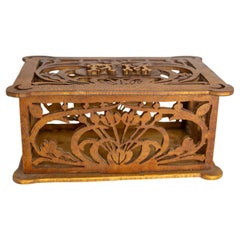
French Art Nouveau Wood Box Openwork Panels, circa 1900
Located in Labrit, Landes
Little wood box with openwork panels, made circa 1900 in the Art Nouveau period.
A little piece of wood is missing on the back side.
A. M. initial are on the top.
Good antique condit...
Category
Early 20th Century French Art Nouveau Decorative Boxes
Materials
Wood
Pair of 19th Century Meissen Porcelain Two-Tier Dessert Dishes with Gilt Bronze
Located in Tarzana, CA
A Pair of 19th Century Meissen Porcelain two-tier dessert dishes with Gilt Bronze
Dimensions: Height: 13", Width: 9"
Signed with 19th century Meissen double sword mark
Excel...
Category
Antique 19th Century Unknown Porcelain
Materials
Ormolu
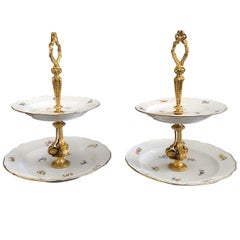
$3,000 / set
H 13 in W 9 in D 9 in
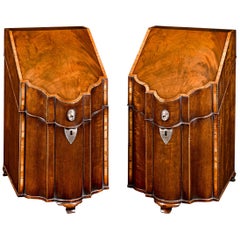
18th Century George III Mahogany Footed Knife Boxes
Located in New Orleans, LA
An exceedingly rare and important pair of George III-period mahogany knife boxes of exceptional quality and condition. The boxes are of serpentine form with refined crossbanded and c...
Category
Antique 18th Century English George III Knife Boxes
Materials
Serpentine
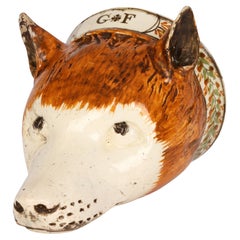
English Rare Creamware Pottery Initialled Fox Head Stirrup Cup
Located in Bishop
s Stortford, Hertfordshire
A charming and rare antique English creamware pottery fox head stirrup cup probably dating from around 1800. The lightly potted large cup is ...
Category
Antique 1790s English George III Pottery
Materials
Pottery
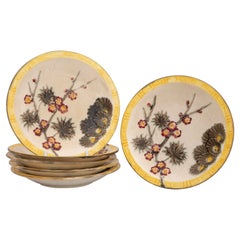
Six Wedgwood Majolica Argenta
Lincoln
Pattern Dessert Dishes
By Wedgwood
Located in Fort Lauderdale, FL
Six Wedgwood majolica Argenta palette ‘Lincoln' pattern dessert plates with finely molded maroon prunus blossoms and dark taupe pine branches surrounded by a yellow Greek key border. The dishes are decorated in the japonisme style and feature the “Three Friends of Winter” motif, an Asian artistic convention showing the pine, plum, and bamboo together to represent steadfastness, perseverance, and resilience.
The Wedgwood factory introduced muted Argenta glazes to its majolicas in the 1880s to keep up with ever-changing fashions. The Argenta glaze color palette was more subdued than that of traditionally vibrant majolica, and was thus more appealing to the Aesthetic Movement japonisme style that pervaded the market. These Argenta majolica dessert dishes...
Category
Antique Late 19th Century English Japonisme Pottery
Materials
Earthenware, Majolica
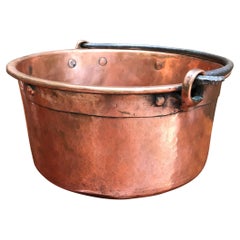
Early 19th Century French Hammered Copper Kettle
Located in Chicago, IL
An early 19th century French hammered copper kettle with wide riveted copper straps, a thick hand-forged iron handle, and scalloped dovetail joi...
Category
Antique Early 19th Century French Primitive Soup Tureens
Materials
Copper, Iron
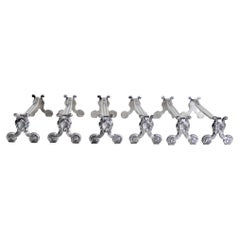
Christofle Silver Plated Antique Styled Knife Rests Set of Six
By Christofle
Located in Hamilton, Ontario
This set of six silver plated knife rests were made by Christofle of France in approximately 1960 in an antique style. The knife rests have nicely decorated serpentine side panels wi...
Category
Mid-20th Century French Louis XVI Sheffield and Silverplate
Materials
Metal
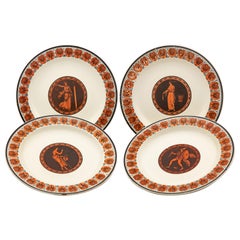
Early Wedgwood Neoclassical Creamware Dessert Dishes Made circa 1780
By Wedgwood
Located in Fort Lauderdale, FL
A set of four early Wedgwood creamware Neoclassical dessert dishes made circa 1780.
Sir William Hamilton’s Collection of Etruscan, Greek and Roman an...
Category
Antique Late 18th Century English Neoclassical Ceramics
Materials
Creamware
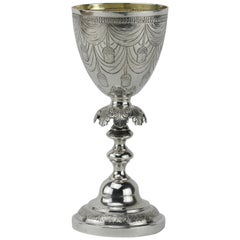
Early 19th Century Polish Silver Kiddus Goblet
Located in New York, NY
Handmade silver Kiddush goblet, Poland, circa 1820.
Large upper portion engraved with curtain decoration, set on a knobbed stem with skirt decoration on a round stylized base. Clearl...
Category
Antique Early 19th Century Polish Religious Items
Materials
Silver
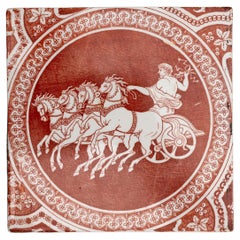
Early 19th Century Spode Red Greek Pattern Tile
By Spode, Josiah Spode
Located in Fort Lauderdale, FL
A Neoclassical red transferware tile made by Spode 1806-1810, with the ‘Zeus in His Chariot’ pattern.
Sir William Hamilton’s Collection of Etruscan, Greek and Roman antiquities, first published in 1766 by Pierre d’Hancarville, was a landmark publication in English design. It intended to disseminate the Antique style through its engravings of Attic pottery. The catalog’s faithful reproductions of Classical vases led British potteries, including Spode, to adapt or even copy the ancient art for modern life. These Spode Greek pattern tiles reflect the major influence of Hamilton’s catalog on English Neoclassicism. The central scene was taken directly from the catalog.
This tile can be dated to a narrow window of production in the Spode factory, 1806-1810. During that time, Spode used a technique known as the “Pluck and Dust” method to print in red transfer designs onto creamware. Using this method, source prints were transferred overglaze using tissue imprinted with a very faint rendition of the design outlined in sticky oil. The decorator applied the tissue to the object then carefully “plucked” or pulled it away, leaving the sticky oil design behind. Then, a finely-ground enamel color was “dusted” onto the surface, sticking to any areas that had the oil. A final firing at a low temperature in the enamel kiln made the pattern permanent. The Pluck and Dust technique improved upon bat-printing and enabled larger designers to be transferred. It was short-lived, however, as under-glaze transfer printing soon took over as the preferred method for producing transferwares.
Dimensions: 5 in. x 5 in. x 1/4 in.
Condition: Excellent.
Provenance:
The Collection of Nancy and Andrew Ramage
Jonathan Horne...
Category
Antique Early 19th Century English Neoclassical Pottery
Materials
Earthenware, Creamware
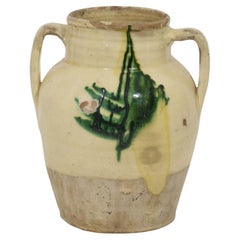
19th Century, Italian Yellow/ Green Glazed Earthenware Jug/Jar
Located in Buisson, FR
Great authentic piece of pottery from Italy. Unique and rare glaze. Beautiful weathered. Chips and imperfections help authenticate this jug/ jar as it was a utilitarian type piece,
I...
Category
Antique 19th Century Italian Rustic Pottery
Materials
Earthenware
$390 Sale Price
53% Off
H 8.67 in W 7.49 in D 7.49 in