Ernest Johnson Antiques Lacquer
to
4
2
2
2
1
4
1
1
4
3
3
1
1
4
4
4
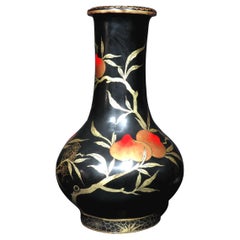
A Monumental 19th C. Ryukyu Hariko (Papier Mâché) Vase, Meiji Period (1868-1912)
Located in Ottawa, Ontario
A stunningly attractive & exceptionally large baluster shaped ‘Ryukyu Hariko’ (papier mâché) vase, masterfully decorated overall with hand painted images of a fruiting peach tree ren...
Category
Antique Early 1900s Japanese Meiji Lacquer
Materials
Lacquer, Paper
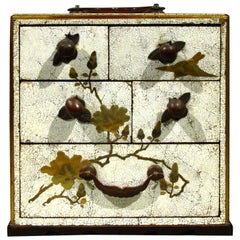
Signed Japanese White Lacquer and Maki-E Lacquer Tansu, Meiji Period
Located in Ottawa, Ontario
The case decorated overall in crackle-glaze white lacquer and fitted with a patinated metal carrying handle over three tiers of small drawers. The first two tiers are comprised of a ...
Category
Antique Late 19th Century Japanese Meiji Lacquer
Materials
Lacquer
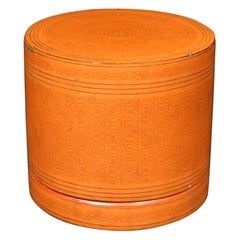
Highly Decorative Antique Burmese Lacquered Betel Box / Kun-It, Circa 1900
Located in Ottawa, Ontario
The vermillion lacquered cylindrical body decorated overall with repeating bands of curvilinear geometric motifs, the cover lifting to reveal both of its original trays intended to h...
Category
Early 20th Century Burmese Lacquer
Materials
Lacquer, Bamboo
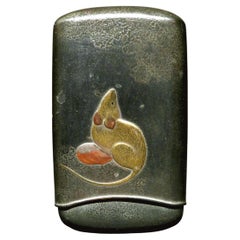
A Very Fine Takamaki-e Lacquer Cheroot Case in the Manner of Shibata Zeshin
By Shibata Zeshin
Located in Ottawa, Ontario
The 'ishime' lacquered case consisting of two conforming molded sections with one sliding overtop the other, both sides decorated with hand painted gilt, silver & burnt dark russet (kasshoku) lacquers, depicting motifs in low relief of a rat with an acorn on one side and two acorns on the opposing.
In Japanese culture rats are considered auspicious symbols of fertility & wealth, acorns symbolize prosperity & growth. Signed with characters and a mon on one edge.
Takamaki-e is a lacquer technique in which metallic powders such as silver, gold, copper, pewter etc., are used in combination with lacquer & clay-dust to build up motifs in low relief.
Please note that the color tones & hues of the lacquered motifs appear somewhat more vibrant in the images due to ambient lighting conditions.
Regarding the opinion stating the superior quality of this fine example being likened to works associated with those by Shibata...
Category
Antique 1870s Japanese Meiji Lacquer
Materials
Lacquer
Related Items
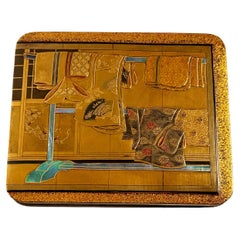
Japanese Tagasode (Whose Sleeves?) Lacquer Incense Box, Kobako, Meiji Period
Located in Austin, TX
A fine and unusual Japanese lacquer box for incense accessories, kobako, featuring a tagasode (whose sleeves?) design, Meiji Period, circa 1900, Japan.
The exquisite box of simple rectangular shape worked in maki-e lacquer, taka-maki-e, and raden, all against a lush ground of gold nashiji. Fitted with silver rims.
The main decorative element of the box depicts a six panel folding screen, byobu, showing an interior scene with kimono strewn over a rack, a motif known as tagasode (whose sleeves), all in raised taka-maki-e lacquer and inlaid raden.
The screen depicts an intimate room with tatami mats on the floor and sliding shoji doors in the background. The foreground depicts a large clothing...
Category
Antique Early 1900s Japanese Meiji Lacquer
Materials
Silver

$7,500
H 1 in W 4 in D 3.25 in
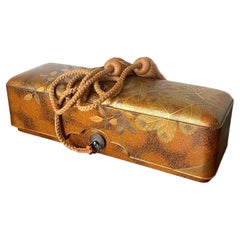
Japanese Lacquer Maki-E Scroll Box Fubako by Kansonsai Edo Period
Located in Atlanta, GA
A Japanese lacquered wood fubako (a box to store document or small scroll painting) circa late 18th century of Edo period. The rectangular box features a deep lid with rounded corners and recessed mid-edge and a lower box with two bronze medallion rings and tasseled silk ties. The surface of the fubako was elaborately decorated with hiramaki-e and a low takamaki-e on a mottled Mura-nashiji background. The motifs on the lid depict branches of Japanese pine with finely rendered needles on the lower part; on the upper part, it showcases fruited persimmon branches. Two different shades of gold fundame were used to contrast the design and augmented by scattered gold kirigane to highlight some of the leaves. The design continues and cascades down to all sides of the lid as well as the walls of the box. The two bronze medallions appear original to the box and the silk ties show significant fading from the age. This Fine fubako is signed on the lower wall "Kanshosai" in Kanji with a kao mark. All the trims were finished in gold fundame and the interiors a dense nashiji in gold.
Kanshosai is the mark of the distinguished lacquer artist Lizuka Toyo I who also signed his work "Toyosai". He was active in the second half of the 18th century during Edo period, employed by Hachisuka Shigeyoshi (1738-1801), daimyo of Awa on Shikoku Island. Although most survived work bearing his marks are inros, he was also known to decorated trays and other larger objects...
Category
Antique Late 18th Century Japanese Edo Lacquer
Materials
Wood, Lacquer
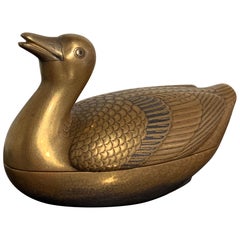
Small Japanese Lacquer Duck Incense Box, Kogo, Meiji Period, Late 19th Century
Located in Austin, TX
An exquisite Japanese Meiji Period small lacquer incense box, kogo, in the form of a duck or goose, late 19th century, Japan.
The delicate lacquer box, known as a kogo in Japanese, ...
Category
Antique Late 19th Century Japanese Meiji Lacquer
Materials
Lacquer
$2,900
H 1.5 in W 2.88 in D 1 in
Japanese Meiji Period (1868-1912) Satsuma Earthenware Vase Taizan for Hattori
Located in Newark, England
Meiji Period (1868-1912)
From our Japanese collection, we are delighted to offer Japanese Meiji Period Satsuma Vases. The Satsuma Vase of hexagonal form with a slight waisted neck and tight rounded rim is extensively decorated with multiple figures to two large scenes. The first scene features a beach with waves to the background and a plethora of figures including multiple geisha holding traditional Japanese wagasa’s. The second scene follows on from the first with a large building in the foreground holding figures on a large platform under a pagoda roof with a pagoda building in the background and further figures in the foreground. The scenes are framed by a full detailed border with gilt shapes, flowers amongst pink shaded backgrounds and butterflies around the neck. The Satsuma Vase is unusually signed Fine Art, Satsuma Ware, Dai Nippon (Great Japan), Hattori Made, Gosuido Works, Taizan Painted. 美術, サツマヤキ(薩摩焼), 大日本, 服部造, 五スイ堂工, 對山画 and dates to the Meiji Period (1868-1912) and the turn of the 20th century circa 1905.
Satsuma ware is a type of earthenware pottery originating from the Satsuma province in Southern Kyushu, Japan’s third largest island.
Wagasa are traditional Japanese umbrellas made of washi paper attached to a bamboo frame and treated to ensure it is waterproof.
Meiji Period was an era of Japanese history that spanned from 1868 to 1912. It was the first half of the Empire of Japan, when the Japanese people began to build a paradigm of a modern, industrialised nation state and emergent great power, influenced by Western countries and aesthetics. As a result of radically different ideas, the changes to Japan were profound and it affected the social structure, politics, economy, military, and foreign relations across the board. The period corresponded to the reign of Emperor Meiji and was preceded by the Keio era and was succeeded by the Taisho era.
Cultural Art during the Meiji Period was of particular interest to the government and they overhauled the art export market which in turn promoted Japanese arts via various world’s fairs, beginning in Vienna at the world fair in 1873. The government heavily funded the fairs and took an active role organising how Japan’s culture was presented to the world including creating a semi-public company named Kiritsu Kosho Kaisha (First Industrial Manufacturing Company). The Kiritsu Kosho Kaisha was used to promote and commercialise exports of Japanese art and established the Hakurankai Jimukyoku (Exhibition Bureau) to maintain quality standards. For the 1876 Centennial International Exhibition in Philadelphia, the Japanese government created a Centennial Office and sent a special envoy to secure space for the 30,000 items that would be displayed. The Imperial Household also took an active interest in arts and crafts, commissioning works by select artists to be given as gifts for foreign dignitaries further emphasising the high quality and importance of Japanese art. Just before the end of the 19th century in 1890, the Teishitsu Gigeiin (Artist to the Imperial Household) system was created to recognise distinguished artists. These artists were selected for their exceptionally high quality wares and talent in their own industry. Over a period of 54 years Seventy artists were appointed, amongst these were ceramicist Makuzu Kozan and cloisonné enamel artist...
Category
Antique Early 1900s Japanese Meiji Ceramics
Materials
Earthenware, Pottery

$3,164
H 4.63 in W 2.17 in D 2.37 in
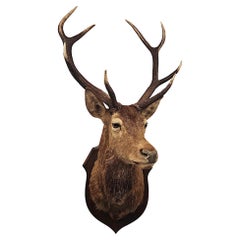
A Very Fine Taxidermy Stags Head
Located in Dublin, IE
A very fine and beautifully detailed taxidermy stags head mounted on a well figured oak shield plaque.
Category
20th Century English Taxidermy
Materials
Oak
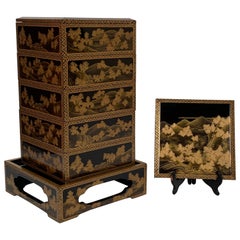
Japanese Maki-e Lacquer Stacking Box, Jubako, Meiji Period, Japan
Located in Austin, TX
A fine and impressive Japanese gold maki-e decorated black lacquer five-tier jubako with presentation tray, two lids, and the original tomobako storage box, Meiji period, late 19th c...
Category
Antique Late 19th Century Japanese Meiji Lacquer
Materials
Lacquer
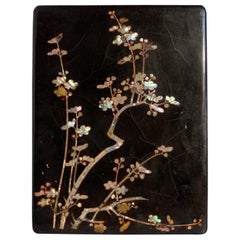
Japanese Momoyama Period Black Lacquer and Mother of Pearl Box, 16th Century
Located in Austin, TX
A fine and unusual Japanese black lacquer and mother of pearl inlaid box, Momoyama Period, 16th century, Japan.
The large box and cover featu...
Category
Antique 16th Century Japanese Edo Lacquer
Materials
Lacquer, Abalone
$9,800
H 4 in W 11 in D 15 in
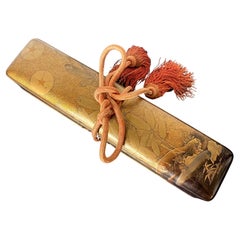
Japanese Lacquered Gold Maki-E Naga Fubako Meiji Period
Located in Atlanta, GA
A Japanese lacquered wood Naga Fubako (a long box used to store document or large scroll painting), circa 19th century Meiji period. The rectangular box features an unusually deep lipped lid with slightly rounded corners, a conforming lower box with bronze medallion rings with tasseled...
Category
Antique 19th Century Japanese Meiji Lacquer
Materials
Wood, Lacquer
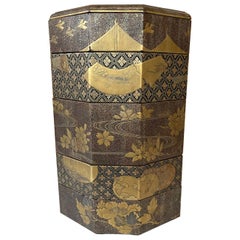
Japanese Maki-e Lacquer Stack Box Jubako
Located in Atlanta, GA
An antique jubako (stack boxes) with five tiers in an elongated octagon shape circa 19th century (end of Edo or beginning of Meiji period). jubako was traditionally used to store and...
Category
Antique 19th Century Japanese Japonisme Lacquer
Materials
Wood, Lacquer
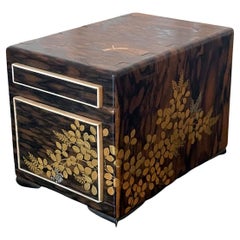
Fine Miniature Japanese Kodansu with Lacquer Inlays
Located in Atlanta, GA
A fine Japanese miniature kodansu constructed from Kaki wood (Persimmon) circa 19th century, late Meiji period. With its expressive exotic wood grains and exposed tenon construction,...
Category
Antique Late 19th Century Japanese Meiji Lacquer
Materials
Wood
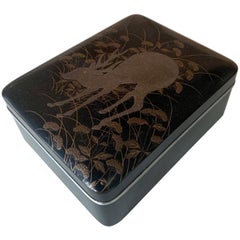
Japanese Rinpa Style Lacquer Box Meiji Period
Located in Atlanta, GA
A black lacquer tebako (hand box) with maki-e decoration and silver trim, circa late 19th century, Meiji period. The surface of the lid features a Rinpa style maki-e paint depicting ...
Category
Antique 1890s Japanese Japonisme Lacquer
Materials
Wood, Lacquer
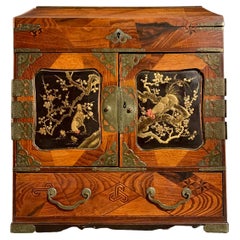
Japanese Marquetry and Lacquer Jewelry Chest, Meiji Period, circa 1900, Japan
Located in Austin, TX
A very attractive Japanese wood table top jewelry or collector's chest with marquetry and lacquer decoration, Meiji period, circa 1900, Japan. Previously in the collection of Asbjorn Lunde (1927 - 2017).
The chest is crafted in the form of a Chinese seal...
Category
Antique Early 1900s Japanese Meiji Lacquer
Materials
Wood, Softwood, Lacquer
$3,400
H 15.75 in W 14.25 in D 7 in