Farrago Design Inc Paintings
to
1
11
6
5
Height
to
Width
to
5
6
3
2
1
1
1
8
8
4
2
1
1
1
11
11
11
1
1
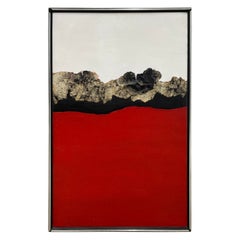
Mixed Media Painting by Steven Colucci
By Jackson Pollock
Located in New York City, NY
Steven Colucci’s iconoclastic approach to performance and the visual arts
have not only long blurred the boundaries between these disciplines, but have
challenged its most basic assumptions. The title of this show references a
most rudimentary dance move --the plié --and our assumptions of what to
expect in relation to this. Also the suggestion that we can simply press a
button and a preconceived outcome will be courteously delivered --a form of
prefabricated belief in itself. Steven Colucci’s artwork turns such basic
assumptions on their heads. Finding early inspiration in the New York school
of abstract expressionists such as Jackson Pollock with his action painting,
and then further by his professor --a then young Vito Acconci while studying
at the School of Visual Arts, Steven Colucci went from exploring the raw
existentialist experimentation of New York’s early painting and performance
scenes, to investigating the other end of the spectrum --the rigorously
measured and controlled disciplines of pantomime and ballet; studying in
Paris under the tutelage of world-famous Marcelle Marceau, and engaging
with the concepts of dramatic movement pioneer and intellectual Etienne
Decroux. Colucci has explained the difference between the extremes of
pantomime and dance as being that pantomime forces movement via an
internal capacity --movement directed inward to the core of one’s self --a
source requiring extreme mental and physical control. Dance by contrast is
an external expression; likewise requiring great precision, although instead
an extension of self or sentiment that projects outwardly. While such
historical ‘movement’ disciplines serve as foundation blocks for Steven’s
artistic explorations, it is the realm in between that he is best known for his
contributions --an experimental movement and performance art that
simultaneously honors, yet defiantly refutes tradition; rejecting a
compartmentalization regarding art and movement, yet incorporating its
elements into his own brand of experimental pastiche. Colucci’s performance
works manifest as eerily candy-coated and familiar, yet incorporate
unexpected jags of the uncanny throughout, exploiting a sort of coulrophobia
in the viewer; an exploration of a cumulative artifice that binds human
nature against its darker tendencies; highlighting traditions of artifice itself -
the fabricated systemologies that necessitate compartmentalization in the
first place.
It is evident in Steven Colucci’s paintings that he has established a uniquely
distinctive pictorial vocabulary; a strong allusion to --or moreso an extension
of --his performance works. Colucci’s paintings depict a sort of kinetic
spectrum, or as he refers to them “a technical expression of physicality and
movement”. Whereas the French performance and visual artist Yves Klein
used the human body as a “paint brush” to demarcate his paintings and
thereby signify a residue of performance, Colucci’s utilization of nonsensical
numbers and number sequences taken from dance scores, as well as heat-
induced image abstraction depicting traces of movement likewise inform his
vocabulary. In the strand of the choreographed, yet incorporating moments of
chance, Colucci’s paintings represent an over arching structure; a rhythm of
being and state, yet detail erratic moments --moments that denote a certain
frailty --the edge of human stamina. Colucci’s paintings dually represent a
form of gestural abstraction --and also the reverse of this --a unique
anthropomorphization of varying states of movement – that sometimes
present as a temperature induced color field, at others are juxtapositions of
movement and depictions of physical gestural images themselves. Colucci’s
use of vernacular and found materials such as cardboard evoke his mastery of
set design, and also reference a sort of collective experience of urbanity and
the ephemeral. Such contradictions seem to permeate not only Steven
Colucci’s artwork, but also are reflected in his person – one who grew up in
New York’s Bronx during a zeitgeist moment in visual and performing arts in
the 1960s – one who shifts with ease from happenings and experiments in
New York City, to his meticulously choreographed megaproductions at
Lincoln Center or starring in the Paris ballet...
Category
2010s Paintings
Materials
Acrylic
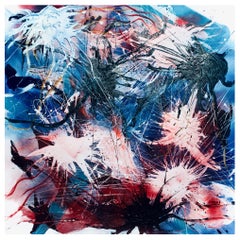
Mixed Media Painting by Steven Colucci
By John Byard
Located in New York City, NY
Steven Colucci’s iconoclastic approach to performance and the visual arts
have not only long blurred the boundaries between these disciplines, but have
challenged its most basic assumptions. The title of this show references a
most rudimentary dance move --the plié --and our assumptions of what to
expect in relation to this. Also the suggestion that we can simply press a
button and a preconceived outcome will be courteously delivered --a form of
prefabricated belief in itself. Steven Colucci’s artwork turns such basic
assumptions on their heads. Finding early inspiration in the New York school
of abstract expressionists such as Jackson Pollock with his action painting,
and then further by his professor --a then young Vito Acconci while studying
at the School of Visual Arts, Steven Colucci went from exploring the raw
existentialist experimentation of New York’s early painting and performance
scenes, to investigating the other end of the spectrum --the rigorously
measured and controlled disciplines of pantomime and ballet; studying in
Paris under the tutelage of world-famous Marcelle Marceau, and engaging
with the concepts of dramatic movement pioneer and intellectual Etienne
Decroux. Colucci has explained the difference between the extremes of
pantomime and dance as being that pantomime forces movement via an
internal capacity --movement directed inward to the core of one’s self --a
source requiring extreme mental and physical control. Dance by contrast is
an external expression; likewise requiring great precision, although instead
an extension of self or sentiment that projects outwardly. While such
historical ‘movement’ disciplines serve as foundation blocks for Steven’s
artistic explorations, it is the realm in between that he is best known for his
contributions --an experimental movement and performance art that
simultaneously honors, yet defiantly refutes tradition; rejecting a
compartmentalization regarding art and movement, yet incorporating its
elements into his own brand of experimental pastiche. Colucci’s performance
works manifest as eerily candy-coated and familiar, yet incorporate
unexpected jags of the uncanny throughout, exploiting a sort of coulrophobia
in the viewer; an exploration of a cumulative artifice that binds human
nature against its darker tendencies; highlighting traditions of artifice itself -
the fabricated systemologies that necessitate compartmentalization in the
first place.
It is evident in Steven Colucci’s paintings that he has established a uniquely
distinctive pictorial vocabulary; a strong allusion to --or moreso an extension
of --his performance works. Colucci’s paintings depict a sort of kinetic
spectrum, or as he refers to them “a technical expression of physicality and
movement”. Whereas the French performance and visual artist Yves Klein
used the human body as a “paint brush” to demarcate his paintings and
thereby signify a residue of performance, Colucci’s utilization of nonsensical
numbers and number sequences taken from dance scores, as well as heat-
induced image abstraction depicting traces of movement likewise inform his
vocabulary. In the strand of the choreographed, yet incorporating moments of
chance, Colucci’s paintings represent an over arching structure; a rhythm of
being and state, yet detail erratic moments --moments that denote a certain
frailty --the edge of human stamina. Colucci’s paintings dually represent a
form of gestural abstraction --and also the reverse of this --a unique
anthropomorphization of varying states of movement – that sometimes
present as a temperature induced color field, at others are juxtapositions of
movement and depictions of physical gestural images themselves. Colucci’s
use of vernacular and found materials such as cardboard evoke his mastery of
set design, and also reference a sort of collective experience of urbanity and
the ephemeral. Such contradictions seem to permeate not only Steven
Colucci’s artwork, but also are reflected in his person – one who grew up in
New York’s Bronx during a zeitgeist moment in visual and performing arts in
the 1960s – one who shifts with ease from happenings and experiments in
New York City, to his meticulously choreographed megaproductions at
Lincoln Center or starring in the Paris ballet...
Category
2010s Paintings
Materials
Acrylic
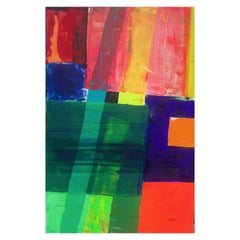
Mixed Media Painting by Steven Colucci- My eyes on you
By Andrzej Galek
Located in New York City, NY
Steven Colucci’s iconoclastic approach to performance and the visual arts
have not only long blurred the boundaries between these disciplines, but have
challenged its most basic assumptions. The title of this show references a
most rudimentary dance move --the plié --and our assumptions of what to
expect in relation to this. Also the suggestion that we can simply press a
button and a preconceived outcome will be courteously delivered --a form of
prefabricated belief in itself. Steven Colucci’s artwork turns such basic
assumptions on their heads. Finding early inspiration in the New York school
of abstract expressionists such as Jackson Pollock with his action painting,
and then further by his professor --a then young Vito Acconci while studying
at the School of Visual Arts, Steven Colucci went from exploring the raw
existentialist experimentation of New York’s early painting and performance
scenes, to investigating the other end of the spectrum --the rigorously
measured and controlled disciplines of pantomime and ballet; studying in
Paris under the tutelage of world-famous Marcelle Marceau, and engaging
with the concepts of dramatic movement pioneer and intellectual Etienne
Decroux. Colucci has explained the difference between the extremes of
pantomime and dance as being that pantomime forces movement via an
internal capacity --movement directed inward to the core of one’s self --a
source requiring extreme mental and physical control. Dance by contrast is
an external expression; likewise requiring great precision, although instead
an extension of self or sentiment that projects outwardly. While such
historical ‘movement’ disciplines serve as foundation blocks for Steven’s
artistic explorations, it is the realm in between that he is best known for his
contributions --an experimental movement and performance art that
simultaneously honors, yet defiantly refutes tradition; rejecting a
compartmentalization regarding art and movement, yet incorporating its
elements into his own brand of experimental pastiche. Colucci’s performance
works manifest as eerily candy-coated and familiar, yet incorporate
unexpected jags of the uncanny throughout, exploiting a sort of coulrophobia
in the viewer; an exploration of a cumulative artifice that binds human
nature against its darker tendencies; highlighting traditions of artifice itself -
the fabricated systemologies that necessitate compartmentalization in the
first place.
It is evident in Steven Colucci’s paintings that he has established a uniquely
distinctive pictorial vocabulary; a strong allusion to --or moreso an extension
of --his performance works. Colucci’s paintings depict a sort of kinetic
spectrum, or as he refers to them “a technical expression of physicality and
movement”. Whereas the French performance and visual artist Yves Klein
used the human body as a “paint brush” to demarcate his paintings and
thereby signify a residue of performance, Colucci’s utilization of nonsensical
numbers and number sequences taken from dance scores, as well as heat-
induced image abstraction depicting traces of movement likewise inform his
vocabulary. In the strand of the choreographed, yet incorporating moments of
chance, Colucci’s paintings represent an over arching structure; a rhythm of
being and state, yet detail erratic moments --moments that denote a certain
frailty --the edge of human stamina. Colucci’s paintings dually represent a
form of gestural abstraction --and also the reverse of this --a unique
anthropomorphization of varying states of movement – that sometimes
present as a temperature induced color field, at others are juxtapositions of
movement and depictions of physical gestural images themselves. Colucci’s
use of vernacular and found materials such as cardboard evoke his mastery of
set design, and also reference a sort of collective experience of urbanity and
the ephemeral. Such contradictions seem to permeate not only Steven
Colucci’s artwork, but also are reflected in his person – one who grew up in
New York’s Bronx during a zeitgeist moment in visual and performing arts in
the 1960s – one who shifts with ease from happenings and experiments in
New York City, to his meticulously choreographed megaproductions at
Lincoln Center or starring in the Paris ballet...
Category
2010s Paintings
Materials
Acrylic
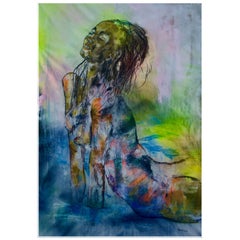
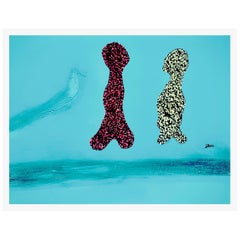
Mixed Media Painting by Steven Colucci- Two Men
By Jeff Koons
Located in New York City, NY
Steven Colucci’s iconoclastic approach to performance and the visual arts
have not only long blurred the boundaries between these disciplines, but have
challenged its most basic assumptions. The title of this show references a
most rudimentary dance move --the plié --and our assumptions of what to
expect in relation to this. Also the suggestion that we can simply press a
button and a preconceived outcome will be courteously delivered --a form of
prefabricated belief in itself. Steven Colucci’s artwork turns such basic
assumptions on their heads. Finding early inspiration in the New York school
of abstract expressionists such as Jackson Pollock with his action painting,
and then further by his professor --a then young Vito Acconci while studying
at the School of Visual Arts, Steven Colucci went from exploring the raw
existentialist experimentation of New York’s early painting and performance
scenes, to investigating the other end of the spectrum --the rigorously
measured and controlled disciplines of pantomime and ballet; studying in
Paris under the tutelage of world-famous Marcelle Marceau, and engaging
with the concepts of dramatic movement pioneer and intellectual Etienne
Decroux. Colucci has explained the difference between the extremes of
pantomime and dance as being that pantomime forces movement via an
internal capacity --movement directed inward to the core of one’s self --a
source requiring extreme mental and physical control. Dance by contrast is
an external expression; likewise requiring great precision, although instead
an extension of self or sentiment that projects outwardly. While such
historical ‘movement’ disciplines serve as foundation blocks for Steven’s
artistic explorations, it is the realm in between that he is best known for his
contributions --an experimental movement and performance art that
simultaneously honors, yet defiantly refutes tradition; rejecting a
compartmentalization regarding art and movement, yet incorporating its
elements into his own brand of experimental pastiche. Colucci’s performance
works manifest as eerily candy-coated and familiar, yet incorporate
unexpected jags of the uncanny throughout, exploiting a sort of coulrophobia
in the viewer; an exploration of a cumulative artifice that binds human
nature against its darker tendencies; highlighting traditions of artifice itself -
the fabricated systemologies that necessitate compartmentalization in the
first place.
It is evident in Steven Colucci’s paintings that he has established a uniquely
distinctive pictorial vocabulary; a strong allusion to --or moreso an extension
of --his performance works. Colucci’s paintings depict a sort of kinetic
spectrum, or as he refers to them “a technical expression of physicality and
movement”. Whereas the French performance and visual artist Yves Klein
used the human body as a “paint brush” to demarcate his paintings and
thereby signify a residue of performance, Colucci’s utilization of nonsensical
numbers and number sequences taken from dance scores, as well as heat-
induced image abstraction depicting traces of movement likewise inform his
vocabulary. In the strand of the choreographed, yet incorporating moments of
chance, Colucci’s paintings represent an over arching structure; a rhythm of
being and state, yet detail erratic moments --moments that denote a certain
frailty --the edge of human stamina. Colucci’s paintings dually represent a
form of gestural abstraction --and also the reverse of this --a unique
anthropomorphization of varying states of movement – that sometimes
present as a temperature induced color field, at others are juxtapositions of
movement and depictions of physical gestural images themselves. Colucci’s
use of vernacular and found materials such as cardboard evoke his mastery of
set design, and also reference a sort of collective experience of urbanity and
the ephemeral. Such contradictions seem to permeate not only Steven
Colucci’s artwork, but also are reflected in his person – one who grew up in
New York’s Bronx during a zeitgeist moment in visual and performing arts in
the 1960s – one who shifts with ease from happenings and experiments in
New York City, to his meticulously choreographed megaproductions at
Lincoln Center or starring in the Paris ballet...
Category
2010s Paintings
Materials
Acrylic
"La Salute" Cityscape by Lazzaro Donati - Oil on Board
By Lazzaro Donati
Located in New York City, NY
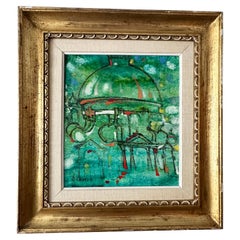
"La Salute" is a striking oil painting by renowned Italian artist Lazzaro Donati, depicting the iconic Santa Maria della Salute church in Venice. Known for his vivid, expressionistic...
Category
Vintage 1960s Italian Paintings
Materials
Paint
Signed color aquatint, etching, carborundum, and collage by James Coignard
Located in New York City, NY
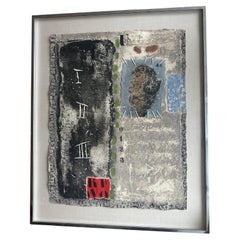
This dynamic mixed-media by James Coignard, exemplifies the artist’s innovative approach to abstraction. A perfect fusion of color aquatint, etching, carborundum, and collage, the pi...
Category
Vintage 1970s Paintings
Materials
Thread, Paper
Joyce Roybal – "Trumpet Players" – Original Oil Painting with Ornate Frame
By Graciela Rodo Boulanger
Located in New York City, NY
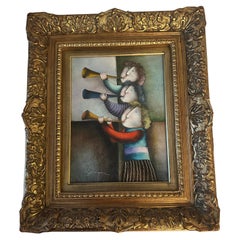
This whimsical and vibrant painting by Joyce Roybal captures her signature style of joyful, childlike wonder. Featuring three stylized figures playing trumpets, the composition is ri...
Category
Mid-20th Century Paintings
Materials
Acrylic, Plywood, Paint
O/C Mid-Century Abstract Figurative Painting, Signed and Dated
By Wifredo Lam
Located in New York City, NY
This striking mid-century abstract painting depicts a seated dancer rendered in a sophisticated cubist-inspired style reminiscent of Pei Yang's work, though attribution remains uncon...
Category
Mid-20th Century Paintings
Materials
Paint

My eyes on you -Mixed Media Painting by Steven Colucci
By Jackson Pollock
Located in New York City, NY
Steven Colucci is a perfectionist. As a painter, he describes himself as “a dictator, a controlling ballet master with a stick,” dispassionately choreographing his composition to achieve the exact result he desires. The paintings of the “Sea Series,” largely completed in 2010, are actually the culmination of 4-5 years of practice for the artist, during which he consistently developed and refined the language and formal elements that visually distinguish the series, sometimes repeating the same image for months until he was satisfied.
Colucci’s methods and philosophy reflect his experience with movement as a performing art. While he studied with and admires Vito Acconci, Colucci is no proponent of conceptualism, finding his voice in the intense discipline of traditional forms, explaining, “If you don’t practice art like a classical pianist, every day, you can’t execute your concepts.” After completing his studies at New York’s School of Visual Arts, he moved to Paris, where he studied and performed mime and ballet, working closely with Marcel Marceau, who also painted, and Etienne Decroux, a sculptor as well as the originator of the form “classical mime,” which has roots in the sculpture of Rodin.
If the word “sea” in the title of a painting conjures for you images of little easels and landscape canvases featuring sandy beaches, waves, and vast horizons, think again – Colucci’s oceanic visions are experiential, viewing them you are often looking down at the sea, within it, or even dreaming of the ocean. Water, deep or shallow, still or fast-moving, rules how we see light and subjects, as the artist works to reflect what he calls “the spirit, the soul of the water.” In “Deep Blue,” he conjures this anima via a window through levels of roiling currents of rich dark waves and dancing highlights, inviting the viewer to experience the sea as a vibrant and enveloping sensual entity.
Colors, too, differ from the subdued palette of the seaside afternoon painter. Often his choices originate in what Colucci describes as the rhythm of color present in Afro-Carribean art and design. In the paintings, these hues express the water’s likeness to the seamless flow of the Dominican culture’s music and dance, which he so enjoys during frequent visits to Upper Manhattan’s El Barrio district, a movement with the melodic line that he so simply and perfectly employs in the delightfully sexy “Swimming with the Fish.”
As our bodies, like the sea, are largely water, Colucci’s water visions...
Category
2010s Paintings
Materials
Acrylic
Large Modern Abstract Art Painting Signed Original Mark Dickson
By (after) Mark Rothko
Located in New York City, NY
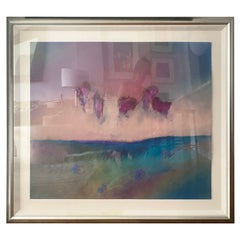
This is an Original Mark Dickson painting and can be described as nothing short of a revelation in the realm of contemporary art. As one navigates through his vibrant interplay of colors—pinks, purples, blues, and greens—it becomes evident that his works are a bridge between abstract expression and a deep-seated Coloradan sensibility.
From afar, the paintings resonate with the raw energy and abstract impulsiveness reminiscent of Adolph Gottlieb or Mark Rothko. However, upon closer introspection, Dickson's canvas unfolds a symphony, harmoniously blending his intuitive understanding of the Colorado landscapes with an almost Rothkoesque play of color and form.
His artistry is a culmination of his academic sojourns, from the bustling art scene of Brooklyn's Pratt Institute to the scholarly corridors of the University of Denver. Yet, what stands out is his capability to transcend these teachings and manifest a unique narrative—one that reflects both the external world and the myriad landscapes of the human psyche.
The choice of medium, notably pastel mixed with watercolors, oil washes, and graphite pencil, demonstrates a tactile indulgence in his craft. It's as if he's chiseling his memories, experiences, and observations of the Coloradan terrains and skies into each canvas.
For the discerning eye, his works might also evoke the expansive color fields of Milton Avery. Yet, Dickson’s approach, particularly his relationship with color, is refreshingly instinctual, almost challenging the viewer to feel rather than dissect.
In Mark Dickson's work, we're treated to an exhilarating dance of abstract brilliance juxtaposed with the tangible and intangible memories of Colorado's landscapes. In a sense, each painting becomes an invitation—to wander, to wonder, and to immerse in the art of profound introspection.
The majority medium is pastel and a mixed media of watercolors, oil washes, and graphite pencil. Color is of primary importance to his work. His work shows the influence of artists Milton Avery(who used large areas of color) and Mark Rothko and Adolph Gottlieb (known for their work in the variations of color). Mark is fascinated with color and explores every aspect of its relationships. He feels his use of color is more intuitive versus analytical.
Mark Dickson’s paintings, prints and monotypes are represented in private, corporate and public art collections nationally.
Pratt Institute, Graduate School of Fine Arts, Brooklyn, New York, 1970
University of Denver, Graduate School of Art, MFA, Denver, Brooklyn, New York, 1973
Denver Art Museum, Colorado Annual, 1967
National Academy of Design, National Audubon Exhibition, New York
Joslin Art Museum Exhibition of Colorado artists, Omaha, Nebraska
Included in Outstanding and Noteworthy Americans, Bicentennial Edition, New York
Chicago Botanical Garden, solo exhibition, North Brook Illinois
Colorado Symphony Orchestra Association, limited-edition lithograph commission
Broadway South West department store Commission; shopping bag and print.
Award of Merit from American Institute of graphic arts, and Award of Distinction: "Creativity 86" Art Direction Magazine, New York
Stables Art Center, Taos New Mexico, Artist of Taos
Who's Who in American Art, 1990, New York
Arts Student's League of Denver, Board of Directors
O'Sullivan Art Center, Regis University solo exhibition, Denver
Britto Central Gallery, solo exhibition, São Paulo Brazil, 2003
Amarillo Art Museum, permanent collection
Amoco Oil Company, Chicago
Federal Reserve Bank, Denver
University of Colorado, permanent collection, Boulder, Colorado
Garnett Corporation headquarters, Arlington Virginia
IBM Corporation Miami Florida
Las Vegas Federal Medical Center
Kirkland Art Museum, permanent collection, Denver
Northern Trust Bank, Naples, Florida
Planes Art...
Category
1990s Paintings
Materials
Acrylic, Paint, Paper

$3,920 Sale Price
20% Off
Mixed Media Painting by Steven Colucci, Sea Series
By Jackson Pollock
Located in New York City, NY
Steven Colucci’s iconoclastic approach to performance and the visual arts have not only long blurred the boundaries between these disciplines, but have challenged its most basic assumptions. The title of this show references a most rudimentary dance move -- the plié -- and our assumptions of what to expect in relation to this. Also the suggestion that we can simply press a button and a preconceived outcome will be courteously delivered -- a form of prefabricated belief in itself. Steven Colucci’s artwork turns such basic assumptions on their heads. Finding early inspiration in the New York school of abstract expressionists such as Jackson Pollock with his action painting, and then further by his professor -- a then young Vito Acconci while studying at the School
of Visual Arts, Steven Colucci went from exploring the raw existentialist experimentation of New York’s early painting and performance scenes, to investigating the other end of the spectrum -- the rigorously measured and controlled disciplines of pantomime and ballet; studying in Paris under the tutelage of world-famous Marcelle Marceau, and engaging with the concepts of dramatic movement pioneer and intellectual Etienne Decroux. Colucci has explained the difference between the extremes of pantomime and dance as being that pantomime forces movement via an internal capacity -- movement directed inward to the core of one’s self -- a source requiring extreme mental and physical control. Dance by contrast is an external expression; likewise requiring great precision, although instead an extension of self or sentiment that projects outwardly. While such historical ‘movement’ disciplines serve as foundation blocks for Steven’s artistic explorations, it is the realm in between that he is best known for his contributions -- an experimental movement and performance art that simultaneously honors, yet defiantly refutes tradition; rejecting a compartmentalization regarding art and movement, yet incorporating its elements into his own brand of experimental pastiche. Colucci’s performance works manifest
as eerily candy-coated and familiar, yet incorporate unexpected jags of the uncanny throughout, exploiting a sort of coulrophobia in the viewer; an exploration of a cumulative artifice that binds human nature against its darker tendencies; highlighting traditions of artifice itself -- the fabricated systemologies that necessitate compartmentalization in the first place.
It is evident in Steven Colucci’s paintings that he has established a uniquely distinctive pictorial vocabulary; a strong allusion to -- or moreso an extension of -- his performance works. Colucci’s paintings depict a sort of kinetic spectrum, or as he refers to them “a technical expression of physicality and movement”. Whereas the French performance and visual artist Yves Klein used the human body as a “paint brush” to demarcate his paintings and thereby signify a residue of performance, Colucci’s utilization of nonsensical numbers and number sequences taken from dance scores, as well as heat-induced image abstraction depicting traces of movement likewise inform his vocabulary. In the strand of the choreographed, yet incorporating moments of chance, Colucci’s paintings represent an over arching structure; a rhythm of being and state, yet detail erratic moments -- moments that
denote a certain frailty -- the edge of human stamina. Colucci’s paintings dually represent a form of gestural abstraction -- and also the reverse of this -- a unique anthropomorphization of varying states of movement -- that sometimes present as a temperature induced color field, at others are juxtapositions of movement and depictions of physical gestural images themselves. Colucci’s use of vernacular and found materials such as cardboard evoke his mastery of set design, and also reference a sort of collective experience of urbanity and the ephemeral. Such contradictions seem to permeate not only Steven Colucci’s artwork, but also are reflected in his person -- one
who grew up in New York’s Bronx during a zeitgeist moment in visual and performing arts in the 1960s -- one who shifts with ease from happenings and experiments in New York City, to his meticulously choreographed megaproductions at Lincoln Center or starring in the Paris ballet...
Category
2010s Paintings
Materials
Acrylic
Related Items
Ernst Fuchs " "Giulietta II" Color Etching
By Ernst Fuchs
Located in Vienna, AT
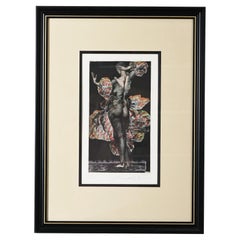
Giulietta II. Etching with color aquatint and soft-ground etching, hand-colored, on laid paper. 38.4 x 21.2 cm (plate edge); 64 x 48 cm (sheet size). Signed. Edition of 90 numbered c...
Category
Vintage 1970s Austrian Paintings
Materials
Paper
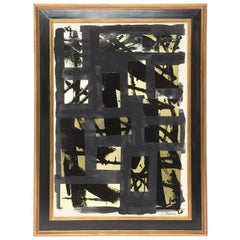
Francisco Franco Mixed-Media Painting
By Francisco Franco
Located in North Miami, FL
An original vintage framed by artist, this mixed media oil, brass on canvas abstract painting is very powerful and highly decorative.
Category
2010s Spanish Paintings
Materials
Brass
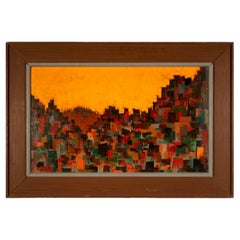
Robert Quigley Signed Modern Cityscape Abstract Oil Painting on Board Framed
Located in Keego Harbor, MI
A bright and expressive mid-century modern oil painting on board by Robert Quigley. Signed bottom right as well as verso. A unique addition to a modern or contemporary space. Created...
Category
Vintage 1960s American Modern Paintings
Materials
Paint
$400
H 21 in W 30.25 in D 1.25 in
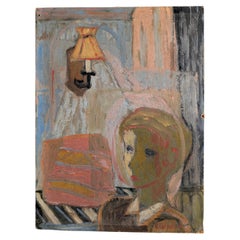
Oil on Board by Einar Granum, Norway, 1950s
Located in Benalmadena, ES
Original work by the renowned Norwegian painter Einar Granum (1920-1992), executed in oil on board. With an immersive composition and a subtly expressive color palette, this piece en...
Category
Vintage 1950s Norwegian Mid-Century Modern Paintings
Materials
Wood, Paint
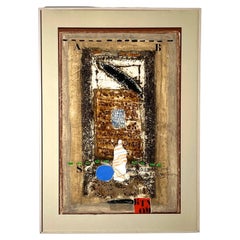
Abstract Mixed Media Collage Painting by James Coignard, circa 1980s
Located in Troy, MI
35x49 James Coignard Abstract Mixed Media Collage Painting 1980s
James Coignard mixed media carborundum etching circa 1980s
Titled Mannequin
Various textures and techniques
Hand sig...
Category
20th Century Modern Paintings
Materials
Rope, Paint, Paper
Original Mid Century Cityscape Oil Painting on Board. 1950s Heller MCM Decor
By Heller
Located in Peoria, AZ
S U P E R B !
MID CENTURY MODERN
C I T Y S C A P E
P A I N T I N G !
ICONIC HELLER
MID CENTURY STYLE!
OIL ON BOARD
HUGE!
Approx. 29 " x 53 "
C I R ...
Category
Vintage 1950s American Mid-Century Modern Paintings
Materials
Canvas, Wood
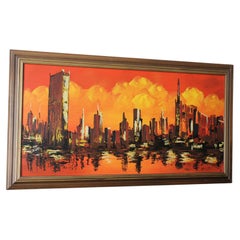
$9,200 Sale Price
20% Off
H 29 in W 53 in D 3 in
Modernist Don Shoemaker "El Cargador" Signed Color Etching Limited Edition of 22
By Don S. Shoemaker
Located in San Diego, CA
Very hard to come by color etching by famous Mexican furniture designer Don Shoemaker, dating from 1951. Hand signed, numbered and titled on...
Category
Mid-20th Century Drawings
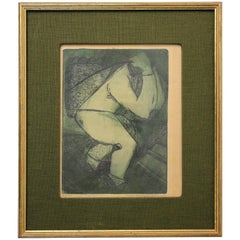
$750
H 15.25 in W 13.25 in D 1.75 in
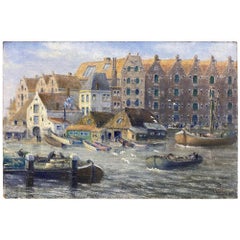
Antique Oil Painting on Board by H. G. Ontrop
Located in Dallas, TX
Antique oil painting on board by H. G. Ontrop (1880-1955) is a slightly more impressionistic work than typical for the artist, with wisp...
Category
Mid-20th Century Belgian Expressionist Paintings
Materials
Wood
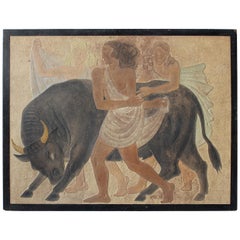
French Art Deco Mixed-Media painting on Panel by Vanvinckenray
Located in Long Island City, NY
French Art Deco mixed-media painting on panel by Vanvinckenray (School: Beaux-Arts of Brussels).
Provenance: Daughter of the artist.
Category
Vintage 1930s French Art Deco Paintings
Materials
Paint
Mixed Media Painting on Board
Located in Denton, TX
Layers of paper and paint make this artwork stand out on it's own.
Unsigned.
Category
20th Century Modern Paintings
Materials
Wood, Paint, Paper
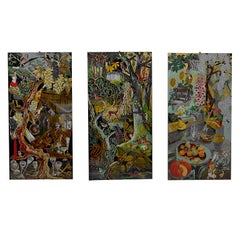
3 Original Mixed Media Paintings on Panels by Jourcin
Located in Long Island City, NY
Three original mixed media paintings on panels by Jourcin with gilded accents,
circa 1962. Signed.
Price is per painting.
Category
Vintage 1960s French Mid-Century Modern Paintings
Mid Century Modern Mixed Media Painting
Located in Bedford Hills, NY
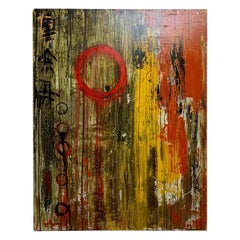
Mid Century Modern mixed media abstract painting, unknown artist.
Category
Late 20th Century American Mid-Century Modern Paintings
Materials
Acrylic, Paper