Gallery of the Masters Animal Prints
to
2
2
3
1
2
Overall Width
to
Overall Height
to
5
1
2
1
1
1
1
2
8
2
1
1
6
4
5
4
3
2
2
2
2
1
1
1
1
1
1
1
1
1
1
9
2
4
10
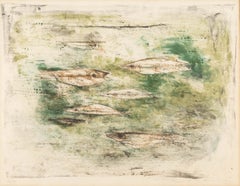
Les Poissons
By Zao Wou-Ki
Located in Missouri, MO
Zao Wou-Ki (Chinese, French, 1921-2013)
Les Poissons, 1953
Lithograph
Hand-signed in pencil Lower Right
Hand-numbered 16/55 in pencil Lower Left
18 x 23 1/8 inches
29 x 33 inches wit...
Category
1950s Modern Animal Prints
Materials
Lithograph

$12,500
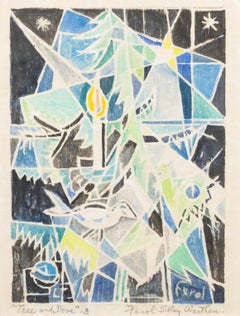
Tree and Dove
Located in Missouri, MO
Tree and Dove
Ferol K. Sibley Warthen (American, 1890-1986)
Color Woodblock Print
Edition of 3
6.25 x 4.75 inches
13 x 11.5 inches with frame
Signed Lower Right
Titled Lower Left
Born 1890, Died 1986...
Category
Mid-20th Century American Modern Animal Prints
Materials
Color
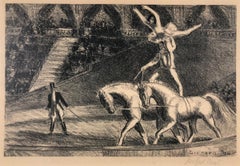
Bareback Act, Old Hippodrome
By Gifford Beal
Located in Missouri, MO
Bareback Act, Old Hippodrome
By Gifford Beal (1879-1956)
Signed Lower Right
Unframed: 6.5" x 9.5"
Framed: 17.5" x 20"
Gifford Beal, painter, etcher, muralist, and teacher, was born in New York City in 1879. The son of landscape painter William Reynolds Beal, Gifford Beal began studying at William Merritt Chase's Shinnecock School of Art (the first established school of plein air painting in America) at the age of thirteen, when he accompanied his older brother, Reynolds, to summer classes. He remained a pupil of Chase's for ten years also studying with him in New York City at the artist's private studio in the Tenth Street Studio Building. Later at his father's behest, he attended Princeton University from 1896 to 1900 while still continuing his lessons with Chase. Upon graduation from Princeton he took classes at the Art Students' League, studying with impressionist landscape painter Henry Ward Ranger and Boston academic painter Frank Vincent DuMond. He ended up as President of the Art Students League for fourteen years, "a distinction unsurpassed by any other artist."
His student days were spent entirely in this country. "Given the opportunity to visit Paris en route to England in 1908, he chose to avoid it" he stated, "I didn't trust myself with the delightful life in ParisIt all sounded so fascinating and easy and loose." His subjects were predominately American, and it has been said stylistically "his art is completely American." Gifford achieved early recognition in the New York Art World.
He became an associate member of the National Academy of Design in 1908 and was elected to full status of academician in 1914. He was known for garden parties, circuses, landscapes, streets, coasts, flowers and marines. This diversity in subject matter created "no typical or characteristic style to his work."
Beal's style was highly influenced by Chase and Childe Hassam, a long time friend of the Beal family who used to travel "about the countryside with Beal in a car sketching...
Category
20th Century American Modern Animal Prints
Materials
Lithograph
Price Upon Request
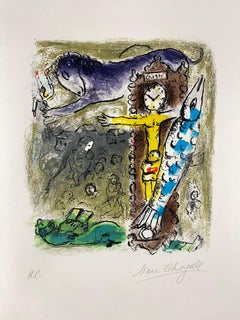
Le Christ a l
Horloge, Paris (Christ in the Clock)
By Marc Chagall
Located in Missouri, MO
Marc Chagall
"Le Christ a l'Horloge, Paris" (Christ in the Clock) 1957 (M. 196)
Color Lithograph on Arches Wove Paper
Signed in Pencil "Marc Chagall" Lower Right
Initialed "H.C." (Hors Commerce) Lower Left, aside from numbered edition of 90
*Floated in Gold Frame with Linen Matting, UV Plexiglass
Sheet Size: 18 3/4 x 14 3/4 inches (47.5 cm x 38 cm)
Image Size: 9 3/4 x 8 1/2 inches
Framed Size: 28.5 x 24.25 inches
Marc Chagall was a man of keen intelligence, a shrewd observer of the contemporary scene, with a great sympathy for human suffering. He was born on July 7, 1887 in Vitebsk, Russia; his original name was Moishe Shagal (Segal), but when he became a foremost member of the Ecole de Paris, he adopted French citizenship and the French spelling of his name. Vitebsk was a good-sized Russian town of over 60,000, not a shtetl. His father supported a wife and eight children as a worker in a herring-pickling plant.
Sheltered by the Jewish commandment against graven images, the young Chagall never saw so much as a drawing until, one day, he watched a schoolmate copying a magazine illustration. He was ridiculed for his astonishment, but he began copying and improvising from magazines. Both Chagall's parents reluctantly agreed to let him study with Yehuda Pen, a Jewish artist in Vitebsk. Later, in 1906, they allowed their son to study in St. Petersburg, where he was exposed to Russian Iconography and folk art. At that time, Jews could leave the Pale only for business and employment and were required to carry a permit. Chagall, who was in St. Petersburg without a permit, was imprisoned briefly.
His first wife, Bella Rosenfeld, was a product of a rich cultivated and intellectual group of Jews in Vitebsk. Chagall was made commissar for the arts for the area, charged with directing its cultural life and establishing an art school. Russian folklore, peasant life and landscapes persisted in his work all his life. In 1910 a rich patron, a lawyer named Vinaver, staked him to a crucial trip to Paris, where young artists were revolutionizing art. He also sent him a handsome allowance of 125 francs (in those days about $24) each month. Chagall rejected cubism, fauvism and futurism, but remained in Paris. He found a studio near Montparnasse in a famous twelve-sided wooden structure divided into wedge-shaped rooms. Chaim Soutine, a fellow Russian Jew, and Modigliani lived on the same floor. To Chagall's astonishment, he found himself heralded as one of the fathers of surrealism. In 1923, a delegation of Max Ernst, Paul Eluard and Gala (later Salvador Dali's wife) actually knelt before Chagall, begging him to join their ranks. He refused.
To understand Chagall's work, it is necessary to know that he was born a Hasidic Jew, heir to mysticism and a world of the spirit, steeped in Jewish lore and reared in the Yiddish language. The Hasidim had a special feeling for animals, which they tried not to overburden. In the mysterious world of Kabbala and fantastic ancient legends of Chagall's youth, the imaginary was as important as the real. His extraordinary use of color also grew out of his dream world; he did not use color realistically, but for emotional effect and to serve the needs of his design. Most of his favorite themes, though superficially light and trivial, mask dark and somber thoughts. The circus he views as a mirror of life; the crucifixion as a tragic theme, used as a parallel to the historic Jewish condition, but he is perhaps best known for the rapturous lovers he painted all his life. His love of music is a theme that runs through his paintings.
After a brief period in Berlin, Chagall, Bella and their young daughter, Ida, moved to Paris and in 1937 they assumed French citizenship. When France fell, Chagall accepted an invitation from the Museum of Modern Art to immigrate to the United States. He was arrested and imprisoned in Marseilles for a short time, but was still able to immigrate with his family. The Nazi onslaught caught Chagall in Vichy, France, preoccupied with his work. He was loath to leave; his friend Varian Fry rescued him from a police roundup of Jews in Marseille, and packed him, his family and 3500 lbs. of his art works on board a transatlantic ship. The day before he arrived in New York City, June 23, 1941, the Nazis attacked Russia. The United States provided a wartime haven and a climate of liberty for Chagall. In America he spent the war years designing large backdrops for the Ballet.
Bella died suddenly in the United States of a viral infection in September 1944 while summering in upstate New York. He rushed her to a hospital in the Adirondacks, where, hampered by his fragmentary English, they were turned away with the excuse that the hour was too late. The next day she died.
He waited for three years after the war before returning to France. With him went a slender married English girl, Virginia Haggard MacNeil; Chagall fell in love with her and they had a son, David. After seven years she ran off with an indigent photographer. It was an immense blow to Chagall's ego, but soon after, he met Valentine Brodsky, a Russian divorcee designing millinery in London (he called her Fava). She cared for him during the days of his immense fame and glory. They returned to France, to a home and studio in rustic Vence. Chagall loved the country and every day walked through the orchards, terraces, etc. before he went to work.
Chagall died on March 28, 1985 in the south of France. His heirs negotiated an arrangement with the French state allowing them to pay most of their inheritance taxes in works of art. The heirs owed about $30 million to the French government; roughly $23 million of that amount was deemed payable in artworks. Chagall's daughter, Ida and his widow approved the arrangement.
Written and submitted by Jean Ershler Schatz, artist and researcher from Laguna Woods, California.
Sources:
Hannah Grad Goodman in Homage to Chagall in Hadassah Magazine, June 1985
Jack Kroll in Newsweek, April 8, 1985
Andrea Jolles in National Jewish Monthly Magazine, May 1985
Michael Gibson...
Category
1950s Modern Figurative Prints
Materials
Lithograph
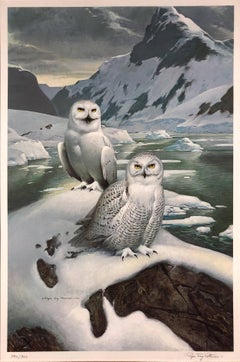
Two Snowy Owls
By Roger Tory Peterson
Located in Missouri, MO
Color Lithograph
Image Size: 30 x 19 inches
Framed Size: 40.25 x 29.75 inches
Edition 392/950
Artist Signed and Numbered
Artist and naturalist Roger Tory Peterson...
Category
Late 20th Century Naturalistic Animal Prints
Materials
Lithograph
Price Upon Request
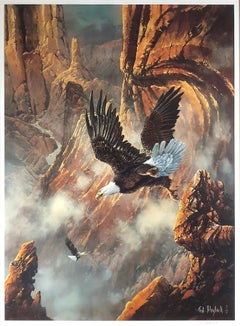
American Eagle (Nest Builder III)
By Ted Blaylock
Located in Missouri, MO
Ted Blaylock (b. 1946)
"Nest Builder III" 1986
Print
Ed. 586/950
Signed and Numbered
Ted Blaylock opened his own art studio and gallery in Collinsville, IL in 1969. He eventually mo...
Category
1980s American Realist Animal Prints
Materials
Paper, Lithograph
Price Upon Request
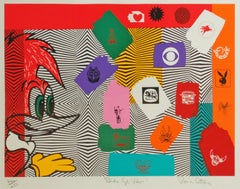
Bird
s Eye View
By Ronnie Cutrone
Located in Missouri, MO
Ronnie Cutrone (1948-2013)
"Bird's Eye View" c. 1980s
Color Lithograph
Ed. 222/250
Signed, Numbered and Titled
Image Size: 17 x 23.5 inches
Framed Size: approx. 24 x 30 inches.
Ronnie Cutrone, a figurehead of the Pop and Post-Pop art scenes, was Andy Warhol's assistant at the Factory atop the Decker Building from 1972-1980, and worked closely with Roy Lichtenstein, combining stylistic elements of both. Cutrone's large-scale paintings of American cartoon icons, like Mickey Mouse, Felix the Cat, and Woody Woodpecker further reinvented kitsch and popular media in terms of fine art.
Executed in fluorescent monochromatic colors with the finesse of mass-produced silkscreen and prints, Cutrone's works are the reverse of tromp-l'oeil; they use fine art media (watercolor, pastel, crayon - on high-quality paper) to celebrate, rather than hide, the artifice of their subjects. "Everything is cartoon for me", Cutrone is noted for saying, even "ancient manuscripts...
Category
Late 20th Century Pop Art Figurative Prints
Materials
Lithograph
Price Upon Request
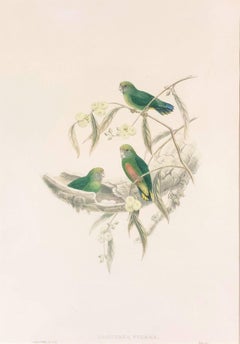
Nasiterna Pygmae
By John Gould
Located in Missouri, MO
John Gould (British, 1804-1881)
Nasiterna Pygmae c. 1849-1861
Hand Colored Lithograph
Image Size: approx 19.5 x 13.5 inches
Framed Size: 27 3/8 x 21 1/2 inches
John Gould was an English ornithologist and bird artist. The Gould League in Australia was named after him. His identification of the birds now nicknamed "Darwin's finches" played a role in the inception of Darwin's theory of evolution by natural selection. Gould's work is referenced in Charles Darwin's book, On the Origin of Species.
Gould was born in Lyme Regis, Dorset, the son of a gardener, and the boy probably had a scanty education. Shortly afterwards his father obtained a position on an estate near Guildford, Surrey, and then in 1818 became foreman in the Royal Gardens of Windsor. He was for some time under the care of J T Aiton, of the Royal Gardens of Windsor. The young Gould started training as a gardener, being employed under his father at Windsor from 1818 to 1824, and he was subsequently a gardener at Ripley Castle in Yorkshire. He became an expert in the art of taxidermy, and in 1824 he set himself up in business in London as a taxidermist, and his skill led to him becoming the first Curator and Preserver at the museum of the Zoological Society of London in 1827.
Gould's position brought him into contact with the country's leading naturalists, and also meant that he was often the first to see new collections of birds given to the Society. In 1830 a collection of birds arrived from the Himalayas, many not previously described. Gould published these birds in A Century of Birds from the Himalaya Mountains (1830-1832). The text was by Nicholas Aylward Vigors, and the illustrations were lithographed by Gould's wife Elizabeth, daughter of Nicholas Coxen of Kent.
This work was followed by four more in the next seven years including Birds of Europe in five volumes - completed in 1837, with the text written by Gould himself, edited by his clerk Edwin Prince. Some of the illustrations were made by Edward Lear as part of his Illustrations of the Family of Psittacidae in 1832. Lear however was in financial difficulty, and he sold the entire set of lithographs to Gould. The books were published in a very large size, imperial folio, with magnificent coloured plates. Eventually 41 of these volumes were published with about 3000 plates. They appeared in parts at £3 3s. a number, subscribed for in advance, and in spite of the heavy expense of preparing the plates, Gould succeeded in making his ventures pay and in realizing a fortune. In 1838 he and his wife moved to Australia to work on the Birds of Australia and shortly after his return to England, his wife died in 1841.
When Charles Darwin presented his mammal and bird specimens collected during the second voyage of HMS Beagle to the Geological Society of London at their meeting on 4 January 1837, the bird specimens were given to Gould for identification. He set aside his paying work and at the next meeting on 10 January reported that birds from the Galápagos Islands, which Darwin had thought were blackbirds, "gross-bills" and finches were in fact "a series of ground Finches which are so peculiar" as to form "an entirely new group, containing 12 species." This story made the newspapers.
In March, Darwin met Gould again, learning that his Galápagos "wren" was another species of finch and the mockingbirds he had labeled by island were separate species rather than just varieties, with relatives on the South American mainland. Subsequently Gould advised that the smaller southern Rhea specimen that had been rescued from a Christmas dinner...
Category
Mid-19th Century Naturalistic Animal Prints
Materials
Lithograph
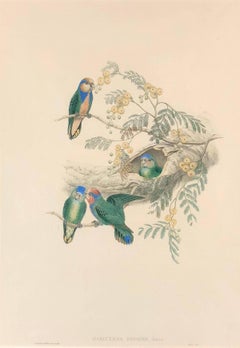
Nasiterna Bruijni
By John Gould
Located in Missouri, MO
John Gould (British, 1804-1881)
Nasiterna Bruijni c. 1849-1861
Hand Colored Lithograph
Image Size: approx 19.5 x 13.5 inches
Framed Size: 27 3/8 x 21 1/2 inches
John Gould was an English ornithologist and bird artist. The Gould League in Australia was named after him. His identification of the birds now nicknamed "Darwin's finches" played a role in the inception of Darwin's theory of evolution by natural selection. Gould's work is referenced in Charles Darwin's book, On the Origin of Species.
Gould was born in Lyme Regis, Dorset, the son of a gardener, and the boy probably had a scanty education. Shortly afterwards his father obtained a position on an estate near Guildford, Surrey, and then in 1818 became foreman in the Royal Gardens of Windsor. He was for some time under the care of J T Aiton, of the Royal Gardens of Windsor. The young Gould started training as a gardener, being employed under his father at Windsor from 1818 to 1824, and he was subsequently a gardener at Ripley Castle in Yorkshire. He became an expert in the art of taxidermy, and in 1824 he set himself up in business in London as a taxidermist, and his skill led to him becoming the first Curator and Preserver at the museum of the Zoological Society of London in 1827.
Gould's position brought him into contact with the country's leading naturalists, and also meant that he was often the first to see new collections of birds given to the Society. In 1830 a collection of birds arrived from the Himalayas, many not previously described. Gould published these birds in A Century of Birds from the Himalaya Mountains (1830-1832). The text was by Nicholas Aylward Vigors, and the illustrations were lithographed by Gould's wife Elizabeth, daughter of Nicholas Coxen of Kent.
This work was followed by four more in the next seven years including Birds of Europe in five volumes - completed in 1837, with the text written by Gould himself, edited by his clerk Edwin Prince. Some of the illustrations were made by Edward Lear as part of his Illustrations of the Family of Psittacidae in 1832. Lear however was in financial difficulty, and he sold the entire set of lithographs to Gould. The books were published in a very large size, imperial folio, with magnificent coloured plates. Eventually 41 of these volumes were published with about 3000 plates. They appeared in parts at £3 3s. a number, subscribed for in advance, and in spite of the heavy expense of preparing the plates, Gould succeeded in making his ventures pay and in realizing a fortune. In 1838 he and his wife moved to Australia to work on the Birds of Australia and shortly after his return to England, his wife died in 1841.
When Charles Darwin presented his mammal and bird specimens collected during the second voyage of HMS Beagle to the Geological Society of London at their meeting on 4 January 1837, the bird specimens were given to Gould for identification. He set aside his paying work and at the next meeting on 10 January reported that birds from the Galápagos Islands, which Darwin had thought were blackbirds, "gross-bills" and finches were in fact "a series of ground Finches which are so peculiar" as to form "an entirely new group, containing 12 species." This story made the newspapers.
In March, Darwin met Gould again, learning that his Galápagos "wren" was another species of finch and the mockingbirds he had labeled by island were separate species rather than just varieties, with relatives on the South American mainland. Subsequently Gould advised that the smaller southern Rhea specimen that had been rescued from a Christmas dinner...
Category
1850s Naturalistic Animal Prints
Materials
Lithograph
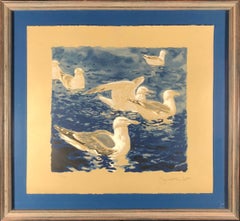
Herring Gulls
By Jamie Wyeth
Located in Missouri, MO
Jamie Wyeth
"Herring Gulls" 1978
Color Lithograph
Signed Lower Right
Numbered Lower Left 149/300
Born in 1946, James Browning Wyeth came of age when the meaning of patriotism was clouded by the traumas of the Vietnam War and the scandals of Watergate. Working in an era of turmoil and questioning of governmental authority, he did art that encompassed both marching off to war and marching in protest.
One of James's early masterworks, Draft Age (1965) depicts a childhood friend as a defiant Vietnam-era teenager resplendent in dark sunglasses and black leather jacket in a suitably insouciant pose.
Two years later Wyeth painstakingly composed a haunting, posthumous Portrait of President John F. Kennedy (1967) that seems to catch the martyred Chief Executive in a moment of agonized indecision. As Wyeth Center curator Lauren Raye Smith points out, Wyeth "did not deify the slain president, [but] on the contrary made him seem almost too human."
Based on hours of study and sketching of JFK's brothers Robert and Edward -
documented by insightful studies in the exhibition - the final, pensive portrait seemed too realistic to family members and friends. "His brother Robert," writes Smith in the exhibition catalogue, "reportedly felt uneasy about this depiction, and said it reminded him of the President during the Bay of Pigs invasion."
In spite of these misgivings, James's JFK likeness has been reproduced frequently and is one of the highlights of this show. The poignancy, appeal and perceptiveness of this portrait, painted when the youngest Wyeth was 21 years old, makes one wish he would do more portraits of important public figures.
James himself feels he is at his best painting people he knows well, as exemplified by his vibrant Portrait of Jean Kennedy Smith (1972), which captures the vitality of the slain President's handsome sister.
He did paint a portrait of Jimmy Carter for the January 1977 man-of-the-year cover of Time magazine, showing the casually dressed President-elect as a straightforward character posed under a flag-draped water tower next to the family peanut plant in Plains, Ga. James recalls that Carter had one Secret Service agent guarding him as he posed outdoors, a far cry from the protection our Chief Executives require today.
As a participating artist in the "Eyewitness to Space" program organized by the National Aeronautics and Space Administration in collaboration with the National Gallery of Art in the late 1960s, Wyeth deftly recorded in a series of watercolors his eyewitness observations of dramatic spacecraft launchings and more mundane scenes associated with the space program.
Commissioned by Harper's Magazine to cover the 1974 congressional hearings and trials of Watergate figures, James Wyeth executed a series of perceptive and now evocative sketches that recall those dark chapters in our history. Memorable images include a scowling John Ehrlichman, a hollow-eyed Bob Haldeman, an owlish Charles Colson, a focused Congressman Peter Rodino, a grim visaged Father/ Congressman Robert Drinan, and vignettes of the press and various courtroom activities. An 11-by-14-inch pencil sketch of the unflappable Judge John Sirica is especially well done. These "images are powerful as historical records," observes Smith, "and as lyrically journalistic impressions of events that changed the nation forever."
Wyeth's sketch of early-morning crowds lined up outside the Supreme Court
building hoping to hear the Watergate case, with the ubiquitous TV cameramen looking on, is reminiscent of recent scenes as the high court grappled with the Bush-Gore contest.
The Wyeth family penchant for whimsy and enigmatic images is evident in Islanders (1990), showing two of James's friends, wearing goofy hats, sitting on the porch of a small Monhegan Island (Me.) cottage draped with a large American flag. Mixing the serious symbolism of Old Glory with the irreverent appearance of the two men, James has created a puzzling but interesting composition.
Painting White House...
Category
1970s American Modern Animal Prints
Materials
Lithograph, Paper
Price Upon Request
Related Items
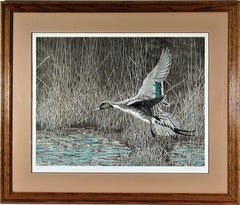
Pintail
Located in San Francisco, CA
This artwork titled "Pintail" c.1990 is a color lithograph by noted Wild life American artist Christopher Forrest, b.1946. It is hand signed, titled and numbered 86/300 in pencil by the artist. The image size is 17.5 x 22.85 inches, framed size is 27.35 x 32.5 inches. Custom framed in a oak frame, with light brown matting. It is in excellent condition
About the artist:
Born in Trenton, New Jersey, 1946 Interested in art from the age of 7, Christopher Forrest still speaks fondly of a set of colored pencils presented to him then by his parents; At 11, he won his first award for painting and started exhibiting in galleries. Along with his interest in art grew a keen attraction for the outdoors and the wildlife which thrived there. After considering schooling in art, Chris chose to study civil engineering. Upon graduation from Virginia Polytechnic Institute, Chris began a career as a commissioned officer in the United States Army Corps of Engineers. The Army provided Chris the opportunity to observe wildlife from the swamps of Florida to the lakes of Quebec, in addition to Europe and Viet Nam. In 1973, the Army sent Chris to graduate school at North Carolina State University, at this time Chris started to paint wildlife. Chris resigned from the Army in 1978 and took a position as an artist with Evergreen Publishing Co. He has produced more than thirty original graphic editions for Evergreen. His original graphics are handled by some 350 galleries in North America. He is currently General Manager at Evergreen. His work and articles about his work have appeared in numerous wildlife and art publications. Chris strongly believes in wildlife conservation and is a member of many conservationist organizations. His donated prints have raised a great deal of money for Ducks Unlimited, Newjersey, Audubon and Ward Foundations. In 1980 he realized one of his major professional goals. He was elected to membership in the Society of Animal Artists. "Creating a painting or graphic is an exciting adventure and challenge for me. Starting with the observation of the animal in the wilderness, I then approach the painting with the attitude that it will be my finest work." COLLECTIONS National Academy of Science, Washington, D.C. New Jersey State Museum, Trenton, N.J. Ferrum College, Ferrum, Va. Franklin Mint, Franklin Center, Pa. Parsons, Brinkerhoff, Quade & Douglas, consulting Engineers, N.Y.C. Fine Art Corporation of America, N.Y.C. Central Carolina Bank, Raleigh, N.C. Ward Foundation Museum, Salisbury, Md. New Jersey Audubon Society, Rancocas, N.J. I.B.M., Louisville, Ky. American World Airways (Pan Am), Miami, Fla. Baush & Lomb, Rochester, N.Y. Thermos, Norwich, Conn. Metro-Goldwyn Mayer, Ca. Ford Motor Co., Atlanta, Ga. Chemical Bank, N.Y.C. City Bank, N.Y.C. ONE-MAN SHOWS N.J. State Museum, Trenton, N.J. 1979 Palette Gallery, Cary, N.C., 1973,-74,-77,-78,-79 Lambertville House, Lambertvi lie, N.J., 1975-76 Triangle Art, Trenton, N.J., 1975 INVITATIONAL SHOWS Triangle Art Christmas Show, 1975 Golden Door Gallery Wildlife Show, New Hope, Pa., 1976 Ward Foundation Wildlife Art & Carving Exhibition, Salisbury and Ocean City, Md., 1976,-78,-79 Easton Waterfowl Art...
Category
Late 20th Century American Realist Animal Prints
Materials
Lithograph
Meditation and Minou
By Will Barnet
Located in Buffalo, NY
Artist: Will Barnet, American (1911 - 2012)
Title: Meditation and Minou
Year: 1980
Medium: Lithograph and Serigraph on BFK Rives, signed and numbered in pencil
Edition: 40/150
Category
1970s American Realist Figurative Prints
Materials
Archival Paper, Lithograph

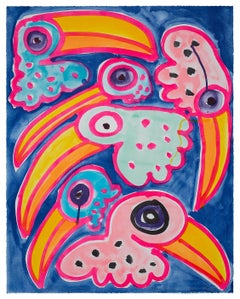
Toco Toucan Tucano
By Katherine Bernhardt
Located in London, GB
Toco Toucan Toucano (2020)
Edition of 150
Nine colour lithographic print on Somerset Velvet 300 gsm.
Signed, numbered, and dated by the artist
Katherine Bernhardt is a contemporar...
Category
2010s Contemporary Animal Prints
Materials
Lithograph
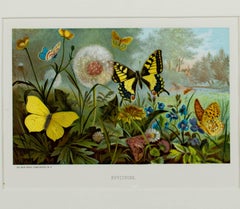
19th century color lithograph butterflies flowers nature trees scene signed
By Louis Prang
Located in Milwaukee, WI
"Erycinids" is an original color lithograph by Louis Prang. It depicts colorful butterflies around a variety of flowers.
5" x 8" art
16 1/2" x 19" framed
Louis Prang was an American printer, lithographer, and publisher. He is sometimes known as the father of the American Christmas card. He created L. Prang and Company in 1860 and became successful and known for their Civil War maps...
Category
Late 19th Century American Realist Animal Prints
Materials
Lithograph
$1,815
H 16.5 in W 19 in
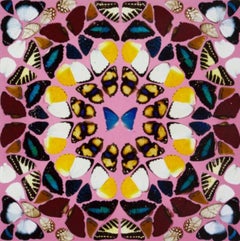
Beneficence
By Damien Hirst
Located in New York, NY
A superb impression of this color giclée print on wove paper. Signed and numbered 20/50 in pencil by Hirst. Published by Other Criteria, London.
Category
2010s Modern Abstract Prints
Materials
Color, Giclée
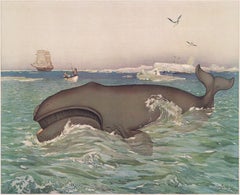
Whaling – Vintage Monumental Zoology Lithograph
Located in Myrtle Beach, SC
Joseph Fleischmann, 'Whaling' (Hartingers Wandtafeln: Zoologie T. XXXII), monumental vintage color lithograph, 1900. Signed in the matrix, lower right. A superb, beautifully nuanced impression, on cream wove paper, the full sheet with margins (1 1/2 to 2 3/16 inches), in very good condition. Sheet size 28 x 38 1/2 inches (711 x 978 mm). The full sheet, unmounted and unmatted—shipped carefully rolled and protected.
Rendering by A. Berger after Joseph Fleischmann. Published by Carl Gerold’s Son, Vienna, 1900.
This Artic whaling scene depicts a Greenland whale in the foreground pursued by whalers. A whaling ship is seen in the background and at right, another whale among icebergs with seagulls overhead. The print by Albert Berger...
Category
Early 1900s Naturalistic Animal Prints
Materials
Lithograph
$1,125 Sale Price
25% Off
H 28 in W 38.5 in
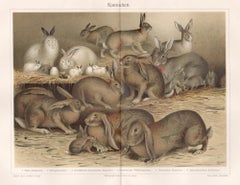
Rabbits, German antique animal chromolithograph print.
Located in Melbourne, Victoria
'Kaninchen'
(Rabbits)
German chromolithograph, circa 1910. Key in German to the types of rabbits at the bottom of the image. Central vertical fold as issued.
245mm by 305mm (shee...
Category
Early 20th Century Naturalistic Animal Prints
Materials
Lithograph
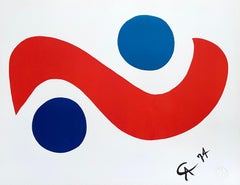
Sky Bird, Braniff International Airways Flying Colors Collection
By Alexander Calder
Located in Fairfield, CT
Artist: Alexander Calder (1898-1976)
Title: Sky Bird, Braniff International Airways Flying Colors Collection
Year: 1975
Medium: Lithograph on vélin d’Arches paper
Size: 20 x 26 inche...
Category
1970s Surrealist Abstract Prints
Materials
Lithograph
$1,036 Sale Price
20% Off
H 20 in W 26 in
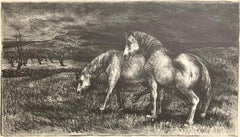
Reginald Wilson, Horses
By Reginald Wilson
Located in New York, NY
Although this work is titled Horses. It nice to think it could be (Horses in a Field in Woodstock, NY), but it was printed by Will Barnet at the Art Students League, about 1938, and Wilson, who visited Woodstock with Arnold Blanche...
Category
1930s American Modern Animal Prints
Materials
Lithograph
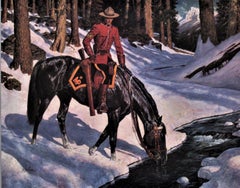
Springtime in the North
Located in San Francisco, CA
This artwork titled "Springtime in the North" c.1980, published 1996, is a color offset lithograph by renown western artist Arnold Friberg, 1913-2010. I...
Category
Late 20th Century American Realist Figurative Prints
Materials
Lithograph
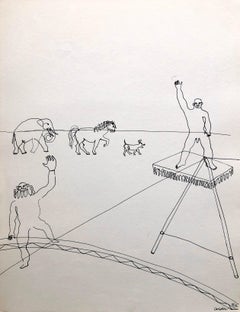
Alexander Calder Circus Reproduction Lithograph After a Drawing
By (after) Alexander Calder
Located in Surfside, FL
(after) Alexander Calder
"Calder's Circus" offset lithograph on wove paper after drawings by the artist
Published by Art in America and Perls gallery in 1964 (from drawings done in the 1930's)
these range slightly in size but they are all about 13 X 17 inches (with minor variations in size as issued.) These have never been framed. The outer folio is not included just the one lithograph.
James Sweeny from the introduction “The fame of Calder’s circus spread quickly between the years 1927 and 1930. All the Paris art world came to know it. It brought him his first great personal success. But what was more important, the circus also provided the first steps in Calder’s development as an original sculptor”
Clive Gray wrote ”A visit to the studio of Alexander Calder led to the chance discovery of some hundred masterful circus drawings completed over thirty years ago. We publish, for the first time, a choice of sixteen from that group.” With signed introduction by Miro.
These whimsical drawings, done in the style of wire sculpture, include acrobats, clowns, jugglers, trapeeze artists, an elephant, dog and lion. they are great.
Alexander Calder is widely considered to be one of the most important American sculptors of the 20th century. He is best known for his colorful, whimsical abstract public sculptures and his innovative mobiles, kinetic sculptures powered by motors or air currents, which embraced chance in their aesthetic. Born into a family of accomplished artists, Calder's work first gained attention in Paris in the 1930s and was soon championed by the Museum of Modern Art in New York, resulting in a retrospective exhibition in 1943. Major retrospectives were also held at the Solomon R. Guggenheim Museum (1964) and the Museum of Contemporary Art, Chicago (1974). Calder’s work is in many permanent collections, most notably in the Whitney Museum of American Art, but also the Guggenheim Museum; the Museum of Modern Art; the National Gallery of Art, Washington, D.C.; and the Centre Georges Pompidou. He produced many large public works, including .125 (at JFK Airport, 1957), Pittsburgh (Carnegie International prize winner 1958, Pittsburgh International Airport) Spirale (UNESCO in Paris, 1958), Flamingo and Universe (both in Chicago, 1974), and Mountains and Clouds (Hart Senate Office Building, Washington, D.C., 1976). Although primarily known for his sculpture, Calder was a prodigious artist with a restless creative spirit, whose diverse practice included painting and printmaking, miniatures (such as his famous Cirque Calder), children’s book illustrations, theater set design, jewelry design, tapestry and rug works, and political posters. Calder was honored by the US Postal Service with a set of five 32-cent stamps in 1998, and received the Presidential Medal of Freedom, posthumously in 1977, after refusing to receive it from Gerald Ford one year earlier in protest of the Vietnam War.
Calder moved to New York and enrolled at the Art Students League, studying briefly with Thomas Hart Benton, George Luks, Kenneth Hayes Miller, and John Sloan. While a student, he worked for the National Police Gazette where, in 1925, one of his assignments was sketching the Ringling Bros. and Barnum & Bailey Circus. Calder became fascinated with the action of the circus, a theme that would reappear in his later work.
In 1926, Calder moved to Paris, enrolled in the Académie de la Grande Chaumière, and established a studio at 22 rue Daguerre in the Montparnasse Quarter. In June 1929, while traveling by boat from Paris to New York, Calder met his future wife, Louisa James (1905-1996), grandniece of author Henry James and philosopher William James. They married in 1931. While in Paris, Calder met and became friends with a number of avant-garde artists, including Fernand Léger, Jean Arp, and Marcel Duchamp. Cirque Calder (on view at the Whitney Museum of American Art at present) became popular with the Parisian avant-garde. He also invented wire sculpture, or "drawing in space," and in 1929 he had his first solo show of these sculptures in Paris at Galerie Billiet. Hi! (Two Acrobats) in the collection of the Honolulu Museum of Art is an early example of the artist's wire sculpture. The painter Jules Pascin, a friend of Calder's from the cafes of Montparnasse, wrote the preface to the catalog. A visit to Piet Mondrian's studio in 1930, where he was impressed by the environment-as-installation, "shocked" him into fully embracing abstract art, toward which he had already been tending.
Dating from 1931, Calder’s sculptures of discrete movable parts powered by motors were christened “mobiles” by Marcel Duchamp, a French pun meaning both "motion" and "motive." At the same time, Calder was also experimenting with self-supporting, static, abstract sculptures, dubbed "stabiles" by Jean Arp in 1932 to differentiate them from mobiles.
Public commissions increasingly came his way in the 1960s. Notable examples are .125 for JFK Airport in 1957, Spirale for UNESCO in Paris 1958 and Trois disques, commissioned for Expo 67 in Montreal, Quebec, Canada. Calder's largest sculpture at 25.7 meters high was El Sol Rojo, constructed outside the Aztec Stadium for the 1968 Summer Olympics "Cultural Olympiad" events in Mexico City. Many of his public works were commissioned by renowned architects; I.M. Pei commissioned his La Grande Voile (1966), a 25-ton, 40-foot high stabile for the Massachusetts Institute of Technology.
Part of Calder's repertoire includes pivotal stage sets for more than a dozen theatrical productions, including Nucléa, Horizon, and most notably, Martha Graham’s Panorama (1935), a production of the Erik Satie symphonic drama Socrate (1936), and later, Works in Progress (1968).
In addition to sculptures, Calder painted throughout his career, beginning in the early 1920s. He picked up his study of printmaking in 1925, and continued to produce illustrations for books and journals.As Calder’s professional reputation expanded in the late 1940s and 1950s, so did his production of prints. Masses of lithographs based on his gouache paintings hit the market, and deluxe editions of plays, poems, and short stories illustrated with fine art prints by Calder became available for sale.
One of Calder's most celebrated and unconventional undertakings was a commission from Dallas-based Braniff International Airways to paint a full-size Douglas DC-8-62 four-engined jet as a "flying canvas."
Calder created over 2,000 pieces of jewelry over the course of his career, many of them as gifts for friends and relatives. For his lifelong friend Joan Miró, he set a shard of a broken porcelain vessel in a brass ring. Peggy Guggenheim received enormous silver mobile earrings and later commissioned a hammered silver headboard...
Category
1930s American Modern Animal Prints
Materials
Lithograph
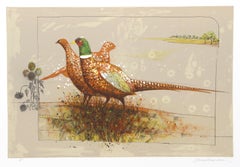
Pheasants, American Realist Lithograph by Allan Mardon
Located in Long Island City, NY
Allan Mardon, Canadian (1931 - ) - Pheasants, Year: circa 1979, Medium: Lithograph, signed and numbered in pencil, Edition: 300, Size: 17 x 23 in. (43.18 x 58.42 cm)
Category
1970s American Realist Animal Prints
Materials
Lithograph