Gallery of the Masters Landscape Prints
to
9
2
5
4
Overall Width
to
Overall Height
to
8
3
1
1
3
2
2
1
1
5
15
1
1
1
1
4
1
16
3
1
8
5
4
3
3
3
3
3
2
2
2
2
2
1
1
1
1
1
1
1
9
7
3
2
1
8
20
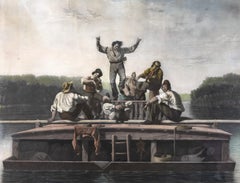
The Jolly Flat Boat Men
By George Caleb Bingham
Located in Missouri, MO
The Jolly Flat Boat Men, 1847
After George Caleb Bingham (American, 1811-1879)
Engraved by Thomas Doney (French, active New York 1844-1849)
Engraving with Hand-Coloring
Published by The American Art-Union, New York (1838-1851)
Printed by Powell and Co.
18 x 24 inches
32 x 38 inches with frame
In 1847, the American Art-Union purchased Bingham’s painting "The Jolly Flat Boat Men" (1846; National Gallery of Art) directly from the artist. The subscription-based organization, founded in 1838 as the Apollo Association, boasted nearly ten-thousand members at this date. For an annual fee of five dollars, each received a large reproductive engraving and was entered in a lottery to win original artworks exhibited at the Art-Union’s Free Gallery. Aimed at educating the public about contemporary American art, the organization developed an impressive distribution network that reached members in every state. The broad circulation of the Art-Union's print helped to establish Bingham's reputation and made his river scene famous.
Born in Augusta County, Virginia in the Shenandoah River Valley, George Caleb Bingham became known for classically rendered western genre, especially Missouri and Mississippi River scenes of boatmen bringing cargo to the American West and politicians seeking to influence frontier life. One of his most famous river genre paintings was The Jolly Flatboatmen completed in several versions in 1846. This first version of this painting is in the Manoogian Collection at the National Gallery of Art. Fame resulted for this work when it was exhibited in New York at the American Art Union whose organizers made an engraving of 10,000 copies and distributed it to all of their members. Paintings such as Country Politician (1849) and County Election (1852) and Stump Speaking (1854) reflected Bingham's political interests.
In 1819, as an eight-year old, he moved to Boon's Lick, Missouri with his parents and grandfather who had been farmers and inn keepers in the Shenandoah Valley near Rockingham, Virginia. Reportedly as a child there, he took every opportunity to escape supervision to travel the River and watch the marine activity.
His father died in 1827, when his son was sixteen years old. His mother had encouraged his art talent, but art lessons were not easily obtainable. In order to earn money, he apprenticed to a cabinet maker but determined to become an artist. By 1835, he had a modest reputation as a frontier painter and successfully charged twenty dollars per portrait in St. Louis. "His portraits had become standard decorations in prosperous Missouri homes." (Samuels 46). In 1836, he moved to Natchez, Mississippi and there had the same kind of career, only was able to charge forty dollars per portrait.
He remained largely self taught until 1837, when he, age 26 and using the proceeds from his portraiture, studied several months at the Pennsylvania Academy of the Fine Arts. He later said that he learned much of his atmospheric style and classically balanced composition by copying paintings in collections in St. Louis and Philadelphia and that among his most admired painters were Thomas Cole, John Vanderlyn, and William Sidney Mount. Between 1856 and 1859, Bingham traveled back and forth to Dusseldorf, Germany, where he studied the work of genre painters. Some critics think these influences were negative on his work because during that time period, he abandoned his luminist style that had brought him so much public affirmation.
Bingham credited Chester Harding (1792-1866) as being the earliest and one of the most lasting influences on his work. Harding,a leading portraitists when Bingham was a young man, had a studio in Franklin, near Bingham's home town. In 1822, when Bingham was ten years old, he watched Harding finish a portrait of Daniel Boone. Bingham recalled that watching Harding with the Boone portrait was a lasting inspiration and that it was the first time he had ever seen a painting in progress. Harding suggested to Bingham that he begin doing portraiture by finding subjects in the river men, which, of course, opened the subject matter that established fame and financial success for Bingham. Harding also encouraged Bingham to copy with paint engravings. He later painted two portraits of Boone but, contrary to the assertions of some scholars, he did not do Boone portraits in the company of Harding.
Bingham's portraits of Boone are not located, but one of them, a wood signboard for a hotel in Boonville circa 1828 to 1830, showed a likeness of Boone in buckskin dress...
Category
1840s Hudson River School Figurative Prints
Materials
Engraving
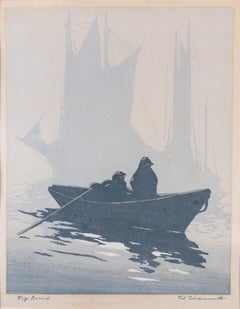
Fog Bound
By Tod Lindenmuth
Located in Missouri, MO
Fog Bound
Tod Lindenmuth (American, 1885-1976)
Woodblock Print
14 x 11 inches
26 x 20.25 inches with frame
Signed Lower Right
Titled Lower Left
A founder of the Provincetown Art Association and one of the original Provincetown Printers, Tod Lindenmuth was a semi-abstract painter and graphic artist who did much to promote modernist styles. Although he was much influenced by Abstract Expressionism, his subject matter was realistic enough to be recognizable. He did linoleum cuts and was one of the first to work with that medium, and towards the end of his life, he experimented with collage. In the 1930s, he had commissions for the Public Works of Art Project and the Works Progress Administration.
Lindenmuth was born in Allentown, Pennsylvania. He studied with Robert Henri at the New York School of Art in Manhattan, and in Provincetown with E. Ambrose Webster and George Elmer Browne.
He first exhibited in Provincetown in 1915, and between 1917 and 1928 served on the jury for the Provincetown Art Association's 'First Modernistic Exhibition". He exhibited regularly with the Society of Independent Artists in New York.
He married artist and illustrator Elizabeth Boardman Warren...
Category
Mid-20th Century American Modern Figurative Prints
Materials
Color

$3,000
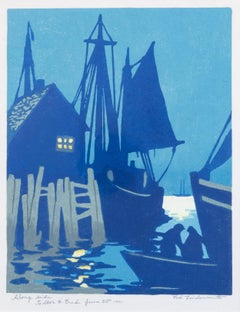
Alongside
By Tod Lindenmuth
Located in Missouri, MO
Alongside, 1941
Tod Lindenmuth (American, 1885-1976)
Color Woodblock Print
9 x 7 inches
19.75 x 14.5 inches with frame
Signed Lower Right
Titled and Dated Lower Left
A founder of the Provincetown Art Association and one of the original Provincetown Printers, Tod Lindenmuth was a semi-abstract painter and graphic artist who did much to promote modernist styles. Although he was much influenced by Abstract Expressionism, his subject matter was realistic enough to be recognizable. He did linoleum cuts and was one of the first to work with that medium, and towards the end of his life, he experimented with collage. In the 1930s, he had commissions for the Public Works of Art Project and the Works Progress Administration.
Lindenmuth was born in Allentown, Pennsylvania. He studied with Robert Henri at the New York School of Art in Manhattan, and in Provincetown with E. Ambrose Webster and George Elmer Browne.
He first exhibited in Provincetown in 1915, and between 1917 and 1928 served on the jury for the Provincetown Art Association's 'First Modernistic Exhibition". He exhibited regularly with the Society of Independent Artists in New York.
He married artist and illustrator Elizabeth Boardman Warren...
Category
1940s American Modern Figurative Prints
Materials
Color
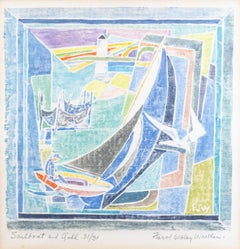
Sailboat and Gull
Located in Missouri, MO
Sailboat and Gull
Ferol K. Sibley Warthen (American, 1890-1986)
Color Woodblock Print
Edition 31/31
7 x 7 inches
14 x 14 inches with frame
Signed Lower Right
Titled and Numbered Lower Left
Born 1890, Died 1986...
Category
Mid-20th Century American Modern Figurative Prints
Materials
Color
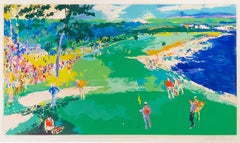
The 18th at Pebble Beach
By LeRoy Neiman
Located in Missouri, MO
The 18th at Pebble Beach
Leroy Neiman (American, 1921-2012)
Signed in pencil lower right
Edition 176/400 lower left
26 x 43 inches
37.25 x 54.5 inches with frame
Known for his bright, colorful paintings and screen prints of famous sports stars...
Category
20th Century American Modern Landscape Prints
Materials
Color, Lithograph
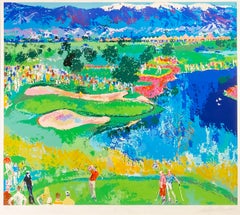
Cove at Vintage
By LeRoy Neiman
Located in Missouri, MO
Cove at Vintage
Leroy Neiman (American, 1921-2012)
Signed in pencil lower right
Edition 237/375 lower left
34 x 36.5 inches
43 x 45.5 inches with frame
Known for his bright, colorful paintings and screen prints of famous sports stars...
Category
20th Century American Modern Landscape Prints
Materials
Color, Lithograph
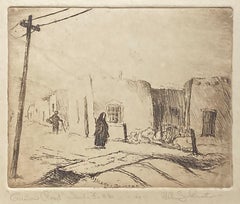
Canyon Road, Sante Fe
By Will (William Howard) Shuster
Located in Missouri, MO
Canyon Road, Santa Fe
By. William Howard Shuster (American, 1893-1969)
Signed Lower Right
Edition of 100 Lower Center
Titled Lower Left
Unframed: 4" x 4.75"
Framed: 15.75" x 15.25"
A realist and early modernist painter, graphic artist, illustrator, and sculptor, Will Shuster became known primarily for his work in New Mexico where in 1920, he settled in Santa Fe, having been encouraged to come there by John Sloan. He had studied electrical engineering at the Drexel Institute in Philadelphia and later was a student of Sloan's in Santa Fe in both etching and painting.
He was in World War I, where he suffered a gas attack. On his return, he studied with J William Server in Philadelphia but was advised to go West for his health.
In Santa Fe in 1921, he became one of the founding members of Los Cinco Pintores...
Category
20th Century American Modern Landscape Prints
Materials
Etching
Price Upon Request
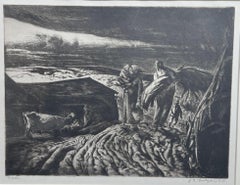
Fodder
By John Costigan
Located in Missouri, MO
Fodder by John Costigan (1888-1972)
Signed Lower Right
Titled Lower Left
9.75" x 12.75" Unframed
17.5" x 19.75" Framed
John Edwards Costigan was born in Providence, Rhode Island on ...
Category
20th Century American Impressionist Landscape Prints
Materials
Etching
Price Upon Request
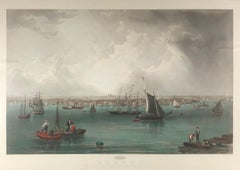
Boston
By John William Hill
Located in Missouri, MO
John William Hill (1812-1879)
"Boston" 1857
Hand-Colored Engraving
Site Size: 29 x 41 inches
Framed Size: 39 x 52 inches
Born in London, England, John William Hill came to America with his family at age 7. His father, John Hill, was a well-known landscape painter, engraver, and aquatintist. John William had a career of two phases, a city topographer-engraver and then, the leading pre-Rafaelite school painter in this country. Employed by the New York Geological Survey and then by Smith Brothers...
Category
1850s Pre-Raphaelite Landscape Prints
Materials
Engraving, Aquatint
Price Upon Request
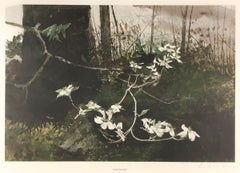
Dogwood
By Andrew Wyeth
Located in Missouri, MO
Andrew Wyeth
"Dogwood" 1983
Collotype
Ed. 115/300
Signed and Numbered Lower Right
Image Size: 21 x 28 3/4 inches
Framed Size: approx. 29 x 36.5 inches
A painter of landscape and figure subjects in Pennsylvania and Maine, Andrew Wyeth became one of the best-known American painters of the 20th century. His style is both realistic and abstract, and he works primarily in tempera and watercolor, often using the drybrush technique.
He is the son of Newell Convers and Carolyn Bockius Wyeth of Chadds Ford, Pennsylvania, and was home-schooled because of delicate health. His art instruction came from his famous-illustrator father, who preached the tying of painting to life--to mood and to essences and to capturing the subtleties of changing light and shadows.
The Wyeth household was a lively place with much intellectual and social stimulation. Because of the prominence of N.C. Wyeth, persons including many dignitaries came from all over the country to visit the family. Andrew's sisters Carolyn and Henriette became noted artists as did his brother-in-law, Peter Hurd. The non-art oriented brother, Nathaniel Wyeth...
Category
1980s American Modern Landscape Prints
Materials
Paper, Lithograph
Price Upon Request
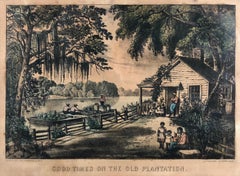
Good Times on the Old Plantation
By Currier
Ives
Located in Missouri, MO
Currier & Ives (Publishers)
"Good times on the Old Plantation" 1872
Handcolored Lithograph
Size Height 10 in.; Width 13.9 in.
Framed Size: approx 16 x 19.5
Category
1870s Victorian Figurative Prints
Materials
Lithograph
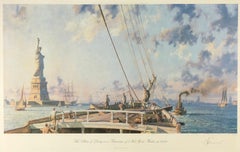
The Statue of Liberty in a Panorama of New York City in 1886
By John Stobart
Located in Missouri, MO
John Stobart
"The Statue of Liberty in a Panorama of New York City in 1886"
Color Lithograph
approx 32 x 43 inches framed
Signed in Pencil and Numbered 914/950
A marine painter of ...
Category
1970s American Realist Landscape Prints
Materials
Lithograph
St. Louis, Gateway to the West
By John Stobart
Located in Missouri, MO
John Stobart
"St. Louis, Gateway to the West"
Color Lithograph
30 x 42 inches framed
Signed in Pencil and Numbered 434/750
Category
1970s American Realist Landscape Prints
Materials
Lithograph
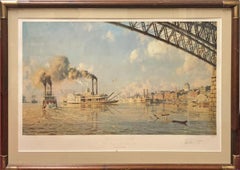
A View of St. Louis
By John Stobart
Located in Missouri, MO
John Stobart
"St. Louis, A View Through the Arches of the Eads Bridge" 1979
Color Lithograph
32.5 x 37.5 inches framed
Signed in Pencil and Numbered 221/75...
Category
1970s American Realist Landscape Prints
Materials
Lithograph

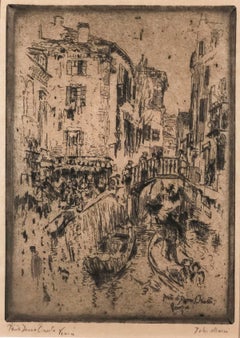
Ponte di Donna Onesta, Venice
By John Marin
Located in Missouri, MO
Very rare etching by John Marin.
"Ponte di Donna Onesta, Venice" 1907
Original Etching
Hand Signed Lower Right
Titled Lower Left
Edition: c. 30
Cat. Rais: ...
Category
Early 1900s Abstract Landscape Prints
Materials
Etching
Price Upon Request
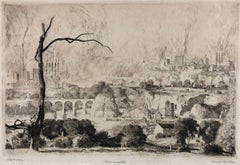
Harmonville
By Daniel Garber
Located in Missouri, MO
DANIEL GARBER
"Harmonville, Pennsylvania" c. 1925
Etching printed in black ink on wove paper.
7 7/8 x 11 3/4 inches, full margins.
Signed, titled and inscribed "DG imp" in pencil, ...
Category
1920s American Impressionist Landscape Prints
Materials
Etching
Price Upon Request
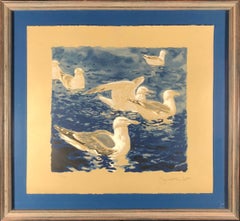
Herring Gulls
By Jamie Wyeth
Located in Missouri, MO
Jamie Wyeth
"Herring Gulls" 1978
Color Lithograph
Signed Lower Right
Numbered Lower Left 149/300
Born in 1946, James Browning Wyeth came of age when the meaning of patriotism was clouded by the traumas of the Vietnam War and the scandals of Watergate. Working in an era of turmoil and questioning of governmental authority, he did art that encompassed both marching off to war and marching in protest.
One of James's early masterworks, Draft Age (1965) depicts a childhood friend as a defiant Vietnam-era teenager resplendent in dark sunglasses and black leather jacket in a suitably insouciant pose.
Two years later Wyeth painstakingly composed a haunting, posthumous Portrait of President John F. Kennedy (1967) that seems to catch the martyred Chief Executive in a moment of agonized indecision. As Wyeth Center curator Lauren Raye Smith points out, Wyeth "did not deify the slain president, [but] on the contrary made him seem almost too human."
Based on hours of study and sketching of JFK's brothers Robert and Edward -
documented by insightful studies in the exhibition - the final, pensive portrait seemed too realistic to family members and friends. "His brother Robert," writes Smith in the exhibition catalogue, "reportedly felt uneasy about this depiction, and said it reminded him of the President during the Bay of Pigs invasion."
In spite of these misgivings, James's JFK likeness has been reproduced frequently and is one of the highlights of this show. The poignancy, appeal and perceptiveness of this portrait, painted when the youngest Wyeth was 21 years old, makes one wish he would do more portraits of important public figures.
James himself feels he is at his best painting people he knows well, as exemplified by his vibrant Portrait of Jean Kennedy Smith (1972), which captures the vitality of the slain President's handsome sister.
He did paint a portrait of Jimmy Carter for the January 1977 man-of-the-year cover of Time magazine, showing the casually dressed President-elect as a straightforward character posed under a flag-draped water tower next to the family peanut plant in Plains, Ga. James recalls that Carter had one Secret Service agent guarding him as he posed outdoors, a far cry from the protection our Chief Executives require today.
As a participating artist in the "Eyewitness to Space" program organized by the National Aeronautics and Space Administration in collaboration with the National Gallery of Art in the late 1960s, Wyeth deftly recorded in a series of watercolors his eyewitness observations of dramatic spacecraft launchings and more mundane scenes associated with the space program.
Commissioned by Harper's Magazine to cover the 1974 congressional hearings and trials of Watergate figures, James Wyeth executed a series of perceptive and now evocative sketches that recall those dark chapters in our history. Memorable images include a scowling John Ehrlichman, a hollow-eyed Bob Haldeman, an owlish Charles Colson, a focused Congressman Peter Rodino, a grim visaged Father/ Congressman Robert Drinan, and vignettes of the press and various courtroom activities. An 11-by-14-inch pencil sketch of the unflappable Judge John Sirica is especially well done. These "images are powerful as historical records," observes Smith, "and as lyrically journalistic impressions of events that changed the nation forever."
Wyeth's sketch of early-morning crowds lined up outside the Supreme Court
building hoping to hear the Watergate case, with the ubiquitous TV cameramen looking on, is reminiscent of recent scenes as the high court grappled with the Bush-Gore contest.
The Wyeth family penchant for whimsy and enigmatic images is evident in Islanders (1990), showing two of James's friends, wearing goofy hats, sitting on the porch of a small Monhegan Island (Me.) cottage draped with a large American flag. Mixing the serious symbolism of Old Glory with the irreverent appearance of the two men, James has created a puzzling but interesting composition.
Painting White House...
Category
1970s American Modern Animal Prints
Materials
Lithograph, Paper
Price Upon Request
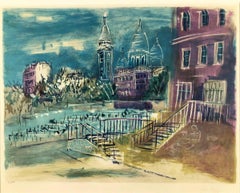
Montmartre at Sacre Coeur
By Jean Dufy
Located in Missouri, MO
Jean Dufy
"Montmartre et La Basilique du Sacre Coeur" c. 1950s
Color Lithograph
Signed in Pencil Lower Right
Numbered 78/250 Lower Left
Image Size: approx...
Category
1950s Impressionist Landscape Prints
Materials
Lithograph
Price Upon Request
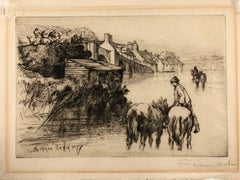
Wareham Bridge
By Seymour Haden
Located in Missouri, MO
Wareham Bridge
Medium Drypoint
Year of Work 1877-1877
Image Size: approx. 6 in.; Width 8.9 in. / Height 15.2 cm.; Width 22.7 cm.
Sir Francis Seymour Haden (16 September 1818 - 1 June 1910), was an English surgeon, best known as an etcher.
He was born in London, his father, Charles Thomas Haden, being a well-known doctor and lover of music. He was educated at Derby School, Christ's Hospital, and University College, London, and also studied at the Sorbonne, Paris, where he took his degree in 1840. He was admitted as a member of the College of Surgeons in London in 1842.
In 1843-1844, with his friends Duval, Le Cannes and Colonel Guibout, he travelled in Italy and made his first sketches from nature. Haden attended no art school and had no art teachers, but between 1845 and 1848 he studied portfolios of prints belonging to a second-hand dealer named Love, who had a shop in Bunhill Row, the old Quaker quarter of London. Arranging the prints in chronological order, he studied the works of the great original engravers, Albrecht Dürer, Lucas van Leyden and Rembrandt. These studies, besides influencing his original work, led to his important monograph on the etched work of Rembrandt. By lecture and book, and with the aid of the memorable exhibition at the Burlington Fine Arts Club in 1877, he tried to give a true reflection of Rembrandt's work, giving a nobler idea of the master's mind by taking away from the list of his works many dull and unseemly plates that had long been included in the lists. His reasons were founded upon the results of a study of the master's works in chronological order, and are clearly expressed in his monograph, The Etched Work of Rembrandt critically reconsidered, privately printed in 1877, and in The Etched Work of Rembrandt True and False (1895).
Haden's printmaking was invigorated by his much younger brother-in-law, James Whistler, at the Haden home in Sloane Street in 1855. A press was installed there and for a while Haden and Whistler collaborated on a series of etchings of the Thames. The relationship and project did not last.
Haden followed the art of original etching with such vigour that he became not only the foremost British exponent of that art but brought about its revival in England. His strenuous efforts and perseverance, aided by the secretarial ability of Sir WR Drake, resulted in the foundation of the Royal Society of Painter-Etchers and Engravers. As president he ruled the society with a strong hand from its first beginnings in 1880.
Notwithstanding his study of the old masters of his art, Haden's own plates were very individual, and are particularly noticeable for a fine original treatment of landscape subjects, free and open in line, clear and well divided in mass, and full of a noble and dignified style of his own. Even when working from a picture his personality dominates the plate, as for example in the large plate he etched after J.M.W. Turner's "Calais Pier," which is a classical example of what interpretative work can do in black and white. Of his original plates, more than 250 in number, one of the most notable was the large "Breaking up of the Agamemnon."
An early plate, rare and most beautiful, is "Thames Fisherman". "Mytton Hall" is broad in treatment, and a fine rendering of a shady avenue of yew trees leading to an old manor-house in sunlight. "Sub Tegmine" was etched in Greenwich Park in 1859; and "Early Morning--Richmond", full of the poetry and freshness of the hour, was done, according to Haden, actually at sunrise. One of the rarest and most beautiful of his plates is "A By-Road in Tipperary"; "Combe Bottom" is another; and "Shere Mill Pond" (both the small study and the larger plate), "Sunset in Ireland," "Penton Hook," "Grim Spain" and "Evening Fishing, Longparish," are also notable examples of his genius. A catalogue of his works was begun by Sir William Drake and completed by Harrington in 1880. During later years Haden began to practise the sister art...
Category
1870s Other Art Style Landscape Prints
Materials
Etching
Shere Mill Pond
By Sir Francis Seymour Haden, R.A.
Located in Missouri, MO
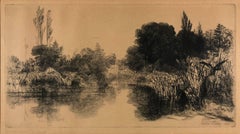
Shere Mill Pond, No. II (large plate). 1860. Etching and drypoint. Schneiderman 37.v/ix. 7 x 13 1/8 (sheet 10 3/4 x 16 3/8). This state is prior to publication in Études à l'Eau-Forte. Illustrated: Keppel The Golden Age of Engraving; Print Collector's Quarterly 1 (1911): 18; : Guichard, British Etchers, 1850-1940. A rich, brilliant proof with drypoint burr printed on white laid paper. Signed in pencil.
-------------------------------------------------------------------------------------------
Shere Mill Pond, No. II was one of the most highly praised landscape prints of the etching revival. An impression was exhibited at the Royal Academy in 1861 under Haden’s pseudonym, H. Dean. Francis Seymour Haden used this anagram of his own name early in his career as an artist, in order to retain his anonymity and preserve his professional reputation as a surgeon.
Biography:
Sir Francis Seymour Haden (16 September 1818 - 1 June 1910), was an English surgeon, best known as an etcher.
He was born in London, his father, Charles Thomas Haden, being a well-known doctor and lover of music. He was educated at Derby School, Christ's Hospital, and University College, London, and also studied at the Sorbonne, Paris, where he took his degree in 1840. He was admitted as a member of the College of Surgeons in London in 1842.
In 1843-1844, with his friends Duval, Le Cannes and Colonel Guibout, he travelled in Italy and made his first sketches from nature. Haden attended no art school and had no art teachers, but between 1845 and 1848 he studied portfolios of prints belonging to a second-hand dealer named Love, who had a shop in Bunhill Row, the old Quaker quarter of London. Arranging the prints in chronological order, he studied the works of the great original engravers, Albrecht Dürer, Lucas van Leyden and Rembrandt. These studies, besides influencing his original work, led to his important monograph on the etched work of Rembrandt. By lecture and book, and with the aid of the memorable exhibition at the Burlington Fine Arts Club in 1877, he tried to give a true reflection of Rembrandt's work, giving a nobler idea of the master's mind by taking away from the list of his works many dull and unseemly plates that had long been included in the lists. His reasons were founded upon the results of a study of the master's works in chronological order, and are clearly expressed in his monograph, The Etched Work of Rembrandt critically reconsidered, privately printed in 1877, and in The Etched Work of Rembrandt True and False (1895).
Haden's printmaking was invigorated by his much younger brother-in-law, James Whistler, at the Haden home in Sloane Street in 1855. A press was installed there and for a while Haden and Whistler collaborated on a series of etchings of the Thames. The relationship and project did not last.
Haden followed the art of original etching with such vigour that he became not only the foremost British exponent of that art but brought about its revival in England. His strenuous efforts and perseverance, aided by the secretarial ability of Sir WR Drake, resulted in the foundation of the Royal Society of Painter-Etchers and Engravers. As president he ruled the society with a strong hand from its first beginnings in 1880.
Notwithstanding his study of the old masters of his art, Haden's own plates were very individual, and are particularly noticeable for a fine original treatment of landscape subjects, free and open in line, clear and well divided in mass, and full of a noble and dignified style of his own. Even when working from a picture his personality dominates the plate, as for example in the large plate he etched after J.M.W. Turner's "Calais Pier," which is a classical example of what interpretative work can do in black and white. Of his original plates, more than 250 in number, one of the most notable was the large "Breaking up of the Agamemnon."
An early plate, rare and most beautiful, is "Thames Fisherman". "Mytton Hall" is broad in treatment, and a fine rendering of a shady avenue of yew trees leading to an old manor-house in sunlight. "Sub Tegmine" was etched in Greenwich Park in 1859; and "Early Morning--Richmond", full of the poetry and freshness of the hour, was done, according to Haden, actually at sunrise. One of the rarest and most beautiful of his plates is "A By-Road in Tipperary"; "Combe Bottom" is another; and "Shere Mill Pond" (both the small study and the larger plate), "Sunset in Ireland," "Penton Hook," "Grim Spain" and "Evening Fishing, Longparish," are also notable examples of his genius. A catalogue of his works was begun by Sir William Drake and completed by Harrington in 1880. During later years Haden began to practise the sister art...
Category
Late 19th Century Old Masters Landscape Prints
Materials
Drypoint, Etching
Related Items
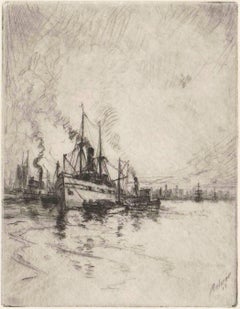
Tugs on the Hudson
By Charles Frederick William Mielatz
Located in Middletown, NY
Drypoint etching with engraving printed in black ink on Japanese mulberry paper, 4 1/2 x 3 3/8 inches (113 x 84 mm), full margins. In superb condition. A beautiful New York City river...
Category
Early 20th Century American Modern Landscape Prints
Materials
Handmade Paper, Drypoint, Etching
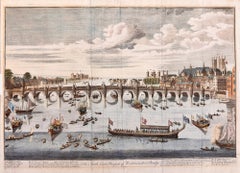
The South East Prospect of Westminster Bridge
By Alfred Benjamin Cole
Located in Middletown, NY
After Giovanni Antonio Canal, called Canaletto
Copper plate engraving with hand coloring on cream laid paper with the Arms of France watermark (a crown in shield topped by a fleur-de-lys and the letters GR), 22 3/4 x 15 3/4 inches (576 x 400 mm), wide to full margins. Multiple vertical and horizontal creases from folding and rolling; none appear to be particularly hard, there is however some associated cockeling. While there is some minor mat tone visible around the perimeter of the sheet, the extensive handcoloring remains extremely fresh and saturated in the intended areas. There are edge tears at each the right and left sheet edge (outside of the image area) due to an improper effort to mount the sheet to a mat. Otherwise in very good condition with all issues being consistent with age.
The print is wrongly titled "The South East Prospect of Westminster Bridge...
Category
Mid-18th Century English School Landscape Prints
Materials
Laid Paper, Engraving, Watercolor
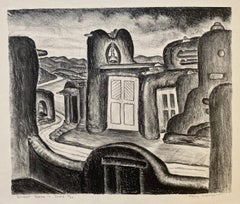
Mary Lightfoot, Street Scene in Taos
Located in New York, NY
Mary Lightfoot was born in Ravenna, Texas. She studied at the College of Industrial Arts in Denton and the North Texas State Teachers College prior to receiving a master of arts degree from Columbia University. Her entire teaching career was with the Dallas Public School system; she summered in Europe...
Category
Mid-20th Century American Modern Landscape Prints
Materials
Lithograph
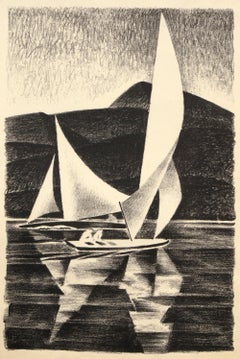
Arnold Ronnebeck 1930s Lithograph – Grand Lake Colorado Yacht Races, WPA Era
By Arnold Rönnebeck
Located in Denver, CO
This striking vintage 1930s black-and-white lithograph by celebrated Colorado artist Arnold Ronnebeck (1885–1947) captures the dynamic energy of the Grand Lake...
Category
1930s American Modern Landscape Prints
Materials
Lithograph
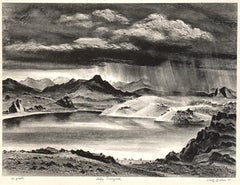
$1,600
H 12.75 in W 8.5 in D 0.1 in
Adolf Dehn, Lake Tarryall, 1941 mid-century lithograph of Colorado mountain lake
By Adolf Dehn
Located in New York, NY
Lake Tarryall, a 1941 lithograph by Adolf Dehn (1895-1968) was made while he was teaching in Colorado. A native of Waterville, Minnesota, Dehn attended the Minneapolis School of Art ...
Category
1940s American Modern Landscape Prints
Materials
Lithograph
$600 Sale Price
20% Off
H 13.75 in W 17.25 in
Delayed (Bus is late, the umbrella up and the long walk home thru rain begins)
By Art Werger
Located in New Orleans, LA
The bus is delayed and the night is cold and rainy as a lone woman raises her umbrella to brave the shadowy walk home after giving up on her ride She has just left the bus shelter a...
Category
21st Century and Contemporary American Modern Figurative Prints
Materials
Mezzotint

Original California Ferrari Louis Vuitton Parc de Bagatelle hand signed poster
By Razzia (Gérard Courbouleix–Dénériaz)
Located in Spokane, WA
Original 1989 Louis Vuitton Automobile Classiques Poster –Hand Signed, Archival Linen-Backed. This poster was created for the Concours d’Elegance ...
Category
1980s American Modern Landscape Prints
Materials
Lithograph

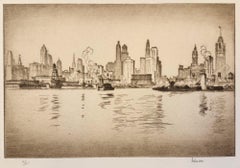
Chicago Skyline
By Paul Schumann
Located in Middletown, NY
A beautiful turn-of-the-century lake view of Chicago by an American artist known for his Texas landscapes.
Etching with drypoint on watermarked Umbria laid paper with deckle edges, 7 1/4 x 10 7/8 inches (182 x 275 mm), full margins. Signed and numbered 4/25 in pencil, lower margin. In good condition with adhesive residue at the sheet edges on the verso, does not show through to the recto. A lovely Lake Michigan landscape...
Category
Early 20th Century American Modern Landscape Prints
Materials
Handmade Paper, Etching, Drypoint
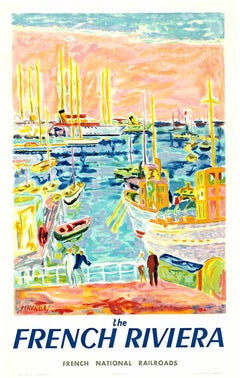
Original The French Riviera (Cote d
Azur) French Railways vintage travel poster
By Jules Cavailles
Located in Spokane, WA
Original vintage travel advertising poster for the FRENCH RIVIERA FRENCH NATIONAL RAILROADS SNCF (French National Railways) - the French Riviera. (Cote D'Azur, known as the French Riviera) The image features people looking out towards a marina full of sailing boats. Colorful artwork by the French painter Jules Cavailles (1901-1977). Printed by Perceval, Paris in 1953. Mid-Century Modern. Grade A-
This is the English version of the poster compared to the design created for Cote d'Azur. The English version is much rarer (both are rare today). The poster gives the impression of a naive painting at this Mediterranean beach and seaport.
Step into a world of timeless elegance and sunlit dreams with this exquisite French Riviera Vintage...
Category
1950s American Modern Landscape Prints
Materials
Lithograph
Jules CavaillesOriginal The French Riviera (Cote d
Azur) French Railways vintage travel poster, 1953
$1,498
H 39 in W 24.5 in D 0.3 in
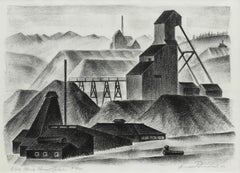
Arnold Ronnebeck Lithograph "Silver Mine, Russell Gulch" Colorado Scene
By Arnold Rönnebeck
Located in Denver, CO
"Silver Mine, Russell Gulch (12/25)" is a striking black-and-white lithograph by German-born American Modernist Arnold Ronnebeck (1885–1947). This rare print depicts a historic minin...
Category
1930s American Modern Figurative Prints
Materials
Lithograph
$2,750
H 20.5 in W 26.5 in D 0.5 in
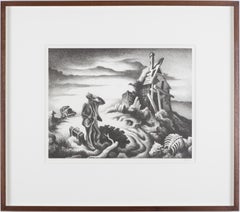
Prodigal Son
By Thomas Hart Benton
Located in London, GB
A man raises his hand to his chin, his neck tilted and face turned to look at a dilapidated farmhouse, barely held together by planks of wood and exposed to the elements. Behind him ...
Category
1930s American Modern Landscape Prints
Materials
Lithograph
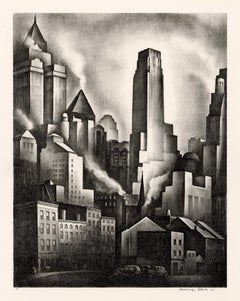
Financial District
, New York City — American Modernism
By Howard Norton Cook
Located in Myrtle Beach, SC
Howard Cook, 'Financial District', lithograph, 1931, edition 75, Duffy 155. A fine, richly-inked impression, on cream wove paper, the full sheet with wide margins (2 3/4 to 5 5/8 inches), in excellent condition. Image size 13 5/16 x 10 3/8 inches (338 x 264 mm); sheet size 23 x 16 inches (584 x 406 mm). Matted to museum standards, unframed.
Literature: 'American Master Prints from the Betty and Douglas Duffy Collection', the Trust for Museum Exhibitions, Washington, D.C., 1987.
Collections: Crystal Bridges Museum of American Art, Library of Congress, Metropolitan Museum of Art, Philadelphia Museum of Art, Smithsonian American Art Museum.
ABOUT THE ARTIST
Howard Norton Cook (1901-1980) was one of the best-known of the second generation of artists who moved to Taos. A native of Massachusetts, he studied at the Art Students League in New York City and at the Woodstock Art Colony. Beginning his association with Taos in 1926, he became a resident of the community in the 1930s. During his career, he received two Guggenheim Fellowships and was elected an Academician in the National Academy of Design. He earned a national reputation as a painter, muralist, and printmaker.
Cook’s work in the print mediums received acclaim early in his career with one-person exhibitions at the Denver Art Museum (1927) and the Museum of New Mexico (1928). He received numerous honors and awards over the years, including selection in best-of-the-year exhibitions sponsored by the American Institute of Graphics Arts, the Brooklyn Museum, the Society of American Etchers, and the Philadelphia Print Club. His first Guggenheim Fellowship took him to Taxco, Mexico in 1932 and 1933; his second in the following year enabled him to travel through the American South and Southwest.
Cook painted murals for the Public Works of Art Project in 1933 and the Treasury Departments Art Program in 1935. The latter project, completed in Pittsburgh, received a Gold Medal from the Architectural League of New York. One of his most acclaimed commissions was a mural in the San Antonio Post Office in 1937.
He and Barbara Latham settled in Talpa, south of Taos, in 1938 and remained there for over three decades. Cook volunteered in World War II as an Artist War Correspondent for the US Navy, where he was deployed in the Pacific. In 1943 he was appointed Leader of a War Art Unit...
Category
1930s American Modern Figurative Prints
Materials
Lithograph
$12,000
H 13.32 in W 10.38 in