Graves International Art More Prints
to
4
Overall Width
to
Overall Height
to
3
1
3
1
1
1
3
1
3
3
2
1
1
4
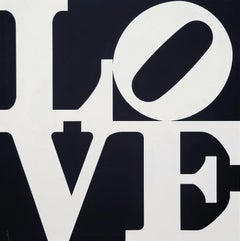
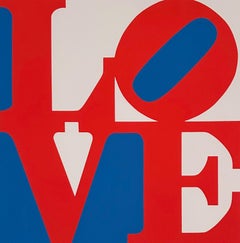
LOVE /// Robert Indiana Typography Pop Art Screenprint Black and White Print Art
By Robert Indiana
Located in Saint Augustine, FL
Artist: (after) Robert Indiana (American, 1928-2018)
Title: "LOVE"
Portfolio: Banner, Multiples Calendar for 1970
*Issued unsigned
Year: 1969
Medium: Original Screenprint on smooth w...
Category
1960s Pop Art More Prints
Materials
Screen
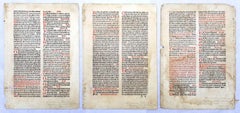
Set of Three Leaves from "Breviarium Pataviense" /// German Catholic Incunabula
Located in Saint Augustine, FL
Artist: Erhard Ratdolt (German, 1442-1528)
Title: "Vol. 6, page 10-11", "Vol. 6, page 6-7", and "Vol. 6, 28-29"
Portfolio: Breviarium Pataviense
Year: 1490 (First edition)
Medium: Set of Three Original Incunabula Leaves on watermarked laid paper
Limited edition: Unknown
Printer: Erhard Ratdolt, Ausburg, Germany
Publisher: Friedrich von Öttingen and Christoph von Schachner, Passau, Germany
Reference: Hain No. 3875; Bod-Inc No. B-542; GW No. 5426; Weale/Bohatta No. 335; Schreiber No. 3615
Sheet size (each): approx. 12.5" x 8.88"
Condition: "Vol. 6, page 10-11", "Vol. 6, page 6-7", and "Vol. 6, 28-29" all have scattered wormholes, staining, foxing, and soiling about their sheets. The latter two have remnants of tape at their edges. "Vol. 6, 28-29" has heavier staining to its sheet and edge wear about. Have been professionally stored away for decades. They are all otherwise strong impressions in overall fair condition with strong colors
Extremely rare
Notes:
Comes from Ratdolt's six volume "Breviarium Pataviense", (1490) (First edition), which consists of 378 pages of Gothic texts in Latin with red rubricated initials, psalms, readings, hymns, and woodcut engraved illustrations. Printed in Augsburg by Erhard Ratdolt on May 12, 1490. There was a subsequent printing on November 27, 1490. Both "Vol. 6, page 10-11" and "Vol. 6, 28-29" have a bow and arrow watermark in the center of their sheets. Some information and old prices inscribed in pencil to their sheets.
Breviary is a liturgical book in the Roman Catholic Church that contains the daily service for the divine office, the official prayer of the church consisting of psalms, readings, and hymns that are recited at stated hours of the day.
Biography:
Erhard Ratdolt (1442–1528) was an early German printer from Augsburg. He was active as a printer in Venice from 1476 to 1486, and afterwards in Augsburg. From 1475 to 1478 he was in partnership with two other German printers. The first book the partnership produced was the Calendarium (1476), written and previously published by Regiomontanus, which offered one of the earliest examples of a modern title page. Other noteworthy publications are the "Historia Romana of Appianus" (1477), and the first edition of "Euclid's Elements" (1482), where he solved the problem of printing geometric diagrams, the "Poeticon astronomicon", also from 1482, "Haly Abenragel" (1485), and "Alchabitius" (1503). Ratdolt is also famous for having produced the first known printer's type specimen...
Category
15th Century and Earlier Old Masters More Prints
Materials
Laid Paper, Woodcut
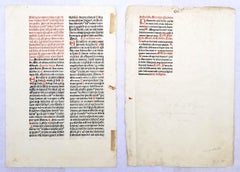
Set of Two Leaves from "Missale Frisingense" /// German Catholic Incunabula 15th
Located in Saint Augustine, FL
Artist: Erhard Ratdolt (German, 1442-1528)
Title: "Preface Page" and "Page CVI - 106"
Portfolio: Missale Frisingense
Year: 1492 (First edition)
Medium: Set of Two Original Incunabula Leaves on watermarked laid paper
Limited edition: Unknown
Printer: Erhard Ratdolt, Ausburg, Germany
Publisher: Sixtus of Tannberg, Freising, Germany
Reference: Hain No. 11303; Weale/Bohatta No. 396; Schreiber No. 4699; Pell No. 7944
Sheet size (each): approx. 11.94" x 8.13"
Condition: "Preface Page" has the occasional wormhole. Remnants of tape, a tape and a paper clip stain along its edge. Minor foxing and soiling mainly in margins. "Page CVI - 106" has remnants of tape and a small stain along its left edge. Light foxing and soiling about its sheet with some general edge wear. Have been professionally stored away for decades. They are both otherwise strong impressions in good condition with strong colors
Very rare
Notes:
Comes from Ratdolt's one volume "Missale Frisingense", (1492) (First edition), which consists of 576 pages of Gothic texts in Latin with red rubricated initials, music, and woodcut engraved illustrations. Printed in Augsburg by Erhard Ratdolt on March 17, 1492. "Preface Page" has a bull's head and cross watermark in the upper center of its sheet. Some information and old prices inscribed in pencil to their sheets.
A missal is a book that contains the prayers, chants, biblical readings, and rubrics for celebrating Mass. The first missals were found in monasteries in the 12th and 13th centuries. The term missale is Latin for "Mass book".
Biography:
Erhard Ratdolt (1442–1528) was an early German printer from Augsburg. He was active as a printer in Venice from 1476 to 1486, and afterwards in Augsburg. From 1475 to 1478 he was in partnership with two other German printers. The first book the partnership produced was the Calendarium (1476), written and previously published by Regiomontanus, which offered one of the earliest examples of a modern title page. Other noteworthy publications are the "Historia Romana of Appianus" (1477), and the first edition of "Euclid's Elements" (1482), where he solved the problem of printing geometric diagrams, the "Poeticon astronomicon", also from 1482, "Haly Abenragel" (1485), and "Alchabitius" (1503). Ratdolt is also famous for having produced the first known printer's type specimen...
Category
15th Century and Earlier Old Masters More Prints
Materials
Laid Paper, Woodcut
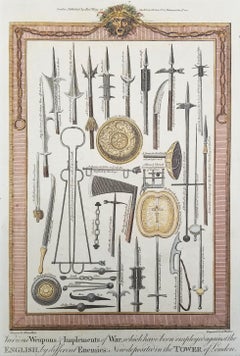
Various Weapons
Implements of War /// Edward Barnard
s "History of England"
Located in Saint Augustine, FL
Artist: Edward Barnard (English, 1717-1781)
Title: "Various Weapons & Implements of War ... Which have been Employed Against the English, by Different Enemies: Now Deposited in the Tower of London"
Portfolio: New Complete and Authentic History of England
Circa: 1785
Medium: Original Hand-Colored Etching on laid paper
Limited edition: Unknown
Printer: Alex Hogg, London, UK
Publisher: Alex Hogg, London, UK
Sheet size: 15.38" x 9.63"
Image size: 11.75" x 7.94"
Condition: Slight toning to edges. Has been professionally stored away for decades. It is otherwise a strong impression in excellent condition
Notes:
Provenance: private collection - Cheltenham, UK. Engraved by English artist George Walker (1781-1856) after a drawing by English artist William Hamilton (1751-1801). Comes from Barnard's one volume "New Complete and Authentic History of England", (1783, 1785, 1790) (First - third editions), which consists of 105 engravings. Printed in one color from one copper plate: black.
Biography:
Edward Barnard (1717-1781) was an English cleric and academic, provost of Eton from 1764. Barnard was second son of Rev. George Barnard...
Category
1780s Old Masters More Prints
Materials
Watercolor, Laid Paper, Engraving, Intaglio
Related Items
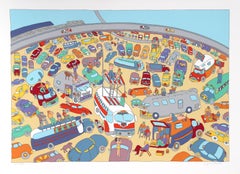
Daytona 500, 1970s Pop Art Screenprint by Seymour Chwast
By Seymour Chwast
Located in Long Island City, NY
Artist: Seymour Chwast, American (1931 - )
Title: Daytona 500
Year: circa 1979
Medium: Serigraph, signed and numbered in pencil
Edition: 250
Image Size:...
Category
1970s Pop Art More Prints
Materials
Screen
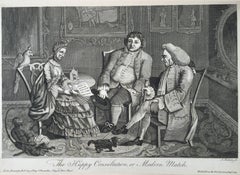
The Happy Consultation, or Modern Match
Located in Santa Monica, CA
EIGHTEENTH CENTURY BRITISH CARICATURE
THE HAPPY CONSULTATION, or MODERN MATCH, 1769 (DG 4335)
...
Category
1760s Old Masters More Prints
Materials
Engraving

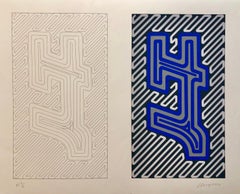
1970
s Large Silkscreen Abstract Geometric Day Glo Serigraph Pop Art Print Neon
By Chryssa Vardea-Mavromichali
Located in Surfside, FL
Silkscreen on Arches paper, Hand signed and Numbered in Pencil. Serigraph in white, back, blue gray (silver).
Chryssa Vardea-Mavromichali (Greek: Χρύσα Βαρδέα-Μαυρομιχάλη; December 31, 1933 – December 23, 2013) was a Greek American artist who worked in a wide variety of media. An American art pioneer in light art and luminist sculpture widely known for her neon, steel, aluminum and acrylic glass installations, she has always used the mononym Chryssa professionally. She worked from the mid-1950s in New York City studios and worked since 1992 in the studio she established in Neos Kosmos, Athens, Greece.
Chryssa was born in Athens into the famous Mavromichalis family from the Mani Peninsula. one of her sisters, who studied medicine, was a friend of the poet and novelist Nikos Kazantzakis.
Chryssa began painting during her teenage years and also studied to be a social worker.In 1953, on the advice of a Greek art critic, her family sent her to Paris to study at the Académie de la Grande Chaumiere where Andre Breton, Edgard Varese, and Max Ernst were among her associates and Alberto Giacometti was a visiting professor.
In 1954, at age twenty-one, Chryssa sailed for the United States, arrived in New York and went to San Francisco, California to study at the California School of Fine Arts. Returning to New York in 1955, she became a United States citizen and established a studio in the city.
Chryssa's first major work was The Cycladic Books preceded American minimalism by seventeen years.
1961, Chryssa's first solo exhibition was mounted at The Guggenheim.
1963, Chryssa's work was shown at the Museum of Modern Art in curator Dorothy Canning Miller's Americans 1963 exhibition. The artists represented in the show also included Richard Anuszkiewicz, Lee Bontecou, Robert Indiana, Richard Lindner, Marisol, Claes Oldenburg, Ad Reinhardt, James Rosenquist and others.
1966, The Gates to Times Square, regarded as "one of the most important American sculptures of all time" and "a thrilling homage to the living American culture of advertising and mass communications." The work is a 10 ft cube installation of two huge letter 'A's through which visitors may walk into "a gleaming block of stainless steel and Plexiglas that seems to quiver in the play of pale blue neon light" which is controlled by programmed timers. First shown in Manhattan's Pace Gallery, it was given to the Albright-Knox Art Gallery in Buffalo, New York in 1972.
1972, The Whitney Museum of American Art mounted a solo exhibition of works by Chryssa.
That's All (early 1970s), the central panel of a triptych related to The Gates of Times Square, was acquired by the Museum of Modern Art between 1975 and 1979.
1973, Chryssa's solo exhibition at the Gallerie Denise René was reviewed for TIME magazine by art critic Robert Hughes before it went on to the Galleries Denise René in Düsseldorf and Paris.
Other works by Chryssa in composite honeycomb aluminum and neon in the 1980s and 1990s include Chinatown, Siren, Urban Traffic, and Flapping Birds.
Chryssa 60/90 retrospective exhibition in Athens in the Mihalarias Art Center. After her long absence from Greece, a major exhibition including large aluminum sculptures - cityscapes, "neon boxes" from the Gates to the Times Square, paintings, drawings etc. was held in Athens.
In 1992, after closing her SoHo studio, which art dealer Leo Castelli had described as "one of the loveliest in the world," Chryssa returned to Greece. She found a derelict cinema which had become a storeroom stacked with abandoned school desks and chairs, behind the old Fix Brewery near the city center in Neos Kosmos, Athens. Using the desks to construct enormous benches, she converted the space into a studio for working on designs and aluminum composite honeycomb sculptures...
Category
1980s Pop Art Abstract Prints
Materials
Screen
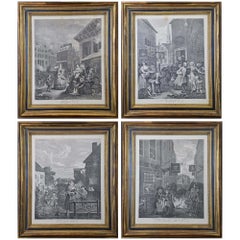
Four Framed Hogarth Engravings "Four Times of the Day"
By William Hogarth
Located in Alamo, CA
The four plates in this "Four Times of the Day" set were created utilizing both engraving and etching techniques by William Hogarth in 1738. Hogarth's original copper plates were refurbished where needed by James Heath and these engravings were republished in London in 1822 by Braddock, Cradock & Joy. This was the last time Hogarth's original copper plates were used for printing. Most were melted down during World War I for the construction of bombs. Printed upon early nineteenth century wove paper and with large, full margins as published by William Heath in 1822. The inscription below each print reads "Invented Painted & Engraved by Wm. Hogarth & Publish'd March 25. 1738 according to Act of Parliament".
These large folio sized "Four Times of the Day" engravings/etchings are presented in complex gold-colored wood frames with black bands and scalloped gold inner trim. A majority of each thick impressive frame is covered with glass applied near the outer edge. Each frame measures 25.75" high, 22.25" wide and 1.88" deep. There are a few small dents in the edge of these frames, which are otherwise in very good condition. "Morning" has two focal areas of discoloration in the upper margin and some discoloration in the right margin, a short tear in the left margin and a short tear or crease in the right margin. "Noon" has a spot in the upper margin that extends into the upper image, but it is otherwise in very good condition. "Evening" has a faint spot in the upper margin, but it is otherwise in very good condition. "Night" is in excellent condition.
The "Four Times of the Day" series is in the collection of many major museums, including: The British Museum, The Metropolitan Museum of Art, The Tate Museum, The Chicago Art Institute and The Victoria and Albert Museum.
Through this series Hogarth is portraying early 18th century London street life at "Four Times of the Day". His characters are exhibiting their personalities, quircks, strange activities, but he also wants to draw attention the disparities between the wealthy aristocracy and the common working class.
Plate 1, "Morning" depicts morning in Covent Garden in the winter in front of Tom King...
Category
Mid-18th Century Old Masters Landscape Prints
Materials
Engraving, Etching
$6,775
H 25.75 in W 22.25 in D 1.88 in
Nude
By Tom Wesselmann
Located in New York, NY
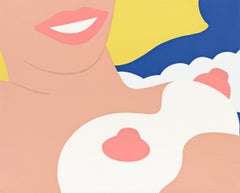
Pencil signed and numbered 115/200 in pencil on lower edge. Published by Original Editions, New York. From 11 Pop Artists, Volume II.
A spectacular, colorful image, and a Pop Art m...
Category
1960s Pop Art Nude Prints
Materials
Screen, Color
The Book of Love 5
By Robert Indiana
Located in Washington, DC
Artist: Robert Indiana
Title: The Book of Love 5
Medium: Serigraph
Date: 1996
Edition: Trial Proof (aside from the edition of 200)
Frame Size: 30" x 28 1/4"
Sheet Size: 24" x 20"
Sig...
Category
1990s Pop Art More Prints
Materials
Screen
Frankfort, Germany: A 16th Century Hand-colored Map by Braun
Hogenberg
By Franz Hogenberg
Located in Alamo, CA
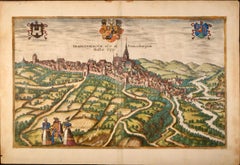
This is a 16th century original hand-colored copperplate engraved map of Frankfort, Germany entitled "Francenbergum, vel ut alij Francoburgum Hassiae Opp" by Georg Braun & Franz Hogenberg, from their famous city atlas "Civitates Orbis Terrarum", published in Cologne, Germany in 1595.
This is an English translation of an excerpt from the original text in the atlas:
"Frankenberg or, according to others, Francoburgum, a town in Hesse. Charlemagne vested the town of Frankenberg with many freedoms and privileges, which it still enjoys to this day, and on account of its valiant and victorious soldiers awarded a signet, upon which there formerly appeared a golden castle with a tower, together with the letter F and a golden crown.
Frankenberg, seen here from the northeast, lies on a hill above the River Eder. The hillside is covered with fields neatly separated by bushes and fences. Soaring above the town is the massive Liebfrauenkirche, which was modelled on St Elizabeth's church in Marburg. The New Town was founded in 1335 at the foot of the hill (right) and merged with the Old Town as late as 1556. Frankenberg was founded by Conrad of Thuringia in 1233/34 to prevent the archbishops of Mainz from expanding their sphere of influence...
Category
16th Century Old Masters Landscape Prints
Materials
Engraving
$975
H 14.75 in W 21.75 in
View of Seravalle, Italy: A 16th Century Hand-colored Map by Braun
Hogenberg
By Franz Hogenberg
Located in Alamo, CA
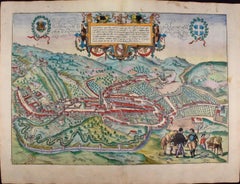
This is an original 16th century copperplate originally hand-colored engraved map of View of Seravalle, Italy entitled "Seravallum Celeberrimum Marchiae Tarvisiniae in Agro Foro Juliensi Opp. - Seravalli, quam vides, Spectator, iconem, operi huic nostro suis sumptib. . . ." by Georg Braun & Franz Hogenberg, from their famous city atlas "Civitates Orbis Terrarum", published in Augsberg, Germany in 1575.
The map depicts a view of Seravalle, now Vittorio Veneto, in San Marino, Italy, north of Venice, in a topographically accurate bird's-eye view from the south. A water-filled moat is seen to the south of the city walls and farmland to the east. Two men are depicted standing on a hill in the lower right in conversation next to grain sacks and a grazing horse, while a younger man behind them to the right herds a mule carrying presumably pigs. A very colorful and ornate title cartouche is in the upper center and coat-of-arms are in the right and left upper corners. Serravalle lies in an idyllic setting in the foothills and surrounded by orchards. St Mary's Cathedral with its tall bell tower is prominent in the center of the town. The marketplace and town hall with a bell tower in the square are depicted. Houses and shops are around the main square. Serravalle's importance as an agricultural centre is emphasized by the figures in the foreground. In 1337 Serravalle was conquered by the Republic of Venice. In 1866 the town was united with neighbouring Ceneda to form the town of Vittorio Veneto.
The following is an English translation of an excerpt from the French description of the city on the back of the map: "Serravalle, a market town renowned for cloth, wine and grain, is in such a beautiful situation that the number of its inhabitants, attracted by the loveliness of the place, has grown so much at times that the wall encircling it has had to be enlarged for the third time. The city with the surrounding town once belonged to the Church in Ceneda as an imperial fief. It subsequently became the seat of the Da Camino family (a princely house that at that time was one of the five most noble in all Italy). Now the city is under the sway of the Venetians but is prudently governed by them. For they send only one city councillor with instructions to ensure that justice prevails and to collect duties. In all else, power lies in the hands of the noble families."
This is a translation of the Latin in the title cartouche on the front: "The picture of the town of Serravalle, which you see, viewer, has been contributed to our work entirely at his own expense by Minutius, son of Hieronymus Minutius, a noble gentleman and one renowned for the far-reaching competence of his jurisdiction. We saw him sojourning in Cologne, where he was on business for Gregory XIII; while our good wishes accompany him, we should also like to accompany him on his way with this remembrance, even though it might be against his will, so that even those who have not seen him may learn of his excellence. However, those who do not yet know him will also see his excellence if God the Almighthy does not summon erring souls too soon back to the eternal seat of the Blessed."
References: Van der Krogt 4, 4728, State 1; Taschen, Braun and Hogenberg, p.331; Fauser, #14960
This striking hand-colored city view is printed on laid, chain-linked paper with wide margins. The sheet measures 16" high by 21" wide. There is a central vertical fold as issued and French text on the verso, with Latin on the front. There is some discoloration in the upper and right margins which may represent some watercolor paint from the time of the original hand-coloring of the map. There is a small hole to the right of the upper portion of the vertical fold, which is only visible when held up to light and an area of reinforcement on the verso of the lower vertical fold. The map is otherwise in very good to excellent condition.
Braun and Hogenberg's 'The Civitates Orbis Terrarum' was the second atlas of maps ever published and the first atlas of cities and towns of the world. It is one of the most important books published in the 16th century. Most of the maps in the atlas were engraved by Franz Hogenberg and the text, with its descriptions of the history and additional factual information of the cities, was written by a team of writers and edited by Georg Braun. The work contained 546 bird-eye views and map views of cities and towns from all over the world. It gave graphic representation of the main features of the illustrated cities and towns, including the buildings and streets. Although the ordinary buildings are stylized, the principal buildings are reproduced from actual drawings created on location. The principal landmarks and streets can still be recognized today. In addition, the maps often include the heraldic arms of the city, the nature of the surrounding countryside, the important rivers, streams and harbors, even depicting stone bridges, wooden pontoons, flat-bottomed ferries, ships and working boats, wharves and jetties, as well as land-based activities, including horsemen, pedestrians, wagons, coaches, and palanquins. Small vignettes are often included which illustrate the trade, occupations and habits of the local inhabitants, such as agriculture, paper-making and textiles, as well as local forms of punishment, such as gibbets, wheels, floggings etc. Large figures dressed in their local costume are often presented out of proportion in the foreground. The aim of the authors was to give as much information as possible in a pleasing visual form. They succeeded in creating maps that were both informative and decorative works of art. The atlas is a wonderful glimpse of life in medieval Europe.
Georg Braun (1541-1622) was German Catholic...
Category
16th Century Old Masters Landscape Prints
Materials
Engraving
Cartusia Bruxellensis Monastery in Brussels: A 17th C. Hand-colored Engraving
By Lucas Vorsterman the Younger
Located in Alamo, CA
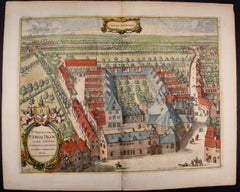
This is a 17th century hand-colored copperplate engraving entitled "Cartusia Bruxellensis" by Lucas Vorsterman, the Younger, after a drawing by Jacob van Werden or Jacques van Weerden, published in 1659 in Antonius Sanderus' book 'Chorographia sacra Brabantiae sive celebrium aliquot in ea provincia ecclesiarum et coenobiorum descriptio . . . Brussel' (A sacred chorography of Brabant, or a description of several famous churches and convents in that province). It also appeared in other publications by Sanderus. In the 17th century, Brussels was within the Duchy of Brabant.
This engraving depicts a bird's-eye view of the Scheut Carthusian Monastery in Brussels. Scheut is a district of Anderlecht, a municipality of Brussels, Belgium. The monastery housed monks, who took a vow of silence, in 20 rooms. There is a central courtyard with trees and shrubs. Monks are depicted strolling along its pathways. The cells for the friars are in the middle the cloister. There are people along the streets in the foreground and to the right of the large, imposing monastery. Some are on horseback, others are walking. In the lower right, what appears to be a dog pulls a small cart containing barrels, possibly of beer or wine. Districts and neighborhoods are labelled in the background, including Scheut, Anderlecht and Ransfort. A very ornate cartouche in the lower left contains Latin and the artist's attribution. Another decorative cartouche in the upper central area contains the title.
This beautifully hand-colored and detailed engraving is printed on laid, chain-linked paper with wide, full margins. The sheet measures 17.25" high and 21.25" wide. It has Latin text on the verso. It has a central vertical fold, as issued, which is reinforced on the verso. Two small spots in the lower margin may actually represent drops of watercolor paint used to color the engraving. It is otherwise in very good condition.
Antonius Sanderus (1586-1664) was a Flemish Catholic cleric and historian. He was born "Antoon Sanders", but Latinized his name like many writers and scholars of his time. He was the author of several books, including 'Chorographia Sacra Brabantiae', which was illustrated with this engraving.
Lucas Vorsterman the Younger (1624-between 1666 & 1676) was a Flemish Baroque engraver and draughtsman. He produced engravings after the work of contemporary painters and for books by Antwerp publishers.
Jacob van Werden or Jacques van Weerden (active 1643-1669), was a Flemish draughtsman, cartographer, military engineer and archer who was active in the Habsburg Netherlands. His drawings were used as designs for prints executed by various printmakers. He worked on maps, topographical views, historical scenes, portraits and book illustrations. He had a career as a military engineer and a member of the guard of the Spanish King. He advised on various military engineering projects and was an engineer of the Spanish army...
Category
Mid-17th Century Old Masters Landscape Prints
Materials
Engraving
"Allegory of Justice": A 17th Century Old Master Engraving by van Swanenburg
By Willem van Swanenburg
Located in Alamo, CA
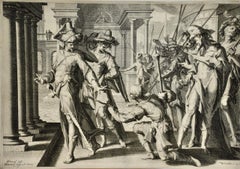
This old master engraving entitled "Allegorie op de Rechtspraak" is by Willem van Swaanenburg after a painting by Joachim Wtewael, published by Ch...
Category
Early 1600s Old Masters Interior Prints
Materials
Engraving
Hungarian Surrealism Pop Art Hebrew Silkscreen Judaica Print Jewish Serigraph
By Jozsef Jakovits
Located in Surfside, FL
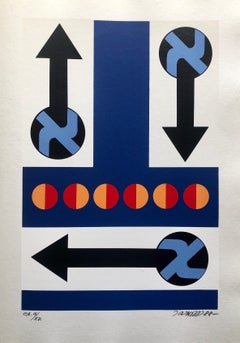
Abstract Hebrew Prints on heavy mould made paper from small edition of 15. there is a facing page of text in Hungarian folded over. Hard edged geometric abstract prints in color base...
Category
1980s Pop Art Abstract Prints
Materials
Archival Paper, Screen
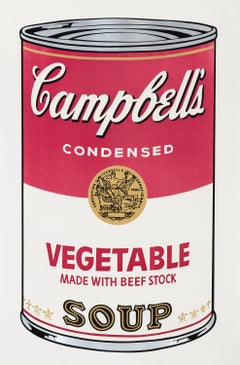
Vegetable Made With Beef Stock - Pop Art Screen Print, 1968
By Andy Warhol
Located in Palm Desert, CA
“Vegetable Made With Beef Stock” is an AP screenprint by American Pop artist, Andy Warhol. The work is AP Q/Z and is signed verso, "Andy Warhol Q"
Andy Warhol's Campbell's Soup I: Vegetable Soup (1968) is part of his first screenprint portfolio dedicated to the iconic soup cans, produced in an edition of 250 with additional artist's proofs. The speed with which the art world embraced Warhol was remarkable: in July 1962, his thirty-two Campbell's Soup Cans paintings debuted at the Ferus Gallery in Los Angeles, quickly cementing his reputation. Those early canvases, among his last hand-painted works, appeared almost mechanically produced, but Warhol soon abandoned the brush in favor of silkscreen, a commercial process that allowed for both endless repetition and striking variations of his chosen subjects. Vegetable Soup was one of the original thirty-two varieties and remains a pop culture phenomenon, continually reappearing on everything from plates and mugs to t-shirts, neckties, and even surfboards...
Category
Mid-20th Century Pop Art Still-life Prints
Materials
Screen