Hirschl Adler Abstract Prints
to
4
Overall Width
to
Overall Height
to
4
1
1
4
3
1
1
1
1
1
4
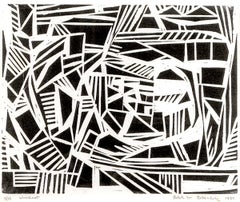
American Landscape: Houses, Gardens and Trees
By Ralph Rosenborg
Located in New York, NY
Signed (at lower right): Ralph M. Rosenborg 1939; ll: 3/15 Woodcut
Category
Mid-20th Century American Modern Abstract Prints
Materials
Woodcut
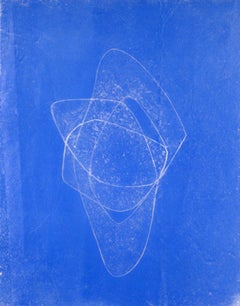
Opus Eight
Located in New York, NY
Naum Gabo was a major constructivist sculptor and highly influential member of the European avant-garde art movement. Gabo signaled a rejection of conventional sculptural modes by em...
Category
20th Century American Modern Abstract Prints
Materials
Monoprint
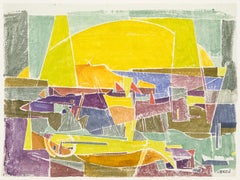
Bar Harbor
Located in New York, NY
Edition: 5 or less. One of possibly 3 variants
Category
20th Century American Modern Abstract Prints
Materials
Monotype
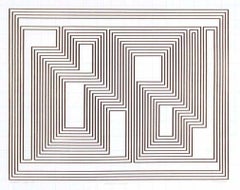
Prefatio, from the Graphic Tectonics Series
By Josef Albers
Located in New York, NY
Edition: 34. This impression is one of only two proofs printed on graph paper. Printed by Reinhard Schumann, Hickory, North Carolina. Reproduced in Formulation: Articulation (portfol...
Category
20th Century American Modern Abstract Prints
Materials
Screen
Related Items
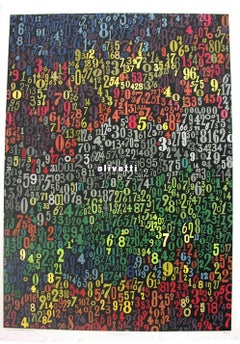
Olivetti
By Giovanni Pintori
Located in New York, NY
Pintori, Giovanni. Olivetti. 1967. 2nd printing. 1st Printing 1946.
Offset Lithograph. Rare
Giovanni Pintori (1912 – 1999) was an Italian graphic designer and painter. His most famous works are the advertisement posters for Olivetti typewriters...
Category
1960s American Modern Abstract Prints
Materials
Offset
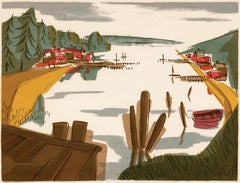
River View
— Mid-Century American Modernism
By Edward August Landon
Located in Myrtle Beach, SC
Edward Landon 'River View, color serigraph, 1942, edition 50, Ryan 159. Signed in pencil in the image, lower right. Titled, dated, and annotated '9 COLORS – 50 PRINTS' in the screen,...
Category
1940s American Modern Abstract Prints
Materials
Screen

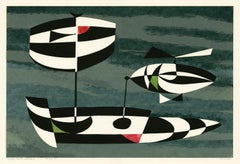
Flyable Objects Identified
— Mid-Century Modernism
By Edward August Landon
Located in Myrtle Beach, SC
Edward Landon, 'Flyable Objects Identified', color serigraph, 1969, edition 30, Ryan 83. Signed, titled, and annotated 'Edition 30' in pencil. A fine impression, with fresh colors, o...
Category
Mid-20th Century American Modern Abstract Prints
Materials
Screen
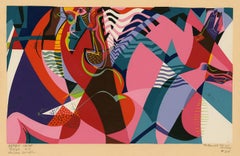
Sister Kate — Mid-century, Jazz-inspired Modernism
By James Houston McConnell
Located in Myrtle Beach, SC
James Houston McConnell, 'Sister Kate', color serigraph, 1947, edition 24. Signed, dated, titled, and numbered '24' in pencil. Annotated '10.00 - 19 colors - 24 copies - #24' in pencil. A fine impression, with vibrant, fresh colors, on heavy tan wove paper, with full margins (11/16 to 1 1/2 inches). Tack holes in the four margin corners, well away from the image, otherwise in excellent condition. Matted to museum standards, unframed. Scarce.
Another of McConnell's mid-century modernist, jazz-inspired serigraphs, 'Combo', is featured in the British Museum's 2008 publication (and traveling exhibition) 'The American Scene: Prints from Hopper to Pollock'.
ABOUT THE IMAGE
"I Wish I Could Shimmy Like My Sister Kate", often simply "Sister Kate", is an up-tempo jazz dance song, written by Armand J. Piron and published in 1922. The lyrics of the song are narrated in the first person by Kate's sister, who sings about Kate's impressive dancing skill and her wish to be able to emulate it. She laments that she's not quite "up to date", but believes that dancing like "Sister Kate" will rectify this, and she will be able to impress "all the boys in the neighborhood" like her sister.
Over the years this song has been performed and recorded by many artists, including Frances Faye and Rusty Warren, a 1959 version by Shel Silverstein...
Category
1940s American Modern Abstract Prints
Materials
Screen
$1,800
H 8.63 in W 14.07 in
Still Life — Mid-century Modern
By Charles Quest
Located in Myrtle Beach, SC
Charles Quest, 'Still Life', 1947, wood engraving, edition 8. Signed, dated, and numbered '3/8' in pencil. Titled and annotated 'wood engraving' in the bottom left margin. A fine impression, on off-white wove paper, with full margins (1 to 2 inches), in excellent condition. Scarce. Matted to museum standards, unframed.
ABOUT THE ARTIST
Charles Quest, painter, printmaker, and fine art instructor, worked in various mediums, including mosaic, stained glass, mural painting, and sculpture. Quest grew up in St. Louis, his talent evident as a teenager when he began copying the works of masters such as Michelangelo on his bedroom walls. He studied at the Washington University School of Fine Arts, where he later taught from 1944 to 1971. He traveled to Europe after his graduation in 1929 and studied at La Grande Chaumière and Academie Colarossi, Paris, continuing to draw inspiration from the works of the Old Masters.
After returning to St. Louis, Quest received several commissions to paint murals in public buildings, schools, and churches, including one from Joseph Cardinal Ritter, to paint a replica of Velasquez's Crucifixion over the main altar of the Old Cathedral in St. Louis. Quest soon became interested in the woodcut medium, which he learned through his study of J. J. Lankes' A Woodcut Manual (1932) and Paul Landacre's articles in American Artist magazine ‘since no artists in St. Louis were working in wood’ at that time. Quest also revealed that for him, wood cutting and engraving were ‘more enjoyable than any other means of expression.’
In the late 1940s, his graphic works began attracting critical attention—several of his woodcuts won prizes and were acquired by major American and European museums. His wood engraving entitled ‘Lovers’ was included in the American Federation of Art's traveling print exhibition in 1947. Two years later, Quest's two prize-winning prints, ‘Still Life with Grindstone’ and ‘Break Forth into Singing’, were exhibited in major American museums in a traveling show organized by the Philadelphia Print Club. His work was included in the Chicago Art Institute's exhibition, ‘Woodcut Through Six Centuries’, and the print ‘Still Life with Vise’ was purchased by the Museum of Modern Art in New York.
In 1951 he was invited by artist-Curator Jacob Kainen to exhibit thirty wood engravings and color woodcuts in a one-person show at the Smithsonian's National Museum (now known as the American History Museum). Kainen's press release praised the ‘technical refinement’ of Quest's work: ‘He obtains a great variety of textural effects through the use of the graver, and these dense or transparent grays are set off against whites or blacks to achieve sparkling results. His work has the handsome qualities characteristic of the craftsman and designer.’
At the time of the Smithsonian exhibition, Quest's work was represented by three New York galleries in addition to one in his home town. He had won 38 prizes, and his prints were in the collections of the Library of Congress, the Chicago Art Institute, the Metropolitan Museum, and the Philadelphia Museum of Art. In cooperation with the Art in Embassies program, his color woodcuts were displayed at the American Embassy in Paris in 1951.
Recognition at home came in 1955 with his first solo exhibition in St. Louis. Press coverage of the show heralded the ‘growth of graphic arts toward rivaling painting and sculpture as a major independent medium’.
An exhibition of his prints at the Bethesda Art Gallery in 1983 attracted Curator Emeritus Joseph A. Haller, S.J., who began purchasing his work for Georgetown University's collection. In 1990 Georgetown University Library's Special Collections Division was the recipient of a large body of Quest's work, including prints, drawings, paintings, sculpture, stained glass, and his archive of correspondence and professional memorabilia. These extensive holdings, including some 260 of his fine prints, provide a rich opportunity for further study and appreciation of this versatile and not-to-be-forgotten mid-Western American artist...
Category
1940s American Modern Abstract Prints
Materials
Woodcut
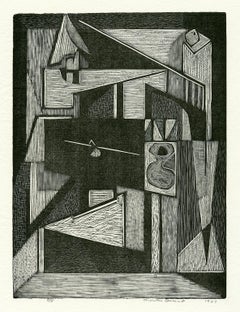
Chinoiserie
— Mid-Century Modernism
By Edward August Landon
Located in Myrtle Beach, SC
Edward Landon 'Chinoiserie', color serigraph, 1947, edition 50, Ryan 36. Signed in pencil in the image, lower right. Titled, dated, and annotated '4 COLORS – EDITION 50' in the scree...
Category
Mid-20th Century American Modern Abstract Prints
Materials
Screen
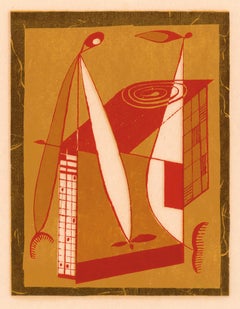
Exhortation
(Priest) — Mid-Century Modernism
By Edward August Landon
Located in Myrtle Beach, SC
Edward Landon 'Exhortation (Priest)', color serigraph, 1957, edition 28, Ryan 72. Signed, titled, and numbered '21/28' in pencil. A superb, richly-inked impression, with strong color...
Category
Mid-20th Century American Modern Abstract Prints
Materials
Screen
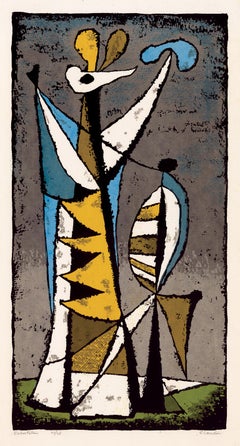
Underwater — Mid-century Modern
By Charles Quest
Located in Myrtle Beach, SC
Charles Quest, 'Underwater', 1948, chiaroscuro wood engraving, edition 12. Signed, titled, dated and numbered '3/12' in pencil. A fine, richly-inked impression, in dark brown and warm black, on off-white wove paper, with full margins (5/8 to 1 1/2 inch), in excellent condition. Scarce.
ABOUT THE ARTIST
Charles Quest, painter, printmaker, and fine art instructor, worked in various mediums, including mosaic, stained glass, mural painting, and sculpture. Quest grew up in St. Louis, his talent evident as a teenager when he began copying the works of masters such as Michelangelo on his bedroom walls. He studied at the Washington University School of Fine Arts, where he later taught from 1944 to 1971. He traveled to Europe after his graduation in 1929 and studied at La Grande Chaumière and Academie Colarossi, Paris, continuing to draw inspiration from the works of the Old Masters.
After returning to St. Louis, Quest received several commissions to paint murals in public buildings, schools, and churches, including one from Joseph Cardinal Ritter, to paint a replica of Velasquez's Crucifixion over the main altar of the Old Cathedral in St. Louis. Quest soon became interested in the woodcut medium, which he learned through his study of J. J. Lankes' A Woodcut Manual (1932) and Paul Landacre's articles in American Artist magazine ‘since no artists in St. Louis were working in wood’ at that time. Quest also revealed that for him, wood cutting and engraving were ‘more enjoyable than any other means of expression.’
In the late 1940s, his graphic works began attracting critical attention—several of his woodcuts won prizes and were acquired by major American and European museums. His wood engraving entitled ‘Lovers’ was included in the American Federation of Art's traveling print exhibition in 1947. Two years later, Quest's two prize-winning prints, ‘Still Life with Grindstone’ and ‘Break Forth into Singing’, were exhibited in major American museums in a traveling show organized by the Philadelphia Print Club. His work was included in the Chicago Art Institute's exhibition, ‘Woodcut Through Six Centuries’, and the print ‘Still Life with Vise’ was purchased by the Museum of Modern Art in New York.
In 1951 he was invited by artist-Curator Jacob Kainen to exhibit thirty wood engravings and color woodcuts in a one-person show at the Smithsonian's National Museum (now known as the American History Museum). Kainen's press release praised the ‘technical refinement’ of Quest's work: ‘He obtains a great variety of textural effects through the use of the graver, and these dense or transparent grays are set off against whites or blacks to achieve sparkling results. His work has the handsome qualities characteristic of the craftsman and designer.’
At the time of the Smithsonian exhibition, Quest's work was represented by three New York galleries in addition to one in his home town. He had won 38 prizes, and his prints were in the collections of the Library of Congress, the Chicago Art Institute, the Metropolitan Museum, and the Philadelphia Museum of Art. In cooperation with the Art in Embassies program, his color woodcuts were displayed at the American Embassy in Paris in 1951.
Recognition at home came in 1955 with his first solo exhibition in St. Louis. Press coverage of the show heralded the ‘growth of graphic arts toward rivaling painting and sculpture as a major independent medium’.
An exhibition of his prints at the Bethesda Art Gallery in 1983 attracted Curator Emeritus Joseph A. Haller, S.J., who began purchasing his work for Georgetown University's collection. In 1990 Georgetown University Library's Special Collections Division was the recipient of a large body of Quest's work, including prints, drawings, paintings, sculpture, stained glass, and his archive of correspondence and professional memorabilia. These extensive holdings, including some 260 of his fine prints, provide a rich opportunity for further study and appreciation of this versatile and not-to-be-forgotten mid-Western American artist...
Category
1940s American Modern Abstract Prints
Materials
Woodcut
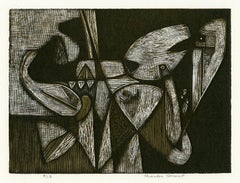
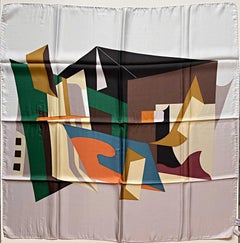
Eggbeater 1: 34 Square inch Limited Edition Silk Scarf, for the Whitney Museum
By Stuart Davis
Located in New York, NY
Stuart Davis
Eggbeater No. 1 Silk Scarf, ca. 1980
100% silks scarf
34 × 34 inches (the smaller measurements shown are after the scarf is folded, to minimize shipping costs, as it sh...
Category
Mid-20th Century American Modern Abstract Prints
Materials
Silk, Screen
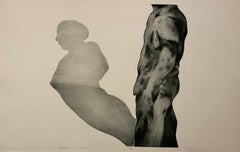
Modernist Figurative Pop Art Etching and Aquatint "the Artist" Michael Mazur
By Michael Mazur
Located in Surfside, FL
Michael Mazur
"The Artist"
Hand signed and editioned from the edition of 50
1967
Michael Burton Mazur (1935-August 18, 2009) was an American artist who was described by William Grim...
Category
Early 2000s American Modern Abstract Prints
Materials
Lithograph, Screen
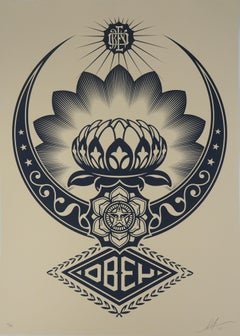
Harmony : The Lotus Flower - Tall original screenprint signed
numbered /89
By Shepard Fairey
Located in Paris, IDF
Shepard FAIREY (Obey Giant)
Harmony : The Lotus Flower
Original sceen print
Handsigned in pencil
blind stamp to margin
Numbered 42 / 89
On vellum 41 x 30 inch (c. 104 x 76 cm)
Come...
Category
2010s American Modern Abstract Prints
Materials
Screen
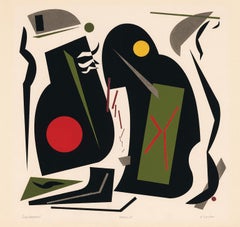
Counterpoint
— Mid-Century Modernist Abstraction
By Edward August Landon
Located in Myrtle Beach, SC
Edward Landon, 'Counterpoint', color serigraph, 1942, edition 25, Ryan 45. Signed, titled, and annotated 'Edition 25' in pencil. A fine impression, with fresh colors, on cream, wove paper; the full sheet with margins (7/8 to 2 1/2 inches). A 1 1/2 inch crease across the top left sheet corner, well away from the image, otherwise in excellent condition. Scarce.
Image size 13 9/16 x 14 5/16 inches (344 x 364 mm); sheet size 14 15/16 x 17 inches (379 x 432 mm). Matted to museum standards, unframed.
Literature:
'A Spectrum of Innovation: Color in American Printmaking', David Acton, New York, London, 1990.
'American Screenprints', Reba and Dave Williams, New York, 1987.
'The American Scene: Prints from Hopper to Pollock', Stephen Coppel, The British Museum, 2008.
Impressions of this work are held in the following museum collections: Albright-Knox Art Gallery, National Gallery of Art, Smithsonian American Art Museum.
ABOUT THE ARTIST
Born in Hartford, Connecticut, Edward Landon dropped out of high school to study art at the Hartford Art School. In 1930 and 1931 he was a student of Jean Charlot at the Art Students League in New York, after which he traveled to Mexico to study privately for a year with Carlos Merida. In 1933 he settled near Springfield, Massachusetts, painted murals in the local trade school, and exhibited with the Springfield Art League. His painting 'Memorial Day' won first prize at the fifteenth annual exhibition of the League at the Springfield Museum of Fine Arts. Landon became an active member of the Artists Union of Western Massachusetts, serving as president from 1934-1938.
Landon acquired Anthony Velonis’s instructional pamphlet on the technique of serigraphy in the late 1930s. With colleagues Phillip Hicken, Donald Reichert, and Pauline Stiriss, he began experimenting with screen printing techniques. The artists' groundbreaking work in screen printing as a fine art medium was the subject of the group’s landmark exhibition at the Springfield Museum of Fine Arts in 1940.
Landon became one of the founding members of the National Serigraph Society and served as editor of its publication, 'Serigraph Quarterly,' in the late 1940s and as its president in 1952 and 1953. The Norlyst Gallery in Manhattan held a one-person show of his prints in 1945. Awarded a Fulbright Fellowship in 1950, Landon traveled to Norway, where he researched the history of local artistic traditions and produced the book 'Scandinavian Design: Picture and Rune Stones...
Category
Mid-20th Century American Modern Abstract Prints
Materials
Screen
$3,600
H 13.57 in W 14.32 in