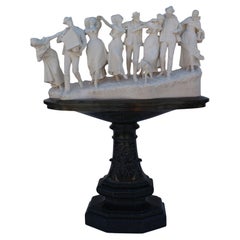
A Very Fine and Charming Italian Late 19th to early 20th-Century Carrara Marble Sculpture Group Titled “The Village Celebration” by Professor Antonio Garella (Italian, 1863-1919). The intricately, impressive and exceptionally carved statuary marble group depicting a dancing and singing group of Italian villagers, dancing and singing in a lively embrace, holding hands and arms. The joyful scene includes a figure playing an accordion, another holding a wicker basket, and a hunter with a rifle slung over his back, accompanied by his hunting dog. The sculpture is elegantly mounted on a swiveling, carved green marble pedestal. Signed: Profre A. Garella – Galleria P. Bazzanti, Firenze. Circa: Florence, 1900.
Antonio Giuseppe Garella (1863–1919) was an Italian sculptor renowned for his work in marble, alabaster, and bronze during the late 19th and early 20th centuries. Born in Ferrara (some sources cite Bologna), he trained at the Accademia di Belle Arti in Florence and in Bologna before establishing himself in Florence, where he became a prominent figure in the city’s artistic community. Often referred to as "Professor Antonio Garella," he was closely associated with the Galleria P. Bazzanti, a prestigious hub for sculpture sales and exhibitions. Garella’s career spanned the fin-de-siècle period, blending neoclassical influences with romantic, narrative themes inspired by everyday Italian life and classical antiquity. His sculptures, known for their intricate carving and emotional expressiveness, include lively portrayals, as seen in The Village Celebration. Other notable works include The Love Letter, a white marble figure of a young woman reading, evoking tender emotion; La Notte (The Night), a nude sculpture of a flying maiden above an orb; Diane of Gabii, a life-size marble inspired by classical antiquity; and Apollo and Daphne, a large marble sculpture modeled after Gianlorenzo Bernini’s 17th-century masterpiece in the Borghese Villa, Rome. In Apollo and Daphne, drawn from Ovid’s Metamorphoses, Garella captures the myth of the chaste nymph Daphne, pursued by the young god Apollo, who is bewitched by Cupid to fall in love with her. As Daphne prays to her river-god father to escape Apollo’s advances, she transforms into a laurel tree. Garella, like Bernini, sensitively carves Daphne’s feet and hands morphing into leaves and branches, while Ovid notes that Apollo can still feel her heart beating beneath the bark. Garella’s monumental commissions further highlight his prominence, including a 1904 statue of Garibaldi in Pistoia and two statues, L’Architettura and La Musica, for the Vittorio Emanuele II Monument in Rome. Though not as celebrated as Antonio Canova (1757–1822), Garella significantly contributed to Florence’s marble sculpture tradition, bridging academic styles with emerging 20th-century trends and influencing decorative arts. His masterpieces, often crafted through ateliers like Galleria P. Bazzanti, remain highly valued in European and American private collections, with limited auction records due to their scarcity in the antiques trade market.
Related Literature: A. Panzetta, Nuovo dizionario degli scultori italiani, Turin, 2003, vol. I.
Museums:
• Museo Civico di Prato (Prato Civic Museum) - Prato, Italy
Ritratto di Filippino Lippi (Portrait of Filippino Lippi)
Bronze and marble bust portraying the Renaissance painter Filippino Lippi (1457–1504), reflecting Garella's skill in portraiture and historical homage.
• Fondazione Sgarbi (Sgarbi Foundation; a private cultural institution with museum-like functions, focused on art collections) - Ro Ferrarese, Italy
Saffo (Sappho) Polymaterial bust (likely marble and other media) depicting the ancient Greek poet Sappho, emphasizing classical themes.
• Muzeum Palac-Herbsta – Łódź,
Poland...