JS Collectibles Mobiles and Kinetic Sculptures
to
1
1
1
1
1
1
1
Height
to
Width
to
1
1
1
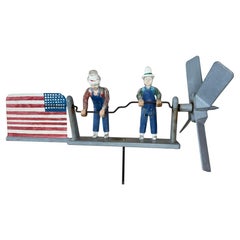
Patriotic Flag Whirligig
Located in Lancaster, PA
Celebrate American craftsmanship with this charming c. 1940 patriotic whirligig. Crafted from wood and metal, this delightful piece features two men and an American flag, capturing a...
Category
Mid-20th Century North American Folk Art Mobiles and Kinetic Sculptures
Materials
Paint

$3,000
Related Items
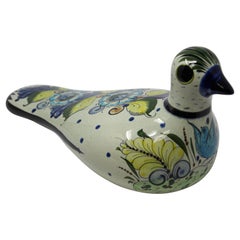
Tonala Folk Art Bird Mexican Hand Painted Colorful Pottery 1960s
By Tonala Pottery
Located in Moreno Valley, CA
Tonala Folk Art Pottery Plate Hand Painted Flying Bird, Mexico, circa 1960's.
Vintage Mexican Tonala hand painted pottery bird Folk Art.
Flora de la Cruz ...
Category
Mid-20th Century Mexican Folk Art Animal Sculptures
Materials
Ceramic
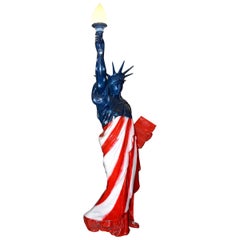
Liberty Statue United States Flag Sculpture
Located in Paris, FR
Sculpture Liberty Statue United States flag painted.
Sculpture in melting. Unique and Exceptional Piece.
Category
21st Century and Contemporary French Figurative Sculptures
Materials
Aluminum
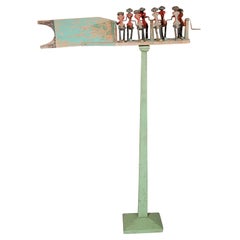
Assembly Line Folk Art Whirligig
Located in Santa Monica, CA
Amazing eight man assembly line whirligig. Attributed to an auto worker in Detroit. Fantastic original dry paint surface. Crank turns and figures move pe...
Category
Early 20th Century American Folk Art Sculptures
Materials
Wood
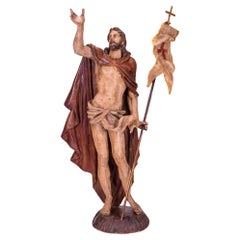
Jesus Christ the Conqueror Raising the Flag After his Resurrection, 16th Century
Located in North Miami, FL
16th Century Italian carved-wood and polychromed sculpture of Jesus Christ the conqueror raising the flag after his resurrection.
Category
Antique 16th Century Italian Renaissance Figurative Sculptures
Materials
Gold Leaf
$14,800 Sale Price
20% Off
H 33 in W 18 in D 17 in
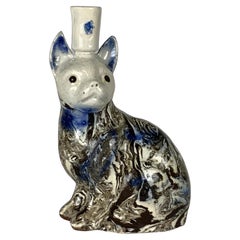
Salt-Glazed Solid Agateware Cat with Candle Holder, Staffordshire, Mid-18th C.
By Staffordshire
Located in Katonah, NY
Staffordshire, England, circa 1745 – 1760
This charming and unusual figure depicts a seated cat, its body marbled in tones of buff, grey, and warm brown, the patterns flowing like fur beneath a translucent salt glaze.
From the crown of its head rises a small candleholder—an enchanting, functional variation that transforms the cat into a decorative light for the Georgian home.
The salt-glazed surface has a gentle satin sheen, enlivened by a cobalt wash brushed across the ears and shoulders, a subtle touch of colour that draws the eye. The figure is compact and beautifully balanced, exuding both humor and grace: a work of wit and craftsmanship meant to charm and amuse as much as to illuminate.
As a pair, this cat with candleholder and its companion cat carrying a mouse form a dialogue of light and life—one playful, one practical—representing the Staffordshire potters’ genius for turning everyday subjects into artful curiosities.
Attribution and Significance
Within the history of English ceramics, agateware animals represent the marriage of experimentation and domestic charm.
They were objects of conversation—proof of a potter’s technical mastery and a household’s refinement.
This cat, with its delicate candleholder, captures that artistic playfulness and innovation.
The glaze’s clarity, the elegant pose, and the subtle marbling make it not only an artifact of mid-18th-century Staffordshire but also a small masterpiece of whimsy and craft.
Scholarly Analysis and Authentication
The figure is made from laminated clays of contrasting colors, known as laid agate, a technique perfected in Staffordshire workshops during the 1740s and 1750s.
Strata of buff, pale grey, and iron-bearing brown clay were rolled together, pressed into a two-part mold, and luted along the spine before firing.
The cat’s body thus shows true through-body marbling: the veining continues through the thickness of the clay, not merely applied on the surface.
The candle socket, made from a single buff clay rather than agate, was luted to the head before glazing.
This practical choice prevented distortion during firing and was a typical workshop economy seen in other mid-18th-century functional animal forms.
The piece was salt-glazed in a wood- or coal-fired kiln into which common salt was introduced near peak temperature.
Sodium vapor combined with the silica of the clay to form a thin, glassy coating.
Here, the glaze is smooth and even, suggesting the cat was fired within a protective sagger.
The underside of the figure is open, revealing the pressed-clay interior.
Two or three minute stilt contacts are visible on the bottom ledge, confirming that the figure rested on kiln props during firing rather than being supported from beneath a closed base.
The cobalt wash was brushed under the glaze before firing.
It fuses permanently into the surface, creating soft haloes of blue wholly consistent with decoration on salt-glazed figures from the Whieldon circle circa 1750-1760.
Later 19th-century reproductions employ overpainted enamels that sit atop the glaze.
The open underside, authentic stratified body, integrated socket, and original cobalt staining collectively identify this as a genuine product of Staffordshire’s mid-18th-century agateware tradition, most plausibly from the orbit of Thomas Whieldon at Fenton Vivian or a closely related potter.
The measured height, modelling, and marbling correspond closely to examples in the Burnap Collection (nos.. 362–363, Nelson-Atkins Museum) and Sotheby’s (2015) — “A Staffordshire agateware cat-form candlestick, circa 1755.
Provenance / Condition:
Current Condition: Excellent, with one ear repaired at the tip and restoration at the top of the candleholder; the glaze remains bright and continuous across the body and socket.
References:
Burnap Collection, English Pottery 1675–1825, nos. 362–363.
Sotheby’s (2015) — “A Staffordshire agateware cat-form candlestick, circa 1755.
Christie’s, London 2010, lot 82.
1stDibs “Staffordshire Agateware Pottery Saltglaze Figure of a Cat,” item ref LU95812370442 Price: $4,482.16
Chipstone Foundation, Marbled Agateware: Techniques and Identification, 2005.
Henry Sandon, Staffordshire Pottery, 1970, pp. 52–54.
John Howard Antiques, Antique Agateware...
Category
Antique Mid-18th Century English Folk Art Animal Sculptures
Materials
Stoneware
$3,200
H 5.5 in W 2.5 in D 3 in
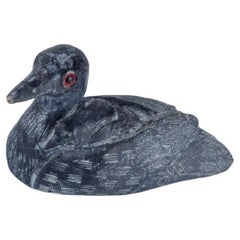
Grønlandica, Figure of a Wild Duck Made of Soapstone, Approximately 1960/1970s.
Located in København, Copenhagen
Grønlandica, figure of a wild duck made of soapstone.
Approximately 1960/1970s.
In good condition, signs of use.
Marked.
Dimensions: L 7.5 x D 3.0 x H 5.0 cm.
Category
Vintage 1960s Greenlandic Folk Art Animal Sculptures
Materials
Soapstone
$200
H 1.97 in W 2.76 in D 1.19 in
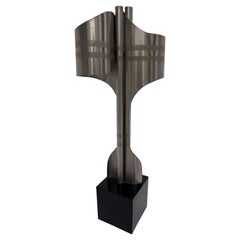
Contemporary Brazilian Metal Flag Sculpture, 2012
Located in Miami, FL
Contemporary Brazilian modern steel flag sculpture on black acrylic box by unknown artist. Signed and dated.
Category
21st Century and Contemporary Brazilian Modern Abstract Sculptures
Materials
Steel
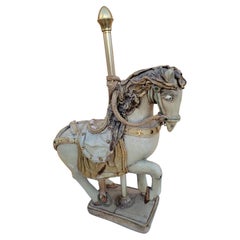
Vintage Leather Carousel Horse Signed By Teresa Corning
Located in Chicago, IL
Vintage Leather Carousel Horse Signed By Teresa Corning
This Antique Carousel Horse is made of leather and the pole is made of metal. The sculpture is fa...
Category
Late 20th Century American Folk Art Animal Sculptures
Materials
Metal
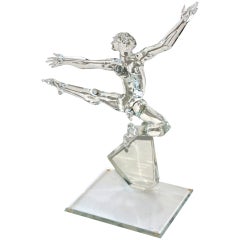
Nude glass male dancer
Located in Palm Springs, CA
A great looking glass sculpture of a male nude dancer with incredible detail. Please see the work in the hands and feet.
Category
Late 20th Century Unknown Folk Art Sculptures
Materials
Glass
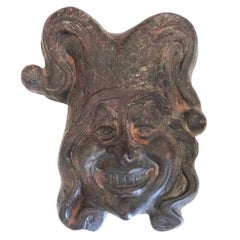
Rare 19th Century Cast Iron Court Jester Folk Art Hanging Sculpture
Located in Los Angeles, CA
Fantastic 19th century wall hanging folk sculpture of the English court jester, looks like the joker. This folky cast sculpture looks like it was somethi...
Category
Antique 19th Century American Folk Art Sculptures
Materials
Iron
$3,080 Sale Price
20% Off
H 15 in W 12 in D 3 in
Small Sailor Whirligig, circa 1930-1940
Located in Nantucket, MA
Figural standing sailor whirligig, carved from Pine wearing a white hat with metal brim,
a blue sailor’s middy with scarf, striped red and white unde...
Category
Early 20th Century American Folk Art Sculptures and Carvings
Materials
Pine
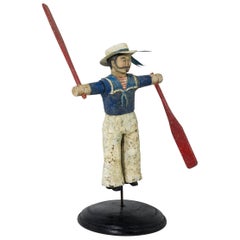
Early 20th Century American Double Sided Whirligig Figure
Located in London, GB
Early 20th century American double sided whirligig figure
A brilliant example of early 20th century American Folk Art. In the form of a hand carved wooden double sided whirligig f...
Category
Antique Early 1900s American Folk Art Figurative Sculptures
Materials
Pine