JAD Antiquités Décoration Paintings and Screens
to
3
6
6
5
1
3
2
2
1
4
3
2
1
1
6
6
6
1
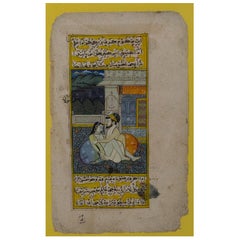
Indo-Persian miniature on paper – erotic scene – 19th century
Located in Beuzevillette, FR
Painted manuscript sheet, inks and opaque gouache enhanced with gold on paper, text in nasta‘līq in cartouches at the top and bottom. The central composition depicts a couple embracing in a garden pavilion, with delicate treatment of fabrics and architectural decorations, and a fresh palette (blues, greens, ochres). A typical work in the tradition of Indo-Persian miniatures...
Category
Antique Late 19th Century Paintings and Screens
Materials
Paper
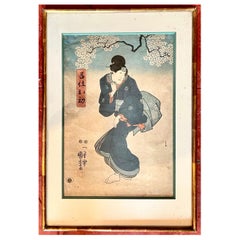
Japanese ukiyo-e woodblock print – Woman under Cherry Blossoms – signed Kunisada
Located in Beuzevillette, FR
A superb Japanese ukiyo-e woodblock print depicting an elegant young woman wearing a blue kimono, walking beneath cherry blossoms in spring. This poetic and refined scene perfectly i...
Category
Antique 19th Century Japanese Edo Paintings and Screens
Materials
Paper
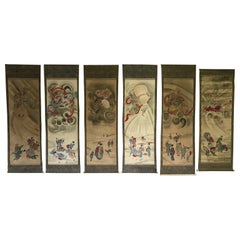
Set of 6 Large Kakemonos Japanese Mythology, 19th Century Japan circa 1800 Edo
Located in Beuzevillette, FR
Beautiful set of 6 large kakemonos from 19th century Japanese mythology.
Paper support with a canvas pasted on the paper
Wonderful set that is part of Japan's history and beliefs
When not hung, the Kakemonos are rolled up.
circa 1800 - Japan - Edo Period
A kakemono translates as "object to hang". In Japan this refers to a painting or calligraphy, most often done on silk or paper framed in a scroll that was intended to be hung on walls or in public lighting. This particular form, which allows them to be in a roll, dates back to the Tang dynasty in China (this would be related to the copying and preservation of ancient Buddhist texts). A Kami is a deity or spirit worshipped in the Shinto religion. A Yokai is a spirit, ghost, demon, or strange apparition from the creatures of Japanese folklore.
Each of these kakemonos represents a unique story:
- A kami, a Japanese deity, is shown painting a rainbow. Indeed, he performs the action with his right hand while his left hand holds a kind of basket with three pots of paint. This kami has a rather closed attitude. He is standing in a dark and tormented sky. Below this figure, 8 villagers are dressed in traditional Japanese clothes. Their faces are softened. They are not afraid of the elements made by the kami above their heads.
- A character with an unreal look is holding a kind of jar with his two hands, which he spills on human figures above. This being is floating in the air, probably a character from mythology, perhaps Susanoo. Underneath, villagers on umbrellas. They are trying to protect themselves as best they can from what is falling on them. One of them is carrying baskets with fish on her shoulders. A character in the background is thrown forward and falls.
- On this kakemono, the god Raijin, dressed in a white and blue outfit, strikes the sky with his two drum hammers to create lightning and its thunderous sound. Surrounded by Tomoe and a long red scarf, Raijin, enraged and with dishevelled hair, creates a dark and violent storm. The villagers seem frightened by this meteorological phenomenon. One of the villagers can be seen fainting in the arms of a man. This scene may seem chaotic, but Japanese legend tells us that once a field is struck by lightning, the harvest is good.
- On this kakemono, we see an unreal-looking figure holding a fan, as if he were sweeping away the bad weather, or simply producing gusts of wind. He is probably the kami of wind and air, Shina tsu-hiko. The figures below him seem surprised by so much wind. An umbrella flies away on the left, the women hold their hair and scarf, the clothes are caught in the power of the wind, there is even a woman on the ground on the bottom left.
- This Kakemono represents a short moment. This Raiju is a yokai (ghost spirit...
Category
Antique 19th Century Japanese Edo Paintings
Materials
Paper

$2,594 Sale Price / set
20% Off
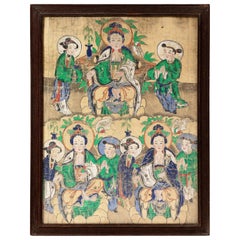
Immortal He Xiangu Painting on Canvas, China, 19th Century Asian Art
Located in Beuzevillette, FR
Chinese painting depicting He Xiangu reproduced three times but with a different attribute: up a lotus flower, bottom left a fly hunt and bottom right again the lotus flower, each time surrounded by disciple the one praying right, the one on the left seems to bring him a bowl.
Pigments on linen or hemp,
19th century.
He Xiangu or Ho Hsien-ku, "Immortal Demoiselle He," is an immortal Taoist, a member of the group of Eight Immortals. She is represented holding in her hand a lotus symbolizing spiritual fulfillment, and sometimes also a sheng, a peach of immortality, a wooden ladle...
Category
Antique 19th Century Chinese Qing Paintings and Screens
Materials
Canvas
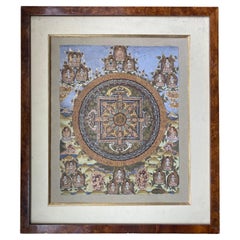
Asian Mandala Tanka circa 1900
Located in Beuzevillette, FR
Very beautiful tanka mandala of the 19th century painted on canvas . Buddha is in the center with the naga on his right arm, surrounded by others arranged like the rays of the sun. T...
Category
Antique 19th Century Asian Paintings and Screens
Materials
Canvas
$461 Sale Price
20% Off
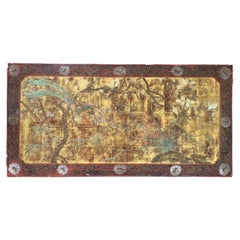
A.Bouverat Chinese Inspired Lacquered Panel Hand-Painted 20th Century
By A. Bouverat
Located in Beuzevillette, FR
Very beautiful rare and large lacquer of Chinese inspiration. Representation of a green space with many plants such as cherry trees and magnolia. A bird crosses the lacquer with its ...
Category
20th Century French Chinoiserie Paintings
Materials
Lacquer
$1,153 Sale Price
20% Off
Related Items
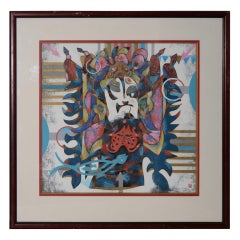
20th Century Chinese Abstract Painting by Qu Jian Xiong
Located in San Francisco, CA
Chinese painting by Qu Jian Xiong
Fantastic original painting by noted Chinese artist Qu Jian Xiong.
Original mixed media with paints and inks. Dimensions 23" x 23".
The fra...
Category
Late 20th Century Chinese Paintings and Screens
Materials
Paper
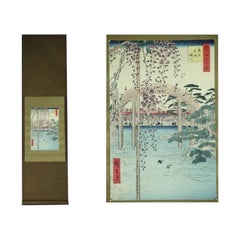
Hiroshige Utagawa "One Hundred Famous Views of Edo Kameido" Woodblock Ukiyo-e
Located in Amsterdam, Noord Holland
Hiroshige Utagawa "One Hundred Famous Views of Edo Kameido"
Condition
vertical width /114.5cm width /30.3Cm (actual paper) vertica...
Category
20th Century Japanese Edo Paintings and Screens
Materials
Bronze
$864 Sale Price
20% Off
H 45.08 in W 11.93 in D 0.04 in
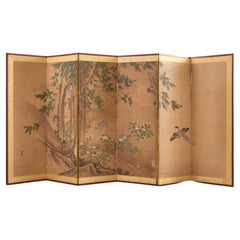
19th Century Japanese Edo Six Panel Kano School Landscape Screen
Located in Rio Vista, CA
Late Edo period 19th century Japanese six-panel landscape screen featuring a cypress tree over a flowering hibiscus with a pair of hototogisu birds. Kano school painted with ink and ...
Category
Antique 19th Century Japanese Edo Paintings and Screens
Materials
Silk, Wood, Paper
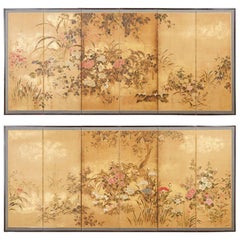
Pair of Japanese Edo Rimpa School Screens after Tawaraya Sōtatsu
Located in Rio Vista, CA
Impressive pair of 17th century Japanese Edo period Rinpa school screens made in the manner and style of Autumn Grasses by Tawaraya Sōtatsu (1570-1640). Beautifully decorated with wi...
Category
Antique 17th Century Japanese Edo Paintings and Screens
Materials
Gold Leaf
$26,000 / set
H 60.5 in W 131 in D 0.75 in
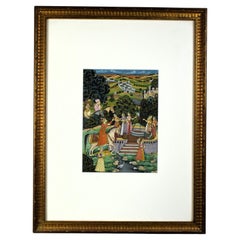
Mughal Miniature of Shah Jahan on a Leisure Stroll, 19th Century
Located in Islamabad, PK
The Mughal miniature painting, meticulously crafted with a single-hair brush on fine rice paper, captures a serene and elegant scene of Emperor Shah Jahan taking a leisurely stroll o...
Category
Antique Mid-19th Century Indian Anglo Raj Paintings and Screens
Materials
Paint, Paper
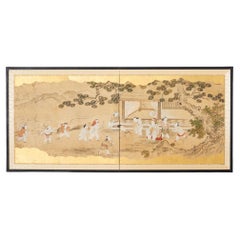
19th Century Japanese Edo Screen Kano School Garden Terrace
Located in Rio Vista, CA
Fantastic 19th century Japanese Edo/Tokugawa period two-panel byobu screen featuring Chinese children frolicking on a garden terrace with a pavilion and large pine tree. Made in the ...
Category
Antique 19th Century Japanese Edo Paintings and Screens
Materials
Brass, Gold Leaf
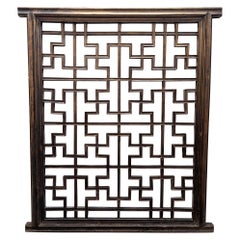
19th Century Chinese Window Lattice Panel Screen
Located in New York, NY
19th Century Window Lattice Screen. Very special Lattice Screen Window Panel from Shanxi China 19th century. Wonderfully assembled sculpted pieces of Cypress wood with each face ro...
Category
Antique Mid-19th Century Chinese Qing Paintings and Screens
Materials
Cypress
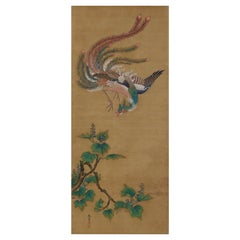
19th Century Japanese Silk Painting by Kano Chikanobu, Phoenix
Paulownia
Located in Kyoto, JP
Birds & Flowers of the seasons
Pheasants & Plum in Snow
Unframed painting. Ink, pigment and gofun on silk
Kano Chikanobu 1819-1888
Signature...
Category
Antique Mid-19th Century Asian Edo Paintings and Screens
Materials
Silk
$4,500
H 46 in W 19.5 in D 0.01 in
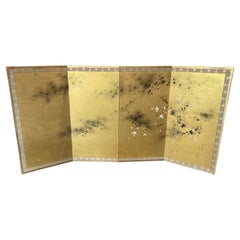
Japanese Asian Signed Four Panel Folding Byobu Cherry Blossom
Pine Tree Screen
Located in Studio City, CA
A gorgeous four-panel Showa Period Japanese Byobu folding screen featuring luminous cherry blossoms amongst the branches of a venerable pine tree. A very serene, tranquil, and peace...
Category
Mid-20th Century Japanese Showa Paintings and Screens
Materials
Silk, Paint
$1,595
H 36 in W 72.5 in D 0.75 in
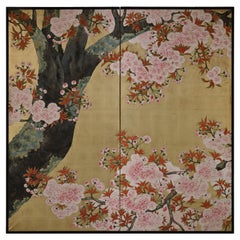
Early 20th Century Japanese Cherry Blossom Screen by Kano Sanrakuki
Located in Kyoto, JP
Cherry Blossoms
Kano Sanrakuki (1898-1981)
Showa period, circa 1930
2-panel Japanese Screen
Color, gofun and gold leaf on paper
Against a backdrop of gold-leafed ground, the lichen covered trunk and branches of the life-sized cherry blossom tree reach out and beyond the confines of the pictorial surface. The overall composition has a feeling of flatness which draws emphasis to the surface and the three-dimensionality of the cherry blossoms. Painstakingly built-up layers of thickly applied shell-white gofun detail the voluminous blossoms and cover large areas of this tour-de-force of Japanese Nihonga painting. By simplifying the background, minimizing the number of colors and depicting the blossoms with such heavy relief, the artist has emphasized the stunning presence of the cherry tree. The type of tree depicted is the Yae-Zakura; a double-layered type of cherry blossom famed for its beauty and strength. When we think of Japanese cherry blossoms, the first thing that comes to mind is Somei Yoshino variety, which has a single flower with five almost white petals. This type is fragile and easily blown away by strong wind or rain. Most of the double-flowered cherry blossoms begin to bloom when the Somei-Yoshino falls, and the flowering period lasts longer than that of the Somei-Yoshino.
Kano Sanrakuki originally studied painting at the Kyoto City Arts and Crafts School under the tutelage of Yamamoto Shunkyo...
Category
Early 20th Century Japanese Showa Paintings and Screens
Materials
Gold Leaf
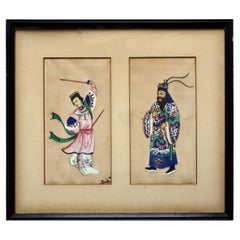
19th C Royal Couple; Pair Chinese Pith Paintings Qing Dynasty. China, Circa 1855
Located in Incline Village, NV
Lovely and authentic all original mid 19th century pair of small Chinese Pith Paintings; under glass and double matted in a single plain narrow black straight reeded trimmed wooden f...
Category
Antique 1850s Chinese Qing Paintings and Screens
Materials
Paper
$395
H 10 in W 11.25 in D 0.5 in
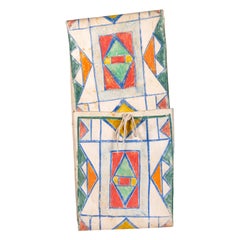
Plateau Parfleche Envelope, circa 1900
By Plateau Indians
Located in Coeur d
Alene, ID
Plateau painted parfleche envelope painted in green, blue, orange, yellow and red.
Period: circa 1900
Origin: Plateau
Size: 28" L x 12" W.
Family ...
Category
Antique Early 1900s American Native American Native American Objects
Materials
Other