Leighton Fine Art Ltd Drawings and Watercolor Paintings
to
2
3
2
Overall Width
to
Overall Height
to
7
3
1
3
5
1
1
3
3
1
2
2
2
1
1
1
1
6
5
4
3
2
3
1
1
1
1
7
7
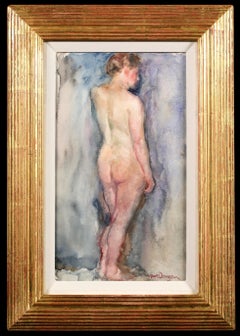
Un nu feminin - Fauvist Nude Figurative Watercolour by Kees Van Dongen
By Kees van Dongen
Located in Marlow, Buckinghamshire
Signed nude watercolour on paper circa 1900 by Kees van Dongen. The piece depicts a standing nude woman with her hair tied up facing away from the artist. This superb work can be dir...
Category
Early 1900s Fauvist Nude Drawings and Watercolors
Materials
Paper, Watercolor
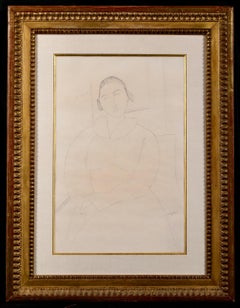
Portrait of Berthe Lipchitz - Modern Portrait Pencil Drawing - Amedeo Modigliani
By Amedeo Modigliani
Located in Marlow, Buckinghamshire
Signed pencil on paper portrait drawing by Italian artist Amedeo Clemente Modigliani. The portrait is of Berthe Lipchitz who was the wife of Modigliani's friend, the sculptor Jacques Lipchitz. This work is a study for "Portrait of Jacques & Berthe Lipchitz" which hangs in the Art Institute of Chicago.
Signature:
Signed lower right
Dimensions:
Framed: 26.75"x18.25"
Unframed: 18.75"x12.25"
Provenance:
The collection of Leopold Survage
The collection of Dimitri Snegaroff
The collection of Leopold Zborowski
Galerie Charpentier - Paris 1958
Private french collection
Galerie Pierre Levy - Paris
Private collection - United Kingdom
Exhibited:
Galerie Charpentier - Cent Tableaux de Modigliani - Paris, 1958
Les Peintres de Zborowski - ~Foundation L'Hermitage, Lausanne 1994
Amedeo Modigliani Exhibition - Museo d'Arte Moderna, Lugano 1999
Amedeo Modigliani was born into a middle-class Jewish family and was the brother of Eugenio Modigliani, who later became the leader of the Italian socialist workers’ party prior to the rise of fascism. Modigliani suffered from poor health as a child and contracted pleurisy in 1895, followed in 1898 by typhus with pulmonary complications, which culminated in tuberculosis in 1901. He moved to Livorno to study under Guglielmo Micheli, who had himself been a pupil of Giovanni Fattori, one of the Macchiaioli group of painters who worked in strong colour patches (macchie) to achieve vivid light and colour effects; their approach came as a reaction against academic art in Italy and, in much the same way as the French Impressionists, they advocated painting from nature rather than aspiring to communicate any particular message or ideology. In 1902, Modigliani enrolled at the academy of fine arts in Florence. He travelled to Rome and Venice in 1903, where he devoted the bulk of his day to visiting museums. At around this time he started to read Dante, dreaming no doubt of the Vita Nuova; he also devoured the works of Leopardi, Carducci, d’Annunzio, Spinoza and Nietzsche.
In 1906, Modigliani moved to Paris, lodging at the Rue Caulaincourt. At that juncture, nothing about him appeared to presage the brilliant career that was to follow. His arrival in the artists’ quarter, then known colloquially as the maquis - the labyrinthine tangle of narrow streets around today’s Avenue Junot in Montmartre - went virtually unnoticed by the artists already living and working there, including Picasso, Braque and Derain. Modigliani’s painting made next to no immediate impact and he was recognised primarily on account of his frail constitution, flashing eyes, innate elegance and intellectual prowess. He was accepted in the community that was Montmartre but never belonged to any particular ‘set’ or circle, and there is no record of his ever having been invited to Pablo Picasso’s studio, the famous ‘wash house’.
The literate and highly articulate Modigliani opted instead for the companionship of Maurice Utrillo, an instinctual painter of whom it could charitably have been said that his conversation was, at best, limited. Nonetheless, Modigliani and ‘Litrillo’ (as Utrillo was commonly known to the street urchins - the ‘p’tits poulbots’) began to frequent the cabarets and dance halls of the Butte de Montmartre, and the nefarious hashish dens - post-Baudelaire ‘institutions’, frequented in the main by out-of-work writers and talentless artists. Modigliani developed an addiction, which, compounded by his alcoholism, took its toll. It also transformed him from an artist of limited ability into one devoid of bourgeois scruples.
In his monograph, Modigliani: Sa Vie et Son Oeuvre, written in 1926 shortly after Modigliani’s death, André Salmon hinted at a ‘pact with the devil’. While somewhat overstating the case, this rather unpromising painter from Livorno metamorphosed virtually overnight into an artist of rare ability and sensitivity. The turning-point came in 1907, when Modigliani met Paul Alexandre, a doctor who befriended him, took him under his wing and purchased some of his work. The banal paintings he had turned out in Montmartre were suddenly superseded by exceptional works, produced first in Montmartre ( Cellist, 1909), and then in Montparnasse.
In Montparnasse, Modigliani started to move in artistic circles, meeting Chaim Soutine, Marc Chagall, Jules Pascin and others, all of whom lived and worked in the building in the Rue Vaugirard known as ‘La Ruche’ (‘the beehive’). Then, in the Cité Falguière, he met the Romanian-born sculptor Constantin Brancusi, who encouraged him to take up sculpture, which he did, between 1909 and 1913. In 1914, several dealers, including the erstwhile poet Léopold Zborowski and the collector Paul Guillaume, tried with little success to market Modigliani’s paintings. From 1914 to 1916, Modigliani was caught up in a tempestuous affair with the English poet and journalist Beatrice Hastings. In 1917, however, he met Jeanne Hébuterne at the Colarossi Academy, who became his constant companion and model, and who gave birth to their daughter Jeanne in 1918. In 1918 and 1919, Modigliani and Jeanne spent time in Nice on the Côte d’Azur but by 1920 he was suffering from tubercular meningitis. His friends, Kisling and the Chilean Ortiz de Zarate, brought him and a pregnant Jeanne back to Paris, where he died on January 20 1920 in the Hôpital de la Charité. His last words were reputed to be: ‘Cara Italia’. Modigliani’s brother, by this time a socialist member of parliament, telegrammed instructions to ‘bury him as befits a prince’. Jeanne Hébuterne, a budding twenty-year-old painter, killed herself and her unborn child on the day of Modigliani’s funeral by jumping to her death from a fifth-floor window.
Modigliani’s first paintings were undistinguished portraits in the Impressionist manner. After moving to Paris in 1907, his early work was influenced by the Swiss-born lithographer Théophile Alexandre Steinlen, Henri de Toulouse-Lautrec and Pablo Picasso, the latter then in his ‘blue’ period. From the onset, Modigliani’s principal preoccupation was the human figure. After the artistic (and literal) limbo of Montmartre, when his output was confined to a few Expressionist-like paintings of street life, the theatre and the circus, Modigliani suddenly erupted on the scene in 1909 with Cellist, a robust, well-constructed and vividly coloured canvas that utterly exceeded all prior expectations. He had not taken part in the protracted debates that took place nightly in Picasso’s studio, but he had superficially assimilated the Cubist ideas developed by Picasso and Georges Braque. Above all, Modigliani had been influenced by African art, which was a key feature of the Cubist movement. He succeeded in treading a fine line between the coolly analytical Cubist approach and the all-too-common European perception of African art as a succession of exaggerated facial grimaces.
It would appear that Modigliani had always been attracted to sculpture as a discipline. The friendly encouragement he received as of 1909 from Brancusi no doubt intensified his interest and reinforced his attempts to achieve a sustained simplicity of line and form. In 1910, he befriended the Russian artists Alexander Archipenko and Jacques Lipchitz, both of whom recorded Modigliani’s distaste for modelling in clay (which he referred to as ‘mud’), on the grounds that it degraded the art of sculpture. Like Brancusi, Modigliani believed in working directly, carving from wood in the case of two extant pieces, and from (sand)stone in others, with the exception of a few bronzes which were, presumably, modelled in clay before being cast into bronze. His sculpture was influenced by archaic and non-western cultures - early Graeco-Roman, African and Khmer - as well as heads carved on columns adorning the façades of Romanesque and Gothic cathedrals (Modigliani rarely sculpted a rear view of his figures). Up to approximately 1912, his sculptures take the form of tall cylinders, usually with elongated heads and shallow relief indentations or projections to indicate the hairline, facial features and neck. He departed from this style only infrequently, most notably in a small number of pieces believed to have been sculpted in 1913, which are characterised by a compressed, cubistic format and shallower and less distinct features. Modigliani eventually abandoned sculpture, presumably because of his general health and circumstances, and possibly due to the fact that his sculptures sold for even less than his paintings. During the years that he devoted to sculpture, Modigliani is recorded as producing only thirty canvases, although after 1913 his sculpture became reflected in his painting.
Following his Montmartre days, Modigliani’s work developed in both quantitative and qualitative terms, presumably helped by the relative stability of his relationship with Jeanne Hébuterne. The first paintings after his short-lived sculptural phase saw him revert briefly to Neo-Impressionist pointillism, followed by a episode marked by Cubism, which was mainly evident in portraits of friends and fellow artists living and working in Montparnasse: Henri Laurens; Juan Gris (1915); Jacques Lipchitz and his Wife; Chaim Soutine; Léopold Sauvage; Paul Guillaume; Max Jacob; Béatrice Hastings con Capello (all 1916); Mlle Modigliani (1917); Léon Bakst; Léopold Zborowski; Concierge’s Son; Adolescent (1918); Mademoiselle Lunia Czechowska; Madame Zborowska; Portrait of the Artist’s Wife (1919). A large number of other portraits exist among his drawings, most of which were executed impromptu in the street or cafés. These quickly drawn portraits often exhibit an urgency and surprising lucidity. Examples include Portrait of the Gypsy Painter Fabiano de Castro; André Salmon (1918); Portrait of the Artist’s Wife (1919); and Lada, Author; Mario, Composer (1920).
Whatever his shortcomings, Amedeo Modigliani ranks as one of the 20th-century’s greatest painters of the female form. The bulk of his painted nudes were produced in 1915-1916 (prior to that date they were predominantly drawings), and are taken from every walk of life, such as a regular at a Montparnasse café, or a waitress at the soup kitchen where he ate his meagre meals. In each instance, he invested his models with an almost aristocratic hauteur. This is exemplified in a number of paintings (usually based on numerous prior drawings): Flower Girl; Blonde Lady; Sleeping Nude (1917); Blonde Nude; Young Woman; Maria (1918); Pink Nude; Reclining Nude; Nude on a Divan; Woman with a Fan (1919); and Young Woman in a Chemise; Reclining Nude (1920). Modigliani painted his subjects in elongated, elliptic ovals: the swell of a breast, the pronounced curve of the pelvis, the fullness of the thigh, the symmetrically oval face and the graceful arabesque of the body. Facial features are reduced to a bare minimum, with the eyes typically empty, like those of a statue. He employed colour as a constructive material in much the same way as stone in sculpture, juxtaposing muted pinks, ochres and pale browns against discreet background tones supplied by décor and garments. The overall effect is to yield a flat image devoid of chiaroscuro but which captures the essence of a subject. It has often been remarked that his women, with their elongated heads and long, graceful necks, generally tilted to one side, possess a melancholy beauty akin to that of the Siena Madonnas (reproductions of which Modigliani kept pinned on his studio wall), which accounts for Modigliani’s soubriquet as the ‘painter of sorrows’. From 1917, the majority of his nudes, characterised by a more pronounced elongation of the female body and lighter palette, were modelled by Jeanne Hébuterne and Luna Czechowska.
Very few artists have been the subject of so many monographs and biographies as Modigliani; the selection appended to this entry indicates only some of the more important of these. Too much, perhaps, has been made of his life as an artiste maudit, of his ‘accursed’ yet colourful life rather than the quality of his work. Some critics have detected in him an artist of great and persistent intellectual curiosity; others emphasise that he was a ‘gentleman to the end’ and stress his physical frailty, ignoring the fact that this was an integral component of his creativity. More seriously, his posthumous fame amongst the public at large acts both for and against him, as if his subsequent popularity has become a yardstick of his artistic ability. The mannerism of his style ensures that a ‘Modigliani’ is instantly recognisable, but his success in adapting Cubism and African art to a language and palette that are entirely his own places him squarely at the heart of the modern movement.
Amedeo Modigliani’s work has featured in numerous group exhibitions, including: Paris in 1908, when he showed his Jewess and three other canvases; the Salon des Indépendants in 1910; and the Salon d’Automne in 1912, where he exhibited examples of his sculpture. His posthumous inclusion in the 1922 Venice Biennale was regarded in Italy as a complete fiasco, prompting the critic Giovanni Scheiwiller to paraphrase Charles Baudelaire’s remark to the effect that, ‘we know that precious few will understand us, but that shall be sufficient’. In 1917-1918, the Berthe Weill Gallery organised a one-man show at the instigation of Zborowski but, on the order of the then chief of police, some of Modigliani’s sensual nudes were withdrawn on account of alleged indecency. On 20 December 1918, the Paul Guillaume Gallery exhibited several paintings by Modigliani alongside others by Matisse, Picasso and Derain.
All other exhibitions of Modigliani’s work have been held since his death. They include those at the Bernheim-Jeune Gallery in Paris (1922); Galerie Bing (Paris, 1925 and 1927); Marcel Benhelm Gallery (Paris, 1931); Palais des Beaux-Arts (Brussels, 1933); Kunsthalle Basel (1934); American-British Art Center (New York, 1944); Galerie de France (Paris, 1945 and 1949); Gimpels Fils Gallery (London, 1947); Cleveland Museum of Art (1951); Museum of Modern Art (New York, 1951); Cantini Museum (Marseilles, 1958); Palazzo Reale (Milan, 1958); Galerie Charpentier (Paris, 1958); Chicago Arts Club (1959); Cincinnati Art Museum (1959); Galleria Nazionale d’Arte Moderna (Rome, 1959); Boston Museum of Fine Arts (1961); Perls Galleries (New York, 1963 and 1966); Kyoto National Museum of Modern Art (1968); Musée Jacquemart-André (Paris, 1970); Musée St-Georges (Liège, 1980); Tokyo Arts Centre (1980); Musée de l’Art Moderne de la Ville de Paris (1970; a comprehensive exhibition of Modigliani’s sculptures...
Category
1910s Modern Portrait Drawings and Watercolors
Materials
Paper, Pencil
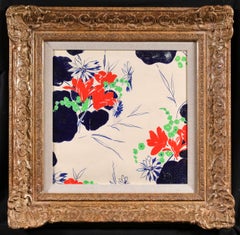
Projet de Tissus - Fauvist Flowers Watercolor
Gouache by Raoul Dufy
By Raoul Dufy
Located in Marlow, Buckinghamshire
Botanical watercolour and gouache on paper circa 1920 by French fauvist painter Raoul Dufy. The work depicts flowers in red, blue and green. This work was executed by Dufy as a fabric design.
Dimensions:
Framed: 19.5"x19.5"
Unframed: 12"x12"
Provenance:
Private collection of works by Raoul Dufy for Bianchini Ferier
Bianchini Ferrier Collection - Christie's London - July 2001
SF Fall Show
Raoul Dufy was one of a family of nine children, including five sisters and a younger brother, Jean Dufy, also destined to become a painter. Their father was an accountant in the employ of a major company in Le Havre. The Dufy family was musically gifted: his father was an organist, as was his brother Léon, and his youngest brother Gaston was an accomplished flautist who later worked as a music critic in Paris. Raoul Dufy's studies were interrupted at the age of 14, when he had to contribute to the family income. He took a job with an importer of Brazilian coffee, but still found time from 1892 to attend evening courses in drawing and composition at the local college of fine arts under Charles Marie Lhullier, former teacher of Othon Friesz and Georges Braque. He spent his free time in museums, admiring the paintings of Eugène Boudin in Le Havre and The Justice of Trajan in Rouen. A municipal scholarship enabled him to leave for Paris in 1900, where he lodged initially with Othon Friesz. He was accepted by the École des Beaux-Arts, where he studied under Léon Bonnat, whose innate conservatism prompted Dufy to remark later that it was 'good to be at the Beaux-Arts providing one knew one could leave'.
And leave he did, four years later, embarking with friends and fellow students on the rounds of the major Paris galleries - Ambroise Vollard, Durand-Ruel, Eugène Blot and Berheim-Jeune. For Dufy and his contemporaries, Impressionism represented a rejection of sterile academism in favour of the open-air canvases of Manet, the light and bright colours of the Impressionists, and, beyond them, the daringly innovative work of Gauguin and Van Gogh, Seurat, Cézanne, Toulouse-Lautrec and others. Dufy was an out-and-out individualist, however, and was not tempted to imitate any of these artists. He produced, between 1935 and 1937, Fée Electricité (Spirit of Electricity), the emblem for the French utilities company Electricité de France (EDF).
Dufy visited the USA for the first time in 1937, as a member of the Carnegie Prize jury. In 1940, the outbreak of war (and his increasingly rheumatic condition) persuaded him to settle in Nice. When he eventually returned to Paris 10 years later, his rheumatism had become so debilitating that he immediately left for Boston to follow a course of pioneering anti-cortisone treatment. He continued working, however, spending time first in Harvard and then in New York City before moving to the drier climate of Tucson, Arizona. The cortisone treatment was by and large unsuccessful, although he did recover the use of his fingers. He returned to Paris in 1951 and decided to settle in Forcalquier, where the climate was more clement. Within a short time, however, he was wheelchair-bound. He died in Forcalquier in March 1953 and was buried in Cimiez.
Between 1895 and 1898, Raoul Dufy painted watercolours of landscapes near his native Le Havre and around Honfleur and Falaise. By the turn of the century, however, he was already painting certain subjects that were to become hallmarks of his work - flag-decked Parisian cityscapes, Normandy beaches teeming with visitors, regattas and the like, including one of his better-known early works, Landing Stage at Ste-Adresse. By 1905-1906 Friesz, Braque, Matisse, Derain, Vlaminck, Van Dongen and Rouault were described collectively as Fauves (the wild beasts). What they had in common was a desire to innovate, but they felt constrained nonetheless to meet formally to set out the guiding principles of what promised to be a new 'movement'. Dufy quickly established that those principles were acceptable; moreover, he was most impressed by one particular painting by Henri Matisse ( Luxury, Calm and Voluptuousness) which, to Dufy, embodied both novelty and a sense of artistic freedom. Dufy promptly aligned himself with the Fauves. Together with Albert Marquet in particular, he spent his time travelling the Normandy coast and painting views similar...
Category
1920s Fauvist Still-life Drawings and Watercolors
Materials
Paper, Watercolor, Gouache
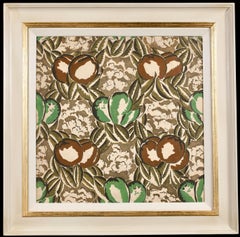
Projet de Tissus - Fauvist Still Life Study Gouache by Raoul Dufy
By Raoul Dufy
Located in Marlow, Buckinghamshire
Botanical gouache on paper circa 1920 by French fauvist painter Raoul Dufy. The work depicts a study of apples and pears. This work was executed by Dufy as a fabric design.
Dimensio...
Category
1920s Fauvist Still-life Drawings and Watercolors
Materials
Paper, Gouache
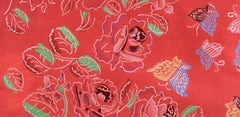
Fleurs et Papillons - Fauvist Flowers Watercolor
Gouache by Raoul Dufy
By Raoul Dufy
Located in Marlow, Buckinghamshire
Botanical watercolour and gouache on paper circa 1920 by French fauvist painter Raoul Dufy. The work depicts flowers in red and butterflies in blues, yellows, black and white. This work was executed by Dufy as a fabric design.
Dimensions:
Framed: 17"x27"
Unframed: 10"x20"
Provenance:
Private collection of works by Raoul Dufy for Bianchini Ferier
Bianchini Ferrier Collection - Christie's London - July 2001
SF Fall Show
Raoul Dufy was one of a family of nine children, including five sisters and a younger brother, Jean Dufy, also destined to become a painter. Their father was an accountant in the employ of a major company in Le Havre. The Dufy family was musically gifted: his father was an organist, as was his brother Léon, and his youngest brother Gaston was an accomplished flautist who later worked as a music critic in Paris. Raoul Dufy's studies were interrupted at the age of 14, when he had to contribute to the family income. He took a job with an importer of Brazilian coffee, but still found time from 1892 to attend evening courses in drawing and composition at the local college of fine arts under Charles Marie Lhullier, former teacher of Othon Friesz and Georges Braque. He spent his free time in museums, admiring the paintings of Eugène Boudin in Le Havre and The Justice of Trajan in Rouen. A municipal scholarship enabled him to leave for Paris in 1900, where he lodged initially with Othon Friesz. He was accepted by the École des Beaux-Arts, where he studied under Léon Bonnat, whose innate conservatism prompted Dufy to remark later that it was 'good to be at the Beaux-Arts providing one knew one could leave'.
And leave he did, four years later, embarking with friends and fellow students on the rounds of the major Paris galleries - Ambroise Vollard, Durand-Ruel, Eugène Blot and Berheim-Jeune. For Dufy and his contemporaries, Impressionism represented a rejection of sterile academism in favour of the open-air canvases of Manet, the light and bright colours of the Impressionists, and, beyond them, the daringly innovative work of Gauguin and Van Gogh, Seurat, Cézanne, Toulouse-Lautrec and others. Dufy was an out-and-out individualist, however, and was not tempted to imitate any of these artists. He produced, between 1935 and 1937, Fée Electricité (Spirit of Electricity), the emblem for the French utilities company Electricité de France (EDF).
Dufy visited the USA for the first time in 1937, as a member of the Carnegie Prize jury. In 1940, the outbreak of war (and his increasingly rheumatic condition) persuaded him to settle in Nice. When he eventually returned to Paris 10 years later, his rheumatism had become so debilitating that he immediately left for Boston to follow a course of pioneering anti-cortisone treatment. He continued working, however, spending time first in Harvard and then in New York City before moving to the drier climate of Tucson, Arizona. The cortisone treatment was by and large unsuccessful, although he did recover the use of his fingers. He returned to Paris in 1951 and decided to settle in Forcalquier, where the climate was more clement. Within a short time, however, he was wheelchair-bound. He died in Forcalquier in March 1953 and was buried in Cimiez.
Between 1895 and 1898, Raoul Dufy painted watercolours of landscapes near his native Le Havre and around Honfleur and Falaise. By the turn of the century, however, he was already painting certain subjects that were to become hallmarks of his work - flag-decked Parisian cityscapes, Normandy beaches teeming with visitors, regattas and the like, including one of his better-known early works, Landing Stage at Ste-Adresse. By 1905-1906 Friesz, Braque, Matisse, Derain, Vlaminck, Van Dongen and Rouault were described collectively as Fauves (the wild beasts). What they had in common was a desire to innovate, but they felt constrained nonetheless to meet formally to set out the guiding principles of what promised to be a new 'movement'. Dufy quickly established that those principles were acceptable; moreover, he was most impressed by one particular painting by Henri Matisse ( Luxury, Calm and Voluptuousness) which, to Dufy, embodied both novelty and a sense of artistic freedom. Dufy promptly aligned himself with the Fauves. Together with Albert Marquet in particular, he spent his time travelling the Normandy coast and painting views similar...
Category
1920s Fauvist Still-life Drawings and Watercolors
Materials
Paper, Watercolor, Gouache
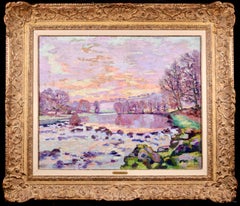
Dam at Genetin - Impressionist Oil, Winter Riverscape by Armand Guillaumin
By Jean Baptiste-Armand Guillaumin
Located in Marlow, Buckinghamshire
Signed and dated impressionist landscape oil on canvas by French painter Jean Baptiste Armand Guillaumin. This simply stunning piece de...
Category
Early 1900s Impressionist Landscape Paintings
Materials
Canvas, Oil
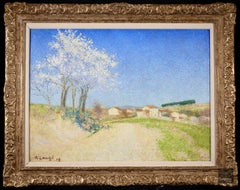
Belveze du Razes - Neo-Impressionist Pointillist Oil, Landscape by Achille Lauge
By Achille Laugé
Located in Marlow, Buckinghamshire
Stunning pointillist landscape oil on panel by French neo-impressionist painter Achille Lauge. The work depicts a path leading to the small village of Belveze du Razes in the South of France on a bright spring day. To the left are white blossom trees in bloom and the houses of the village can be seen in the distance.
Signature:
Signed and dated 1909 lower left
Dimensions:
Framed: 28"x36"
Unframed: 21"x29"
Provenance:
We kindly thank Mme. Nicole Tamburini for allowing us to state that the work is included in the Catalogue Raisonne of the artist which she is currently preparing.
A certificate of authenticity from Mme. Tamburini is available upon request.
Achille Laugé...
Category
Early 1900s Pointillist Landscape Paintings
Materials
Oil, Canvas
Related Items
Landscape. 1990. Oil on cardboard, 24x32, 5 cm
By Edgars Vinters
Located in Riga, LV
Landscape. 1990. Oil on cardboard, 24x32,5 cm
Edgars Vinters (1919-2014)
Edgars Vinters is working in oil, watercolor and monotype techniques. He paints landscapes in different seas...
Category
1990s Impressionist Landscape Paintings
Materials
Oil, Cardboard

$461 Sale Price
20% Off
H 9.45 in W 12.8 in D 0.08 in
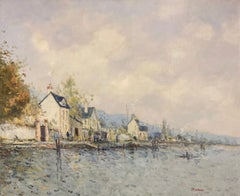
Rowboats on the Seine in Normandy - French Impressionism by Jean Pierre Dubord
Located in PARIS, FR
Conditions: Mint
We have an option for an antique style frame. Price including frame
Shipping in all Continental US and Asia or Europe included.
Jean Pierre Dubord was born in Roue...
Category
1980s Impressionist Landscape Paintings
Materials
Oil
$2,942
H 18.51 in W 21.66 in
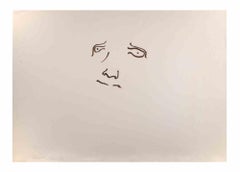
Portrait - Drawing By Reynold Arnould - 1970
Located in Roma, IT
Portrait is a Black Marker Drawing realized by Reynold Arnould (Le Havre 1919 - Parigi 1980).
Good condition on a white paper.
No signature.
Reynold Arnould was born in Le Havre...
Category
1970s Modern Portrait Drawings and Watercolors
Materials
Paper, Pencil
$336
H 11.62 in W 16.54 in D 0.08 in
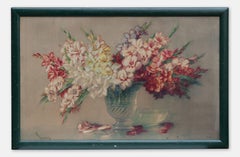
Still Life with Flowers by Isidor Rosenstock
By Isidore Rosenstock
Located in Pasadena, CA
ISIDOR Rosenstock, born in Strasbourg in 1880, died in 1956. 20th century
painter of landscapes and flowers, watercolor.
He exhibited in Paris at the Salon of French Artists, the...
Category
Late 19th Century Impressionist Still-life Drawings and Watercolors
Materials
Gouache
$1,200 Sale Price
50% Off
H 29.93 in W 45.28 in D 1.58 in
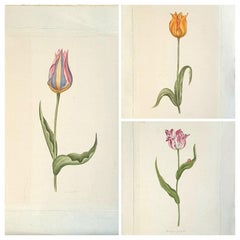
Botanical Studies, Watercolours on Silk on Handmade Paper, Set of Three Tulips.
By La Roche Laffitte
Located in Cotignac, FR
A set of three fine hand painted botanical watercolour studies on silk of tulips by La Roche Laffitte. The works are signed bottom right. Some are titled and numbered (see photos) Th...
Category
Late 20th Century Still-life Paintings
Materials
Silk, Watercolor, Handmade Paper, Gouache
$1,364 Sale Price
20% Off
H 21.19 in W 15.16 in D 0.04 in
Tender words - XX Century, Mixed Media Figurative Painting, Nude, Couple
By Katarzyna Wazyk
Located in Warsaw, PL
Gabryela Wasowicz is a Polish painter born in 1947. She studied at the Academy of Fine Arts of Warsaw and then at the Gerrit Rietveld Akademie in Amsterdam. Once she graduated in 197...
Category
1980s Contemporary Nude Drawings and Watercolors
Materials
Paper, Pastel, Watercolor, Gouache
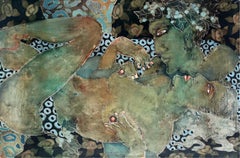
$2,281
H 27.56 in W 39.38 in
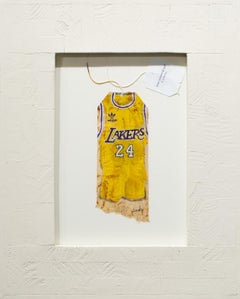
R.I.P. Kobe, Painting on Tea Bag, Tribute to Kobe Bryant
By Ruby Silvious
Located in Philadelphia, PA
This purple, white, beige and orange painting titled "R.I.P. Kobe" is an original artwork by Ruby Silvious made of watercolor and gouache on used tea bag. This...
Category
21st Century and Contemporary Contemporary Still-life Paintings
Materials
Found Objects, Watercolor, Gouache, Tea
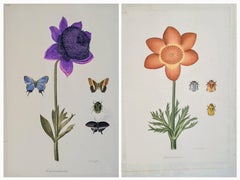
Botanical Studies, Pair of Watercolours on Silk on Handmade Paper, Anemones
Located in Cotignac, FR
A pair of fine hand painted botanical watercolour studies on silk of anemones by La Roche Laffitte. The works are signed bottom right. Both are titled. The silk has been mounted on h...
Category
Late 20th Century Still-life Paintings
Materials
Silk, Watercolor, Handmade Paper, Gouache
$984
H 21.26 in W 15.56 in D 0.04 in
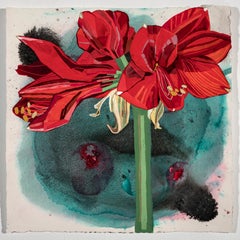
Amaryllis, Flower Painting, Bold Red Botanical Artwork, 16 x 16 Inches, Framed
By Elisabeth Condon
Located in New York, NY
Elisabeth Condon’s Memorial Flowers series reimagines the still life as a meditation on memory, impermanence, and renewal. Using gouache and ink, she stages vibrant floral arrangemen...
Category
2010s Contemporary Still-life Paintings
Materials
Ink, Gouache, Handmade Paper
Elisabeth CondonAmaryllis, Flower Painting, Bold Red Botanical Artwork, 16 x 16 Inches, Framed, 2025
$2,800
H 18 in W 18 in D 2 in
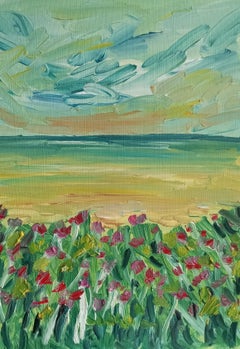
My unforgettable moments at the beach (seaside oil painting)
Located in VÉNISSIEUX, FR
This contemporary seaside artwork "My unforgettable moments at the beach" celebrates my love for the beach, sea, sand and summer vacations spent at the beach.
I explore the beauty o...
Category
2010s Impressionist Landscape Drawings and Watercolors
Materials
Paper, Oil
$504
H 12.01 in W 9.06 in D 0.04 in
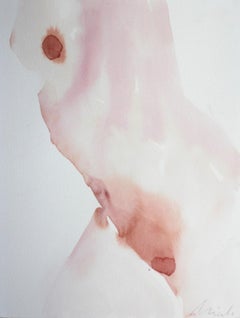
Diana - XXI Century, Watercolor Figurative Painting, Nude, Pink Shades
By Maria Iciak
Located in Warsaw, PL
MARIA ICIAK
Polish painter and art historian. She creates mainly in the technique of watercolour, exploring subjects of formal nature, balancing between abstract and figurative art.
...
Category
2010s Other Art Style Nude Drawings and Watercolors
Materials
Paper, Watercolor
$324
H 12.6 in W 9.85 in
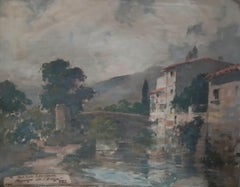
Vintage french art painting by Paul emile Lecomte - oil on canvas, signed
By Paul Emile Lecomte
Located in PARIS, FR
Old exhibition label. Free US CONTINENTAL Shipping, incl Europe and Asia.
Provenance: Artist's family, atelier sale. Excellent condition under UV light with no prior restoration. T...
Category
Late 19th Century Impressionist Landscape Paintings
Materials
Oil
$2,702
H 20.48 in W 25.6 in