Lincoln Glenn Interior Paintings
to
4
4
2
4
4
2
Overall Width
to
Overall Height
to
5
11
1
4
1
3
1
7
4
1
9
6
11
8
5
4
4
2
2
2
1
1
1
1
1
1
1
1
1
1
1
1
15
15
15
15
2
2
1
1
1
1
15
1
16
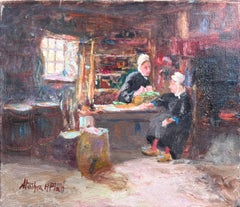
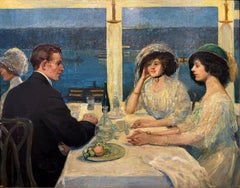
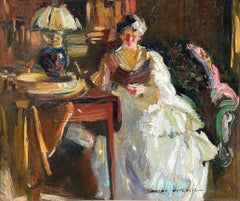
"The Conversation, France" Alethea Hill Platt, American Artist, Interior Scene
Located in New York, NY
Althea Platt
The Conversation, France, circa 1915
Signed lower left
Oil on canvas
8 x 10 inches
Alethea Hill Platt was an American artist and educator. Her paintings of rural lands...
Category
1910s American Impressionist Figurative Paintings
Materials
Canvas, Oil
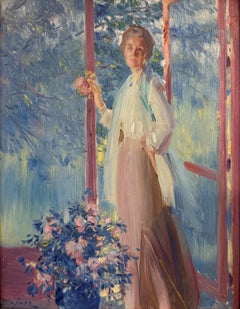
"The Screen Door" Edward Dufner, Pastel Blue, Impressionist, Female Figure
By Edward Dufner
Located in New York, NY
Edward Dufner
The Screen Door, 1923
Signed lower left
Oil on board
10 x 8 inches
Exhibited
New York, National Academy of Design, Winter Exhibition, November 17 - December 16, 1923, ...
Category
1920s American Impressionist Figurative Paintings
Materials
Oil, Board
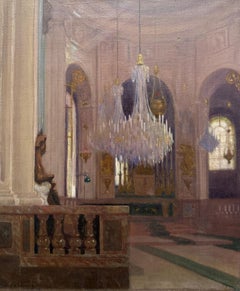
"Interior of Église Saint-Sulpice, Paris" James Roy Hopkins, Church Interior
Located in New York, NY
James Roy Hopkins
Interior of Église Saint-Sulpice, Paris, 1908
Signed and dated lower left and inscribed "Paris"
Oil on canvas
17 3/4 x 14 3/4 inche...
Category
Early 1900s American Impressionist Figurative Paintings
Materials
Canvas, Oil
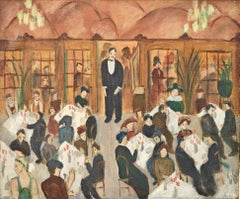
"Restaurant" Adelaide Lawson Gaylor, American Modernist Interior Party Scene
Located in New York, NY
Adelaide Lawson Gaylor
Restaurant
Signed lower right
Oil on canvas
24 1/4 x 30 inches
Modernist artist Adelaide Jaffrey Lawson Gaylor was born in New York City and studied at the A...
Category
1950s Modern Figurative Paintings
Materials
Canvas, Oil
At the Claremont (View of the Hudson River and Palisades), Ida Sedgwick Proper
Located in New York, NY
Ida Sedgwick Proper
At the Claremont (View of the Hudson River and Palisades)
circa 1912
Signed lower right
Oil on canvas
45 1/4 x 57 1/2 inches
Exhibited
New York, Heterodoxy, Malv...
Category
1910s American Impressionist Figurative Paintings
Materials
Canvas, Oil
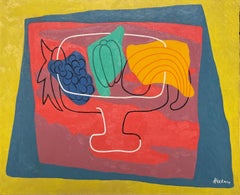
"Untitled" Albert Heckman, Modernist Saturated Blue and Yellow Still Life
By Albert Heckman
Located in New York, NY
Albert Heckman
Untitled, circa 1950
Signed lower right
Oil on canvas
18 x 24 inches
Albert Heckman was born in Meadville, Western Pennsylvania, 1893. He went to New York City to try his hand at the art world in 1915 after graduating from high school and landing a job at the Meadville Post Office. In 1917, at the age of 24, Heckman enrolled part-time in Teachers' College, Columbia University's Fine Arts Department to begin his formal art education. He worked as a freelance ceramic and textile designer and occasionally as a lecturer at the Metropolitan Museum of Art. In the early 1920s, at the age of almost 30, he graduated with a Bachelor of Arts degree from Columbia Teachers College. He was especially impacted by his instructor at Columbia, Arthur Wesley Dow.
After graduating, he was hired by the Teachers' College as a Fine Arts instructor. He stayed with Columbia Teachers' College until 1929, when he left to attend the Leipzig Institute of Graphic Arts in Leipzig, Germany. Isami Doi (1903-1965), who was born in Hawaii, was arguably his most impressive student at Columbia. Doi is now regarded as one of the most prominent artists hailing from Hawaii. Heckman became an active member and officer of the Keramic Society and Design Guild of New York in the 1920s as part of his early commercial art career. The Society's mission was to share knowledge and showcase textile and ceramic design exhibits.
In 1922, Heckman married Florence Hardman, a concert violinist. Mrs. Heckman's concert schedule during the 1920s kept Albert and Florence Heckman apart for a significant portion of the time, but they spent what little time they had together designing and building their Woodstock, New York, summer house and grounds. A small house and an acre of surrounding land on Overlook Mountain, just behind the village of Woodstock, were purchased by Albert and Florence Heckman at the time of their marriage. Their Woodstock home, with its connections, friendships, and memories, became a central part of their lives over the years, even though they had an apartment in New York City.
Heckman's main artistic focus shifted to the house on Overlook Mountain and the nearby towns and villages, Kingston, Eddyville, and Glasco. After returning from the Leipzig Institute of Graphic Arts in 1930, Mr. Heckman joined Hunter College as an assistant professor of art. He worked there for almost thirty years, retiring in 1956. Throughout his tenure at Hunter, Mr. Heckman and his spouse spent the summers at their Woodstock residence and the winters in New York City. They were regular and well-known guests at the opera and art galleries in New York. Following his retirement in 1956, the Heckmans settled in Woodstock permanently, with occasional trips to Florida or Europe during the fall and winter. Mr. Heckman's close friends and artistic career were always connected to Woodstock or New York City. He joined the Woodstock art group early on and was greatly influenced by artists like Paul and Caroline Rohland, Emil Ganso, Yasuo Kuniyoshi, Andre Ruellan, and her husband, Jack...
Category
1950s Modern Interior Paintings
Materials
Canvas, Oil

"Untitled" Albert Heckman, circa 1950 Modernist Colorful Still Life With Fruit
By Albert Heckman
Located in New York, NY
Albert Heckman
Untitled, circa 1950
Signed lower right
Oil on canvas
24 x 30 inches
Albert Heckman was born in Meadville, Western Pennsylvania, 1893. He went to New York City to try his hand at the art world in 1915 after graduating from high school and landing a job at the Meadville Post Office. In 1917, at the age of 24, Heckman enrolled part-time in Teachers' College, Columbia University's Fine Arts Department to begin his formal art education. He worked as a freelance ceramic and textile designer and occasionally as a lecturer at the Metropolitan Museum of Art. In the early 1920s, at the age of almost 30, he graduated with a Bachelor of Arts degree from Columbia Teachers College. He was especially impacted by his instructor at Columbia, Arthur Wesley Dow.
After graduating, he was hired by the Teachers' College as a Fine Arts instructor. He stayed with Columbia Teachers' College until 1929, when he left to attend the Leipzig Institute of Graphic Arts in Leipzig, Germany. Isami Doi (1903-1965), who was born in Hawaii, was arguably his most impressive student at Columbia. Doi is now regarded as one of the most prominent artists hailing from Hawaii. Heckman became an active member and officer of the Keramic Society and Design Guild of New York in the 1920s as part of his early commercial art career. The Society's mission was to share knowledge and showcase textile and ceramic design exhibits.
In 1922, Heckman married Florence Hardman, a concert violinist. Mrs. Heckman's concert schedule during the 1920s kept Albert and Florence Heckman apart for a significant portion of the time, but they spent what little time they had together designing and building their Woodstock, New York, summer house and grounds. A small house and an acre of surrounding land on Overlook Mountain, just behind the village of Woodstock, were purchased by Albert and Florence Heckman at the time of their marriage. Their Woodstock home, with its connections, friendships, and memories, became a central part of their lives over the years, even though they had an apartment in New York City.
Heckman's main artistic focus shifted to the house on Overlook Mountain and the nearby towns and villages, Kingston, Eddyville, and Glasco. After returning from the Leipzig Institute of Graphic Arts in 1930, Mr. Heckman joined Hunter College as an assistant professor of art. He worked there for almost thirty years, retiring in 1956. Throughout his tenure at Hunter, Mr. Heckman and his spouse spent the summers at their Woodstock residence and the winters in New York City. They were regular and well-known guests at the opera and art galleries in New York. Following his retirement in 1956, the Heckmans settled in Woodstock permanently, with occasional trips to Florida or Europe during the fall and winter. Mr. Heckman's close friends and artistic career were always connected to Woodstock or New York City. He joined the Woodstock art group early on and was greatly influenced by artists like Paul and Caroline Rohland, Emil Ganso, Yasuo Kuniyoshi, Andre Ruellan, and her husband, Jack...
Category
1950s Modern Interior Paintings
Materials
Canvas, Oil
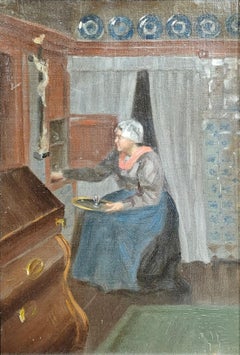
"Lady in a Interior" Addison Thomas Millar, 19th Century American Genre Painting
By Addison Thomas Millar
Located in New York, NY
Addison Thomas Millar
Lady in a Interior
Oil on canvas board
14 x 10 inches
Millar's father emigrated to the United States from Scotland in 1845. He grew up in Warren, Ohio. During his primary education, he took some painting lessons from John Bell, a local landscape painter.
In his late teens, he won three consecutive awards from The Youth's Companion, in their annual art contests. This prompted his parents to allow him to go to Cincinnati to take formal lessons from the genre painter, De Scott...
Category
19th Century American Impressionist Figurative Paintings
Materials
Canvas, Oil, Board
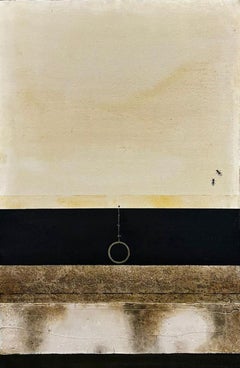
"Untitled" Larry Calcagno, Trompe-l
œil Mixed-Media Minimalist Composition
By Larry Calcagno
Located in New York, NY
Larry Calcagno
Untitled
Mixed media on canvas
36 x 23 1/3 inches
Lawrence Calcagno, better known as Larry, was an artist who gained notoriety during t...
Category
20th Century Modern Figurative Paintings
Materials
Canvas, Mixed Media
"Woman Reading in an Interior" Vaclav Vytlacil, Loose Brushwork Portrait
By Vaclav Vytlacil
Located in New York, NY
Vaclav Vytlacil
Woman Reading in an Interior, circa 1915
Signed lower right
Oil on canvas
16 x 20 inches
As a child, Vytlacil had taken art classes at the Art Institute of Chicago....
Category
1910s Impressionist Interior Paintings
Materials
Canvas, Oil
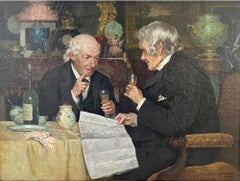
"A Toast" Louis Charles Moeller, American 19th Century Realist Genre Painting
Located in New York, NY
Louis Charles Moeller
A Toast
Signed lower right
Oil on canvas
12 x 16 inches
Louis Charles Moeller was a master of American genre painting. His meticulously detailed, highly finish...
Category
19th Century Realist Figurative Paintings
Materials
Canvas, Oil
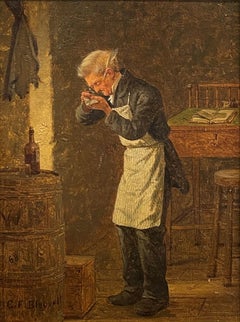
"The Doubtful Bill" Charles Blauvelt, 19th Century Genre Painting Money Interior
Located in New York, NY
Charles Blauvelt
The Doubtful Bill, 1868
Signed and dated lower left
Oil on canvas
12 1/4 x 9 1/2 inches
Provenance:
Private Collection, Connecticut...
Category
1860s Figurative Paintings
Materials
Canvas, Oil
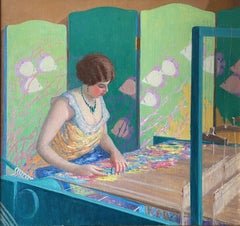
"The Artist
s Wife at the Loom, " Harry Hoffman, Bright American Impressionism
By Harry Leslie Hoffman
Located in New York, NY
Harry Leslie Hoffman (1871 - 1964)
The Artist's Wife (Beatrice Pope) at the Loom, circa 1915
Oil on canvas
30 x 32 inches
Housed in a period Newcomb-Macklin frame
Provenance:
Estate of the artist
Private Collection, Massachusetts
This painting depicts the artist's wife at the loom, producing textile versions of Hoffman's underwater paintings. The screen shown behind Bea is an underwater scene also painted by Hoffman. The study of this painting is held in the collection of the Wolfsonian Museum in Florida.
Harry Leslie Hoffman was born in Cressona, a small community in Pennsylvania's Schuylkill Valley. His mother was an amateur artist who encouraged her son to pursue a career in the arts. In 1893, Hoffman entered the School of Art at Yale University and studied with John Ferguson Weir, the son of Robert Walter Weir. After graduation in 1897, Hoffman moved to New York to continue his studies at the Art Students League. He also traveled to Paris and took classes at the Académie Julien.
In the summer of 1902, Hoffman attended the Lyme Summer School of Art, in the town of Old Lyme on the Connecticut coast. The school was headed by Frank Vincent Dumond and was located in a boarding house owned by Florence Griswold. The school eventually grew into an artists' colony and a center for American Impressionism. When Hoffman first arrived as a student, he was not permitted to stay in the house which was designated for the professional artists only. However, his outgoing personality soon won him many friends at the colony.
In 1905, Hoffman settled in Old Lyme and worked as a full member of the artist colony. He was particularly influenced by Willard Leroy Metcalf, an Impressionist also working in Old Lyme. Fellow artists later fondly recalled Hoffman's antics at the Griswold house, which included playing the flute and banjo, tap-dancing, singing humorous songs, and performing magic tricks. In 1910 Hoffman...
Category
1910s American Impressionist Figurative Paintings
Materials
Canvas, Oil
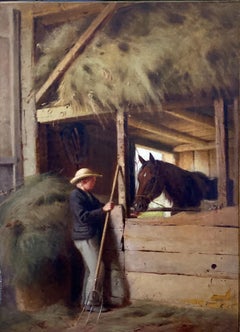
"Interior of a Stable" William Hart, Hudson River School Antique, Boy and Horse
By William Hart
Located in New York, NY
William M. Hart (1823 - 1894)
Interior of a Stable
Oil on canvas
17 x 12 inches
Provenance
William Macbeth Gallery, New York
Mrs. Mabel Brady Garvan Collection
Christie's New York, Sporting Art, November 28, 1995, Lot 116
Ann Carter Stonesifer, Maryland
Estate of above
Brunk Auctions, Asheville, North Carolina, January 27 2018, Lot 777
Exhibited
New York, The Metropolitan Museum of Art, Life in America, April 24 - October 29, 1939, no. 123, illustrated.
New York, Macbeth Gallery, 1892: Sixtieth Anniversary Exhibition, April 1952, p. 5, no. 18.
Literature
Turner Reuter Jr, Animal and Sporting Artists in America, Middleburg, Virginia, 2008, p. 306.
Gary Stiles, William Hart: Catalogue Raisonné and Artistic Biography, no. 1126, illustrated.
It should be noted that the Francis Patrick Garvan and Mrs. Mabel Brady Garvan collection, of which this painting was a part of, was one of the foremost American Art collections and now makes up a large part of the Smithsonian American Art Museum and the Yale University Art Gallery collections.
Born in 1823 in Paisley, Scotland, William Hart emigrated with his parents to the United States at the age of nine and settled in Albany, New York. It was here that Hart first began his artistic training when he was placed under the tutelage of Messrs, Eaton & Gilbert, the prestigious coach-makers from Troy, New York. During this time, Hart learned how to decorate coach panels, covering them with either landscapes or figurative compositions. At the age of seventeen, he was eagerly contemplating an artist’s profession. Consequently, he left the mechanical trade of coach-making and began expanding his artistic pursuits to more refined endeavors.
Hart followed coach-making with decorating window shades and later developed an interest in portraiture. Around 1840, he established his first formal studio in his father’s woodshed in Troy. There, he created many likenesses of individuals, affording him a nominal income. Once, he remarked that he felt prouder over his first fee of five dollars for painting a head then for the larger sums he would command later in his career. Nevertheless, his wages from portraits during this early period proved insufficient. Thus, he expanded into landscape painting, allowing him to barter his works or sell them for modest prices.
In 1842, Hart moved to Michigan in an attempt to further his success; portraiture remained his primary means of support. Unfortunately, his experiences in the West were disappointing. Hart spent three years living a rough existence until he finally returned to Albany in 1845. Upon his return, he fully devoted himself to the art of landscape painting. Despite his failing health, he worked diligently to perfect his skill until 1849 when he traveled abroad to his native land of Scotland. This trip was made possible through the generosity of his patron and advisor, Dr. Ormsby of Albany. For three years, he studied in the open-air, creating brilliant sketches of the Scottish Highlands and the surrounding British Isles.
Returning to Albany once more in 1852, Hart enjoyed improved health and was reinvigorated with purpose. The following year, he moved to New York and opened a studio, promoting himself as a specialist in landscape painting. Hart became a regular contributor to the National Academy of Design. His works received a great deal of attention from artists and connoisseurs alike, all of whom praised him for his fresh, self-taught style. In 1855, he was designated as an associate of the National Academy of Design; three years later he was elected to Academician. In 1865, he was unanimously chosen to be the first president of the Brooklyn Academy of Design. It was during his tenure there that he delivered his famous lecture The Field and Easel, which emphasized the distinguishing principles of landscape art in America. Hart argued that landscape painters should express the “look of the place” being depicted.Critics during the 1870s noted his sensitive balance between capturing a strict “real” interpretation of nature and that of a more “ideal” sentimental tone. For instance, in 1869, Putnam Magazine noted that Hart brought back “exquisite studies” of the surrounding Tappan...
Category
19th Century Hudson River School Animal Paintings
Materials
Canvas, Oil

$60,000 Sale Price
20% Off
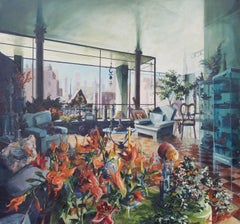
"Tuesday - 8 O
clock, " Frank Boros, View of Manhattan Skyline, New York City
Located in New York, NY
Frank J. Boros (1943 - 2017)
Tuesday - 8 O'clock
Oil on canvas
48 x 51 inches
Signed lower right
Accompanied by original purchase invoice and letter from the artist.
Provenance:
T...
Category
1990s Contemporary Landscape Paintings
Materials
Canvas, Oil
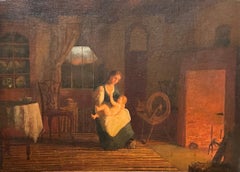
"A Quiet Afternoon" Enoch Wood Perry, Genre Scene Mother and Child Interior
By Enoch Wood Perry Jr.
Located in New York, NY
Enoch Wood Perry, Jr. (1831 - 1915)
A Quiet Afternoon, 1876
Oil on canvas
15 1/4 x 21 inches
Signed and dated lower right
Born in 1831 in Boston, Enoch Wood Perry, Jr, is internati...
Category
1870s Hudson River School Interior Paintings
Materials
Canvas, Oil
Related Items
Fine 1950
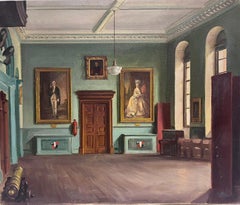
s English Oil Grand Interior Room Scene Ancestral Portraits signed
Located in Cirencester, Gloucestershire
The Guildhall, Worcester
English School, mid 20th century
indistinctly signed verso
oil on canvas
canvas: 20 x 24 inches
provenance: private collection, UK
condition: very good and sound condition
The Worcester Guildhall was originally built as a meeting place for Worcester merchants around 1227. As with many other guildhalls, it became the centre for civic administration, a role it maintained after the merchant guild had disappeared.
The present Worcester Guildhall is a superb Queen Anne building, begun in 1722 by Thomas White, a pupil of Sir Christopher Wren. White was badly paid for his efforts, and he died in poverty in 1738, bestowing the money he was owed on the Worcester Royal Infirmary. The city finally paid its debt in 1753.
The exterior of the Guildhall is brick, dressed with stone. White himself is said to have carved the figure of Queen Anne over the entry, as well as those of Charles I and II, a reminder of the city's long history of royal support. The interior is superb, boasting exceptional period decoration. The Tourist Information Centre is now located in the Guildhall.
HISTORY
In 1227 Henry III granted the citizens of Worcester a royal charter granting them the right to establish a guild of merchants. The guild was responsible for controlling trade in the city, but their meeting place gradually became the main centre of administration for city government and acted as a courthouse. So, in effect, the Guildhall was the town hall, and though the city guilds have long since vanished, the Guildhall name lives on.
The medieval guild merchants would not recognise the building that faces onto High Street now. Their guildhall was a large timber-framed building, occupying the same site, with a piazza for shops fronting the street, courts of justice at each end, and a prison to the north of the building.
Part of the prison was a cell called 'the peephole', which gained a notorious reputation. There was a gaoler's house, and attached to it an alehouse from which the gaoler sold ale at extremely high prices to any prisoner who could afford the cost.
In 1717 the city administration decided on a new Guildhall, and they knew just who to call; upon to build it. Thomas White was not an architect in the way we think of it today, but a stonemason. In 1705 he had carved a statue of Queen Anne to stand in front of the medieval Guildhall and was made a Freeman of the City. The total cost of the fashionable new red-brick building was £3727. The Corporation only put forward £800, and the rest had to be raised by public subscription.
The centre section of the new Guildhall was finished by 1724 and has remained almost unchanged since then. The central facade is a wonderful example of early Georgian style, with three bays flanked by Corinthian pillars.
Over the entrance is a huge carving incorporating the Hanoverian royal arms. White's earlier statue of Queen Anne was placed in a niche over the door, and on either side were statues of Charles I, depicted holding a church, and Charles II, with an orb and royal sceptre. On the rooftop are figures of Labour, Peace, Justice, Plenty, and Chastisement.
North and south wings were added within a few years of the central block. The south wing was used as a judge's lodging when the assizes were taking place, but throughout the rest of the year it housed a coffee shop.
The most striking external feature of the Guildhall is a set of iron gates...
Category
Mid-20th Century Modern Interior Paintings
Materials
Oil, Canvas
$1,311 Sale Price
20% Off
H 20 in W 24 in
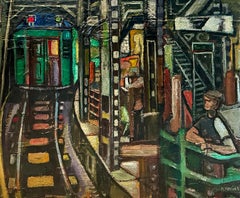
NYC Subway Mid 20th Century Modern American Scene Social Realism Contemporary
Located in New York, NY
NYC Subway Mid 20th Century Modern American Scene Social Realism Contemporary
David Atkins (1910 – 2012)
Subway Train Departure
24 x 30 inches
Oil on can...
Category
1960s American Modern Interior Paintings
Materials
Canvas, Oil
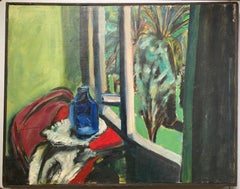
1950s "View from the Window" Jack Hooper Mid Century Still Life Oil Painting
By Jack Hooper
Located in Arp, TX
Jack Hooper
"View From the Window"
c. 1950s
Oil on Canvas
32"x25.25" silver and black wood frame 26.5"x33.25"
Unsigned
Minor wear consistent with age and ...
Category
Mid-20th Century American Modern Interior Paintings
Materials
Canvas, Oil
$1,750 Sale Price
50% Off
H 26.5 in W 33.25 in
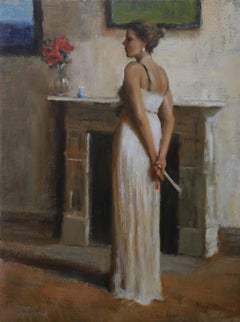
The Evening Gown American Impressionism Oil on Canvas 24" x 18" Figure Interior
Located in Houston, TX
Look for Free Shipping at Checkout
The Evening Gown is an American Impressionistic painting by Stuart Fullerton. The artist is know ...
Category
2010s American Impressionist Figurative Paintings
Materials
Oil, Canvas
$2,200
H 24 in W 18 in D 1 in
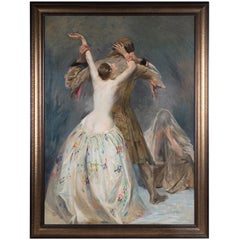
Oil on Canvas Depicting William Shakespeare
s Characters "Othello
Desdemona"
By Hamilton Hamilton
Located in LA, CA
Hamilton Hamilton (American, 1847-1928) A large and impressive oil on canvas "Othello and Desdemona" after the William Shakespeare's play "Othello", depicting a young Desdemona pleading with an enraged Othello, and perhaps Iago is the seated figure, within a giltwood craquelure finished frame. Signed (l/r): H. Hamilton, 1921 .
Canvas Height: 67 inches (170.2 cm)
Canvas Width: 48 inches (121.9 cm)
Frame Height: 75 inches (190.5 cm)
Frame Width: 57 inches (144.8 cm)
Frame Depth: 2 inches (5.1 cm)
Hamilton Hamilton (1 April 1847 – 4 January 1928) was a painter and etcher, known mostly for his landscapes of the American West. Born in Oxford, England, he lived most of his life in the Eastern United States. He painted landscapes in New York, Connecticut, the American West, England, and France. He also painted portraits and drew illustrations.
Artistic career
Hamilton Hamilton was born in Oxford, England, on 1 April 1847. While young, he was a protégé of John Ruskin. In 1872, he began his mostly self-taught career as a portrait artist in Buffalo, New York. He created 47 landscape paintings during an 1873 expedition to Colorado which were chosen to be part of the 1876 Centennial Exposition in Philadelphia. He spent 1878 and 1879 painting in Pont-Aven, Brittany, alongside Barbizon School painters.
He moved to New York City in 1881 and shortly after began to practice genre painting and etching.[6] He became an associate member of the National Academy of Design in 1886 and a National Academician in 1889. Until the end of the century, he and his family resided alternately in upstate New York, Long Island, Colorado, and England.[6] In 1907 and 1908, Hamilton spent two years painting landscapes in Southern California. In 1912 he and his family permanently moved to Norwalk, Connecticut. There he became involved with the Silvermine group of artists led by Solon Borglum...
Category
Early 20th Century American Impressionist Figurative Paintings
Materials
Canvas, Wood, Oil
$34,500
H 75 in W 57 in D 2 in
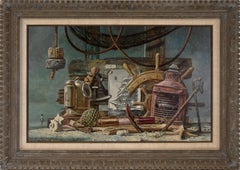
"Of Ships and Men" - Nautical Trompe l
Oeil Composition in Oil on Board
By Russell Tripp
Located in Soquel, CA
"Of Ships and Men" - Nautical Trompe l'Oeil Composition in Oil on Board
Maritime still life by Russell Tripp (American, 1942-2025). This hyper-realistic painting captures a collecti...
Category
1990s American Impressionist Figurative Paintings
Materials
Oil, Board
$3,500
H 25 in W 35 in D 2 in
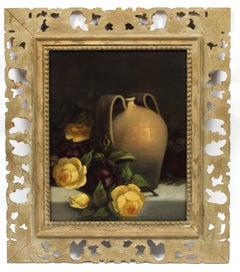
Antique American Realist Framed Flower Jug Still Life Oil Painting Yellow Roses
Located in Buffalo, NY
Very impressive antique American flower still life oil painting.
Stunning and unique original frame.
Oil on canvas.
Painting size, 18H by 14L.
Exceptional quality. Signe...
Category
Late 19th Century Modern Still-life Paintings
Materials
Canvas, Oil
$951 Sale Price
20% Off
H 26 in W 22 in D 2 in
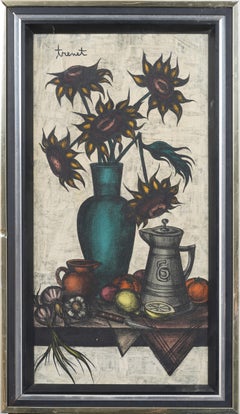
Antique French Modernist Signed Sunflower Still Life Framed Rare Oil Painting
Located in Buffalo, NY
Vintage French modernist still life oil painting. Oil on canvas. Framed. Signed. Measuring: 35 by 20 inches overall. In excellent original condition. Handsomely framed in a modern...
Category
1950s Modern Still-life Paintings
Materials
Canvas, Oil
$975
H 35 in W 20 in D 2 in
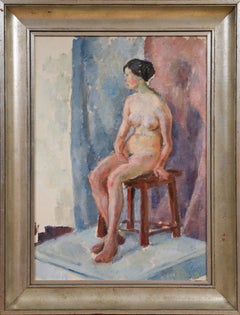
Seated Nude in the Studio – A Modernist Study from the 1920s
Located in Stockholm, SE
This evocative oil painting, titled Studio Muse, depicts a seated nude in a quiet moment of contemplation. The model is shown in profile, resting on a simple wooden stool against a n...
Category
1920s Modern Figurative Paintings
Materials
Canvas, Oil
$2,783
H 28.75 in W 22.05 in
"Adventures in Literature" Figurative 1930
s Illustration art
Located in Soquel, CA
A wonderful original figure painting for a 1930's illustration by Charles Kinghan (American, 1895-1984). A woman in a plaid green skirt and mustard yel...
Category
1930s American Impressionist Figurative Paintings
Materials
Acrylic, Cardboard
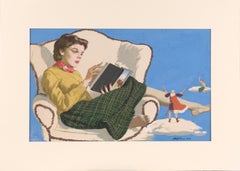
$1,080 Sale Price
20% Off
H 20.25 in W 28.5 in D 0.25 in
Antique American School Modernist Bold Flower Still Life Framed Oil Painting
Located in Buffalo, NY
Very finely painted American modernist flower still life oil painting. Framed. Oil on board. Signed lower right. Image size, 12H by 17L.
Category
1920s Modern Still-life Paintings
Materials
Canvas, Oil
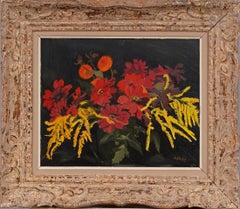
$700 Sale Price
20% Off
H 15 in W 20 in D 2 in
Signed American School Modernist Seashell Minimalist Still Life Oil Painting
Located in Buffalo, NY
Oil on canvas. Framed. Signed.
Category
Early 2000s Modern Interior Paintings
Materials
Canvas, Oil
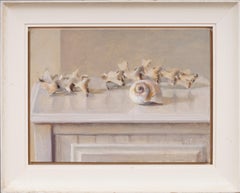
$520 Sale Price
20% Off
H 17 in W 21 in D 2 in