Lotus Gallery More Asian Art, Objects and Furniture
to
10
10
2
6
2
1
1
1
5
3
3
3
2
9
6
3
3
3
10
10
10
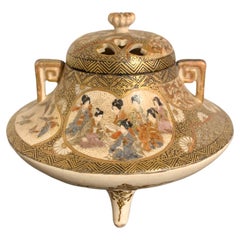
Japanese Satsuma Tripod Censer, Koro, Meiji period, Early 20th Century, Japan
Located in Austin, TX
A small and finely decorated Japanese Satsuma tripod incense burner (koro), signed Kyozan, Meiji period, circa 1900, Japan.
The censer, koro, with a compressed body supported by t...
Category
Antique Early 1900s Japanese Meiji Ceramics
Materials
Stoneware
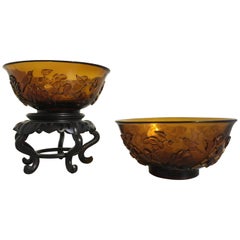
Pair of Chinese Amber Peking Glass Carved Bowls, Qing Dynasty, Late 19th Century
Located in Austin, TX
A fine pair of late 19th century Chinese Qing dynasty carved Peking glass bowls in a lovely amber hue.
The matching Peking glass bowls carved with opposing scenes of birds amongst flowering branches on a rocky outcrop. The amber glass bowls...
Category
Antique Late 19th Century Chinese Qing Decorative Bowls
Materials
Glass
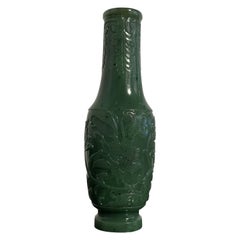
Chinese Spinach Green Jade Incense Tool Vase, Qing Dynasty, 18th/19th Century
Located in Austin, TX
A fine and well carved Chinese spinach jade incense tool vase, Qing Dynasty, Qianlong or Jiaqing Period, 18th/19th century, China.
The small jade vase ...
Category
Antique Early 19th Century Chinese Qing Scholar s Objects
Materials
Jade
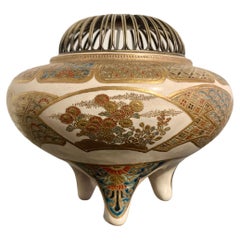
Japanese Satsuma Incense Burner, Koro, Meiji Period, Late 19th Century, Japan
Located in Austin, TX
A fine and elegant Japanese Satsuma tripod incense burner, koro, with pierced metal lid, signed Eizan (?) Meiji Period, late 19th century, Japan.
The koro, or censer, features a stoneware body of slightly compressed globular form, supported on three short and squat legs. The wide mouth with a recessed metal rim, and topped by an openwork metal lid topped with overlapping chrysanthemum blossoms of silver repousse.
The body of the koro finely painted with fan shaped cartouches. The fans in the foreground with sprays of blossoming chrysanthemum. The fans in the background with intricate geometric brocade designs.
The shoulder of the incense burner decorated with cartouches formed as stylized chrysanthemum petals, and intricately decorated with geometric and floral brocade designs.
The painting finely done in raised gilt and polychrome enamels, including the highly desirable gosu blue...
Category
Antique Late 19th Century Japanese Meiji Ceramics
Materials
Silver, Metal
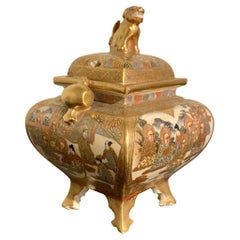
Small Japanese Satsuma Incense Burner, Koro, Meiji Period, Late 19th Century
Located in Austin, TX
A fine Japanese Satsuma stoneware incense burner, koro, Meiji Period, late 19th century, Japan.
The koro of square shape with curved sides,...
Category
Antique 1890s Ceramics
Materials
Enamel
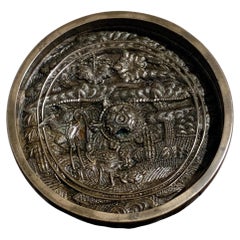
Japanese Cast Bronze "Longevity" Mirror, Edo Period, 18th Century, Japan
Located in Austin, TX
A heavy and finely cast Japanese bronze mirror with longevity symbols, Edo Period, 18th century, Japan.
The small, round mirror with high walls...
Category
Antique Late 18th Century Japanese Edo Metalwork
Materials
Bronze
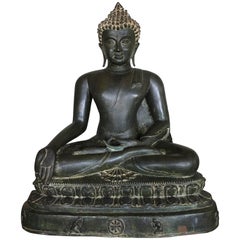
Large Burmese Bronze Medicine Buddha, Pagan Style, Late 19th Century
Located in Austin, TX
A large and magnificent cast bronze image of the Medicine Buddha, Bhaisajyaguru, rendered in the Burmese Pagan style, and most likely based on a period example that was either damaged or lost, 19th century, Burma or Thailand.
He can be identified as the Medicine Buddha by the hand that rests in his lap, with his middle finger touching the thumb. A medicine pot or fruit stem would originally have been placed in his upturned palm.
The face of this Buddha has been sculpted masterfully. He has a beautiful heart shaped face topped by hair neatly arranged in the typical "snail shell curls", and surmounted by a high ushnisha. Long, pendulous earlobes frame his face, a symbol of his princely past. He gazes serenely outwards from heavily lidded, downcast eyes, a content smile upon his full, lush lips.
The Buddha is portrayed seated in vajrasana (full lotus position), his elegant hands displayed in varada mudra, the gesture of granting favors and fulfilling wishes. Long, exquisite fingers extended, the thumb and middle finger touching in a gesture of compassion.
He is clothed in a simple kasaya wrapped around his body and over one shoulder, leaving the shoulder and part of his chest bare. The diaphanous garment clings to his body, outlining his well proportioned and graceful, almost sensuous, form. The excess material pooled in neat pleats in front of him. A sash thrown over his shoulder.
He sits upon a double lotus base upon a raised platform. The platform features two kneeling attendants, usually interpreted as the monks Ananda and Kasyapa. Between them is a circular disc representing the Wheel of Dharma. Contained in the disk is a flower with eight petals, symbolizing the eightfold path, one of the principle teachings of the Buddha.
The sides and back of the platform featuring a series of singha, or lions, representative of the Buddha's royal past.
An applied lacquer patina covers the entirety of the image. Large deposits of ash (from incense) are present between the curls of the hair, as well as some the other crevices, indicating this image was the subject of worship for many years.
Bhaisajyaguru, also called the Medicine Buddha, or Buddha of Healing, is a revered figure in the Buddhist pantheon as a master able to cure suffering, both physical and spiritual, through his teachings.
The Pagan Empire ruled most of present day Burma (Myanmar) from 849 to 1297. The capital, Bagan, served as a both the center of government and religion, where Buddhism reigned supreme. Bagan was also at a crossroads of the Buddhist world, with influence from India, Nepal, Tibet, China, and even Indonesia shaping their culture. As such, Pagan Buddha...
Category
Antique Late 19th Century Burmese Sculptures and Carvings
Materials
Bronze
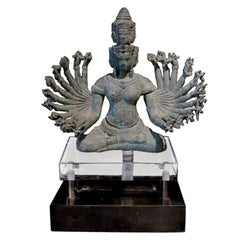
Khmer Bronze Figure of Prajnaparamita with Eleven Faces
Located in Austin, TX
The embodiment of transcendental wisdom, Prajnaparamita is often referred to as the mother of all Buddhas.
In this extremely rare tantric form, she is portrayed seated in the half lotus position. Her eleven faces are arranged in two tiers (seven on the first, with an additional four above), all surmounted by a rising conical chignon. Each face has an associated pair of arms which radiate outwards, each hand holding a discreet attribute.
Careful attention has been paid to her clothing and jewelry. She wears a heavily pleated sampot with a cross hatch pattern, elegantly turned down at the waist and tied with an ornate belt...
Category
Antique 18th Century and Earlier Cambodian Sculptures
Materials
Bronze
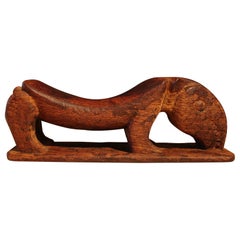
Indonesian Tribal Anteater Form Headrest, Irian Jaya, Mid-20th Century
Located in Austin, TX
A whimsical and intriguing headrest carved from a single piece of hardwood in the form of an anteater. The curved back of the animal would have supported the neck and displays a wonderfully warm patina from tribal use.
The anteater's over sized head has been carved in a charming manner.
Found in Sumatra, but most likely traded from Irian Jaya.
Category
Mid-20th Century Indonesian Tribal Tribal Art
Materials
Hardwood
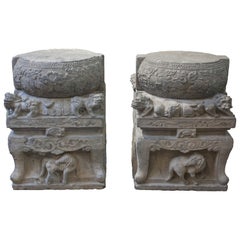
Pair of Chinese Qing Dynasty Carved Limestone Pedestals
Located in Austin, TX
A pair of Chinese carved limestone architectural drum form pedestals, Qing Dynasty, mid 19th century, China.
Masterfully carved, each pedestal is in two pieces. The top in the form a drum carved with "nails" surrounding the top, with relief carvings to the sides of opposing qilin, taotie masks, and scrolling foliage. The separately carved drums are supported by a lotus pedestal and surrounded by Buddhistic lions, all resting upon a high waisted table...
Category
Antique Early 19th Century Chinese Qing Pedestals and Columns
Materials
Stone
Related Items
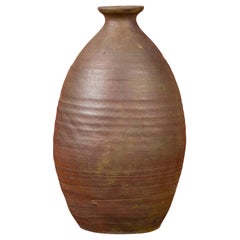
Japanese Meiji Period Early 20th Century Sake Bottle with Brown Patina
Located in Yonkers, NY
An antique Japanese Meiji period monochrome sake bottle from the early 20th century with concentric lines. Created in Japan during the Meiji period, this antique sake bottle captivat...
Category
Early 20th Century Japanese Meiji Bottles
Materials
Ceramic

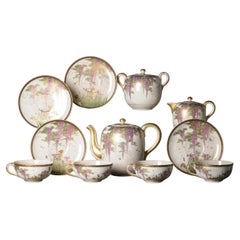
#11 Antique Meiji Period Japanese Satsuma Autumn Tea Set 19th Century Wisteria
Located in Amsterdam, Noord Holland
Fabulous Tea set Satsuma of 11 pieces. Meiji period, 19th century
Marked:
Condition
1 cup with small frits/fleebites rim, rest perfect. Size jugs 110-140mm high cups 90x45mm DXH and...
Category
Antique 19th Century Japanese Qing Ceramics
Materials
Porcelain
$2,115 Sale Price
20% Off
H 0.04 in Dm 0.04 in
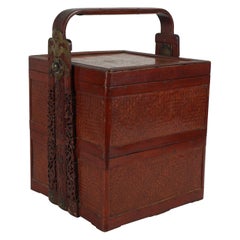
Late Qing Dynasty Chinese Carved Bamboo and Woven Rush Lockable Wedding Basket.
Located in Hudson, NY
This Chinese stackable box made circa 1900-1915 was intended as a wedding basket and is a traditional object of importance within Chinese culture....
Category
Early 20th Century Chinese Qing More Asian Art, Objects and Furniture
Materials
Bamboo, Rush
$850
H 16 in W 12 in D 11 in
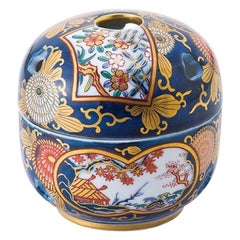
Japanese Contemporary Ko-Imari Gold Blue Porcelain Koro Incense Burner
Located in Takarazuka, JP
Stunning contemporary Japanese Ko-Imari style porcelain koro or incense burner or jewelry box, hand painted on a beautifully shaped round body in cobalt blue, red and green and gener...
Category
21st Century and Contemporary Japanese Meiji Jewelry Boxes
Materials
Gold
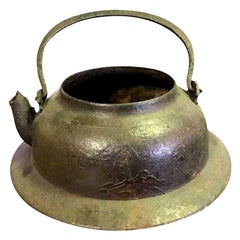
Japanese Edo/Meiji Period Cast Iron Tea Kettle Water Pot Tetsubin, 19th Century
Located in Studio City, CA
A large, heavy and uniquely shaped Japanese cast iron teapot tetsubin without top.
Likely from late Edo/early Meiji Period.
From a collecti...
Category
Antique 19th Century Japanese Meiji Metalwork
Materials
Iron
$315
H 11 in Dm 9.5 in
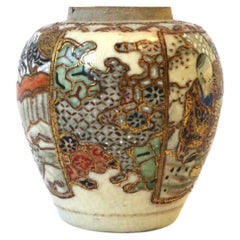
Japanese Satsuma Ginger Jar Vase, circa Early 20th Century
Located in New York, NY
A beautiful small Japanese Satsuma ginger jar vase, circa early-20th century, Japan. Colors include cream, copper, green, blue, white, black, orange...
Category
Early 20th Century Japanese Meiji Vases
Materials
Ceramic, Earthenware, Pottery
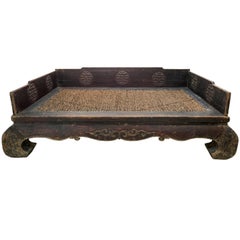
Late 19th Century Large Chinese Daybed
Located in Singapore, SG
A large elmwood daybed from Shandong province, China. The color and patina of the daybed has been kept fully original, but repairs have been made to the woven seat as it was already ...
Category
Antique Late 19th Century Chinese Qing Furniture
Materials
Hemp, Elm
Japanese Meiji Period Satsuma Vase by Ryokuzan
Located in Newark, England
From our Japanese Satsuma Collection, we are delighted to offer this Japanese Satsuma Vase by Ryokuzan 緑山. The Satsuma vase of ovoid shape with a tapered body, circular foot rim, wai...
Category
Antique Early 1900s Japanese Meiji Ceramics
Materials
Ceramic, Earthenware, Pottery

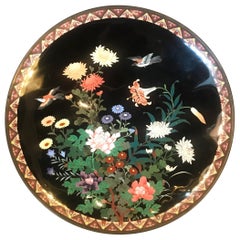
Meiji Period 19th Century Japanese Cloisonné Charger
Located in Lambertville, NJ
Lovely large Japanese cloisonné enamel charger Meiji Period (1868-1912). Measure: Large 14 inch.
Intricate enamel over brass cloisonné portraying a colorful floral and foliage motif...
Category
Antique 1890s Japanese Meiji More Asian Art, Objects and Furniture
Materials
Copper
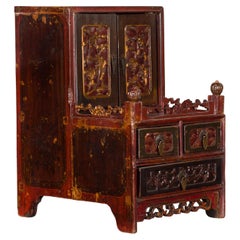
Qing Dynasty 19th Century Red and Brown Lacquer Jewelry Box with Carved Foliage
Located in Yonkers, NY
An antique Chinese Qing Dynasty red and dark brown lacquer elmwood jewelry box from the 19th century with carved and gilt motifs. Created in China during the Qing Dynasty era, this j...
Category
Antique 19th Century Chinese Qing Jewelry Boxes
Materials
Wood
$850 / item
H 16 in W 10 in D 12.5 in
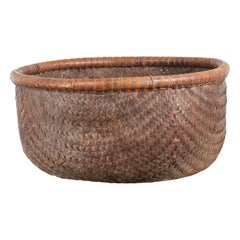
Rustic Chinese Qing Dynasty 19th Century Woven Rattan Round Grain Basket
Located in Yonkers, NY
A Chinese Qing Dynasty antique rattan round grain basket from the 19th century, with nice patina. Created in China during the 19h century, this grain basket features a thin lip sitting above a brown woven rattan body. With its rustic appeal and simple lines, this 19th century Chinese grain basket...
Category
Antique 19th Century Chinese Rustic Decorative Baskets
Materials
Rattan
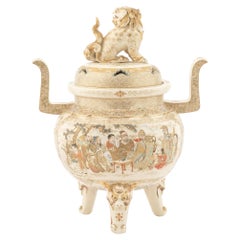
Japanese Meiji Period Satsuma Tripod Censer
Located in New York, NY
Very fine quality Japanese Meiji period Satsuma tripod censer with a foo dog finial.
wonderful painting quality.
Category
Antique Late 19th Century Japanese Meiji Ceramics
Materials
Ceramic