Lowell Libson Jonny Yarker Ltd Art
to
9
7
2
1
1
Overall Width
to
Overall Height
to
15
5
15
19
13
4
20
11
10
8
7
5
3
3
3
2
1
1
1
1
1
1
1
1
1
1
9
5
5
5
5
3
2
2
1
1
17
20
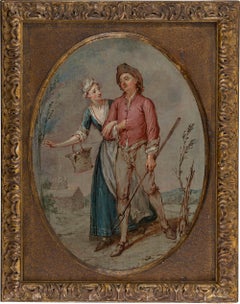
A young couple returning from the fields
Located in London, GB
Oil on panel
13 ⅜ x 9 ⅞ inches; 34 x 25 cm
Framed dimensions: 43.4 x 34.3 cm
Not signed
c. 1730s
Collections:
James Brydges, Duke of Chandos;
Chandos sale, Christopher Cock, Lond...
Category
18th Century Old Masters Figurative Paintings
Materials
Panel, Oil
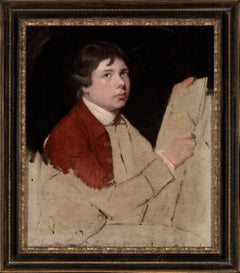
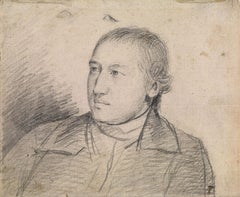
Self-Portrait
By John Hamilton Mortimer
Located in London, GB
Oil on canvas
30 x 25 ⅛ inches; 762 x 638 mm
Verso: after Sir Joshua Reynolds, a self-portrait
Not signed
Painted c. 1758
Collections:
Philip Gell (1775–1842), Hopton Hall, Derbyshire;
By inheritance at Hopton Hall to his daughter, Isabella, who married William Pole Thornhill, who renounced Hopton and its contents in favour of his kinsman, Henry Chandos-Pole-Gell (1829–1902);
By descent to his son, Brigadier General Harry Chandos-Pole-Gell (1872–1934), who sold Hopton Hall in 1918 and moved the family to Newnham Hall, Northamptonshire;
By descent to his son, Lt Colonel John Chandos-Pole (1909–1993), Newnham Hall;
Thence by descent until 2015, when acquired
By descent to 2015;
Lowell Libson
Jonny Yarker Ltd.
Literature:
Algernon Graves and Walter V. Cronin, A History of the works of Sir Joshua Reynolds P.R.A., London, 1901, IV, p. 1394.
David Manning...
Category
18th Century Old Masters Portrait Paintings
Materials
Canvas, Oil
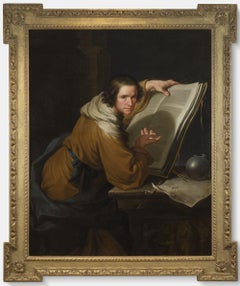
Sir Charles Frederick
Located in London, GB
Oil on canvas
50 x 40 inches; 127 x 101.6 cm
Framed dimensions: 151.5 x 127 cm
Inscribed on plinth: ‘VOTIS X ET XX’
Not signed
Painted c.1748
Collections:
Christie’s London, 23rd December 1954, lot.272;
J. Singer;
Somerville
Simpson Ltd, London, by 1985;
The Matthiesen Gallery, London;
Richard Feigen, New York;
Matthew Rutenberg, New York to 2019;
Lowell Libson and Jonny Yarker Ltd.
Literature:
Stella Rudolph, La Pittura del’ 700 a Roma, Milan, 1983, reproduced pl.133;
Jacob Simon, Handel, a celebration of his life and times 1685-1759, exh. cat. London, (National Portrait Gallery), 1985, no.196;
Catherine Whistler, Baroque
Later Paintings in the Ashmolean Museum, London, 2016, pp.102-105, reproduced p.104
Exhibited:
London, National Portrait Gallery, Handel, a celebration of his life and times 1685-1759, 1985-86, no.196, reproduced p.198
This powerful portrait of the antiquarian and courtier Sir Charles Frederick was completed in 1748 by the Roman painter Andrea Casali. Frederick, as comptroller of the royal laboratory, one of the ‘great officers’ of the Board of Ordinance at Woolwich, had just been responsible for the famed pyrotechnic display celebrating the Peace of Aix-la-Chapelle: the so-called ‘Royal Fireworks’ for which George Frederick Handel composed music. Casali’s portrait pays tribute to Frederick’s role as comptroller of the royal laboratory, showing him with a firing diagram and mortar, it also points to Frederick’s interests as an antiquarian with the inclusion of antique relief. Casali had first met Frederick in Rome in 1738, where he had painted his portrait, Frederick subsequently encouraged Casali to travel to London. This probably accounts for the unusual format; rather than a modern man of science, Casali casts Frederick as an alchemist bent on some mystic discovery, as such, it is one of the most unusual portraits of the period.
Andrea Casali was a pupil of Sebastiano Conca and then of Francesco Trevisani, who recommended him to the Spanish court in 1736. He enjoyed some success in Rome as a painter of frescoes and altarpieces, notably a large cycle of Scenes from the Life of St Dominic at the cloister of S. Sisto Vecchio, for which he was made a Knight of the Golden Spur in 1729. Casali began painting Grand Tourist portraits in Rome around 1738. His first portrait of Sir Charles Frederick is dated that year Ashmolean Museum, Oxford), it casts Frederick as a focused scholar, showing him seated at an elaborately carved console table, hard at work. In common with other Grand Tour portraiture of the period, Casali includes a famous Roman landmark in the background, in this case the façade of the Pantheon. Horace Walpole noted that it was thanks to the encouragement of ‘Mr Frederick and his Friends at Rome’ that Casali travelled to London in 1741.
Charles Frederick was a fascinating Augustan polymath. Born at Fort St George, Madras, where his father, Sir Thomas Frederick, was governor, he successively matriculated at New College, Oxford (1725), was called to the Middle Temple (1728), became a Fellow of the Royal Society (1731) and Director of the Society of Antiquaries (1735). His interests were wide ranging. Frederick was an amateur architect, he designed the monument to Lucy, Lady Lyttleton, in Hagley Church and the monument to Thomas Miller, bishop of Waterford, in Highclere church, Hampshire. He was a numismatist and collector of antiquities, as well as an amateur scientist. It was in the last capacity that he was appointed comptroller of the royal laboratory at Woolwich and clerk of the deliveries in 1746, this was the most junior of the ‘great officers’ who made up the membership of the royal Board of Ordnance. This appointment came through the good offices of the master-general of the Ordnance, a fellow antiquarian, John, 2nd Duke of Montagu. As comptroller, Frederick was responsible for the fireworks celebration of the treaty of Aix-la-Chapelle, for which Handel composed his celebrated music. As Horace Walpole wrote to his cousin, Henry Seymour Conway:
‘Charles Frederick has turned all his virtu into fireworks, and, by his influence with the Ordnance has prepared such a spectacle for the proclamation of Peace as is to surpass all its predecessors of bouncing memory. It is to open with a concert of fifteen hundred hands, and conclude with so many thousand crackers all set to music, that all the men killed in the war are to be wakened with a crash, as if it was the day of judgement, and fall a-dancing, like the troops in the Rehearsal. I wish you could see him making squibs of his papillotes, and bronzed over with a patina of gunpowder, and talking himself still hoarser on the superiority that his fireworks will have over the Roman naumachia.’
Performed in Green Park, the fireworks were mounted on a temporary structure designed by the architect Giovanni Niccolò Servandoni decorated by Adrea Soldi and Casali.
Casali’s second portrait of Frederick was completed following the success of the firework display. In this remarkable image, we discover Frederick at work, dressed in almost monastic garb, pouring over an impossibly large tome propped on an antique altar. The altar is identifiable as a Roman relief depicting Victory writing on a shield, the original is at Villa Medici in Rome, but was engraved by Pietro Santi Bartoli...
Category
18th Century Old Masters Portrait Paintings
Materials
Canvas, Oil
The Valley of the River Severn with a distant view of Shrewsbury
By Richard Wilson
Located in London, GB
Oil on canvas
20 x 37 ¼ inches; 50.8 x 94.6 cm
Framed dimensions: 67.5 x 110.5 cm
Not signed
c.1744-1745
Collections:
Possibly John Charles Middleton (1757-1793);
Revd Frederick M...
Category
18th Century Old Masters Landscape Paintings
Materials
Canvas, Oil
Alfred Baldwin, Esq.
By Edward John Poynter
Located in London, GB
Oil on unlined canvas, stamped
26 x 21¼ inches; 66.5 x 54 cm
Framed dimensions: 95.5 x 83.5 cm
‘Wood & Co 190 Brompton Road London SW’
Signed with monogram and dated ‘1878’, centr...
Category
19th Century Old Masters Portrait Paintings
Materials
Canvas, Oil
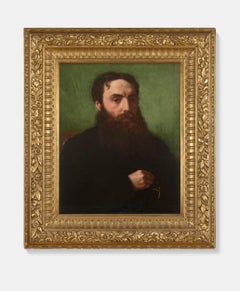
Eustace-Hyacinthe Langlois, called Langlois de L
Arche
Located in London, GB
Plaster
480 mm; 19 inches diameter
Inscribed: ‘H. Langlois du Pont de l’Arche Archeologue Peintre Graveur
par son ami P. J. David (D Angers) 1838’
Collections:
Sotheby’s, 22nd May...
Category
19th Century Old Masters Figurative Sculptures
Materials
Plaster
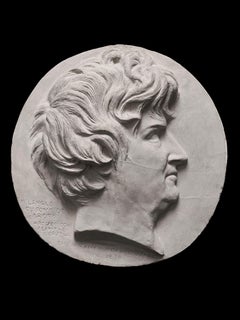
Oedipus before the Temple of the Furies at Colonus
Located in London, GB
Terracotta
19 x 25 ½ inches; 480 x 650 mm
Signed and dated: ‘W Tyler Excu. 1765’
Collections:
Cyril Humphris, London;
Humphris sale, Sotheby's, New York, 10-11 January 1995, lot 74...
Category
18th Century Old Masters Figurative Sculptures
Materials
Terracotta
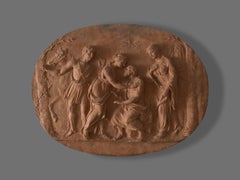
A Pair of Portraits
By Francis Cotes
Located in London, GB
Pastel on paper stretched on canvas
Each 23 ¼ x 19 ¾ inches; 59 x 50 cm
Framed dimensions, each: 83 x 67.5 cm
Both signed ‘F. Cotes Px 1751’
Collections:
Captain Penton;
Christie’...
Category
18th Century Old Masters Portrait Paintings
Materials
Canvas, Paper, Pastel
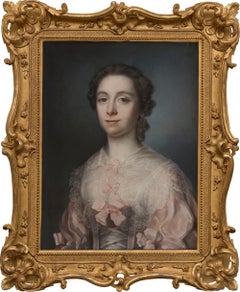
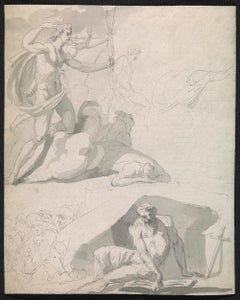
Eighteenth century Old Master drawing - Apollo destroying Niobe
s children
By John Hamilton Mortimer
Located in London, GB
Pen, ink and wash
Framed dimensions: 13 x 11 ¼ inches
Drawn c.1765
Verso: a study of a hanged man
Mortimer has filled this small sheet with action, depicting in the top right, Apollo and Artemis...
Category
18th Century Old Masters Figurative Drawings and Watercolors
Materials
Ink, Pen
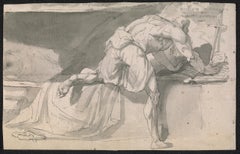
Eighteenth century Old Master drawing - St Jerome
By John Hamilton Mortimer
Located in London, GB
Pen, ink and wash
Framed dimensions: 9 ½ x 11 ¼ inches
Drawn c. 1763
This small, powerful study shows St Jerome contemplating the bible with a cross and sk...
Category
18th Century Old Masters Figurative Drawings and Watercolors
Materials
Ink, Pen
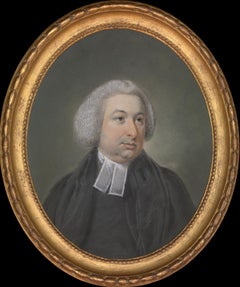
Eighteenth-century Irish portrait of the Rev. Henry Dabzac
By Hugh Douglas Hamilton
Located in London, GB
Pastel on paper, oval
9 x 7 ¼ inches; 230 x 185 mm
Inscribed on the verso:
‘The Revd Henry Dabzac D.D./ late Senior Fellow of/ Trinity College Dublin/ ever to be lamented by all that knew/ Him. Extensive learning, zeal, gently tempered/ by a spirit of charity & above all, a strong/ faith & a piety deservedly gained/ the character of a great and good man./ This exceptional man died 12th May 1790/ This picture was his give to Jane [Mary] Crofton, his sincerely [missing] sister.’
Collections:
Rev. Dr Henry Dabzac gift to his sister, Jane Crofton (d.1797);
Sir Hugh Crofton (1763-1834);
By descent to 1990;
Private collection, Dorset to 2020.
Literature:
Robert Staveley, Traces of Past and Present, Dublin, 1895, p.74;
Neil Jeffares, Dictionary of Pastellists Before 1800, online edition, no.J3751247
This characteristic pastel portrait by Hugh Douglas Hamilton was made early in his career; it depicts precisely the kind of education, well-connected Irish sitter who fuelled his success. The Reverend Henry Dabzac was from a distinguished Huguenot family, a celebrated academic historian, Dabzac received the Donegall lectureship in 1764 and from 1785 was Librarian and Senior Fellow of Trinity College, Dublin. According to his earliest biographer, Hamilton was the son of a peruke-maker based in Crow Street, Dublin. As Anne Hodge has pointed out, this places Hamilton’s father at the heart of the city: Crow street was a narrow thoroughfare formed part of the busy warren of streets bordered by the old Houses of Parliament and Trinity College at one end, and by Dublin Castle at the other. It is perhaps telling that in this early portrait, Hamilton shows Dabzac in a splendid powdered wig and his clerical bands. In 1754 Hamilton was apprenticed to James Mannin, a ‘pattern drawer’ who two years later was appointed master of the school of ornament at the Dublin Society’s drawing school, run by Robert West. Here Hamilton took the first prize in the 1755 competition, winning a premium of £1/16/. Hamilton developed a popular and profitable method of making pastel likenesses of sitters in a distinctive oval format. Hamilton developed a technique of using a sharpened pastel to hatch shaded areas of the features and, in the case of this portrait of Dabzac, the white powdered wig, which is drawn with particular care. In 1764 Hamilton moved to London where this small, oval pastels proved...
Category
18th Century Old Masters Portrait Drawings and Watercolors
Materials
Pastel
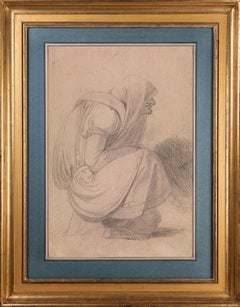
Drawing of a captive woman
By Henry Fuseli
Located in London, GB
Collections:
Sir Thomas Lawrence, who acquired the contents of Fuseli’s studio;
Susan, Countess of Guilford, née Coutts (1771-1837), acquired from the Lawrence estate;
Susan, Baroness North (1797-1884), daughter of the above;
Mrs A. M. Jaffé, acquired in France, c. 1950 to 2016.
Black chalks, on buff-coloured paper
Stamped verso: ‘Baroness Norths Collection / of Drawings by H Fuseli Esq.’
Framed dimensions: 26.38 x 20.63 inches
This boldly drawn sheet depicting a seated figure was made by Fuseli at an important and highly productive moment in his career. The monumental drawing is closely related to another sheet by Fuseli in the British Museum which Schiff published as subject unknown. Both drawings were made when Fuseli was designing his most important sequence of historical works, including scenes from Shakespeare and Milton, The Nightmare and The Death of Dido which was exhibited at the Royal Academy to great critical acclaim in 1781. The present drawing does not relate directly to any of Fuseli’s finished historical paintings of the period, but evidently the image of a slightly menacing, seated and covered old woman was precisely the sort of motif he was playing with. It is notable that the same figure reappears later in Fuseli’s work as the witch from Ben Jonson’s Witch’s Song which Fuseli produced as both a painting and engraving in 1812.
Fuseli returned to London in 1779 from a highly creative and productive period in Rome and established himself as one of the leading history painters of the period. Fuseli re-established contact with his old mentor Sir Joshua Reynolds, becoming a regular guest at his dinner table and visitor to his studio. The earliest and most striking manifestation of this strategy was Fuseli's Death of Dido, exhibited in 1781 at the Royal Academy. Executed on the same scale as Reynolds's version (Royal Collection), Fuseli's vertically oriented picture was hung directly opposite Reynolds's with its horizontal orientation, inevitably inviting comparison between the two works and garnering Fuseli much publicity and favourable reviews in the newspapers.
The present, previously unpublished sheet, relates closely to a drawing now in the British Museum. That sheet shows the same seated old woman, drawn on a smaller scale and more schematic in design, seated next to an anatomical drawing of a man. The pose of this figure is related to the pose of Dido in his Death of Dido; the foreshortened torso, arrangement of head, oblique view of Dido’s features and arms all suggest that the study can be viewed as an initial thought for the composition. Fuseli may have initially thought of including the figure of the hunched and covered old woman. Drawn on identical paper to the British Museum sheet, our study is an enlarged depiction of the same figure, more elaborately delineated and developed. The presence of a chain to the right of the figure, suggests that the iconography was related in some way to a scene of imprisonment.
Fuseli had first explored the motif of the hooded old woman in an early Roman drawing, 'The Venus Seller'. The idea of a grotesque old woman, hooded and with angular nose and projecting chin seen in profile was most spectacularly used by Fuseli in his sequence of paintings depicting The Three Witches from Macbeth. Fuseli seems to have kept the present sheet and may have returned to it when preparing a painting of The Witch and the Mandrake from Ben Jonson’s Witch’s Song from his Masque of Queens in 1812. Here the same seated figure looks out from under her hood and picks a mandrake by moonlight. Jonson’s drama had been performed at the court of James I in 1609, inspired the subject. To throw the nobility of the queens into relief, the poet added a coven of witches, one of whom declares: ‘I last night lay all alone, On the ground, to hear the mandrake groan; And plucked him up, though he grew full low, And, as I had done, the cock did crow.’ The figure was reversed in the associated etching which was published in 1812. It seems likely that the present drawing remained as part of Fuseli’s working archive of figure studies.
The present drawing was presumably purchased with the bulk of Fuseli’s drawings after the artist’s death by Sir Thomas Lawrence. Lawrence’s large group of Fuseli drawings were then acquired by Susan, Countess of Guildford (1771-1837). Lady Guildford was the eldest daughter of the banker Thomas Coutts (1735-1822), who himself had supported Fuseli’s journey to Rome in the 1770s and had remained one of the artist’s key...
Category
18th Century Old Masters Figurative Drawings and Watercolors
Materials
Chalk
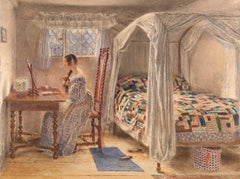
19th century watercolour of a Girl at her Dressing Table
By William Henry Hunt
Located in London, GB
Collections:
Muir Hetherington;
Sir John and Lady Witt, acquired 1974;
By descent to 2015.
Literature:
Tom Jones (ed.), William Henry Hunt 1790-1864, exh. cat., 1981, no. 145 (Girl in a bedroom);
John Witt, William Henry Hunt (1790-1864) Life and Work, London, 1982, no. 553, p. 194, colour pl. 16.
Exhibited:
Wolverhampton, Central Art Gallery, Preston, Harris Museum and Art Gallery and Hastings, Hastings Museum and Art Gallery, William Henry Hunt 1790-1864, 1981, no. 145 as Girl in a bedroom (Lent by Sir John & Lady Witt)
Framed dimensions: 20 x 20.75 inches
This unusually charming and well-preserved watercolour was painted by William Henry Hunt in around 1833. Almost certainly depicting his young wife, Sarah, possibly in the interior of her family home at Bramley in Hampshire. This work shows Hunt’s remarkable virtuosity as a watercolourist, Hunt, for example, articulates the profile of his young wife, by leaving a reserve of white paper to suggest the light modelling her features. Throughout the 1830s Hunt made a sequence of richly painted interior views of both domestic and agricultural spaces which pay scrupulous attention to detail.
Hunt was born in London, the son of a tin-plate worker and japanner. J. L. Roget recorded the observation of Hunt’s uncle: ‘nervy, little Billy Hunt… was always a poor cripple, and as he was fit for nothing, they made an artist of him.’ At the age of sixteen he was apprenticed to the landscape painter John Varley for seven years, moving to live with Varley at 18 Broad Street, Golden Square, London. There he made close friends with both John Linnell and William Mulready. Hunt worked at the ‘Monro Academy’, at 8 Adelphi Terrace, London, the house of Dr Thomas Monro, an enthusiastic patron of landscape watercolourists. Through Monro, Hunt was introduced to the 5th Earl of Essex...
Category
19th Century Old Masters Figurative Drawings and Watercolors
Materials
Watercolor, Pencil
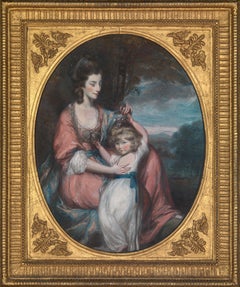
18th century pastel portrait of Lady Augusta Corbett and her son, Stuart
By Daniel Gardner
Located in London, GB
Collections:
Commissioned by Andrew Corbett, husband of the sitter;
The Venerable Stuart Corbett;
Sir Stuart Corbett;
By descent to 2002;
Sotheby’s, London 21 March 2002, lot.104;
Lowell Libson...
Category
18th Century Old Masters Portrait Drawings and Watercolors
Materials
Pastel, Gouache
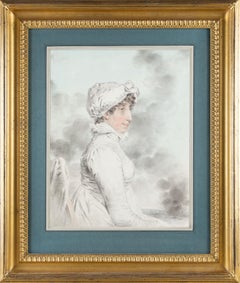
Regency portrait drawing of Arabella Graham-Clarke
By John Downman
Located in London, GB
Collections:
The sitter, and by descent;
Christie's, 19th March 1928, lot 6;
Private collection to 2019
Literature:
G.C. Williamson, John Downman, A.R.A., his Life and Works, Lon...
Category
Early 19th Century Old Masters Portrait Drawings and Watercolors
Materials
Pencil, Watercolor
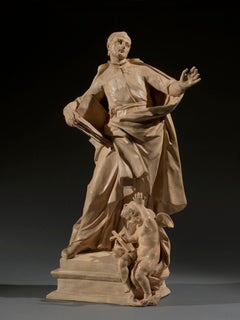
Roman 18th century terracotta model for the sculpture of San Camillo de Lellis
Located in London, GB
This remarkably fluid terracotta bozetto was made in preparation for Pietro Pacilli’s most important public commission, a large-scale marble statue of San Camillo de Lellis for the nave of St Peter’s Basilica in Rome. Expressively modelled, this terracotta sculpture is a rare and significant work made by a major Roman sculptor at a transformative moment of European sculpture. Pacilli began his working life on the great Baroque decorative projects initiated in the seventeenth century, but he found success as a restorer of ancient sculpture working to finish antiquities for a tourist market, becoming an important figure in the emergence of an archaeologically minded Neoclassicism. Pacilli trained Vincenzo Pacetti and provided important decorative work for the Museo Pio-Clementino, at the same time he is recorded restoring some of the most celebrated antiquities excavated and exported during the period.
Pacilli was born into a family of Roman craftsmen, his father Carlo was a wood carver, and Pacilli is recorded working with him on the Corsini Chapel in San Giovanni Laternao as early as 1735. In 1738 his terracotta model of Joseph and Potiphar’s Wife won the first prize in the second class of the sculpture concorso at the Accademia di San Luca, this is particularly notable as Bartolomeo Cavaceppi came third. He worked as a carver and stuccoist completing works for the churches of San Marco and SS. Trinita dei Domeniciani Spagnoli. Pacilli operated as a sculptor and restorer of antiquities from his studio at the top of the Spanish Steps, close to Santa Trinita dei Monti, where he is listed as a potential vendor to the Museo Pio-Clementino in 1770.
In 1763 Pacilli completed a silver figure of San Venanzio for the treasury of San Venanzio. He is recorded as Pacetti’s first master and it was evidently through Pacilli that he began to acquire his facility as a restorer of ancient sculpture. Pacilli, at his studio ‘poco prima dell’Arco della Regina alla Trinita dei Monti,’ exercised, what the nineteenth-century scholar, Adolf Michaelis called ‘rejuvenating arts’ on several important pieces of classical sculpture, including in 1760 the group of a Satyr with a Flute for the natural brother of George III, General Wallmoden, Hanovarian minister at Vienna. In 1765, Dallaway and Michaelis record that Pacilli was responsible for the restorations, including the addition of a new head, to the Barberini Venus which he had acquired from Gavin Hamilton. The Venus was then sold to Thomas Jenkins, who in turn passed it on to William Weddell at Newby Hall. In 1767 Pacilli exported a series of ancient busts ‘al naturale’ including portraits of Antinous, Julius Ceaser and Marus Aurelius, also a statue of a Muse and a Venus. As early as 1756 Pacilli seems to have been operating as an antiquarian, helping to disperse the collection of the Villa Borrioni. Pacilli supplied sculpture to notable British collectors, including Charles Townley, who on his first trip to Italy purchased the Palazzo Giustiniani statue of Hecate from Pacilli. Pacilli was involved with the Museo Pio Clementino from its conception, supplying busts of Julius Ceaser and a Roman Woman as well as completing stucco putti surmounting the arms of Pope Bendedict XIV to signal the entrance to the new Museo Critiano.
In 1750 Il Diario Ordinario del Chracas announced that Pacilli had begun work on a sculpture of San Camillo de Lellis for St Peter’s. Camillo de Lellis founded his congregation, the Camillians, with their distinctive red felt crosses stitched on black habits in 1591. Having served as a soldier in the Venetian army, Camillo de Lellis became a novitiate of the Capuchin friars, he moved to Rome and established a religious community for the purpose of caring for the sick. In 1586 Pope Sixtus V formerly recognised the Camillians and assigned them to the Church of Santa Maria Maddalena in Rome. Camillo de Lellis died in 1614 and was entombed at Santa Maria Maddalena, he was canonised by Benedict XIV on June 26, 1746. It was an occasion that prompted the Camillians to make a number of significant artistic commissions, including two canvases by Pierre Subleyras showing episodes from San Camillo’s life which they presented to Benedict XIV. In 1750 Pacilli was commissioned to fill one of the large niches on the north wall of the nave with a sculpture of San Camillo.
The present terracotta bozetto presumably had two important functions, to enable Pacilli to work out his ideas for the finished sculpture and at the same time to show his design to the various commissioning bodies. In this case it would have been Cardinal Alessandro Albani and Monsignor Giovan Francesco Olivieri, the ‘economo’ or treasurer of the fabric of St Peter’s. Previously unrecorded, this terracotta relates to a smaller, less finished model which has recently been identified as being Pacilli’s first idea for his statue of San Camillo. Preserved in Palazzo Venezia, in Rome, the terracotta shows San Camillo with his left hand clutching his vestments to his breast; the pose and action more deliberate and contained than the finished sculpture. In producing the present terracotta Pacilli has expanded and energised the figure. San Camillo is shown with his left hand extended, his head turned to the right, apparently in an attempt to look east down the nave of St Peter’s. The model shows Pacilli experimenting with San Camillo’s costume; prominently on his breast is the red cross of his order, whilst a sense of animation is injected into the figure through the billowing cloak which is pulled across the saint’s projecting right leg. The power of the restrained, axial contrapposto of bent right leg and outstretched left arm, is diminished in the final sculpture where a baroque fussiness is introduced to the drapery. What Pacilli’s terracotta demonstrates, is that he conceived the figure of San Camillo very much in line with the immediate tradition of depicting single figures in St Peter’s; the rhetorical gesture of dynamic saint, arm outstretched, book in hand, head pointed upwards was perhaps borrowed from Camillo Rusconi’s 1733 sculpture of St. Ignatius...
Category
18th Century Baroque Figurative Sculptures
Materials
Terracotta
18th century view of the Elephant and Castle in London
Located in London, GB
Collections:
With Martyn Gregory;
Judy Egerton, 1984, acquired from the above;
By descent to 2014.
Exhibited:
London, Martyn Gregory, Exhibition of English & Continental Watercolours, 1984, no. 94.
London, Lowell Libson...
Category
18th Century Old Masters Landscape Paintings
Materials
Gouache, Vellum
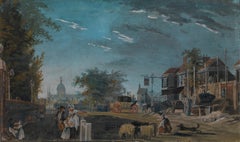
18th century ink study for the Leveson-Gower Children
By George Romney
Located in London, GB
Collections: J. Goodfriend, USA.
Brown wash and pencil on laid paper
Framed dimensions: 13.25 x 11.75 inches
This powerful drawing was made at the time that Romney was painting the famous group portrait of the Gower Children now in Abbot Hall Art Gallery, Kendal. Romney was a bold and incisive draughtsman who made numerous rich brown ink studies, principally for historical compositions; by contrast, comparatively few studies linked directly to his portraits survive. The existence of a group of studies for the Gower Children underscores its importance to Romney. The sitters were the five youngest of the eight children of Granville, 2nd Earl Gower who, at the time the portrait was commissioned, was President of the Council in Lord North’s government and one of the best-connected and most influential people in England. The present drawing which is a large scale treatment of the composition in its final form perfectly distils Romney’s conceit: the younger children dancing whilst their elder sister, in the guise of a Bacchante plays the tambourine. The bold and dramatic study underlines both the artistic confidence and classical grandeur Romney gained during his trip to Italy between 1773 and 1775.
The commission from Granville, 2nd Earl Gower to paint five of his children came shortly after Romney’s Continental tour. The initial idea, as represented by the present drawing, seems to have been to paint Lady Anne, the figure on the right of the composition playing the tambourine, who was the youngest of Gower’s first four children by his second wife Lady Louisa Egerton and who married the Rev. Edward Vernon Harcourt, later Archbishop of York, with three of her younger half-siblings by Gower’s third wife, Lady Susanna Stewart: at the left Lady Georgina, who became Countess of St Germans following her marriage to the Hon. William Eliot; at the right Lady Charlotte Sophia, later Duchess of Beaufort and in the centre Lady Susanna, later Countess of Harrowby. Romney added a fifth child to the finished portrait, Gower’s son: Lord Granville, later created Viscount Granville and Earl Granville. In Italy Romney had produced a large number of studies of classical antiquities and old master paintings.
The commission from Gower offered Romney the opportunity to explore a complex multi-figural group, putting into practice the kind of ambitious classical quotations that Reynolds was currently exploiting. In 1773 Reynolds had completed the remarkable group portrait of the Montgomery Sisters, now in the Tate Gallery, London, which showed them adorning a herm of the Roman god Hymen; the composition used a garland to link the three figures who were shown in classical costume dancing at the foot of a Roman sculpture. Scholars have long pointed to a similar sources for the two compositions: the works of Nicolas Poussin. Whilst the Montgomery Sisters is based, in part, on a Bacchanal now in the Musée des Beaux-Arts, the Gower Children has always been associated with Poussin’s Dance to the Music of Time, now in the Wallace Collection, London. It seems more likely that Romney was looking to an antique source in the form of the Borghese Dancers, a Roman relief, then in Palazzo Borghese in Rome. Romney would have seen the relief of interlocking, dancing maidens and would also have known Guido Reni’s Aurora...
Category
18th Century Old Masters Portrait Drawings and Watercolors
Materials
Ink, Pencil

18th century portrait drawing of the Rev. William Atkinson
By George Romney
Located in London, GB
Collections:
Henry Scipio Reitlinger (1882-1950);
Private collection, UK to 2019
Framed dimensions: 14.50 x 15.38 inches
This drawing is one of only two known portrait drawings by Romney (as opposed to preliminary studies for portraits) and is dated by Alex Kidson as being executed no later than 1769. It is likely that the present drawing was originally part of a sketchbook, now largely dismembered (Abbot Hall Art Gallery, Kendal), which Kidson notes, contained some of Romney’s most beautiful early drawings. This drawing, and a second sheet formerly with Andrew Wyld, have been identifying as depicting the Rev. William Atkinson...
Category
18th Century Old Masters Portrait Drawings and Watercolors
Materials
Pencil
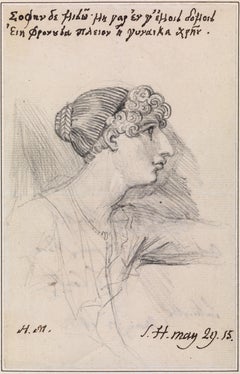
Portrait drawing of Harriot Mellon, Mrs Thomas Coutts
By Henry Fuseli
Located in London, GB
Inscribed by the artist in pen and brown ink, upper margin: 'σοφὴν δὲ μισῶ: μὴ γὰρ ἔν γ' ἐμοῖς δόμοις / εἴη φρονοῦσα πλείον' ἢ γυναῖκα χρή [Euripides, Hippolytus, 11, 640-41: “But a ...
Category
19th Century Old Masters Portrait Drawings and Watercolors
Materials
Pencil
Related Items
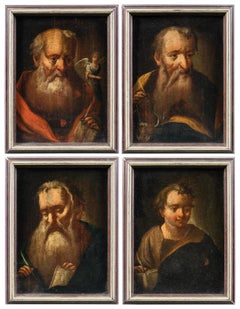
Baroque Italian painter - Set of four 18th century figure paintings - Evangelist
Located in Varmo, IT
Italian painter (early 18th century) - Four Evangelists.
25.5 x 19 cm without frame, 29 x 22.5 cm with frame.
Ancient oil painting on panel. in wooden frames (not signed).
Conditi...
Category
Early 18th Century Old Masters Figurative Paintings
Materials
Oil, Panel

$1,776 Sale Price
40% Off
H 22.84 in W 17.72 in
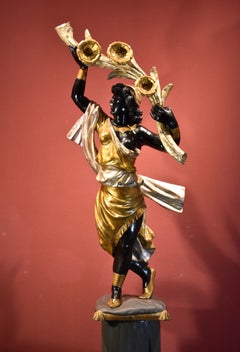
Antique Sculpture Female Moor Venice 19th Century Gold Italy
Located in Riva del Garda, IT
Antique sculpture of a female Moor with flowering cornucopia
Venice, 19th century
Carved, lacquered and gilded/silvered wood
Total height 202 cm (column base 82 cm, figure 120 cm)
...
Category
19th Century Old Masters Sculptures
Materials
Gold
Shepherd with Sheep, Cows and a Goat in a Landscape by Jan Frans Soolmaker
Located in Stockholm, SE
Jan Frans Soolmaker (Flanders 1635‑1685)
Shepherd with Sheep, Cows and a Goat in a Landscape
oil on relined canvas
canvas size 56 x 53 cm
frame i...
Category
17th Century Old Masters Animal Paintings
Materials
Canvas, Oil

$5,773 Sale Price
25% Off
H 22.05 in W 20.87 in
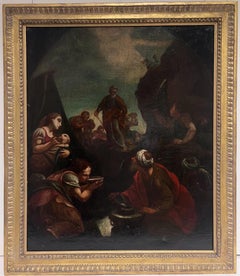
17th Century Italian Old Master Oil Painting Moses Striking Water from the Rock
By Pier (Pietro) Dandini
Located in Cirencester, Gloucestershire
Moses Striking Water from the Rock;
Circle of Pietro Dandini, Italian 1646-1712
Italian School, late 17th century
oil on canvas, framed
framed: 3...
Category
Early 18th Century Old Masters Portrait Paintings
Materials
Canvas, Oil
$6,828 Sale Price
20% Off
H 32 in W 28 in D 1 in
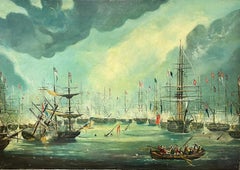
Naval Battle Engagement at Sea Large Busy Battle Scene Many Ships, Signed Oil
Located in Cirencester, Gloucestershire
English School, early 20th century
signed
oil painting on canvas, unframed
canvas: 17 x 24 inches
provenance: private collection, Eng;and
condition: good and sound condition, minor ...
Category
Early 20th Century Old Masters Landscape Paintings
Materials
Oil, Canvas
$1,529 Sale Price
20% Off
H 17 in W 24 in
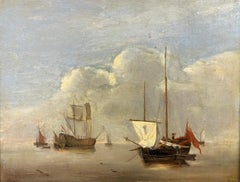
Shipping in Calm Waters, 18th Century Dutch Oil on Wood Panel, Man o War
Located in Cirencester, Gloucestershire
Shipping in Calm Waters
Dutch School, 18th century
oil painting on wood panel
panel: 10 x 12.75 inches
framed: 14 x 17 inches
condition: very good, minor evidenc...
Category
18th Century Old Masters Landscape Paintings
Materials
Oil, Wood Panel
$2,403 Sale Price
20% Off
H 14 in W 17 in D 1 in
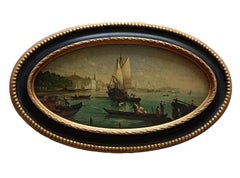
VENICE - Gianluca Gorini - Italian Landscape Oil on Canvas Painting
By Giancarlo Gorini
Located in Napoli, IT
VENICE - Italian landscape oil on canvas oval painting cm.44x74 by Giancarlo Gorini, Italy 2002.
Gold gilded wooden frame available o...
Category
Early 2000s Old Masters Landscape Paintings
Materials
Canvas, Oil
$4,145
H 11.82 in W 23.63 in
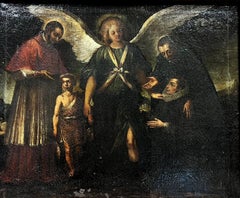
Fine Italian Old Master Oil Painting Angel
Saints Appearing to Figures
Located in Cirencester, Gloucestershire
Artist/ School: Italian Old Master, 18th century
Title: Angel and Saints appearing to figures, one dressed in a white ruff collar.
Medium: oil on canvas...
Category
Early 18th Century Old Masters Figurative Paintings
Materials
Canvas, Oil
$5,462 Sale Price
20% Off
H 22 in W 26 in
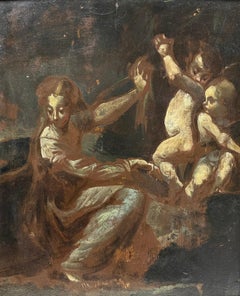
Angelic Cherubs with Classical Figure in Wilderness Finely Painted Preparatory
Located in Cirencester, Gloucestershire
Figure with Cherubim in Wilderness
Italian School, 17th century
oil painting on wood panel
framed 13 x 11 inches
condition: overall for its age very good, though the work is most likely a preparatory...
Category
17th Century Old Masters Figurative Paintings
Materials
Oil, Wood Panel
$2,840 Sale Price
20% Off
H 13 in W 11 in D 1 in
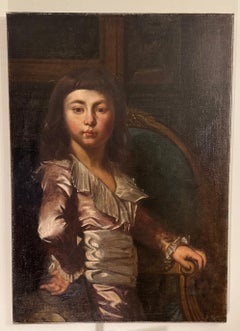
19th century English Portrait of a Young boy in a Cavalier costume
Located in Woodbury, CT
This elegant English 19th-century portrait of a young boy dressed in a Cavalier costume, painted circa 1860, is a striking example of Victorian portraiture that seamlessly combines h...
Category
1860s Old Masters Portrait Paintings
Materials
Canvas, Oil
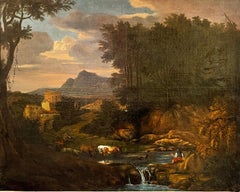
Huge 18th Century Italian Old Master Oil Painting Figures
Animals Arcadian
Located in Cirencester, Gloucestershire
The Arcadian Landscape
Italian School, 18th century
oil painting on canvas, unframed
canvas size: 32 x 40 inches
condition: excellent condition for its age, fully restored.
provenance: from a private collection in Paris, France.
Large scale classical 18th century Italian Old Master...
Category
Early 18th Century Old Masters Landscape Paintings
Materials
Canvas, Oil
$8,685 Sale Price
20% Off
H 32 in W 40 in D 1 in
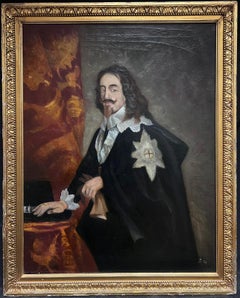
King Charles 1st Antique Oil Painting Portrait of Famous British Monarch
Located in Cirencester, Gloucestershire
King Charles I
British artist, early 20th century
signed with initials
oil on canvas, framed
framed: 36 x 29 inches
canvas: 32 x 26 inches
provenance: p...
Category
Early 1900s Old Masters Portrait Paintings
Materials
Oil, Canvas
$1,529 Sale Price
20% Off
H 36 in W 29 in