Lowell Libson Jonny Yarker Ltd Drawings and Watercolor Paintings
to
7
3
Overall Width
to
Overall Height
to
7
3
7
10
8
2
10
8
7
5
2
2
2
1
1
1
1
1
1
1
5
3
3
3
2
2
2
2
1
1
10
10
Eighteenth century Old Master drawing - Apollo destroying Niobe
s children
By John Hamilton Mortimer
Located in London, GB
Pen, ink and wash
Framed dimensions: 13 x 11 ¼ inches
Drawn c.1765
Verso: a study of a hanged man
Mortimer has filled this small sheet with action, depicting in the top right, Apollo and Artemis...
Category
18th Century Old Masters Figurative Drawings and Watercolors
Materials
Ink, Pen
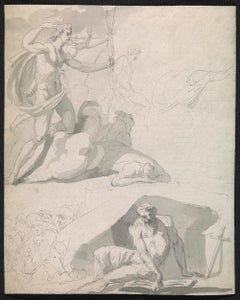
Eighteenth century Old Master drawing - St Jerome
By John Hamilton Mortimer
Located in London, GB
Pen, ink and wash
Framed dimensions: 9 ½ x 11 ¼ inches
Drawn c. 1763
This small, powerful study shows St Jerome contemplating the bible with a cross and sk...
Category
18th Century Old Masters Figurative Drawings and Watercolors
Materials
Ink, Pen
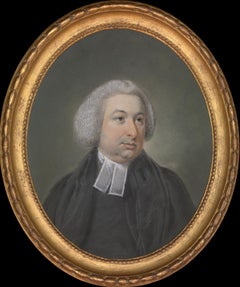
Eighteenth-century Irish portrait of the Rev. Henry Dabzac
By Hugh Douglas Hamilton
Located in London, GB
Pastel on paper, oval
9 x 7 ¼ inches; 230 x 185 mm
Inscribed on the verso:
‘The Revd Henry Dabzac D.D./ late Senior Fellow of/ Trinity College Dublin/ ever to be lamented by all that knew/ Him. Extensive learning, zeal, gently tempered/ by a spirit of charity & above all, a strong/ faith & a piety deservedly gained/ the character of a great and good man./ This exceptional man died 12th May 1790/ This picture was his give to Jane [Mary] Crofton, his sincerely [missing] sister.’
Collections:
Rev. Dr Henry Dabzac gift to his sister, Jane Crofton (d.1797);
Sir Hugh Crofton (1763-1834);
By descent to 1990;
Private collection, Dorset to 2020.
Literature:
Robert Staveley, Traces of Past and Present, Dublin, 1895, p.74;
Neil Jeffares, Dictionary of Pastellists Before 1800, online edition, no.J3751247
This characteristic pastel portrait by Hugh Douglas Hamilton was made early in his career; it depicts precisely the kind of education, well-connected Irish sitter who fuelled his success. The Reverend Henry Dabzac was from a distinguished Huguenot family, a celebrated academic historian, Dabzac received the Donegall lectureship in 1764 and from 1785 was Librarian and Senior Fellow of Trinity College, Dublin. According to his earliest biographer, Hamilton was the son of a peruke-maker based in Crow Street, Dublin. As Anne Hodge has pointed out, this places Hamilton’s father at the heart of the city: Crow street was a narrow thoroughfare formed part of the busy warren of streets bordered by the old Houses of Parliament and Trinity College at one end, and by Dublin Castle at the other. It is perhaps telling that in this early portrait, Hamilton shows Dabzac in a splendid powdered wig and his clerical bands. In 1754 Hamilton was apprenticed to James Mannin, a ‘pattern drawer’ who two years later was appointed master of the school of ornament at the Dublin Society’s drawing school, run by Robert West. Here Hamilton took the first prize in the 1755 competition, winning a premium of £1/16/. Hamilton developed a popular and profitable method of making pastel likenesses of sitters in a distinctive oval format. Hamilton developed a technique of using a sharpened pastel to hatch shaded areas of the features and, in the case of this portrait of Dabzac, the white powdered wig, which is drawn with particular care. In 1764 Hamilton moved to London where this small, oval pastels proved...
Category
18th Century Old Masters Portrait Drawings and Watercolors
Materials
Pastel
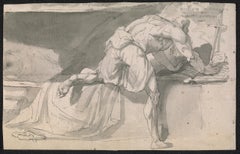
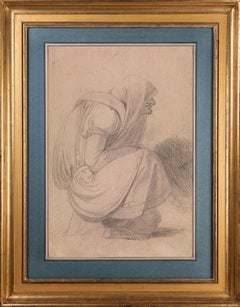
Drawing of a captive woman
By Henry Fuseli
Located in London, GB
Collections:
Sir Thomas Lawrence, who acquired the contents of Fuseli’s studio;
Susan, Countess of Guilford, née Coutts (1771-1837), acquired from the Lawrence estate;
Susan, Baroness North (1797-1884), daughter of the above;
Mrs A. M. Jaffé, acquired in France, c. 1950 to 2016.
Black chalks, on buff-coloured paper
Stamped verso: ‘Baroness Norths Collection / of Drawings by H Fuseli Esq.’
Framed dimensions: 26.38 x 20.63 inches
This boldly drawn sheet depicting a seated figure was made by Fuseli at an important and highly productive moment in his career. The monumental drawing is closely related to another sheet by Fuseli in the British Museum which Schiff published as subject unknown. Both drawings were made when Fuseli was designing his most important sequence of historical works, including scenes from Shakespeare and Milton, The Nightmare and The Death of Dido which was exhibited at the Royal Academy to great critical acclaim in 1781. The present drawing does not relate directly to any of Fuseli’s finished historical paintings of the period, but evidently the image of a slightly menacing, seated and covered old woman was precisely the sort of motif he was playing with. It is notable that the same figure reappears later in Fuseli’s work as the witch from Ben Jonson’s Witch’s Song which Fuseli produced as both a painting and engraving in 1812.
Fuseli returned to London in 1779 from a highly creative and productive period in Rome and established himself as one of the leading history painters of the period. Fuseli re-established contact with his old mentor Sir Joshua Reynolds, becoming a regular guest at his dinner table and visitor to his studio. The earliest and most striking manifestation of this strategy was Fuseli's Death of Dido, exhibited in 1781 at the Royal Academy. Executed on the same scale as Reynolds's version (Royal Collection), Fuseli's vertically oriented picture was hung directly opposite Reynolds's with its horizontal orientation, inevitably inviting comparison between the two works and garnering Fuseli much publicity and favourable reviews in the newspapers.
The present, previously unpublished sheet, relates closely to a drawing now in the British Museum. That sheet shows the same seated old woman, drawn on a smaller scale and more schematic in design, seated next to an anatomical drawing of a man. The pose of this figure is related to the pose of Dido in his Death of Dido; the foreshortened torso, arrangement of head, oblique view of Dido’s features and arms all suggest that the study can be viewed as an initial thought for the composition. Fuseli may have initially thought of including the figure of the hunched and covered old woman. Drawn on identical paper to the British Museum sheet, our study is an enlarged depiction of the same figure, more elaborately delineated and developed. The presence of a chain to the right of the figure, suggests that the iconography was related in some way to a scene of imprisonment.
Fuseli had first explored the motif of the hooded old woman in an early Roman drawing, 'The Venus Seller'. The idea of a grotesque old woman, hooded and with angular nose and projecting chin seen in profile was most spectacularly used by Fuseli in his sequence of paintings depicting The Three Witches from Macbeth. Fuseli seems to have kept the present sheet and may have returned to it when preparing a painting of The Witch and the Mandrake from Ben Jonson’s Witch’s Song from his Masque of Queens in 1812. Here the same seated figure looks out from under her hood and picks a mandrake by moonlight. Jonson’s drama had been performed at the court of James I in 1609, inspired the subject. To throw the nobility of the queens into relief, the poet added a coven of witches, one of whom declares: ‘I last night lay all alone, On the ground, to hear the mandrake groan; And plucked him up, though he grew full low, And, as I had done, the cock did crow.’ The figure was reversed in the associated etching which was published in 1812. It seems likely that the present drawing remained as part of Fuseli’s working archive of figure studies.
The present drawing was presumably purchased with the bulk of Fuseli’s drawings after the artist’s death by Sir Thomas Lawrence. Lawrence’s large group of Fuseli drawings were then acquired by Susan, Countess of Guildford (1771-1837). Lady Guildford was the eldest daughter of the banker Thomas Coutts (1735-1822), who himself had supported Fuseli’s journey to Rome in the 1770s and had remained one of the artist’s key...
Category
18th Century Old Masters Figurative Drawings and Watercolors
Materials
Chalk
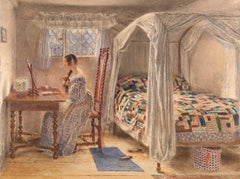
19th century watercolour of a Girl at her Dressing Table
By William Henry Hunt
Located in London, GB
Collections:
Muir Hetherington;
Sir John and Lady Witt, acquired 1974;
By descent to 2015.
Literature:
Tom Jones (ed.), William Henry Hunt 1790-1864, exh. cat., 1981, no. 145 (Girl in a bedroom);
John Witt, William Henry Hunt (1790-1864) Life and Work, London, 1982, no. 553, p. 194, colour pl. 16.
Exhibited:
Wolverhampton, Central Art Gallery, Preston, Harris Museum and Art Gallery and Hastings, Hastings Museum and Art Gallery, William Henry Hunt 1790-1864, 1981, no. 145 as Girl in a bedroom (Lent by Sir John & Lady Witt)
Framed dimensions: 20 x 20.75 inches
This unusually charming and well-preserved watercolour was painted by William Henry Hunt in around 1833. Almost certainly depicting his young wife, Sarah, possibly in the interior of her family home at Bramley in Hampshire. This work shows Hunt’s remarkable virtuosity as a watercolourist, Hunt, for example, articulates the profile of his young wife, by leaving a reserve of white paper to suggest the light modelling her features. Throughout the 1830s Hunt made a sequence of richly painted interior views of both domestic and agricultural spaces which pay scrupulous attention to detail.
Hunt was born in London, the son of a tin-plate worker and japanner. J. L. Roget recorded the observation of Hunt’s uncle: ‘nervy, little Billy Hunt… was always a poor cripple, and as he was fit for nothing, they made an artist of him.’ At the age of sixteen he was apprenticed to the landscape painter John Varley for seven years, moving to live with Varley at 18 Broad Street, Golden Square, London. There he made close friends with both John Linnell and William Mulready. Hunt worked at the ‘Monro Academy’, at 8 Adelphi Terrace, London, the house of Dr Thomas Monro, an enthusiastic patron of landscape watercolourists. Through Monro, Hunt was introduced to the 5th Earl of Essex...
Category
19th Century Old Masters Figurative Drawings and Watercolors
Materials
Watercolor, Pencil
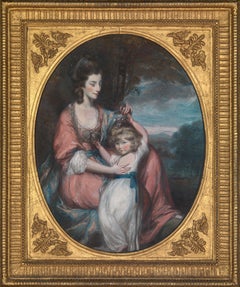
18th century pastel portrait of Lady Augusta Corbett and her son, Stuart
By Daniel Gardner
Located in London, GB
Collections:
Commissioned by Andrew Corbett, husband of the sitter;
The Venerable Stuart Corbett;
Sir Stuart Corbett;
By descent to 2002;
Sotheby’s, London 21 March 2002, lot.104;
Lowell Libson...
Category
18th Century Old Masters Portrait Drawings and Watercolors
Materials
Pastel, Gouache
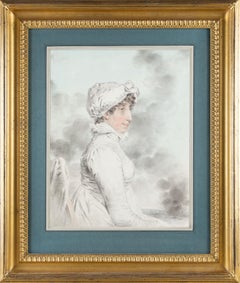
Regency portrait drawing of Arabella Graham-Clarke
By John Downman
Located in London, GB
Collections:
The sitter, and by descent;
Christie's, 19th March 1928, lot 6;
Private collection to 2019
Literature:
G.C. Williamson, John Downman, A.R.A., his Life and Works, Lon...
Category
Early 19th Century Old Masters Portrait Drawings and Watercolors
Materials
Pencil, Watercolor
18th century ink study for the Leveson-Gower Children
By George Romney
Located in London, GB
Collections: J. Goodfriend, USA.
Brown wash and pencil on laid paper
Framed dimensions: 13.25 x 11.75 inches
This powerful drawing was made at the time that Romney was painting the famous group portrait of the Gower Children now in Abbot Hall Art Gallery, Kendal. Romney was a bold and incisive draughtsman who made numerous rich brown ink studies, principally for historical compositions; by contrast, comparatively few studies linked directly to his portraits survive. The existence of a group of studies for the Gower Children underscores its importance to Romney. The sitters were the five youngest of the eight children of Granville, 2nd Earl Gower who, at the time the portrait was commissioned, was President of the Council in Lord North’s government and one of the best-connected and most influential people in England. The present drawing which is a large scale treatment of the composition in its final form perfectly distils Romney’s conceit: the younger children dancing whilst their elder sister, in the guise of a Bacchante plays the tambourine. The bold and dramatic study underlines both the artistic confidence and classical grandeur Romney gained during his trip to Italy between 1773 and 1775.
The commission from Granville, 2nd Earl Gower to paint five of his children came shortly after Romney’s Continental tour. The initial idea, as represented by the present drawing, seems to have been to paint Lady Anne, the figure on the right of the composition playing the tambourine, who was the youngest of Gower’s first four children by his second wife Lady Louisa Egerton and who married the Rev. Edward Vernon Harcourt, later Archbishop of York, with three of her younger half-siblings by Gower’s third wife, Lady Susanna Stewart: at the left Lady Georgina, who became Countess of St Germans following her marriage to the Hon. William Eliot; at the right Lady Charlotte Sophia, later Duchess of Beaufort and in the centre Lady Susanna, later Countess of Harrowby. Romney added a fifth child to the finished portrait, Gower’s son: Lord Granville, later created Viscount Granville and Earl Granville. In Italy Romney had produced a large number of studies of classical antiquities and old master paintings.
The commission from Gower offered Romney the opportunity to explore a complex multi-figural group, putting into practice the kind of ambitious classical quotations that Reynolds was currently exploiting. In 1773 Reynolds had completed the remarkable group portrait of the Montgomery Sisters, now in the Tate Gallery, London, which showed them adorning a herm of the Roman god Hymen; the composition used a garland to link the three figures who were shown in classical costume dancing at the foot of a Roman sculpture. Scholars have long pointed to a similar sources for the two compositions: the works of Nicolas Poussin. Whilst the Montgomery Sisters is based, in part, on a Bacchanal now in the Musée des Beaux-Arts, the Gower Children has always been associated with Poussin’s Dance to the Music of Time, now in the Wallace Collection, London. It seems more likely that Romney was looking to an antique source in the form of the Borghese Dancers, a Roman relief, then in Palazzo Borghese in Rome. Romney would have seen the relief of interlocking, dancing maidens and would also have known Guido Reni’s Aurora...
Category
18th Century Old Masters Portrait Drawings and Watercolors
Materials
Ink, Pencil

18th century portrait drawing of the Rev. William Atkinson
By George Romney
Located in London, GB
Collections:
Henry Scipio Reitlinger (1882-1950);
Private collection, UK to 2019
Framed dimensions: 14.50 x 15.38 inches
This drawing is one of only two known portrait drawings by Romney (as opposed to preliminary studies for portraits) and is dated by Alex Kidson as being executed no later than 1769. It is likely that the present drawing was originally part of a sketchbook, now largely dismembered (Abbot Hall Art Gallery, Kendal), which Kidson notes, contained some of Romney’s most beautiful early drawings. This drawing, and a second sheet formerly with Andrew Wyld, have been identifying as depicting the Rev. William Atkinson...
Category
18th Century Old Masters Portrait Drawings and Watercolors
Materials
Pencil
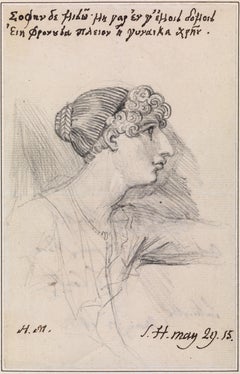
Portrait drawing of Harriot Mellon, Mrs Thomas Coutts
By Henry Fuseli
Located in London, GB
Inscribed by the artist in pen and brown ink, upper margin: 'σοφὴν δὲ μισῶ: μὴ γὰρ ἔν γ' ἐμοῖς δόμοις / εἴη φρονοῦσα πλείον' ἢ γυναῖκα χρή [Euripides, Hippolytus, 11, 640-41: “But a ...
Category
19th Century Old Masters Portrait Drawings and Watercolors
Materials
Pencil
Related Items
France 18th Century, Pastorale (Arcadian Landscape), original drawing
Located in Paris, FR
France 18th Century,
Pastorale (Arcadian Landscape)
Black chalk and heightenings of white gouache on blue-grey paper
19 x 31 cm
Framed : 34.5 x 46.5 cm
The atmosphere and the subje...
Category
1760s Old Masters Landscape Drawings and Watercolors
Materials
Chalk

$1,008 Sale Price
20% Off
H 7.49 in W 12.21 in
17th Century Dutch Old Master Ink Drawing Christ on the Cross Many Figures 1674
Located in Cirencester, Gloucestershire
Christ on the Cross
attributed to Jan Luyken (Dutch, 1649–1712)
inscribed 1674 upper corner
pencil drawing, watercolor and ink wash on paper over oard, framed
framed: 12 x 11 inches
...
Category
17th Century Old Masters Figurative Paintings
Materials
Color Pencil, Ink, Watercolor
$2,074 Sale Price
20% Off
H 12 in W 11 in
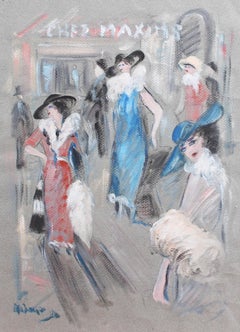
Chez Maxim
s
By André Meurice
Located in London, GB
'Chez Maxim's', pastel and gouache on fine art paper, by André Meurice (circa 1950s - 60s). The artist depicts the glamorous clientele at the entryway to...
Category
Mid-20th Century Art Nouveau Figurative Drawings and Watercolors
Materials
Pastel, Gouache
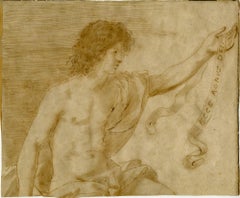
St. John the Baptist in the wilderness , Ecce Agnus Dei (Behold the Lamb of God)
By Giovanni Francesco Barbieri (Il Guercino)
Located in Middletown, NY
Pen and sepia ink and wash on vellum, 8 7/8 x 10 1/2 inches (225 x 267 mm). In very good condition with some modern notations in pencil on the verso, minor cockling, and a 1-inch hor...
Category
Mid-17th Century Old Masters Portrait Drawings and Watercolors
Materials
Ink, Watercolor, Vellum, Pencil
$650
H 8.88 in W 10.5 in
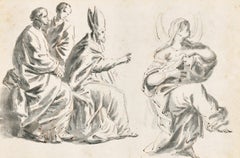
1600’s Flemish Old Master Ink Wash Drawing Biblical Figures Group on paper
Located in Cirencester, Gloucestershire
Figure Studies
Attriubted to Cornelis Schut
(1597 - 1655) Flemish
ink drawing on paper, inscribed on mount
size: 4.75 x 7 inches
private collection, France
The painting is in overa...
Category
Early 17th Century Old Masters Figurative Paintings
Materials
Ink, Watercolor
$1,031 Sale Price
20% Off
H 4.75 in W 7 in
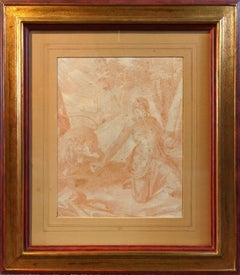
Saint Jerome in the Desert, Prague school sanguine drawing
Located in New York, NY
Saint Jerome in the Desert Prague school sanguine drawing.
Category
Early 17th Century Old Masters Figurative Drawings and Watercolors
Materials
Paper, Chalk
$4,000
H 11.42 in W 9.06 in D 0.4 in
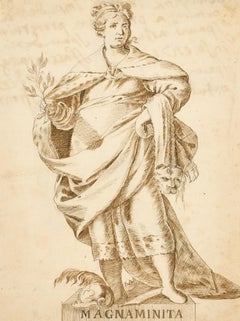
Fine 1700
s Italian Old Master Ink
Wash Drawing Roman Allegorical Magnaminita
Located in Cirencester, Gloucestershire
'Mgnaminia'
Italian School, 18th century
ink and wash drawing on paper, framed within a light oak wood frame (behind glass)
image size: 10.5 x 7 inches
overall framed: 17 x 13 inches...
Category
18th Century Old Masters Figurative Paintings
Materials
Ink, Watercolor, Archival Paper
$540 Sale Price
20% Off
H 17 in W 13 in
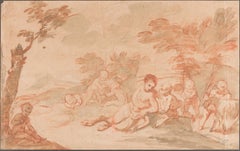
Fauness and Putti
Located in Paris, Île-de-France
Nicolas Chaperon (1612–1653/4)
Fauness and Putti
Black chalk, red chalk, wash in red chalk and grey on paper,
195 x 313 mm
Unsigned
Provenance:
Private collection
Expert opinion ...
Category
1620s Old Masters Figurative Drawings and Watercolors
Materials
Chalk
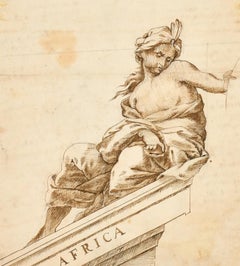
Fine 1700
s Italian Old Master Ink
Wash Drawing Roman Allegorical Africa
Located in Cirencester, Gloucestershire
'Africa'
Italian School, 18th century
ink and wash drawing on paper, framed within a light oak wood frame (behind glass)
image size: 10.5 x 7 inches
overall framed: 17 x 13 inches
co...
Category
18th Century Old Masters Figurative Paintings
Materials
Ink, Watercolor, Archival Paper
$540 Sale Price
20% Off
H 17 in W 13 in
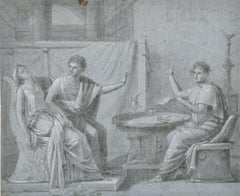
FINE 18th CENTURY OLD MASTER CHALK DRAWING - ROMANESQUE FIGURES INTERIOR SCENE
Located in Cirencester, Gloucestershire
Artist/ School: French School, 18th century
Title: Classical figures within an interior.
Medium: chalk on paper, mounted.
Size: drawing: 11.5 x 13.5 inches
Provenance:...
Category
Early 18th Century Old Masters Figurative Paintings
Materials
Chalk
$1,037 Sale Price
20% Off
H 11.5 in W 13.5 in
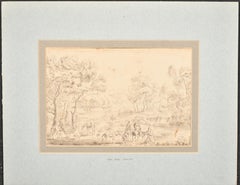
Fine 17th Century Dutch Old Master Drawing Hunting Party Landscape
Located in Cirencester, Gloucestershire
The Hunting Party
Attributed to Dirk Maes (1659-1717) Dutch.
Figures in a Classical Landscape,
Watercolour and wash on paper,
Mounted, unframed image 6.75" x 9.75" (17.1 x 24.7cm)...
Category
17th Century Old Masters Landscape Paintings
Materials
Watercolor, Pencil
$1,201 Sale Price
20% Off
H 6.75 in W 9.75 in
Mythological combat scene with Roman soldiers on horseback.
By Virgil Solis
Located in Middletown, NY
Pen and brownish black ink on grayish-cream laid paper, 6 1/2 x 8 inches (165 x 175 mm), irregular hexagonal sheet with margins. Some archival repairs along the top sheet edge, scatt...
Category
16th Century Old Masters Figurative Drawings and Watercolors
Materials
Ink, Laid Paper, Pen