Lundgrens Antiques Lacquer
to
2
2
2
2
2
2
2
2
2
2
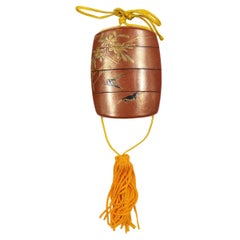
Lacquer inro, Japanese, Late 19th c.
Located in Stockholm, SE
A fourpart Japanese lacquer Inro. the lacquer is red with motives of a spider with its web in gold and two flying cranes. The lowest part of the inro has a crack on one side.
Category
Antique Late 19th Century Japanese Lacquer
Materials
Lacquer
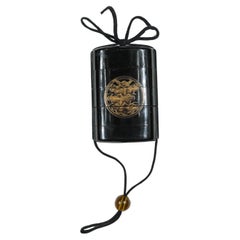
Large Japanese five part lacquer Inro, late 19th c.
Located in Stockholm, SE
A large five part lacquer inro. A family crest in gold on black background.
Category
Antique Late 19th Century Japanese Lacquer
Materials
Lacquer
Related Items
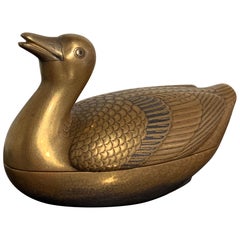
Small Japanese Lacquer Duck Incense Box, Kogo, Meiji Period, Late 19th Century
Located in Austin, TX
An exquisite Japanese Meiji Period small lacquer incense box, kogo, in the form of a duck or goose, late 19th century, Japan.
The delicate lacquer box, known as a kogo in Japanese, ...
Category
Antique Late 19th Century Japanese Meiji Lacquer
Materials
Lacquer

$2,900
H 1.5 in W 2.88 in D 1 in
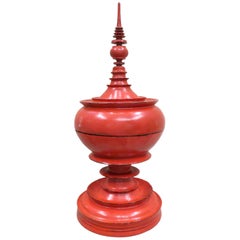
Late 19th Century Burmese Red Lacquer Offering Vessel "Hsunok"
Located in Torino, IT
Late 19th century Burmese
red lacquer special
ceremonial offering vessel.
Detailed spire form the top of
the lid, stepped curved ring
molded bowl above round
base. Multiple lay...
Category
Antique 19th Century Burmese Lacquer
Materials
Wood
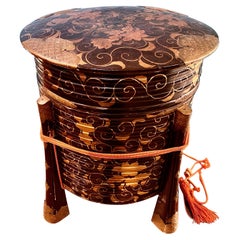
Japanese Lacquer Hokai Box, 19th Century
Located in Pasadena, CA
This is a good example of a traditional Japanese Hokai shell storage box for the Kai-awase game. This box is well-detailed in chased brass appliques and makie. The box is in overall ...
Category
Antique Late 19th Century Japanese Japonisme Lacquer
Materials
Wood, Lacquer
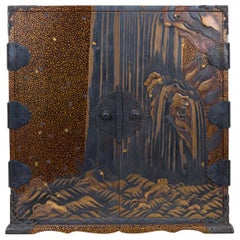
Japanese 19th Century Miniature Lacquer Chest with Waterfall
Located in Hudson, NY
Japanese 19th century miniature lacquer chest with waterfall. Late Edo to early Meiji period lacquer chest (mid to late 19th century) with two characters on the front reading Nuno an...
Category
Antique Late 19th Century Japanese Lacquer
Materials
Gold, Silver, Bronze
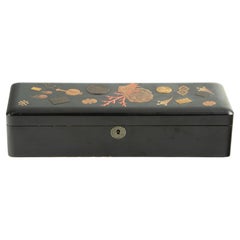
Late 19th Century Japanese Lacquer Box with Coral Design
Located in New York, NY
Late Meiji to early Taishō period Japanese lacquer box (circa 1890–1920), decorated in the takaramono (宝物, “treasures”) motif, symbolizing prosperity, longevity, and good fortune. Th...
Category
Antique Late 19th Century Japanese Meiji Lacquer
Materials
Metal
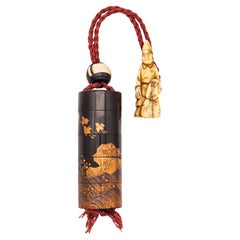
Japan 1870 Meiji Period Round Five Drawer Inro Lacquered Wood With Flying Cranes
Located in Miami, FL
Japanese Inro from the Meiji Period (1868-1912).
Beautiful Inro, created in Japan during the Meiji imperial period, circa 1870. It was carefully crafted in carved precious wood with applications of lacquer and decorated with orientalism patterns. All dan trays are attached together with a himo cord. The detailed craftsmanship was a true pleasure to behold.
Period: Meiji 1868-1912, Period of Emperor Mutsuhito.
Approximate Date: 1870.
Motif: Organic design with cascade landscape scene and five flying cranes.
Drawers: Five.
Shape: Cylinder. Very unusual and rare shape.
Technique: Carved wood, Lacquer, hiramaki-e, takamaki-e, Gilding.
Ojime: 17mm, round with Ebony wood.
Netsuke: Carved dressed...
Category
Antique 1870s Japanese Meiji Lacquer
Materials
Wood, Ebony, Giltwood, Lacquer
$2,089 Sale Price
30% Off
H 3.07 in Dm 1.18 in
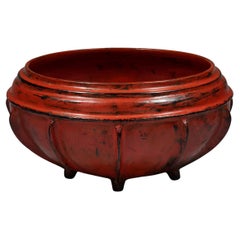
Late 19th/ early 20th Century Large Red Lacquer Offering Bowl, Burma
Located in Point Richmond, CA
Large Red Offering Bowl
Burma
Late 19th/early 20th century
Bamboo, lacquer
D: 21 in x H: 7.5 in :: 78.7 cm x 19 cm
Traditionally used to bring offerings to an altar, and to present ...
Category
Early 20th Century Burmese Tribal Lacquer
Materials
Bamboo, Lacquer
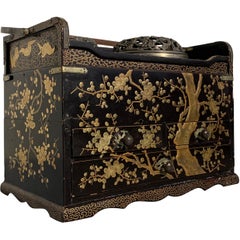
Japanese Lacquer Smoking Box, Tabako Bon, Edo Period, 19th Century
Located in Austin, TX
A very fine Japanese maki-e lacquer decorated tabako bon, or smoking box, late Edo Period, mid-19th century, Japan.
The elegant smoking box of black lacquer decorated with a wonderful gold lacquer takamaki-e design of a gnarled and elegantly twisted plum tree with branches in full bloom. A border of golden cranes in flight to the top.
The smoking box, called a tabako bon, is comprised of an open section at the top with inset with two cylindrical metal canisters...
Category
Antique Mid-19th Century Japanese Edo Lacquer
Materials
Lacquer
Japanese Lacquered Box Signed, Late 19th Century
Located in Beuzevillette, FR
Pretty Japanese lacquered box decorated with birds and foliage.
signed
Lacquered inside and outside
Late 19th century
Without key
Nice lock
Ideal for storing jewelry.
Category
Antique Late 19th Century Japanese Decorative Boxes
Materials
Wood

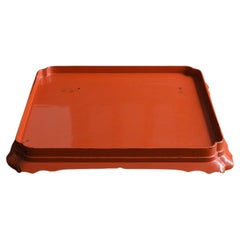
A large square tray made of Japanese antique lacquer / Late Edo period/19th
Located in Sammu-shi, Chiba
These trays were made after the late Edo period in Japan (after 1800).
This particular type of tray is known as "Negoro-bon."
Negoro lacquerware is a specific style of Japanese lacqu...
Category
Antique 19th Century Japanese Edo Lacquer
Materials
Lacquer
$1,000
H 2.09 in W 17.84 in D 18.12 in
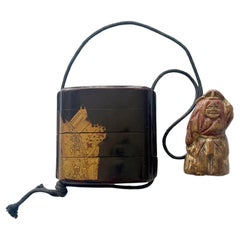
Japanese Lacquer Inro with Gold Maki-e and Carved Wood Netsuke Meiji Period
Located in Atlanta, GA
A Japanese four-case inro with a stringed carved wood netsuke circa 19th century. The inro has a near square form with rounded corners, The surface is decorated with gold hiramaki-e ...
Category
Antique 19th Century Japanese Meiji Lacquer
Materials
Wood, Lacquer
$1,500
H 2.4 in W 2.4 in D 0.5 in
Fine Japanese Lacquered Inro with Inlays by Kajikawa
Located in Atlanta, GA
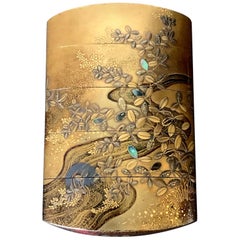
A Japanese four-case lacquer inro by a member of Kajikawa family circa 19th century (late Edo to early Meiji period). It depicts a nocturnal scenery of a meandering stream surrounded by bush clovers, where a full moon is reflected on the water. It was masterfully decorated in gold and silver maki-e using a combination of techniques including takamakie, togidashi and kirigane as well as aogai (abalone shell) inlays. The stream was set between the slightly elevated banks, adding to this piece a already strong three-dimensional composition. The interior was decorated in gold nashiji. It was signed on the bottom "Kajikawa Zou" (made by Kajikawa and a pot seal centered with "Ei" in Kanji. In one of the compartment, there is a katakana mark, appears to be a name, possibly the owner.
Kajikawa clan was one of the most famous lacquer artisanal family established in the 17th century. Many well known members over the generations produced lacquer art in a wide range of formats, but two third were signed only with the family name such as this one. It is therefore not possible to pinpoint the exact author of this piece.
Provenance: This inro was purchased as lot 349 in Christie's New York sale Japanese...
Category
Antique 19th Century Japanese Japonisme Lacquer
Materials
Shell, Wood, Lacquer