Manning Fine Art Interior Prints
to
11
3
1
Overall Width
to
Overall Height
to
2
1
2
1
1
2
7
6
1
1
4
2
8
7
9
9
4
4
3
2
1
1
1
1
1
1
1
1
1
1
1
7
6
5
4
2
8
15
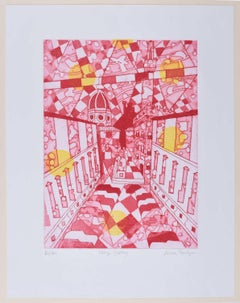
Ufizzi Gallery etching by Julian Trevelyan
By Julian Trevelyan
Located in London, GB
To see our other Modern British Art, scroll down to "More from this Seller" and below it click on "See all from this Seller" - or send us a message if you cannot find the artist you ...
Category
1960s Interior Prints
Materials
Etching
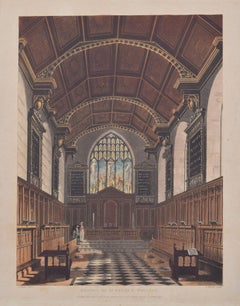
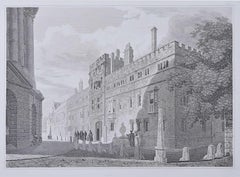
Peterhouse, Cambridge
Chapel of St Peter
s College
engraving by Havell
Located in London, GB
To see our other Oxford and Cambridge pictures, including an extensive collection of works by Ackermann, scroll down to "More from this Seller" and below it click on "See all from th...
Category
1810s Interior Prints
Materials
Engraving, Aquatint
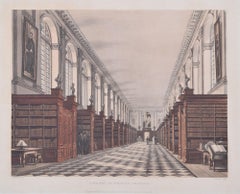
Library of Trinity College, Cambridge engraving by Havell after Pugin
Located in London, GB
To see our other Oxford and Cambridge pictures, including an extensive collection of works by Ackermann, scroll down to "More from this Seller" and below it click on "See all from th...
Category
1810s Interior Prints
Materials
Aquatint, Engraving
Brasenose College, Oxford and the Radcliffe Camera engraving by Joseph Skelton
Located in London, GB
To see our other views of Oxford and Cambridge, scroll down to "More from this Seller" and below it click on "See all from this Seller" - or send us a message if you cannot find the ...
Category
1820s Interior Prints
Materials
Engraving
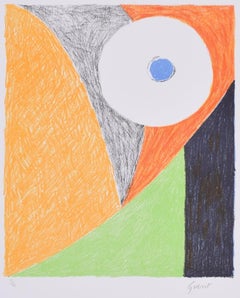
Interior abstract 1973 lithograph by Duncan Grant
By Duncan Grant
Located in London, GB
To see our other Modern British Art, scroll down to "More from this Seller" and below it click on "See all from this Seller" - or send us a message if you cannot find the artist you want.
Duncan Grant (1885 - 1978)
Interior (1973)
Lithograph
36 x 30 cm (paper size 77 x 57 cm)
Signed 'Grant' and numbered 9/90 in pencil; part of the Penwith Portfolio. Published by Penwith Galleries, St Ives in 1973 with works by Barbara Hepworth, Henry Moore, Peter Lanyon, Alan Davie, Merlyn Evans, John Piper, Ben Nicholson, Robert Adams, Bernard Leach, Michael Rothenstein, and F E McWilliam...
Category
1970s Abstract Abstract Prints
Materials
Lithograph
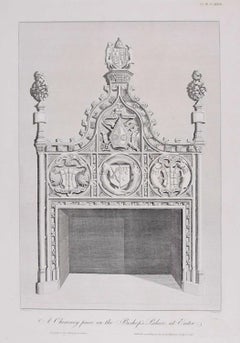
James Basire engraving Bishop
s Palace Exeter England 1796 Chimneypiece
Located in London, GB
James Basire (engraver) after W Davey (illustrator)
Chimneypiece in the Bishop's Palace, Exeter
50x33cm (to plate mark)
Engraving
Published by the Society of Antiquaries 23rd April 1...
Category
1790s Realist Interior Prints
Materials
Engraving
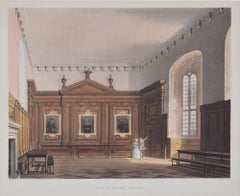
Queens
College, Cambridge hall engraving by Bluck after Pugin for Ackermann
Located in London, GB
To see our other Oxford and Cambridge pictures, including an extensive collection of works by Ackermann, scroll down to "More from this Seller" and below it click on "See all from th...
Category
1810s Interior Prints
Materials
Aquatint
Sidney Sussex College, Cambridge engraving by Havell after Pugin for Ackermann
Located in London, GB
To see our other Oxford and Cambridge pictures, including an extensive collection of works by Ackermann, scroll down to "More from this Seller" and below it click on "See all from th...
Category
1810s Interior Prints
Materials
Aquatint
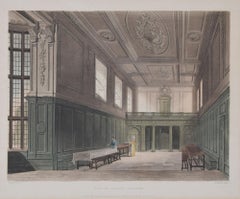
Emmanuel College, Cambridge hall engraving by Bluck after Pugin for Ackermann
Located in London, GB
To see our other Oxford and Cambridge pictures, including an extensive collection of works by Ackermann, scroll down to "More from this Seller" and below it click on "See all from th...
Category
1810s Interior Prints
Materials
Aquatint
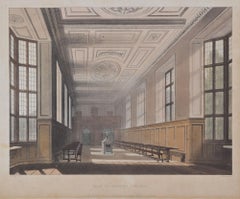
Chapel Interior engraving c. 1800 English/British
Located in London, GB
To see more of our period engravings, scroll down to "More from this Seller" and below it click on "See all from this Seller."
Chapel Interior (circa...
Category
18th Century Realist Interior Prints
Materials
Engraving
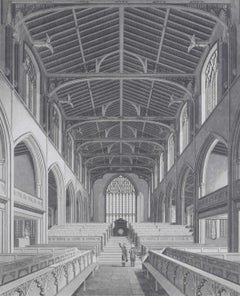
Arabesques and caricatures antiquities engraving
Located in London, GB
To see more, scroll down to "More from this Seller" and below it click on "See all from this Seller."
Arabesques and caricatures
Engraving
24.5 x 36 cm
Category
19th Century Interior Prints
Materials
Engraving
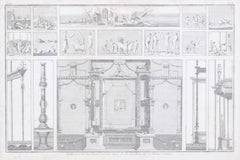
Hans Schleger
Zero
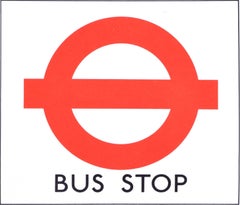
London Transport Bus Stop c. 1970 Original Poster
By Hans Schleger Zero
Located in London, GB
To see our other original vintage travel posters including more pre-war London Transport posters, scroll down to "More from this Seller" and below it click on "See all from this Seller" - or send us a message if you cannot find the poster you want.
Hans Schleger 'Zero' (1898-1976)
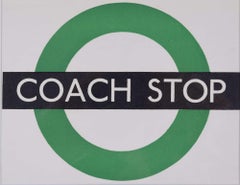
London Transport Coach Stop Poster
Screenprint poster c. 1970
16x17.8 cm
Printed for London Transport
These posters were designed to be used as temporary stops when the usual stop required amendment for instance owing to road works or similar events. Printed on paper they were designed to be posted up at the alternative site, possibly over a different sort of stop (bus stop, coach stop, request stop, etc.).
Working with Edward Johnson's special typeface created for London Transport, Hans Schleger - or Zero as he signed himself - adopted the famous roundel used by London Underground for use at Bus Stops. Born in Germany, Schleger was an influential graphic designer. After serving during the First World War, he studied at the Berlin Kunstgewerbeschule, being taught by Emil Orlik. The same year Walter Gropius founded the Bauhaus at Weimar and Schleger learned the same principles of breaking down the barriers between architecture, design, fine art and craft. A firm believer in the Bauhaus principles of simplicity in design and reduction to essentials, these may be seen in the clean lines of the roundel.
In 1924 he moved to New York, applying Modernism to American advertising, and then returned to Berlin in 1929 working for the British advertising agency Crawfords, where he met Edward McKnight Kauffer who introduced him to Jack Beddington the head of advertising at Shell Mex...
Category
1970s Modern Interior Prints
Materials
Lithograph
Hans Schleger
Zero
London Transport Coach Stop c. 1970 Original Poster
By Hans Schleger Zero
Located in London, GB
To see our other original vintage travel posters including more pre-war London Transport posters, scroll down to "More from this Seller" and below it click on "See all from this Seller" - or send us a message if you cannot find the poster you want.
Hans Schleger 'Zero' (1898-1976)
London Transport Coach Stop Poster
Screenprint poster c. 1970
16x20 cm
Printed for London Transport
These posters were designed to be used as temporary stops when the usual stop required amendment for instance owing to road works or similar events. Printed on paper they were designed to be posted up at the alternative site, possibly over a different sort of stop (bus stop, coach stop, request stop, etc.).
Working with Edward Johnson's special typeface created for London Transport, Hans Schleger - or Zero as he signed himself - adopted the famous roundel used by London Underground for use at Bus Stops. Born in Germany, Schleger was an influential graphic designer. After serving during the First World War, he studied at the Berlin Kunstgewerbeschule, being taught by Emil Orlik. The same year Walter Gropius founded the Bauhaus at Weimar and Schleger learned the same principles of breaking down the barriers between architecture, design, fine art and craft. A firm believer in the Bauhaus principles of simplicity in design and reduction to essentials, these may be seen in the clean lines of the roundel.
In 1924 he moved to New York, applying Modernism to American advertising, and then returned to Berlin in 1929 working for the British advertising...
Category
1970s Interior Prints
Materials
Lithograph
London Transport Bus Stop Original Vintage Poster c. 1970
Located in London, GB
To see our other original vintage travel posters including pre-war London Transport posters, scroll down to "More from this Seller" and below it click on "See all from this Seller" - or send us a message if you cannot find the poster you want.
Hans Schleger 'Zero' (1898-1976)
London Transport Bus Stop Poster
Original Vintage Lithographic poster
Printed for London Transport
Working with Edward Johnson's special typeface created for London Transport, Hans Schleger - or Zero as he signed himself - adopted the famous roundel used by London Underground for use at Bus Stops. Born in Germany, Schleger was an influential graphic designer. After serving during the First World War, he studied at the Berlin Kunstgewerbeschule, being taught by Emil Orlik. The same year Walter Gropius founded the Bauhaus at Weimar and Schleger learned the same principles of breaking down the barriers between architecture, design, fine art and craft. A firm believer in the Bauhaus principles of simplicity in design and reduction to essentials, these may be seen in the clean lines of the roundel.
In 1924 he moved to New York, applying Modernism to American advertising, and then returned to Berlin in 1929 working for the British advertising agency Crawfords, where he met Edward McKnight Kauffer who introduced him to Jack Beddington the head of advertising at Shell Mex...
Category
1970s Modern Interior Prints
Materials
Lithograph

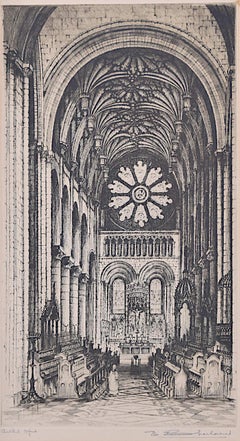
Christ Church Cathedral Oxford etching E W Sharland print College University
Located in London, GB
To see our other views of Oxford and Cambridge, scroll down to "More from this Seller" and below it click on "See all from this Seller" - or send us a message if you cannot find the view you want.
Edward W Sharland (1884-1967) - British
Christ Church Cathedral...
Category
1920s Realist Interior Prints
Materials
Etching
Related Items
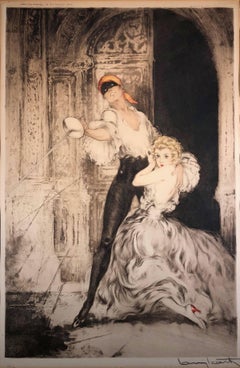
Don Juan
By Louis Icart
Located in Missouri, MO
Aquating Engraving
Image Size: approx. 20 1/4 x 13 3/8
Framed Size: 28 x 20.5 inches
Pencil Signed Lower Right
Louis Justin Laurent Icart was born in Toulouse in 1890 and died in Paris in 1950. He lived in New York City in the 1920s, where he became known for his Art-Deco color etchings of glamourous women.
He was first son of Jean and Elisabeth Icart and was officially named Louis Justin Laurent Icart. The use of his initials L.I. would be sufficient in this household. Therefore, from the moment of his birth he was dubbed 'Helli'. The Icart family lived modestly in a small brick home on rue Traversière-de-la-balance, in the culturally rich Southern French city of Toulouse, which was the home of many prominent writers and artists, the most famous being Henri de Toulouse-Lautrec.
Icart entered the l'Ecole Superieure de Commerce de Toulouse in order to continue his studies for a career in business, particularly banking (his father's profession). However, he soon discovered the play writings of Victor Hugo (1802-1885), which were to change the course of his life. Icart borrowed whatever books he could find by Hugo at the Toulouse library, devouring the tales, rich in both romantic imagery and the dilemmas of the human condition. It was through Icart's love of the theater that he developed a taste for all the arts, though the urge to paint was not as yet as strong for him as the urge to act.
It was not until his move to Paris in 1907 that Icart would concentrate on painting, drawing and the production of countless beautiful etchings, which have served (more than the other mediums) to indelibly preserve his name in twentieth century art history.
Art Deco, a term coined at the 1925 Paris Exposition des Arts Decoratifs, had taken its grip on the Paris of the 1920s. By the late 1920s Icart, working for both publications and major fashion and design studios, had become very successful, both artistically and financially. His etchings reached their height of brilliance in this era of Art Deco, and Icart had become the symbol of the epoch. Yet, although Icart has created for us a picture of Paris and New York life in the 1920s and 1930s, he worked in his own style, derived principally from the study of eighteenth-century French masters such as Jean Antoine Watteau, François Boucher and Jean Honoré Fragonard.
In Icart's drawings, one sees the Impressionists Degas...
Category
1920s Art Deco Figurative Prints
Materials
Engraving, Aquatint

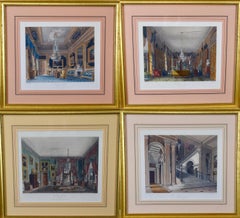
Four 19th Century Hand Colored Engravings Depicting English Royal Residences
By Charles Wild
Located in Alamo, CA
Four hand colored etchings and aquatints depicting interiors within English royal residences, including "The Blue Velvet Room at Carlton House", "The Queen's Library at Frogmore", "T...
Category
1810s Academic Interior Prints
Materials
Engraving
$1,560
H 15.5 in W 17.25 in D 0.88 in
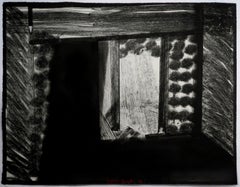
All Alone in the Museum of Modern Art Howard Hodgkin abstract black painting
By Howard Hodgkin
Located in New York, NY
Large scale black and white abstract interior scene with dots, lines, brushstrokes, paint daubs, fingerprints, squares and rectangles, and hand painting in grey. Hang in contemporary, modern and minimalist spaces. While British pop artists such as David Hockney and Patrick Caulfield numbered amongst Howard Hodgkin's circle of friends, Hodgkin's work is painterly, emotional, expressionist, and abstract.
Paper: 29.5 x 38.75 in. / 74.7 x 98.2 cm.
Soft-ground etching with hand coloring in black gouache on grey BFK Rives mould made paper. Signed by the artist, dated 79, and numbered 59/100 lower center in red crayon. Printed from the same plate as 'Thinking Aloud in the Museum of Modern Art', this print was previously titled "Not Quite Alone in the Museum of Modern Art," suggesting an erotic dalliance in the museum.
This print depicts an abstracted scene, perhaps a window and a door, in Hodgkin's signature painterly style. The expressive mark-making in this print is an example of the artist’s movement in the late 70s towards pronounced gestures. Beside bold black strokes, his fingerprints form areas of texture. Always seeking greater richness in his prints, Hodgkin layered ink and hand coloring in this print, rendering each print in the edition unique.
Howard Hodgkin was introduced to the etching technique used in 'All Alone in the Museum of Modern Art' at Petersburg Press, where this print was produced and where he would become a long-time collaborator. This technique allowed him to work fluidly and spontaneously, creating the moody interior scenes that mark Hodgkin’s work from the late 70s and early 80s.
Part of a series of four prints reflecting on a visit to the Museum...
Category
Late 20th Century Abstract Abstract Prints
Materials
Etching
$2,250
H 29.5 in W 38.75 in
Cup with Pot - Original Etching and Aquatint by Miguel Ibarz - 1960s
By Miguel Ibarz Roca
Located in Roma, IT
Hand Signed. Artist's Proof.
Good conditions.
Category
1960s Figurative Prints
Materials
Etching, Aquatint

$308
H 3.15 in W 3.55 in D 0.04 in
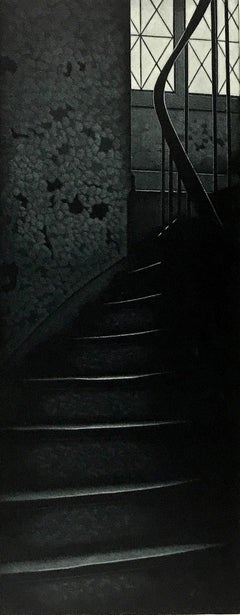
Before It Happened (A mysterious staircase offers no clues as to what happened)
By Jukka Vanttinen
Located in New Orleans, LA
This Finnish artist creates a mezzotint in black and white. This impression is #44 of 100 and is signed, dated and titled in pencil.
Jukka Vanttinen (Finn, b. 1954)
Jukka Vanttinen...
Category
Early 2000s Modern Interior Prints
Materials
Mezzotint
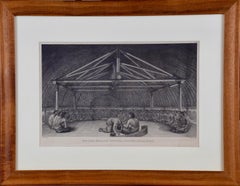
"King of the Friendly Islands" (Tonga); Engraving from Captain Cook
s 3rd Voyage
By John Webber
Located in Alamo, CA
"Poulaho, King of the Friendly Islands, Drinking Kava" is an engraving created by William Sharp (1749-1824), from a drawing by John Webber (1752-1793), who was the artist on Captain James Cook's 3rd and final voyage of discovery. It was published in the atlas of "A Voyage to the Pacific Ocean Undertaken by the Command of His Majesty, for Making Discoveries in the Northern Hemisphere", the official British Admirality sanctioned journal published upon completion of the voyage in London in 1784 by Strahan & Cadell.
Captain Cook visited Tonga on his 3rd voyage, which he named The Friendly Islands because of the warm welcome he and his crew received, unlike some of the other more hostile Pacific islands. The engraving depicts Cook and his men observed a kava ceremony at the village of Mu’a on Tongatapu. King Paulaho sits in the centre foreground, his back to the spectator with a man kneeling before him. The ceremonial mat depicted behind Paulaho indicates that nobody was allowed to sit behind him. The figure in the centre holds a single cup, referring to the Tongan custom of offering the cup to the king first. Kava is native to the islands of the South Pacific and was first described for English readers in 1768 by Captain James Cook. The kava root has been used for centuries as a central feature of ceremonies and celebrations because it was able to bring about a calming and pleasant social atmosphere. The root was crushed and processed into coconut milk to become the focal ceremonial beverage, simply referred to as kava.
This engraving is presented in a Koa wood frame and a white mat. Koa wood is legendary in Hawaii. There are occasional faint spots, but the print is otherwise in very good condition. This amazing Koa wood is native to Hawaii and it is known for the deep rich colors and varied grain pattern. Koa has an honored heritage in Hawaii and is highly revered and sacred. The word “koa” means “warrior” in Hawaiian. The warriors of King Kamehameha the Great, created canoes and weapons from a wood plentiful on the Big Island of Hawaii. This wood became synonymous with the warriors themselves, and it became known as koa.
There are three other engravings listed from the official journal of Captain Cook's 3rd voyage available that are presented in identical Koa wood frames and mats (LU117324682422, LU117324684052, LU117324684032). They would make a wonderful grouping for a display of 2, 3 or 4 prints. A discount is available for a grouping depending on the number of items included.
Captain Cook is remembered as one of the greatest explorers and navigators in history. His explorations included Australia, New Zealand and islands of the South Pacific and the northwest coast of North America. Hawaii was discovered by Captain Cook during this voyage. Hawaii was originally called The Sandwich Islands in honor of The Earl of Sandwich...
Category
1780s Realist Figurative Prints
Materials
Engraving
$2,375
H 18.25 in W 23.5 in D 0.88 in
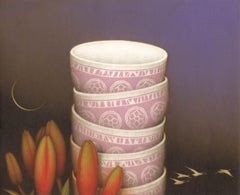
Lillies and Bowls (still life of flowers and colorful bowls)
Located in New Orleans, LA
The moon, bowls, lillies and birds are featured in this 2002 mezzotint. It is #17 from an edition of 75 and is signed, titled, dated and edition by hand by this Korean artist born i...
Category
Late 20th Century Contemporary Still-life Prints
Materials
Mezzotint
$200
H 11 in W 13.25 in
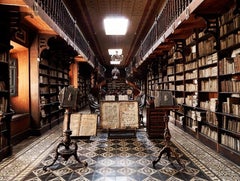
Biblioteca S. Francisco, Lima
By Massimo Listri
Located in New York, NY
Massimo Listri is a Florence-based photographer whose work often presents interiors of great architectural and cultural importance, some open to the public, others not easily accessi...
Category
21st Century and Contemporary Realist Color Photography
Materials
C Print
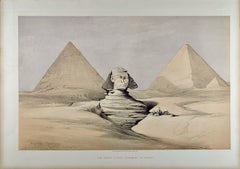
The Great Sphinx
Pyramids, Giza, Egypt: A 19th C. Lithograph by David Roberts
By David Roberts
Located in Alamo, CA
This is an original 19th century duotone lithograph entitled "The Great Sphinx, Pyramids of Gizeh" by David Roberts, from his Egypt and Nubia volumes of the large folio edition, publ...
Category
1840s Realist Landscape Prints
Materials
Lithograph
$4,975
H 16.75 in W 23.75 in
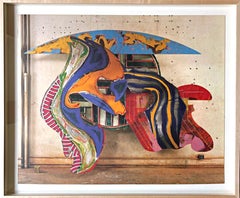
Print of Frank Stella Wall Relief Sculpture, Hand Signed, Dated by Artist Framed
By Frank Stella
Located in New York, NY
Frank Stella (after)
Untitled, for the Very Special Arts Gallery (Hand Signed by Frank Stella), 1992
Photo lithograph and offset litho on thin board (hand signed by Frank Stella)
Fra...
Category
1990s Abstract Expressionist Abstract Prints
Materials
Offset, Lithograph
$38,000
H 22.5 in W 27 in D 2 in
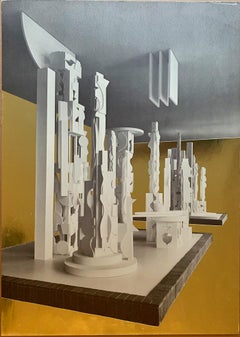
Bicentennial Dawn Lithograph and gold foil, Louise Nevelson sculpture signed/N
By Louise Nevelson
Located in New York, NY
Louise Nevelson
Bicentennial Dawn, 1976
Photolithograph, silkscreen and gold foil on white wove paper
hand signed, dated and numbered 15/100 with incised signature on the front
35 × ...
Category
1970s Abstract Abstract Prints
Materials
Foil
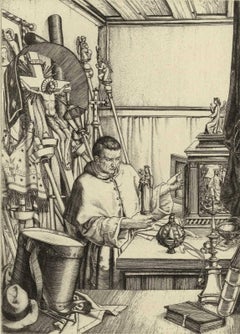
The Sacristan
By Harry Morley
Located in New Orleans, LA
This image shows a cleric seated in a church sacristy surrounded by religious statues, croziers, various saints, statues and chalices. It is an origina...
Category
Early 20th Century Modern Interior Prints
Materials
Engraving