O Sullivan Antiques Dublin End Tables
to
Height
to
Width
to
Depth
to
9
5
2
1
8
8
8
2
2
2
9
5
2
2
1
9
9
9
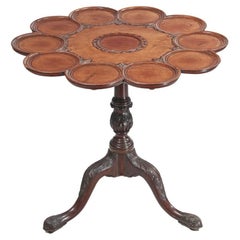
19th Century George III Scalloped Mahogany Occasional Tip-up Table
Located in Dublin 8, IE
19th Century George III scalloped mahogany occasional tip-up table with recessed circular depressions to top for holding cups, saucers or supper plates. The top is further adorned wi...
Category
Antique 19th Century English George III End Tables
Materials
Mahogany
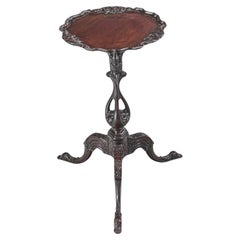
19th Century Mahogany Occasional Table
Located in Dublin 8, IE
19th Century mahogany occasional table with carved circular top featuring a scallop edge with acanthus leaf design, raised on a profusely carved pierced tripod base supported by spla...
Category
Antique 19th Century European End Tables
Materials
Mahogany
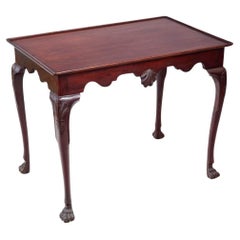
18th Century Mahogany Silver Table
Located in Dublin 8, IE
18th century mahogany silver table, the moulded top of rectangular form raised over shaped frieze with centred scallop shell detailing supported on cabriole leg with foliate motif to...
Category
Antique 18th Century Irish George II End Tables
Materials
Mahogany
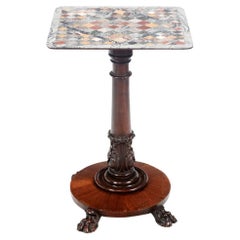
19th Century Stone Topped Occasional Specimen Table
Located in Dublin 8, IE
19th century occasional table with a rectangular top inlaid with stone specimens forming a decorative chevron pattern. It sits above an elegantly carved mahogany round pedestal pillar base...
Category
Antique 19th Century English Regency End Tables
Materials
Marble
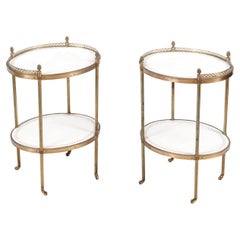
Pair French-Style 19th-Century End Tables with Acorn Finals
By Maison Jansen
Located in Dublin 8, IE
Pair of French-style 19th-century petite end tables in the manner of Maison Jansen with brass filigree ribbed edging and acorn finials. Both have tooled cream leather tops and shelve...
Category
Antique Late 19th Century French Beaux Arts End Tables
Materials
Brass
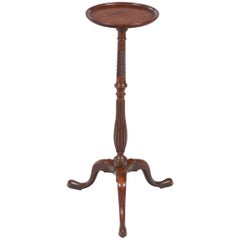
Early 19th Century George III Wine Table
Located in Dublin 8, IE
Early 19th century George III mahogany wine table, the moulded top of circular form raised over turned pod with barley twist and baluster carved reeded detail supported on triform mo...
Category
Antique Early 1800s Irish George III Tables
Materials
Mahogany
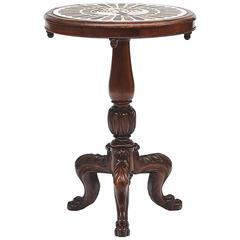
Early 19th Century George III Marble-Top Inlaid Mahogany Table
Located in Dublin 8, IE
Early 19th century George III marble-top inlaid mahogany table, with stone mosaic depicting two birds in a tree, above turned central pillar on tri...
Category
Antique Early 1800s Irish George III End Tables
Materials
Marble
Early 19th Century George III Mahogany Occasional Table
Located in Dublin 8, IE
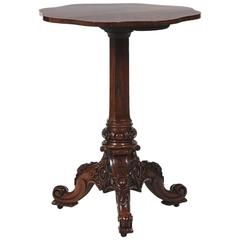
Early 19th century George III mahogany occasional table with shaped top standing on a beautiful carved tripod base.
Category
Antique Early 1800s Irish George III End Tables
Materials
Mahogany
Early 19th Century Regency Mahognay Three Tier Dumbwaiter
Located in Dublin 8, IE
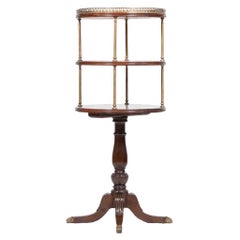
Early 19th Century Regency mahogany three tier dumbwaiter with brass gallery top, brass upright all above carved pod with four outstretched legs ...
Category
Antique 1810s Irish Regency End Tables
Materials
Brass
Related Items
Sublime 19th Century Anglo-Indian Specimen Sample Wood Centre Occasional Table
Located in West Sussex, Pulborough
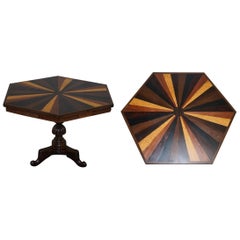
We are delighted to offer for sale this absolutely glorious Anglo-Indian Specimen wood occasional centre table
A very fine and rare table, most likely Sri Lankan Galle district in...
Category
Antique Mid-19th Century Sri Lankan Anglo-Indian Center Tables
Materials
Wood

$5,306
H 30.12 in W 48.23 in D 42.13 in
18th Century Mahogany Spider Leg Occasional Table
Located in Bedfordshire, GB
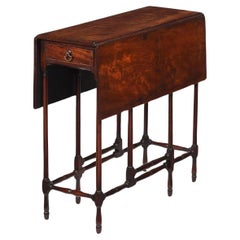
A Charming 18th Century George III Period Mahogany Drop Leaf Occasional Table, Of Rectangular Form, Having Superbly Figured Top Retaining Exceptional Colour And Patina Throughout, Ov...
Category
Antique Mid-18th Century English Georgian End Tables
Materials
Mahogany
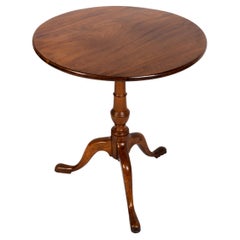
English 18th Century George III Mahogany Tripod Table England, C.1790
Located in London, GB
An English 18th century George III Mahogany tripod table
England, C.1790.
In excellent condition commensurate of age.
Category
Antique 18th Century George III End Tables
Materials
Mahogany
$3,308
H 24.02 in W 24.02 in D 24.02 in
18th Century Walnut Side Table
Located in High Point, NC
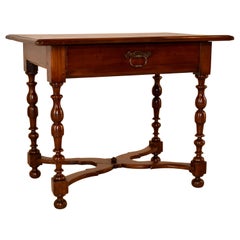
Early 18th century walnut side table from France with a two board top which has pegged construction and a beveled edge, following down t...
Category
Antique Early 18th Century French Louis XV Side Tables
Materials
Walnut
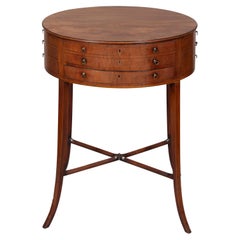
George III Mahogany Work Table
Located in Essex, MA
Oval hinged top and open interior over a conforming case with faux drawers and working drawer.
Square splayed legs and X form stretcher. With key.
Category
Antique 1790s English George III End Tables
Materials
Mahogany
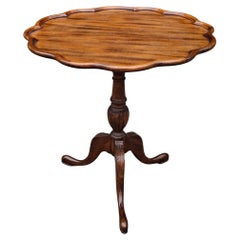
Late 19th Century English George III Style Mahogany PieCrust Scalloped Tea Table
Located in Germantown, MD
A Late 19 th Century English George III Style Mahogany Pie Crust Scalloped Pedestal Tripod Tea Table. Measures 26" in width, 26" in depth and 27.5" in height.
Category
Antique Late 19th Century English George III Card Tables and Tea Tables
Materials
Mahogany
$1,695
H 27.5 in W 26 in D 26 in
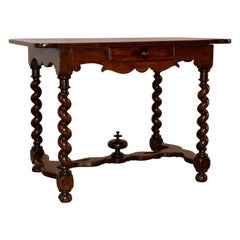
18th Century French Walnut Side Table
Located in High Point, NC
Mid-18th-century walnut side table from France with banded ends on the top, over wonderfully hand scalloped aprons on three sides and a single drawer in the front. The table is finis...
Category
Antique Mid-18th Century French Side Tables
Materials
Walnut
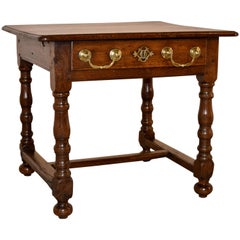
18th Century English Side Table
Located in High Point, NC
18th Century English side table made from oak with a beveled edge around the top, following down to a simple apron with a single drawer in the front. The legs are hand turned and ha...
Category
Antique 18th Century English George III Side Tables
Materials
Brass
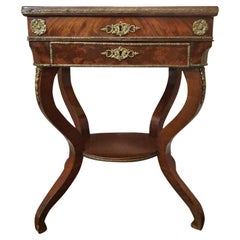
19th C. French Charles X Restoration Period Sewing Stand Work Table
Located in Forney, TX
A scarce period Charles X (1818-1834) French Restoration mahogany travailleuse sewing (thread stand - side table - jewelry dressing table) with light, warm, beautifully aged patina.
Born in France in the early 19th century, almost certainly Parisian work, exquisitely hand-crafted, this exceptionally executed example features ornate gilt bronze ormolu mounts, escutcheons, and elaborate gilt metal trim. Having a highly figured light mahogany hinged lid top, lifting open to reveal a striking finished interior with divided compartments and original inset mirror plate. The conforming rectangular case fitted with a faux drawer front over a dovetailed drawer with sectioned interior. Elegantly rising on oval-shaped medial shelf stretcher-joined curvacious legs.
Dimensions (approx):
27" High, 20" Wide, 13.5" Deep
Stunning light almost blonde antique mahogany coloring and mellow warm tone, superb wood grain detail, and charming, beautifully aged patina over the whole. Great shape overall. Retaining original antique character marks, wear consistent with age and indicative of minimal use, nothing that detracts from the aesthetics or functionality, but only adds to the overall authenticity, refined elegant warmth, luxurious sophistication, and cozy unpretentious rustic elegance.
Delivered cleaned, hand waxed, polished French patina finish, ready for immediate use and generational enjoyment!
What is Charles X style:
The comte d’Artois – or Charles X - was the son of the dauphin Louis-Ferdinand de Franc and Marie-Josèphe de Saxe. He succeeded his two brothers Louis XVI and Louis XVIII and became the King of France in 1824. Thirty years after the French Revolution, he wanted to embody the return of monarchy and became the leader of the catholic party . As the previous kings, he was crowned in 1825 but he was soon overthrown by the revolution in July, 1830, called "Trois Glorieuses". He left then for England, Scotland, Prague and Istria where he died in 1836.
Charles X style lasted from 1818 to 1834 and happened during the Bourbon Restoration (French Restoration). This style did not replace totally the style of furniture from the French Empire but it was different from the formalism in the Napoleonic era, during which strictness and simplicity were inspired by Greco-Roman art. Indeed, artistic fields flourished. In terms of furniture, this renewal was suggested by the softening of shapes. Even though the simple aspect from the French Empire was still visible, shapes became curvier with volutes and arabesques. Another distinction is the loss of the massive aspect of furniture and the decrease of dimensions in order to decorate smaller appartments. Handling ability and comfort were key-words in the making of furniture. Apartments had essential elements such as chests of drawers, big rounded tables in the dining room, desks or secretaries, armoires and even dressing tables, comfortable fainting couches in the living room, small tables, pedestal tables, as well as gondola chairs. The wavy aspect of the latters certainly represent Charles X style the best.
One of the most emblematic features of this style is the use of bois clairs – light woods in warm blond tones - and indigenous woods that are varnished in order to highlight the grains. Bird's-eye maple, ash trees, plane trees, yew trees, beech trees, olive trees and cedar trees were most likely to be used. Indeed, at the beginning of the 19th century dark woods were hard to find. In 1806, the Napoleon’s Continental System was established in order to ruin the United Kingdom by preventing the country from any business with the rest of Europe. Therefore craftsmen had to find alternatives from mahogany which was the most commonly used material at this time. After 1815, the import of wood was even more difficult because of peace treaties and the European political situation, which contributed to the popularity of the bois clairs and indigenous woods. The furniture was often decorated with fine inlays made out of dark wood representing foliage, which contrasted with the veneer. Even though these patterns can look like bronze decorations from the Empire era, they were far more simple and did not represent any military or mythological attributes. On the tables, trays were sometimes made out of marble as in the French Empire, but it was often put aside and inlaid veneer, Verre Eglomisé – a type of glass with a mirror finish –, mirror or porcelain from Sèvres or Paris were more likely to be used.
Decorative elements from the Monarchy were highly appreciated again as they suggested luxury. Indeed, marquetry work was particularly fashionable - Boulle marquetry thrived around 1820 as the works of the Levasseur family can show. In the same way, draperies and trimmings referred to the monarchist splendour. Fabrics were often white – the traditional colour of the Bourbons – or light coloured as oppposed to the typical green from the Napoleonic era.
One of the most symbolic figures from this period of time might be Jean-Jacques Werner (1791-1849), a cabinetmaker who worked for prestigious clients such as the Duchesse de Berry who was Charles’s step-daughter. His works can be seen at the Musée des Arts Décoratifs and at the Grand Trianon in the Palace of Versailles. The duchess’s appartments situated at the pavillon de Marsan and at the Palais de Saint Cloud illustrate Charles X style the best with furniture made out of bois clairs and ornamented with dark wood patterns or fine gold decorations.
Chales X style allows a transition between the sobriety of the Empire style and the abundant aspect of Louis-Philippe style. The gothic style started at this time through the "style à la cathédrale", inspired by religious architecture, which thrived from 1827 to 1830. Indeed, at the beginning of the 19th century, Romanticism put the spotlight on the Middle Ages. Cabinetmakers were not inspired by the medieval furniture but rather by architectural elements of churches and cathedrals. For instance the backs of chairs were decorated with arches shaped like rib and serration. In the same way, before Charles X abdicated, pieces of furniture were made out of dark woods – such as mahogany, which was used again in France – and were inlaid with light wood. Romanticism also influenced the layout of furniture in appartments to suggest movement through a mix of various styles, various shapes and various sizes, as opposed to the static aspect of Neoclassicism. The start of industrialisation and mechanisation also influenced this style as early technical developments led to the production of pieces of furniture in series.
Credit:
Marc Maison
Bibliography:
FANIEL Stéphane (Dir.), Le Dix-neuvième Siècle Français, Collection Connaissance des Arts, 1957, Hachette
SASSONE, Adriana Boidi, Furniture from Rococo to Art Deco, 2000, Evergreen
--
Extremely versatile:
As warm and attractive as it is useful, this remarkable antique table having the ideal size and small proportions for a variety of different uses, including as a side table, accent or occasional table, tall sofa...
Category
Antique Early 19th Century French Charles X End Tables
Materials
Bronze, Ormolu
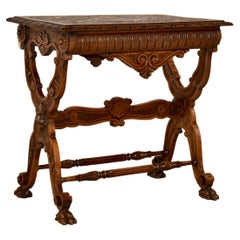
19th Century French Side Table
Located in High Point, NC
19th century oak side table from France, with a beveled and hand carved decorated edge around the top, surrounding an exquisitely hand carved central scene, depicting scrolls, acanth...
Category
Antique 19th Century French Side Tables
Materials
Oak
Antique early 19th century mahogany drum table
Located in London, GB
An early 19th Century Regency period mahogany Drum Table of attractive small proportions, ebony strung throughout, having circular top with central “money compartment” above frieze d...
Category
Antique Early 19th Century English Regency End Tables
Materials
Mahogany
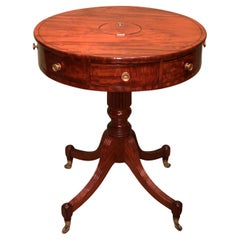
19th Century French Side Table
Located in High Point, NC
19th century walnut side table from France with a beveled and hand carved decorated edge around the top, following down to a fabulously hand carved apron on all four sides of the tab...
Category
Antique 19th Century French Napoleon III Side Tables
Materials
Walnut