Pattaya Antiques Paintings and Screens
to
1
1
1
1
1
1
1
1
1
1
1
1
English Portrait Of A Lady From Circa End Of The 17th Century
Located in Chonburi, TH
Circle of Willem Wissing
Oil on canvas in its original frame
Canvas size 65x75cm = 25.5”x29.5"
Including frame 82x93cm = 32”x36.5"
The oil painting is in excellent condition.
Fr...
Category
Antique 17th Century British Georgian Paintings and Screens
Materials
Canvas, Linen, Wood

Related Items
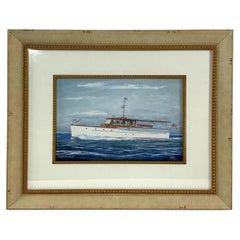
Portrait of Motor Yacht Thirsty Lady ii
Located in Norwell, MA
Portrait of the motor Yacht "Thirsty Lady II". Signed lower right "John Austin Taylor". Framed under glass. Not examined outside the frame. No obvio...
Category
20th Century North American Paintings and Screens
Materials
Paint

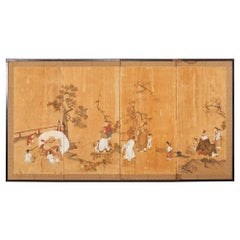
17th Century Japanese Edo Four Panel Screen Hotei with Chinese Sages
Located in Rio Vista, CA
Beautifully weathered late 17th/early 18th century Japanese edo period four panel byobu screen depicting hotei (fat monk) in a treed landscape with Chinese sages engaged in leisurely...
Category
Antique 17th Century Japanese Edo Paintings and Screens
Materials
Brass
$4,000
H 43.5 in W 80.5 in D 0.75 in
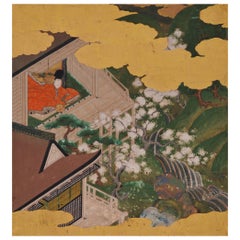
Japanese Painting, 17th Century, Tale of Genji, Tosa School
Located in Kyoto, JP
Illustration to an unidentified chapter of the Tale of Genji (Genji Monogatari)
Tosa School (second half of the 17th Century)
Ink, pigment, gofun and...
Category
Antique Late 17th Century Japanese Edo Paintings and Screens
Materials
Gold Leaf
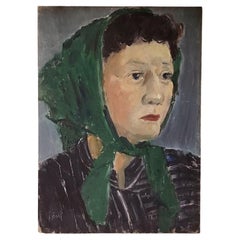
Portrait of a Lady Japanese Vintage Oil Painting by Yoshito Shibata
Located in Chiba, JP
Vintage oil painting on wooden plate, by a Japanese painter, Yoshito Shibata (1910-1995), circa 1960-70s, 24 x 33.3 x 0.5 cm (9.44 x 13.11 x 0.19in)
Category
Vintage 1960s Japanese Showa Paintings and Screens
Materials
Wood
$150
H 13.12 in W 9.45 in D 0.2 in
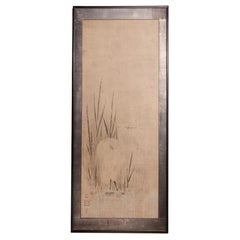
Antique Japanese Suibokuga Egrets by Kano Tokinobu, 17th century.
Located in Point Richmond, CA
Antique Japanese Suibokuga Egrets by Kano Tokinobu, 17th century.
A sumi-e ink on paper painting illustrating two egrets in reserve with no outlines contrasting with the reeds from the marsh in the background. The painting with 3 vermillion seals of the artist in the lower left corner. Japanese dry mount paper on a wood frame with thin brocade border silver leafed surround and lacquered wood outer frame.
Condition: Lighter discoloration on the lower portion of the painting, other minor signs of age, wear, stains and repairs otherwise fine condition.
Age: Painting Edo Period, circa 1670. Mounting circa 1985.
Image: 51-1/2 in. x 20-1/2 in. (131cm x 52cm)
Frame 59-1/4 in. x 25-1/4 in. (150cm x 64cm)
Weight: 6 lbs.
Provenance:
with Honeychurch Antiques...
Category
Antique 1670s Japanese Edo Paintings and Screens
Materials
Paper
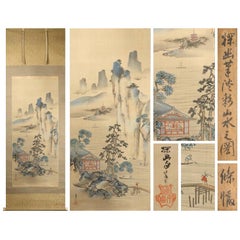
Lovely 17th-18th Century Scroll Painting Japan Artist Kano Soyu Painted
Located in Amsterdam, Noord Holland
It is a work that is said to have been drawn by Kano Soyu as you can see.
It is a picture of the light-colored Sansui map carefully drawn to the smallest detail, and the
towering m...
Category
Antique 17th Century Japanese Edo Paintings and Screens
Materials
Silk
$3,028 Sale Price
20% Off
H 79.73 in W 26.58 in D 0.04 in
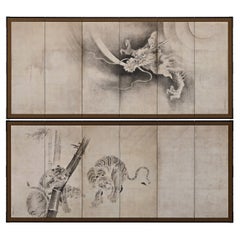
17th Century Japanese Screen Pair. Tiger
Dragon by Kaiho Yusetsu
Located in Kyoto, JP
Kaiho Yusetsu (1598-1677)
Tiger and Dragon
Early Edo Period, Circa 1650
A Pair of Six-fold Japanese Screens. Ink and slight color on paper.
Dimensions:
Each screen: H. 171 cm x W. 380 cm (67.5’’ x 149.5’’)
In this pair of early Edo period Japanese screens a group of tigers prowl in a bamboo grove whipped with fierce wind, while a dragon claws through clouds and mist. The dragon embodies elemental qualities - looming out of the mist, the coils of its body disappearing in the clouds. The dragon is calling for rain, symbolizing spring which is considered the fountain of life. On the other side, the tigers calls for the wind, symbolizing autumn which is considered the end of life. Tigers were familiar motifs within Japanese art from ancient times though the animals were imaginary to the people in the 17th century. While dragons and tigers are usually associated as sacred and ferocious, in this painting, both animals have rather amusing expressions. The tigers appear to glare at the dragon with cat-like eyes, and the look on the swirling dragon’s face appears almost affectionate - lending a playful flair to an otherwise magnificent theme.
The tiger and dragon are cosmological symbols of the balancing forces in the world. Screens such as this were originally meant to express the fluctuating nature of the world. For Japanese in the early Edo period, they likely suggested the powers of the cosmos. In Japan the tiger and dragon motif was originally absorbed into the circles of Zen monasteries before spreading into the secular world. The theme especially appealed to the military classes with the Kano school, the official painters to the Shogun and the samurai, being the leading contributors. The painter of this pair of screens, Kaiho Yusetsu (1598-1677), was closely patronized by the third Shogun Tokugawa Iemitsu. In his later years he worked with Kano school artists...
Category
Antique Mid-17th Century Japanese Edo Paintings and Screens
Materials
Silk, Wood, Paper
$78,000 / set
H 67.5 in W 149.5 in D 0.75 in
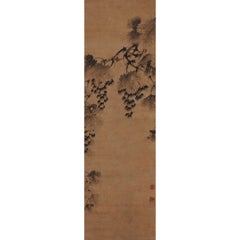
Korean Painting, Wall Panel, 17th Century Ink Grapevine
Located in Kyoto, JP
Grapevine
Anonymous. Korean, 17th century.
Wall panel, ink on paper.
Upper seal:
Kou Kinun in
Lower seal:
Kaigen
Dimensions:
Measures: 98.5 cm x 29.5 cm (39” ...
Category
Antique 17th Century Korean Other Paintings and Screens
Materials
Wood, Paper
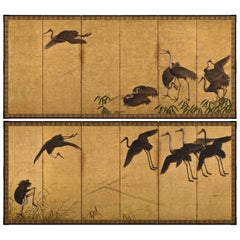
17th Century Japanese Screen Pair. Flock of Cranes. Ink and color on gold leaf.
Located in Kyoto, JP
A pair of six-fold Japanese screens from the 17th century depicting a flock of cranes arriving at their wintering grounds. The expansive scene is heavily atmospheric. The cranes are...
Category
Antique 17th Century Japanese Edo Paintings and Screens
Materials
Gold Leaf
$72,000 / set
H 66.5 in W 149.5 in D 0.75 in
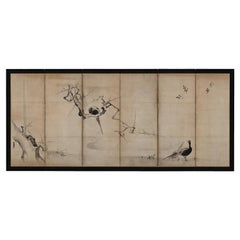
17th Century Japanese Screen. Ink Plum Tree
Birds by Kano Naonobu.
Located in Kyoto, JP
Kano Naonobu (1607-1650)
Plum Tree and Birds
Six-fold Japanese Screen. Ink and slight color on paper.
In this evocative ink work spread over a six-panel folding screen, we see the consummation of the elegance and refinement of the Edo Kano school. This 17th century screen is a rare surviving example of a large-scale bird and flower painting by Kano Naonobu, the younger brother of Kano Tanyu...
Category
Antique 17th Century Japanese Edo Paintings and Screens
Materials
Wood, Paper
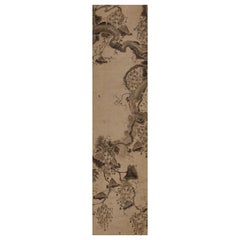
17th Century Korean Grapevine and Squirrel Scroll Painting, Mid Joseon Period
Located in Kyoto, JP
Anonymous. Korean, 17th century. Joseon period.
Hanging scroll. Ink on paper.
Seal: Shinso
Dimensions:
Scroll: H. 200 cm x W. 31 cm (79” x 12”)
Image: H. 122 cm x W. 29.5 cm (48” x 11.5”)
The grapevine came to China and then Korea from western Asia via the silk road trade routes. By the mid-Joseon period, it was one of the most popular subjects for Korean literati painters. Grapevines were painted as a singular subject or, less commonly, in combination with squirrels, which are associated with children due to their playful nature. Together, grapevines and squirrels embody wishes for abundant offspring and wealth.
For the Korean literati artist the twisting vines, curling tendrils and round, plump grapes provided ample opportunity for expressive "brush play”. In this painting the artist has abstracted the scene and is seemingly unconcerned with discontinuities and proportion. Vines spring up from nowhere, grapes hang in random clusters and the squirrel’s head appears as if twisted backwards. For the vines and leaves we can feel a sense of speed in the brushstrokes, imparting a dynamic feel which is at once intense and animated. This contrasts dramatically with the countless tiny strokes of ink which realistically capture the texture of the squirrel’s fur...
Category
Antique 17th Century Korean Other Paintings and Screens
Materials
Paper
$18,000
H 79 in W 12 in D 1 in
17th Century
Late 1600s
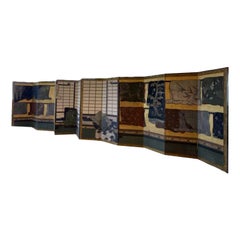
, Japanese Edo Period 12-Panel Folding Screen Painted
Located in North Miami, FL
A pair of 17th Century (Late 1600s) Japanese Edo screens made of 12-panels. This folding silk screen is painted on a gold leaf background. It has a...
Category
Antique 17th Century Japanese Edo Paintings and Screens
Materials
Silk, Wood, Paint, Paper
$595,000 / set
H 68.5 in W 292 in D 0.75 in