Provenance Antiques Mounted Objects
to
1
1
1
1
1
1
1
Height
to
Width
to
1
1
1
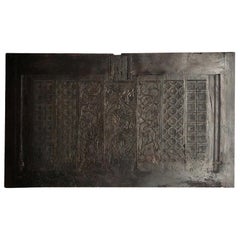
French Late 16th Century Grand Scale Trunk Facade
Located in Round Top, TX
A stunning, early 17th century trunk facade of grand scale. Dated 1621. Soundly constructed from richly stained oak with beautiful carvings of grapes on t...
Category
Antique Early 17th Century French Architectural Elements
Materials
Oak
Related Items
16th Century Late Medieval Heraldic Encaustic Tile
Located in Wormelow, Herefordshire
A 445-year-old late medieval 16th century heraldic encaustic tile of Flemish origin (unmarked). Made from terracotta and glazed, this 6-inch antique tile is an excellent collector’s ...
Category
Antique 16th Century Dutch Medieval Mounted Objects
Materials
Terracotta

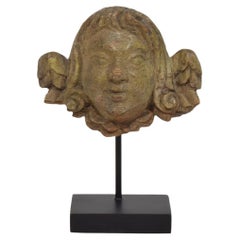
French 16th/ 17th Century Weathered Oak Renaissance Angel Fragment
Located in Buisson, FR
Beautiful weathered oak winged angel head Renaissance ornament.
France, 16/ 17th century. Weathered
Measurements include the wooden pedestal.
Category
Antique 16th Century French Renaissance Figurative Sculptures
Materials
Oak
$268 Sale Price
47% Off
H 5.32 in W 3.94 in D 1.58 in
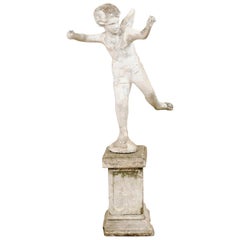
Early 20th Century French Antique Cupid Garden Statue
Located in Atlanta, GA
A tall French garden sculpture of a winged boy angel from the early 20th century. This antique statue from France sweetly depicts the figure of Cupid with arms raised as if he would ...
Category
20th Century French Architectural Elements
Materials
Concrete
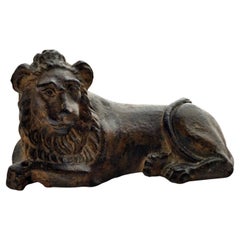
Lion of Forge, Spain, 16th Century
Located in Madrid, ES
Lion of Forge, Spain, 16th century
In forging, measurements: 10 x 17 x 5 cm
Good condition
Spanish private collection.
Category
Antique 16th Century Spanish Baroque Animal Sculptures
Materials
Iron
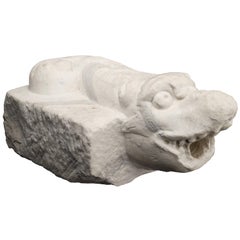
Italian Ancient Marble Sculpture Fountain, Late 16th Century
Located in Milano, IT
Sea monster
Carrara marble mouth fountain
Italy, late 16th century
It measures 13.8 x 31.5 x 18.9 in (35 x 80 x 48 cm)
State of conservation: some small evident gaps and widespread signs of wear due to outdoor exposure. The gray marks crossing it do not come from restoration, but are rather the natural veins of the marble.
This work has some morphological characteristics typically associated with the iconography of the sea monster: an elongated muzzle, sharp teeth, protruding eyes, elongated ears, and a coiled serpent's tail.
An in-depth series of studies on artistic depictions of the sea monster attempted to verify how this symbol evolved in antiquity in the European and Mediterranean contexts and how it gradually changed its image and function over time. The iconography itself is mutable and imaginative and its history is rich with cultural and artistic exchange, as well as the overlapping of ideas. This occurred so much that it is difficult to accurately pinpoint the "types" that satisfactorily represent its various developments.
However, we can try to summarize the main figures, starting from the biblical Leviathan and the marine creature that swallowed Jonah (in the Christian version, this figure was to become a whale or a "big fish", the “ketos mega”, translation of the Hebrew “dag gadol”). Other specimens ranged from the dragons mentioned in the Iliad (which were winged and had legs) to "ketos” (also from Greek mythology), the terrifying being from whose Latinized name (“cetus”) derives the word "cetacean". See J. Boardman, “Very Like a Whale” - Classical Sea Monsters, in Monsters and Demons in the Ancient and Medieval Worlds, in Papers presented in Honor of Edith Porada, Mainz am Rhein 1987, pp. 73-84).
In Italy the monster underwent yet further variations: it can be found in Etruscan art on the front of some sarcophagi representing the companion of souls, while among the Romans we find the “Pistrice” (cited by Plinio in Naturalis Historia PLIN., Nat., II 9, 8 and by Virgilio in Eneide: VERG., Aen., III, 427), which appeared in the shape of a stylized hippocampus or a very large monstrous cetacean and evolved into a hideous being with a dragon's head and long webbed fins.
During the Middle Ages, the sea monster was the object of new transformations: at this time, it is often winged, the head is stretched like a crocodile, the front legs are often very sharp fins - sometimes real paws - until the image merges with dragons, the typical figures of medieval visionary spirituality widely found throughout Europe (on this topic and much more, see: Baltrušaitis, J., Il Medioevo fantastico. Antichità ed esotismi nell’arte gotica, Gli Adelphi 1997).
In Italy during the 15th and 16th centuries, the revival of classicism - representative of the humanistic and Renaissance periods - led to a different reading of these "creatures". Indeed, the sea monster was also to find widespread use as an isolated decorative motif, especially in numerous fountains and sculptures where dolphins or sea monsters were used as a characterizing element linked to water (on this theme see: Chet Van Duzer, Sea Monsters on Medieval and Renaissance Maps, London, The British library, 2013).
From the morphological point of view, the "sea monsters" of this period are mostly depicted as hybrid figures, in which the body of a mythological or real being (a hippocampus, a sea snake, a dolphin), is joined to a head with a rather indistinct appearance. It was usually characterized by large upright ears, an elongated snout, sharp teeth and globular, protruding eyes; a complex and indefinite figure, both from the symbolic point of view and from that of its genesis.
The work we are examining is placed as a cross between the medieval sea serpent and the Renaissance dolphin, with stylistic features which recall the snake as often used in heraldry (such as the "snake" depicted in the coat of arms of the Visconti - the lords and then dukes of Milan between 1277 and 1447 - and which, for some, may be derived from the representations of the “Pistrice” that swallowed Jonah).
In the search for sources, Renaissance cartography and in particular woodcuts should not be neglected. See for example the monsters of Olaus Magnus, from the editions of the “Historia de gentibus septentrionalibus” (“History of the peoples of the north”) and the natural histories of Conrad Gesner, Ulisse...
Category
Antique 16th Century Italian Renaissance Animal Sculptures
Materials
Carrara Marble
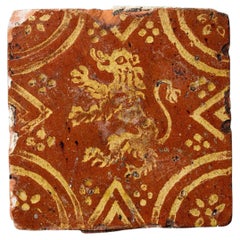
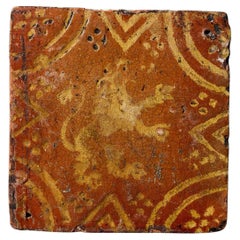
16th Century Late Medieval Encaustic Tile with Rampant Lion
Located in Wormelow, Herefordshire
A 445-year-old late medieval 16th century encaustic tile of Flemish origin (unmarked), detailed with a rampant lion. Made from terracotta and glazed, this 6-inch antique tile is an e...
Category
Antique 16th Century Dutch Medieval Mounted Objects
Materials
Terracotta
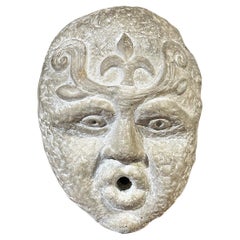
16th CENTURY FOUNTAIN MASK SCULPTURE
Located in Firenze, FI
Unique and precious sculpture in carved white marble, likely depicting Aeolus, the god of the wind. The sculpture originated as a fountain mask, as evidenced by the opening in the mo...
Category
Antique 16th Century Italian Renaissance Figurative Sculptures
Materials
Marble
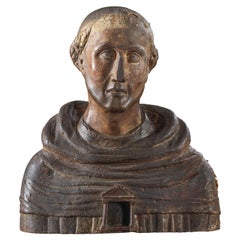
16th Century Polychrome Reliquary of a Monk
Located in Saint-Ouen, FR
The monk is depicted with an oval face, marked with high and strong cheekbones, sunken cheeks, strong jawbones and a cleft chin. His almond shaped eyes are opened under very strong a...
Category
Antique 16th Century Italian Renaissance Busts
Materials
Wood
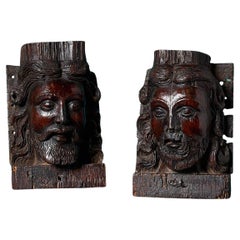
Pair of 16th Century Carved Oak Corbels
Located in Wormelow, Herefordshire
A decorative pair of 16th century carved oak corbels.
Each intricately hand carved to showcase the head of a man with fine details of flowing locks and thick beards.
Backed onto oa...
Category
Antique 16th Century English Tudor Busts
Materials
Wood, Oak
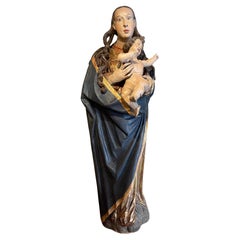
Large Virgin and Child, Tyrol, 16th century
Located in PARIS, FR
Large wooden Madonna and Child, painted and carved in hollow at the back.
The theme of the Virgin and Child is the most represented in all Christian art, whereas the infancy of Jesus...
Category
Antique 16th Century German Renaissance Figurative Sculptures
Materials
Wood, Pine
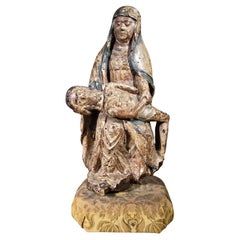
Rare 16th-Century French Polychrome Wooden Pietà Sculpture
Located in Madrid, ES
This rare and extraordinary 16th-century French sculpture depicts the iconic Pietà, showcasing exceptional craftsmanship and emotional depth. Finely carved from wood and adorned with...
Category
Antique 16th Century Figurative Sculptures
Materials
Fruitwood
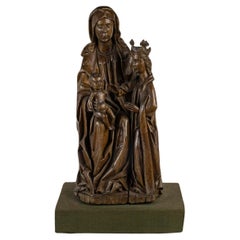
Oak Sculpture of Saint Anne, 16th Century.
Located in Saint-Ouen, FR
Oak sculpture of Saint Anne, 16th century.
Large oak sculpture of Saint Anne. Work from the Upper Rhine, Basel region. First third of the 16th century.
An arm is missing from the i...
Category
Antique 16th Century French Renaissance Figurative Sculptures
Materials
Oak