Puritan Values Beds and Bed Frames
to
6
6
4
1
2
4
3
1
1
1
1
5
4
1
1
1
6
5
5
1
6
6
6
1
1
1
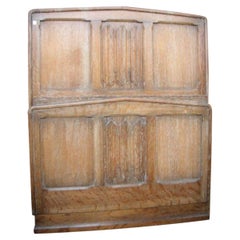
Heals, an Arts and Crafts Limed Oak Single Bed with Linenfold Carved Details
By Ambrose Heal
Located in London, GB
Heals. An Arts & Crafts limed oak single bed with arched tops and linenfold details to the centre panels.
We do have the iron side rails to put the base on, it will require a new b...
Category
Vintage 1930s English Arts and Crafts Beds and Bed Frames
Materials
Oak
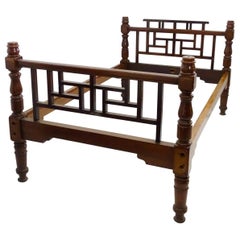
E W Godwin Style Rare Anglo-Japanese Walnut Double Bed with Lattice Work Details
By Collinson
Lock, Edward William Godwin
Located in London, GB
An extremely rare Anglo-Japanese walnut double bed or a four poster bed, in the style of E W Godwin probably made by Collinson and Lock of London.
With...
Category
Antique 1870s English Anglo-Japanese Beds and Bed Frames
Materials
Walnut
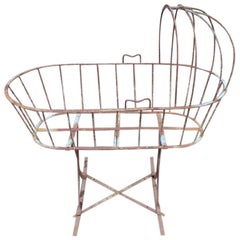
French Art Deco Decorative Iron Cot or Cradle with Canopy on Gentle Rockers
Located in London, GB
Good quality French Art Deco Decorative Iron child's cot or cradle with semi circular canopy above, and semi circular ends to the bed area with two handles to the upper edge, the who...
Category
Early 20th Century French Art Deco Children s Furniture
Materials
Iron
Shapland
Petter an Arts
Crafts Oak Double Bed in the Manner of C.F.A. Voysey
By Charles Voysey, Shapland
Petter
Located in London, GB
Shapland and Petter, in the style of C.F.A. Voysey
A good quality Arts & Crafts solid quarter sawn oak double bed with wonderful figuring to the oak pa...
Category
Antique Early 1900s English Arts and Crafts Beds and Bed Frames
Materials
Oak
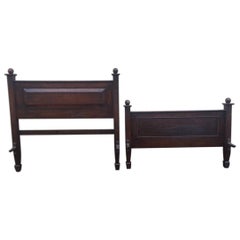
Heals, Near Pair of Arts
Crafts Single Oak 3 Foot Wide Beds with Carved Hearts
By Heal
s
Located in London, GB
Heals and Son. A near pair of Arts & Crafts 3 foot wide single oak beds with carved heart details, one also with a carved tied knot.
Category
Vintage 1910s English Arts and Crafts Beds and Bed Frames
Materials
Oak
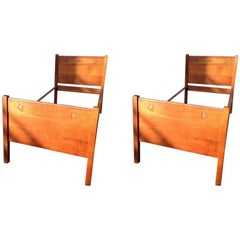
Good Quality Pair of Arts
Crafts Single Oak Beds in the Manner of Heals
By Heal
s
Located in London, GB
A good quality pair of Arts & Crafts single oak beds in the manner of Heals.
They do come with side irons and will require a slatted base to be made fo...
Category
Antique 1890s English Arts and Crafts Beds and Bed Frames
Materials
Oak
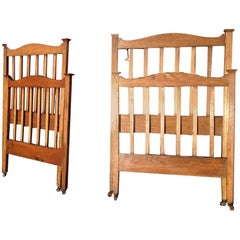
Related Items
Antique Walnut Louis XV Style Full Size Bed with Metal Rails
Located in Old Town Orange, CA
Antique Walnut Carved Full size French bed
Headboard, footboard with metal rails. (original rails not available)
Overall size: 58”w x 81”d x 61”h...
Category
Antique 19th Century French Louis XV Beds and Bed Frames
Materials
Walnut
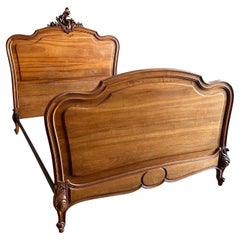

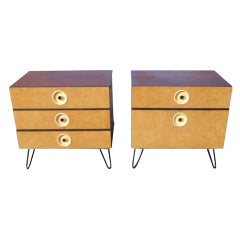
Pair of Mid Century Nightstands in the Manner of Paul Frankl
By Paul Frankl
Located in Pasadena, TX
Pair of mid century nightstands featuring cork fronts
Pair of walnut vintage nightstands or side tables with metal hairpin legs in the style of Paul Frankl. Featuring circular recessed bakelite pulls and cork facings. One with three drawers and the other features one top drawer and a pull down cabinet...
Category
Vintage 1950s German Mid-Century Modern Night Stands
Materials
Steel
$3,040 Sale Price
20% Off
H 19 in W 19 in D 13 in
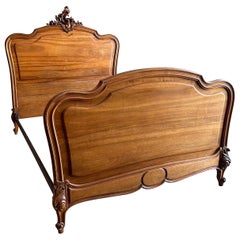
Antique Walnut Louis XV Style Full Size Bed with Metal Rails
Located in Old Town Orange, CA
Antique Walnut Carved Full size French bed
Headboard, footboard with metal rails. (original rails not available)
Overall size: 58”w x 81”d x 61”h...
Category
Antique 19th Century French Louis XV Beds and Bed Frames
Materials
Walnut
$2,513 Sale Price
30% Off
H 61 in W 58 in D 81 in
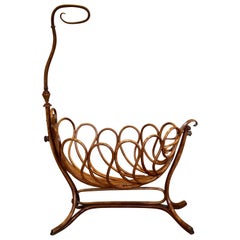
Rare French Bentwood Cradle in the Thonet Style Late 19th Century
By Thonet
Located in London, Park Royal
This French bentwood cradle made in the Thonet style is a rare find, circa late 1900s. The cradle is in perfect working order with a gentle rocking act...
Category
Antique 1890s French Art Nouveau Beds and Bed Frames
Materials
Bentwood
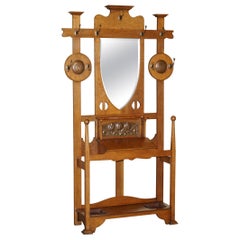
ANTiQUE 1900 ARTS
CRAFTS SHAPLAND AND PETTER HALL COAT GLOVE UMBRELLA STAND
By Shapland
Petter
Located in West Sussex, Pulborough
Royal House Antiques
Royal House Antiques is delighted to offer for sale this stunning original Arts & Crafts Shapland & Petter Hall stand with hand hammered Copper panels over a Walnut frame with inset sheild mirror
Please note the delivery fee listed is just a guide, it covers within the M25 only for the UK and local Europe only for international, if you would like an accurate quote please send me your postcode and I’ll provide you with the exact price
A very good looking well made and decorative hat glove coat and scarf rack, this one is rare as it has the central mirror and its an earlier than usual example circa 1900
Made by Shapland & Petter, a full blub on their life and works can be found below
In terms of the condition it is straight and solid, the piece sits well in any setting and looks decorative and very English country house, we have cleaned waxed and polished the timber, there is one hook slightly bent, otherwise its in fine order
Dimensions
Height:- 205cm
Width:- 113cm
Depth:- 40cm
Please note all measurements are taken at the widest point, if you would like any additional or specific measurements please ask
Shapland and Petter of Barnstaple
Introduction
This Barnstaple based company manufactured some of the finest pieces of furniture in Arts and Crafts style but very little has been written about the company or the pieces they produced. It a great shame that whilst Shapland and Petter pieces have been illustrated in books and auction catalogues they are invariably attributed to other makers such as Liberty and Co in London or Wylie and Lochhead in Glasgow. With this feature, we intend to inspire a more thorough appreciation of the work of the company; readers are invited to help with the task by sending photographs and information.
Collectors and auction houses are now showing significantly more interest in Shapland and Petter pieces. The company, based in Barnstaple, England produced a very wide range of furniture in several different styles including many pieces in period reproduction and municipal style for town halls and commercial premises alongside their superb Arts and Crafts range
Distinctive features of their superb Arts and Crafts style are the use of heart shaped piercing, geometric shapes with angled arches and the application of repousse copper panels. Decoration with marquetry, metal inlay, mounting of ceramic and enamel cabochons were techniques which they mastered with a combination of state of the art technology and traditional craftsmanship. Most distinctively, the pieces were extremely well made, with care and very best quality materials
The growing interest in Shapland and Petter has raised many questions about the origins of the firm, and the sources of influence on their designs, some of which resemble designs by Ashbee, Ballie Scott, Voysey and Talwin Morris. Links have been assumed with Liberty and Co with the supposition Shapland and Petter worked on commissions for Liberty. There appears to be little evidence to support many of the assumptions which have developed around the company and this article is intended to help to start the discussion and to stimulate research
The History of Shapland and Petter
The Museum of North Devon in Barnstaple have an archive of Shapland and Petter which includes some company records and a small display of furniture and related items. The following text gives history of the company and is reproduced from the display boards in the museum with kind permission of North Devon Museums
For over 100 years the Shapland and Petter factory has stood at the end of Barnstaple Long Bridge. Manufacturers of doors, door sets, and custom wood interiors, NT Shapland and Petter Ltd are still one of the towns largest employers. The company was established by Henry Shapland (b. 1823), a cabinet maker by trade. He embarked on a voyage to America in 1848, where he was inspired by an invention for a wave-moulding machine. He was only allowed to see it if he left the country immediately. Returning home with only rough notes, he reproduced the machine and in 1854 began a cabinet making business in one room at the Raleigh woolen mill in Pilton. Later the firm moved to Bear Street in Barnstaple. Henry Petter was an accountant who entered into partnership with Mr Shapland. The business progressed and in 1864 they bought the Raleigh Factory where Shapland first began his work. Success was rapid, but in 1888 the building burnt down. Immediately work began on a bigger and better factory - their present site by the Long Bridge - which included many modern inventions
The two Henrys died within two years of each other - Petter in 1907 and Shapland in 1909. In 1924 Shapland and Petter merged with the Barnstaple Cabinet Company, producing North Devon's biggest industry. During the First World War Shapland and Petter's skilled craftsmen turned their hands to wooden propellers for the aircraft of the Royal Flying Corps. After the war, public tastes changed, and hand carved furniture was too expensive for many. Shapland and Petter's output now included elegant veneered pieces with smooth Art Deco lines. The company fitted out Pullman carriages and ocean liners and made hand-carved church furniture. The famous England Rugby Captain W. W. Wakefield was appointed Company Director in 1927. Throughout the depression of the late 1920's and early 1930's the company still managed to produce high quality work
Furniture manufacturing continued until the outbreak of the Second World War in 1939. Many workers left to fight, while the factory worked on Air Ministry contracts for ammunition boxes. After the war came radio cabinets and laboratory and contract furniture, until eventually large quantities of doors were being produced for hospitals, hotels, schools, offices and other buildings. Examples of Shapland and Petter's work can be seen all over North Devon. In Barnstaple, the shop front at 109 High Street is a good example, and the interior of the old Lloyd's Bank, now Chamber's Brasserie, was also Shapland's work. Examples of carving by Shapland's men can be seen in two chairs and a reading desk in Barnstaple Parish Church
As cabinet makers, Shapland and Petter employed up to 350 people at a time. There were designers, carvers, cabinet makers, machinists, polishers, and labourers. The company was one of the first to install American labour-saving devices and was keen to adopt the most up-to-date machinery
The fire of 1888 at the Raleigh Cabinet Works was a huge loss for the company. However, it resulted in a new factory which was altogether more modern and better equipped. The new building by the river was arranged into blocks. The production line began with the saw mills and ended with the finishing rooms. There was modern machinery in every department - one of their saws was the first of its kind in Britain. Water sprinklers and electric lights were a necessity - this factory would not burn down
As well as the furniture production, Shapland and Petter imported timber by sea and rail. The new factory 's facilities were exceptional
Shapland and Petter were renowned for excellent design and workmanship. The carvers were highly skilled, serving seven year apprenticeships and attending classes at the Barnstaple School of Art. Ornately carved furniture required up to a hundred tools
The factory produced made to order woodwork for banks, hotels, and shops; mantelpieces, paneling and staircases. They fitted out Pullman railway carriages, the London Guildhall, and Edgar Wallace 's dining room as well as houses like Tapeley Park in North Devon
Much of the work involved intricate leaded glass panels, or inlaid fruitwood designs, like the white bedroom suite shown in the exhibition here. This type of work is typical of Art Nouveau 1895 to 1910, inspired by the fluid shapes of plants and flowers
Many pieces were made from standard designs. There were hundreds to choose from, and a selection could be seen in local and London showrooms and in catalogues. Although mass-produced, this furniture was well-made by skilled technicians and modern machinery
Arts and Crafts designs of Shapland and Petter
The development of the Arts and Crafts Movement in the South West of England has not been written up in any detail though we do know of the Art Potters of Barnstaple from the excellent book of this name by Audrey Edgeler. Less is known of the Barnstaple Guild of Metal Workers. We know of the Bath Cabinet Makers and the Newlyn School of Industrial Art in Cornwall but very little has been written about the furniture makers of Barnstaple in Devon
The establishment of a large cabinet making firm in Barnstaple is not remarkable in itself; there were several cabinet makers in the area. What is interesting is that this particular Barnstaple firm should become a leading maker of Arts and Crafts furniture, copying the styles of the leading Architect designers and creating their own unique style
Critics may point out that as their work was commercially driven and reliant upon machines it therefore does not really qualify as Arts and Crafts. Whilst the company was highly innovative in machine technology, they also employed many craftsmen who worked with their hands in woodcarving, marquetry work, design and application of decorative copperwork and other artistic embellishment in the true Arts and Crafts tradition. Anyone who has experience of Shapland and Petter workmanship knows the level of craftsmanship invested in each piece
Sources of inspiration
There appears to be no evidence to link any known architect, artist or designer to the Shapland and Petter company. Their designs appear to have been created solely by their own internal design staff none of whom appear to have published or registered their work in any other context
C. R. Ashbee who established the Guild of Handicrafts visited Barnstaple in 1893 and provided a twelve week course on the design and decoration of furniture. It is presumed that this visit was hosted by Shapland and Petter, and that their own staff and those from other local furniture makers attended the course. Ashbee appears to have been unimpressed by the commercial attitudes he encountered and apparently disappointed at the lack of interest in his (high minded) lectures. What is interesting however is the similarity between some of his designs and those used by Shapland and Petter, particularly in respect to inlaid floral design. Perhaps he left a lasting influence which has not yet been verified
There has been some speculation on the influence of Scottish designers, particularly because of the use of Glasgow rose designs which are typical of the Glasgow School, and particularly of Talwin Morris. There are also several designs which use similar motifs to those used by Baillie Scott, the use of two doves in flight for example. More research is needed to trace possible links here. One thing that is clear is that there was a great deal of copying and selling designs in the furniture industry at the time and a nineteenth century survey on the furniture trade recorded that '' Barnstaple pays the best prices for designs ..''
Collaboration with other companies
There is evidence that Shapland and Petter organised a wide network of companies to retail their products and hence many pieces have the labels of retail furnishers added. Little is known of their marketing in Europe and America but it may be that many Arts and Crafts pieces were sold abroad. Shapland and Petter had excellent access to rail and shipping lines for importing timber and presumably for exporting their finished products
The extent of their collaboration with other companies is yet to be ascertained but there is evidence that their suppliers included the Della Robbia Pottery, Pilkingtons Tile...
Category
Antique Early 1900s English Arts and Crafts Coat Racks and Stands
Materials
Copper
$4,058
H 80.71 in W 44.49 in D 15.75 in
19th C. Neo Classic Large Bed With Gilt Work
Painted "Boucher" Style Cherubs
Located in London, Park Royal
This bed isn’t just fit for a king—it was actually made for royalty!
Handcrafted in solid oak in France circa 1880, this remarkable Neo-Classical bed was commissioned a member of Eu...
Category
Antique Late 19th Century French Louis XVI Beds and Bed Frames
Materials
Wood
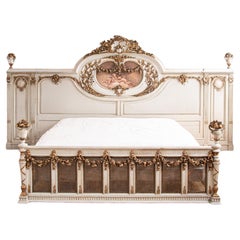
$16,990
H 76.78 in W 150.01 in D 86.62 in
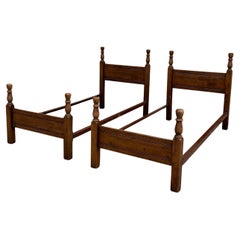
A Pair of Solid Oak Single Beds Early 20th Century
Located in Leicester, GB
A lovely pair of solid oak bed frames from the early 20th century. The oak has a great colour and patina. Beautifully made, solid constraction, easy to put together with metal sides ...
Category
Vintage 1930s English Art Deco Beds and Bed Frames
Materials
Oak
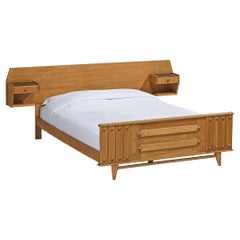
French Double Bed in Oak
Located in Waalwijk, NL
European double bed, oak, black colored glass, France, 1960s
This remarkable double bed hails from France, showcasing its excellence in composition, material use, and intricate deta...
Category
Vintage 1960s French Mid-Century Modern Beds and Bed Frames
Materials
Oak, Glass
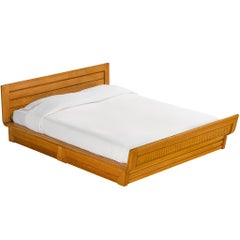
Guillerme
Chambron Double Bed in Solid Oak
By Guillerme et Chambron, Votre Maison
Located in Waalwijk, NL
Guillerme & Chambron for Votre Maison, double bed, solid oak, France, 1960s
The standout feature of this bed is immediately apparent: the exceptional craftsmanship of the woodwork. ...
Category
Vintage 1960s French Mid-Century Modern Bedroom Furniture
Materials
Oak
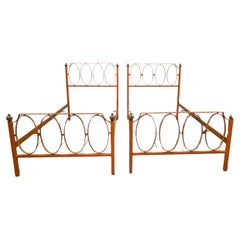
Pair of painted iron single beds, 1960s
Located in SAN PIETRO MOSEZZO, NO
Pair of 1960s single beds in orange painted iron, original color and brass details.
Sound structure, heavy material and quality finish.
Ideal for a second home or a bedroom set wit...
Category
Vintage 1960s Italian Mid-Century Modern Beds and Bed Frames
Materials
Brass, Iron
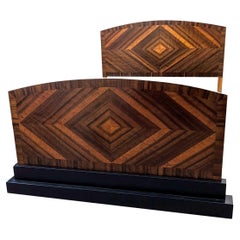
Stunning Art Deco Walnut Double Bed, English, c1930s
Located in Devon, England
This is a golden opportunity to treat yourself to an outstanding and totally original 1930s Art Deco double bed. These style of beds that scream the Art Deco style are very few and f...
Category
Mid-20th Century British Art Deco Beds and Bed Frames
Materials
Iron
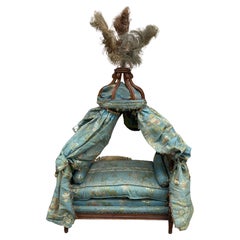
19th Century Pet or Doll Bed
Located in East Hampton, NY
Exquisite pet/ doll bed in the Louis XXI style. all original silk brocade drapery and upholstery. and remnants of trims. mattress is stuffed horsehair. ostrich feather floret. (the h...
Category
Antique Mid-19th Century Beds and Bed Frames
Materials
Silk