Quintessential Things Interior Prints
to
5
1
Overall Width
to
Overall Height
to
1
1
2
3
1
1
5
1
6
3
2
1
1
1
1
1
1
3
1
1
1
5
6
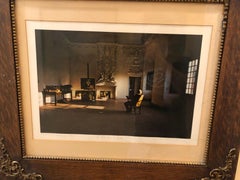
Picasso at Vauvenargues 1962 by David Douglas Duncan
Located in San Francisco, CA
David Douglas Duncan: 1916-2018. Well listed photographer who had rare access to Picasso. He took numerous photos of the master at work, and at pl...
Category
1960s Figurative Photography
Materials
Offset
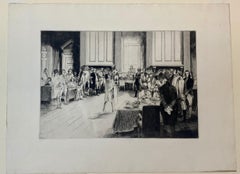
John Winkler "The Constitutional Convention" Original Signed Etching c.1932
Located in San Francisco, CA
John Winkler "The Constitutional Convention" Original Signed Etching c.1932
Plate dimensions 13.75" wide x 9.5" high
Paper dimensions 19.75" wide x 14....
Category
Early 20th Century Interior Prints
Materials
Etching
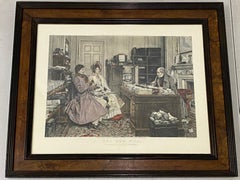
James Dobie "The New Will" Color Engraving After Walter Dendy Sadler c.1894
Located in San Francisco, CA
James Dobie "The New Will" Color Engraving After Walter Dendy Sadler c.1894
Original 19th century color engraving
Engraved by James Dobie after artwork b...
Category
Late 19th Century Interior Prints
Materials
Engraving
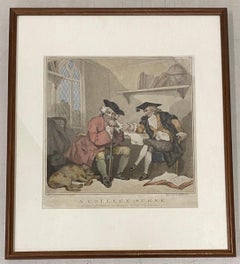
Edward Williams "A College Scene" After Thomas Rowlandson Color Engraving C.1787
By Thomas Rowlandson
Located in San Francisco, CA
Edward Williams "A College Scene" After Thomas Rowlandson Color Engraving C.1787
Late 18th century hand colored engraving after Thomas Rowlandson
A scene of a young student asking ...
Category
Late 18th Century Figurative Prints
Materials
Engraving
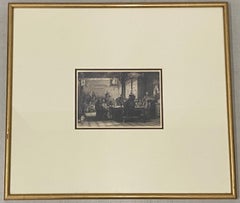
G. Paterson "Dinner Party at a Mandarin
s House" Engraving After T. Allom c.1840
Located in San Francisco, CA
G. Paterson "Dinner Party at a Mandarin's House" Original Engraving After T. Allom C.1840
Original engraving
Dimensions 8" wide x 5" high
The frame measures 20.5" wide x 18.5" hig...
Category
Mid-19th Century Realist Interior Prints
Materials
Engraving
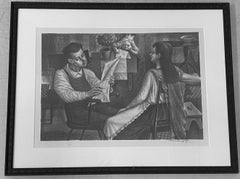
Ture Bengtz "Family Scene" Original Pencil Signed Lithograph C.1940
By Ture Bengtz
Located in San Francisco, CA
Ture Bengtz "Family Scene" Original Pencil Signed Lithograph C.1940
Lithograph dimensions 15.25" wide x 10.5" high
Frame dimensions 21.5" wide x 17" high
Pencil signed in the lowe...
Category
Early 20th Century Figurative Prints
Materials
Lithograph
Related Items
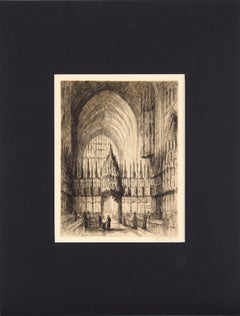
Chester Cathedral - Drypoint Etching in Ink on Paper
Located in Soquel, CA
Chester Cathedral - Drypoint Etching in Ink on Paper
Dramatic drypoint etching by J. Alphege Brewer (British, 1881-1946). This composition shows the interior of Chester Cathedral in Brewer's characteristic style - highly detailed and with strong contrast. The scene encompasses the cathedral from floor to ceiling, capturing the immense size of the building. There are several people in the scene which contribute to the sense of scale.
Signed by hand "J. Alphege Brewer" in the lower right corner.
Titled "Chester Cathedral" in plate, lower left corner.
Includes original card with artist's name.
Presented in a new black mat with foamcore backing.
Mat size: 16"H x 12"W
Paper size: 10.75"H x 7.75"W
James Alphege Brewer was well known in the early 20th century as a producer of color etchings of European cathedrals and other scenes of church, college, and community. He was born July 24, 1881, in the Kensington section of London, England, the son of Henry W. Brewer, noted artist of historical architecture and prominent convert to the Catholic Church, and the grandson of John Sherren Brewer, Jr., “the brilliant editor of the Calendar of Letters of Henry VIII.” His great uncle was E. Cobham Brewer, the polymath who compiled Brewer’s Dictionary of Phrase and Fable. Among his older siblings were the artist Henry C. Brewer and the organist and writer John Francis Brewer.
Brewer attended the Westminster School of Art in London, where his brother Henry also trained. In 1910, he married Florence Emma Lucas, an accomplished painter in oil and watercolor, whose father was the noted landscape artist George Lucas and whose great uncle was David Lucas, the famous engraver for John Constable. Florence's brothers Edwin and George assisted Brewer in the printing of Brewer's etchings.
Brewer exhibited at the Royal Academy (RA) and the Royal Institute of Painters in Watercolour (RI), at the Paris Salon of the Académie des Beaux-Arts, and in the shows of the Royal Cambrian Academy (RCA). He became an associate of the Royal Cambrian Academy in 1929 and a full member in the last two years of his life. He was also a member of the Hampstead Society of Artists, the Society of Graphic Art, and the Ealing Arts Club, where he was first Honorary Art Secretary and then Honorary Art Chairman. Most of Brewer's larger etchings were published by Alfred Bell...
Category
Early 20th Century Romantic Interior Prints
Materials
Paper, Ink, Drypoint

$396 Sale Price
20% Off
H 16 in W 12 in D 0.25 in
Bow Street Office: Rowlandson Hand-colored Engraving from Microcosm of London
By Thomas Rowlandson
Located in Alamo, CA
An early 19th century print entitled "Bow Street Office", an illustration (Plate 11) from "The Microcosm of London", published in London in 1808 by R. Acker...
Category
Early 1800s Other Art Style Interior Prints
Materials
Aquatint, Etching

Thomas RowlandsonBow Street Office: Rowlandson Hand-colored Engraving from Microcosm of London, 1808
$524 Sale Price
40% Off
H 18.5 in W 20 in D 0.88 in
"King of the Friendly Islands" (Tonga); Engraving from Captain Cook
s 3rd Voyage
By John Webber
Located in Alamo, CA
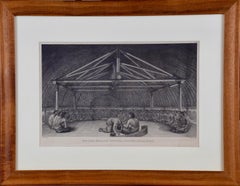
"Poulaho, King of the Friendly Islands, Drinking Kava" is an engraving created by William Sharp (1749-1824), from a drawing by John Webber (1752-1793), who was the artist on Captain James Cook's 3rd and final voyage of discovery. It was published in the atlas of "A Voyage to the Pacific Ocean Undertaken by the Command of His Majesty, for Making Discoveries in the Northern Hemisphere", the official British Admirality sanctioned journal published upon completion of the voyage in London in 1784 by Strahan & Cadell.
Captain Cook visited Tonga on his 3rd voyage, which he named The Friendly Islands because of the warm welcome he and his crew received, unlike some of the other more hostile Pacific islands. The engraving depicts Cook and his men observed a kava ceremony at the village of Mu’a on Tongatapu. King Paulaho sits in the centre foreground, his back to the spectator with a man kneeling before him. The ceremonial mat depicted behind Paulaho indicates that nobody was allowed to sit behind him. The figure in the centre holds a single cup, referring to the Tongan custom of offering the cup to the king first. Kava is native to the islands of the South Pacific and was first described for English readers in 1768 by Captain James Cook. The kava root has been used for centuries as a central feature of ceremonies and celebrations because it was able to bring about a calming and pleasant social atmosphere. The root was crushed and processed into coconut milk to become the focal ceremonial beverage, simply referred to as kava.
This engraving is presented in a Koa wood frame and a white mat. Koa wood is legendary in Hawaii. There are occasional faint spots, but the print is otherwise in very good condition. This amazing Koa wood is native to Hawaii and it is known for the deep rich colors and varied grain pattern. Koa has an honored heritage in Hawaii and is highly revered and sacred. The word “koa” means “warrior” in Hawaiian. The warriors of King Kamehameha the Great, created canoes and weapons from a wood plentiful on the Big Island of Hawaii. This wood became synonymous with the warriors themselves, and it became known as koa.
There are three other engravings listed from the official journal of Captain Cook's 3rd voyage available that are presented in identical Koa wood frames and mats (LU117324682422, LU117324684052, LU117324684032). They would make a wonderful grouping for a display of 2, 3 or 4 prints. A discount is available for a grouping depending on the number of items included.
Captain Cook is remembered as one of the greatest explorers and navigators in history. His explorations included Australia, New Zealand and islands of the South Pacific and the northwest coast of North America. Hawaii was discovered by Captain Cook during this voyage. Hawaii was originally called The Sandwich Islands in honor of The Earl of Sandwich...
Category
1780s Realist Figurative Prints
Materials
Engraving
$1,900 Sale Price
20% Off
H 18.25 in W 23.5 in D 0.88 in
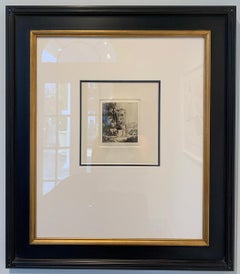
Jesus and the Woman at the Well,
by Amand-Durand, Engraving
By Armand Durand
Located in Oklahoma City, OK
This early 19th century framed 35" x 31" engraving by artist Amand-Durand depcits an etching of 'Jesus and the Woman at the Well,' after the Dutch master, Rembrandt van Rijn. This poignant Biblical story is depicted by Arman-Durand in Rembrandt style...
Category
Early 19th Century Old Masters Figurative Prints
Materials
Engraving
$1,200 Sale Price
20% Off
H 30.5 in W 26.5 in D 1.5 in
Original Save Freedom of Speech, Buy War Bonds (Large) format vintage poster
By Norman Rockwell
Located in Spokane, WA
Original FREEDOM OF SPEECH, large size format, 1943 vintage poster. Archival linen backing with the original fold marks restored and ready to frame. This is the most popular and most requested among the Four Freedoms posters...
Category
1940s American Realist Portrait Prints
Materials
Offset

$2,880
H 56 in W 40 in D 0.3 in
Original "Me Travel? not this summer Vacation At Home vintage poster 1945
Located in Spokane, WA
Original World War Two, U. S. Military poster: ME TRAVEL? … NOT THIS SUMMER, VACATION AT HOME. Artist Albert Dorne. This is the large format printing (26" x 37") of this poster...
Category
1940s American Realist Figurative Prints
Materials
Offset

$719 Sale Price
20% Off
H 37 in W 26 in D 0.05 in
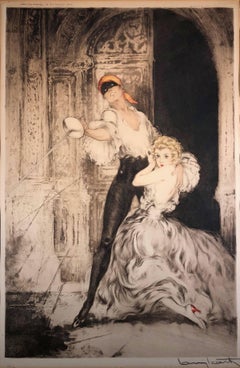
Don Juan
By Louis Icart
Located in Missouri, MO
Aquating Engraving
Image Size: approx. 20 1/4 x 13 3/8
Framed Size: 28 x 20.5 inches
Pencil Signed Lower Right
Louis Justin Laurent Icart was born in Toulouse in 1890 and died in Paris in 1950. He lived in New York City in the 1920s, where he became known for his Art-Deco color etchings of glamourous women.
He was first son of Jean and Elisabeth Icart and was officially named Louis Justin Laurent Icart. The use of his initials L.I. would be sufficient in this household. Therefore, from the moment of his birth he was dubbed 'Helli'. The Icart family lived modestly in a small brick home on rue Traversière-de-la-balance, in the culturally rich Southern French city of Toulouse, which was the home of many prominent writers and artists, the most famous being Henri de Toulouse-Lautrec.
Icart entered the l'Ecole Superieure de Commerce de Toulouse in order to continue his studies for a career in business, particularly banking (his father's profession). However, he soon discovered the play writings of Victor Hugo (1802-1885), which were to change the course of his life. Icart borrowed whatever books he could find by Hugo at the Toulouse library, devouring the tales, rich in both romantic imagery and the dilemmas of the human condition. It was through Icart's love of the theater that he developed a taste for all the arts, though the urge to paint was not as yet as strong for him as the urge to act.
It was not until his move to Paris in 1907 that Icart would concentrate on painting, drawing and the production of countless beautiful etchings, which have served (more than the other mediums) to indelibly preserve his name in twentieth century art history.
Art Deco, a term coined at the 1925 Paris Exposition des Arts Decoratifs, had taken its grip on the Paris of the 1920s. By the late 1920s Icart, working for both publications and major fashion and design studios, had become very successful, both artistically and financially. His etchings reached their height of brilliance in this era of Art Deco, and Icart had become the symbol of the epoch. Yet, although Icart has created for us a picture of Paris and New York life in the 1920s and 1930s, he worked in his own style, derived principally from the study of eighteenth-century French masters such as Jean Antoine Watteau, François Boucher and Jean Honoré Fragonard.
In Icart's drawings, one sees the Impressionists Degas...
Category
1920s Art Deco Figurative Prints
Materials
Engraving, Aquatint
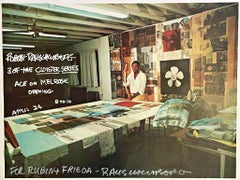
Three of the Cloister Series Hand signed and inscribed to the artist
s famed CPA
By Robert Rauschenberg
Located in New York, NY
Robert Rauschenberg
Three of the Cloister Series (Hand signed and inscribed to CPA Ruben Gorewitz, Andy Warhol's business partner), 1981
Offset lithograph poster (Signed by Robert Ra...
Category
1980s Pop Art Interior Prints
Materials
Lithograph, Offset
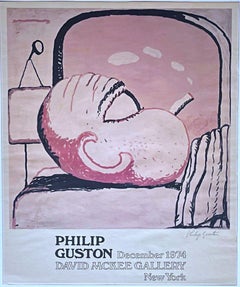
Rare 1970s offset lithograph exhibition poster (pencil signed by Philip Guston)
By Philip Guston
Located in New York, NY
Philip Guston at David McKee Gallery (pencil signed by Philip Guston), 1974
Lithograph and offset lithograph poster
Signed in graphite pencil under the image
24 1/2 × 20 inches
Unframed, unnumbered
Rare vintage lithographic poster of 1974 Guston exhibition at David McKee Gallery
Signed under the image in graphite pencil by Philip Guston
Another hand signed edition is in the permanent collection of Vassar College; otherwise we haven't seen another besides the present work; a true collectors item when hand signed by the artist.
Philip Guston Biography
Philip Guston (1913 – 1980) is one of the great luminaries of twentieth-century art. His commitment to producing work from genuine emotion and lived experience ensures its enduring impact. Guston’s legendary career spanned a half century, from 1930 to 1980. His paintings—particularly the liberated and instinctual forms of his late work—continue to exert a powerful influence on younger generations of contemporary painters. Born in Montreal, Canada, in 1913 to poor Russian Jewish émigrés, Guston moved with his family to California in 1919. Briefly attending the Otis Art Institute in Los Angeles in 1930, he was otherwise completely self-taught.
Guston’s first precocious work, Mother and Child, was completed when he was only seventeen years of age. Influenced by the social and political landscape of the 1930s, his earliest works evoked the stylized forms of Giorgio de Chirico and Pablo Picasso, social realist motifs of the Mexican muralists, and classical properties of Italian Renaissance frescoes of Piero della Francesca and Masaccio that he had seen only in reproduction. Painted in Mexico with another young artist, the huge fresco The Struggle Against War and Fascism drew national attention in the US. Guston’s success continued in the WPA, a Depression-era government program that commissioned American artists to create murals in public buildings. While not widely known today, the young artist’s early experiences as a mural painter allowed a development of narrative and scale that he would draw upon in his late figurative work. In the early 1940s, as the WPA program was ending, Guston found work teaching at universities in the Midwestern United States. In his studio, he was working in oils on easel paintings that were more personal and smaller in scale, focusing on portraits and allegories, like Martial Memory and If This Be Not I. His first solo exhibition in Iowa was well received and, within a few years, he was offered his first solo show in New York City. Guston was awarded a Prix de Rome, allowing him to leave teaching and spend a year in Italy, studying firsthand the Italian masters he loved.
By the time he had finished The Tormentors, Guston’s move to abstraction was all but complete. On his return from Italy, he continued dividing his time between the artists’ colony of Woodstock in Upstate New York and New York City, which was then emerging as the center of the postwar art world. He rented a studio on 10th Street, where abstract expressionists Jackson Pollock, Willem de Kooning and Mark Rothko also worked. For Guston, success was never what mattered most. He was already impatient with the language of pure abstraction and experimenting with larger forms, using a limited palette of grays, pinks and blacks. As his forms became still more reduced, he stopped painting altogether and embarked on a series of simplified abstract “pure drawings” in brush or charcoal. At this juncture, Guston removed himself from the art scene in New York, living and working in Woodstock for the remainder of his life.
Guston’s move was hardly a withdrawal. Freed from the distractions and formal constraints of the art world and the opinions of critics, he was able to experiment with new forms and to engage more deeply with the issues that mattered to him.
The 1960s was a period of great social upheaval in the United States, characterized by assassinations and violence, civil rights and anti-war protests. “When the 1960s came along I was feeling split, schizophrenic,” Guston later said. “The war, what was happening to America, the brutality of the world. What kind of man am I, sitting at home, reading magazines...
Category
1970s Abstract Expressionist Abstract Prints
Materials
Lithograph, Offset
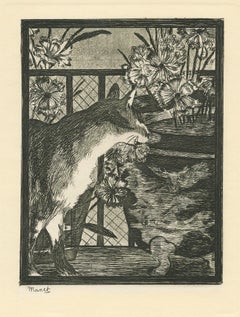
Le Chat et Les Fleurs
By Édouard Manet
Located in Middletown, NY
Etching and aquatint on cream laid, watermarked Rives paper. 6 5/8 x 5 inches (167 x 126 mm). Sixth and final state, a posthumous impression. A fine, inky impression with full margin...
Category
1860s Realist Figurative Prints
Materials
Etching, Aquatint
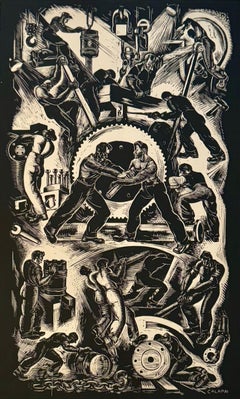
"Labor in a Diesel Plant" Machine Age American Scene Industrial Mid 20th Century
By Letterio Calapai
Located in New York, NY
"Labor in a Diesel Plant" Machine Age American Scene Industrial Mid 20th Century
Letterio Calapai (American 1902-1993)
''Labor in A Diesel Plant''
Wood engraving, 1940
17 x 10 1/2...
Category
1940s American Modern Figurative Prints
Materials
Lithograph
$6,900
H 23 in W 16 in D 2 in
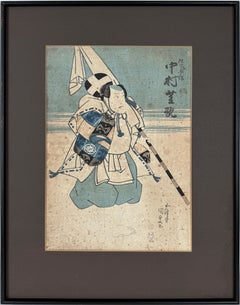
Kabuki actor Nakamura Shikan II by Utagawa Kunisada Edo Japanese Woodblock Print
By Utagawa Kunisada (Toyokuni III)
Located in Soquel, CA
Kabuki actor Nakamura Shikan II by Utagawa Kunisada Japanese Woodblock Print
Wonderful portrait of Nakamura Shikan II, a prominent kabuki actor, in the role of Kisen Hoshi Toyokuni ...
Category
1820s Realist Figurative Prints
Materials
Printer s Ink, Rice Paper, Woodcut
$550
H 21.75 in W 16.75 in D 1.25 in