Rkade Antiques Serveware, Ceramics, Silver and Glass
to
1
1
1
1
1
1
1
1
1
1
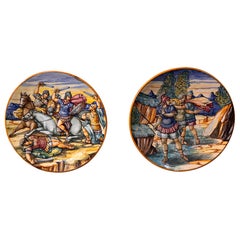
Two Italian Urbino Maiolica painted ceramic dishes
Located in London, GB
Two Italian URBINO Maiolica "Istoriatio" hand painted dishes
Marked in reverse in Italian :
Roman's helping a wounded enemy
horatti & Curiati . Roman champions in battle
Note: pl...
Category
Early 20th Century Italian Classical Roman Ceramics
Materials
Ceramic
Related Items
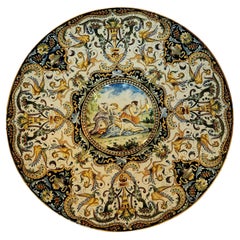
A Large Italian Maiolica Charger, 19th Century
Located in CABA, AR
Maiolica chargers are large, decorative ceramic plates that are part of the broader tradition of Maiolica pottery, a type of tin-glazed earthenware produced in Italy since the Renais...
Category
Antique 19th Century Italian Renaissance Revival Ceramics
Materials
Ceramic

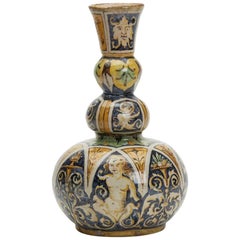
Antique Italian Maiolica Classical Painted Vase 19th Century
Located in Bishop
s Stortford, Hertfordshire
A stunning and rare antique Italian Maiolica pottery triple gourd vase hand-painted with classical stylised figurative and scroll designs in typical ...
Category
Antique 19th Century Italian Vases
Materials
Maiolica, Pottery
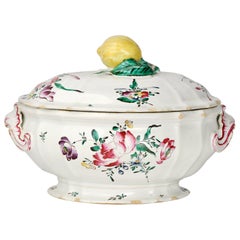
Italian Maiolica Ancient Tureen, Lodi, 1770-1780
By Antonio Ferretti
Located in Milano, IT
Maiolica tureen
Antonio Ferretti Manufacture
Lodi, circa 1770-1780
Maiolica polychrome decorated “a piccolo fuoco” (third fire).
It measures 9.05 x 12.59 x 9.05 in (23 x 32 x 23 cm)
...
Category
Antique 1770s Italian Rococo Ceramics
Materials
Maiolica
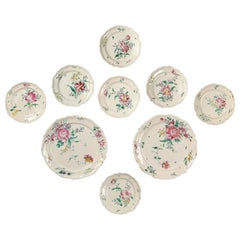
Ancient Maiolica Dishes with flowers, Lombard Manufacture, 1770-1780 Circa
Located in Milano, IT
Assortment of dishes
Lombard manufacture
1770 – 1780 Circa
Maiolica polychrome decorated “a piccolo fuoco” (third fire).
Two large dishes: diameter 14.76 in (37.5 cm); weight 4.5...
Category
Antique 1770s Italian Rococo Ceramics
Materials
Maiolica
$5,404 / set
H 1.19 in Dm 14.77 in
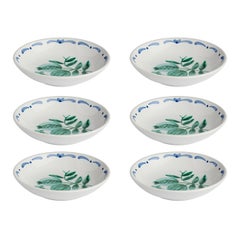
Country Style Set of Six Hand-Painted Ceramic Dishes Sofina Boutique Kitzbühel
By Sofina Boutique Kitzbühel
Located in Kitzbühel, Tirol
Country Style set of six hands-free painted ceramic cereal dishes or soup dishes. Decorated with a handpainted green pomegranate decor in the center and a hands-free painted garlande in blue. The garlande can be ordered in different colors. Produced in Austria in the typical Austrian country style. Bowls and diner plates...
Category
2010s Austrian Country Ceramics
Materials
Ceramic
$864 / set
H 1.97 in Dm 7.88 in
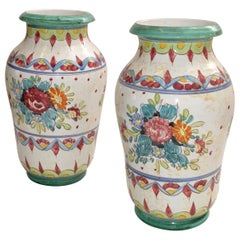
Marked Italy Pottery Hand Painted Ceramic Vases Mint Green Pottery Deruta, Two
By Deruta
Located in Miami, FL
Set of 2 Italian handcrafted and hand painted Deruta style ceramic vases in white and mint foundation and bordeaux / blue flower motif.
The outside and inside is glazed.
The opening ...
Category
Late 20th Century Italian Mid-Century Modern Ceramics
Materials
Ceramic, Pottery
$1,200 / set
H 18 in Dm 11 in
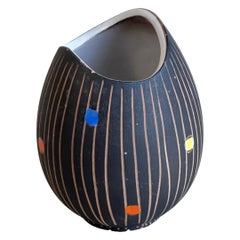
Italian Hand Painted Ceramic 1960s
Located in Byron Bay, NSW
Italian 1960s Hand Painted ceramic vase.
Signed ceramic by AT serial number 3969.
Hand spited stripes and yellowed and blue decorations.
Category
Vintage 1960s Italian Mid-Century Modern Ceramics
Materials
Ceramic
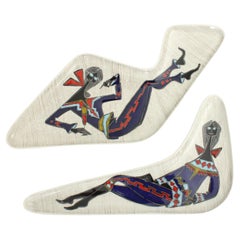
Pair of Hand Painted Freeform Dishes, Italy, 1950
s
Located in Barcelona, ES
A pair of Italian free form dishes from 1950's signed Man. Hand painted glazed ceramic. They can be used as a dish or tray or as wall decoration.
Category
Vintage 1950s Italian Mid-Century Modern Decorative Art
Materials
Ceramic
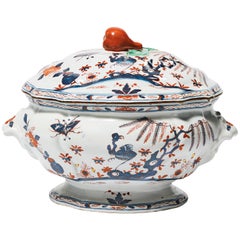
Ancient Italian Maiolica Tureen Milano, 1770 circa
By Felice Clerici, Pasquale Rubati
Located in Milano, IT
Maiolica tureen “allo struzzo” (ostrich decoration)
Milan, Felice Clerici or Pasquale Rubati factory, circa 1750-1780
Measures: 9.25 in x 12.79 in x 10.23 in (cm 23.5 x cm 32.5 x cm 26)
lb 4.78 (kg 2.17)
State of conservation, a felûre consolidated inside with slight edge chipping restored.
In Milan in the 18th century two Majolica warehouses were opened, the first, by Felice Clerici, in 1745, the second in 1756 by Pasquale Rubati.
Traditionally this type of decoration has been attributed to the Pasquale Rubati factory. In reality the motif “allo struzzo”, one of the clearest examples of how the taste for chinoiserie met with considerable success during the 18th century, had been produced, in specimens of greater or lesser quality, by both Milanese manufactories.
This Maiolica tureen has a swollen and ribbed oval bowl, rests on an extroflexed foot and shows stirrup handles.
The tri-color ornament, in the typical tones of Japanese "Imari" decorations, shows an idealized oriental landscape that develops around a perforated rock and has a willow tree with long lance-shaped leaves framing the long-legged bird figure. The ornamentation is enhanced by decorative elements such as butterflies, small florets and a vase with a thin flowery stem.
The lid is ribbed with a pear-shaped knob on top.
The decoration was called in the Milanese manufactories "allo struzzo" (ostrich decoration) and this refers to the oriental figure Xian He or the crane, symbol of longevity, here losing its symbolic value. It is hypothesized that among some 16th century engravings...
Category
Antique 1770s Italian Chinoiserie Ceramics
Materials
Maiolica
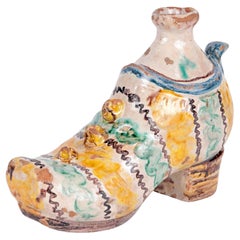
Sicilian South Italian Maiolica Pottery Shoe Shaped Flask
Located in Bishop
s Stortford, Hertfordshire
A stylish pair antique South Italian Sicilian maiolica pottery shoe shaped flask dating from the 18th century. The handmade earthenware flask is modelled as a healed shoe in a clog f...
Category
Antique 18th Century Italian Ceramics
Materials
Earthenware, Majolica
Ancient Italian Renaissance Maiolica Crespina, Faenza, 1580 Circa
Located in Milano, IT
Crespina
Faenza, last quarter of the 16th century
Maiolica painted in two colors, light blue and yellow, on a thick, rich layer of white enamel.
It measures 2.24 in (5.7 cm) in height, 6.10 in (15.5 cm) in diameter.
lb 0.55 (kg 0.25)
State of conservation: mimetic restoration.
The small cup has a raised central “umbone”, a perforated brim and a shaped rim. It rests on a high jutting foot. The "crespina" shape, in some inventories is cited as "tacce de frute" (fruit cups). It was particularly appreciated in the Renaissance and has variants based on the formal types and the different sizes. The decoration, made according to the dictates of the “compendiario” style, used few standardized colors: blue and yellow on a thick white and shiny enamel, deliberately chosen as the colour which was most reminiscent of silver. This choice derived from a trend in creative design of the era: the shapes used in the molds were often taken from metal objects. An idea which would last throughout the Renaissance.
The work shows, in the middle of the “umbone”, a winged putto stepping forward while playing a long thin trumpet.
The depiction of the putto is fully representative of the repertoire of the Faenza workshops of the sixteenth century.
Some specimens with this type of decoration have been published in a volume by Carmen Ravanelli Guidotti: there appears the whole productive repertoire of this fundamental moment of transition between the taste for the “istoriato” style and the great simplification of decoration in the “compendiario” period. This style, in its simplicity, however, saw its expression in a rather varied collection of decorative subjects, including old-fashioned busts...
Category
Antique 16th Century Italian Renaissance Ceramics
Materials
Maiolica
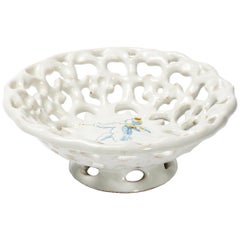
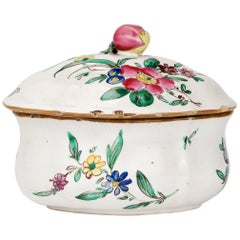
Italian Maiolica Ancient Sugar Bowl, Lodi, 1770-1780
By Antonio Ferretti
Located in Milano, IT
Maiolica sugar bowl
Antonio Ferretti Manufacture
Lodi, Circa 1770-1780
Maiolica polychrome decorated “a piccolo fuoco” (third fire).
It measures 3.54 x 4.52 x 3.54 in (9 x 11,5 x 9 cm)
Weight: 0.394 lb (0.179 kg)
State of conservation: small and slight chips on the edges.
The small sugar bowl has a swollen and ribbed body resting on a flat base. The cap-shaped lid follows the rib of the container and is topped with a small knob in the shape of a two-colored fruit.
The sugar bowl is painted “a piccolo fuoco” (third fire) with the characteristic floral motif of bunches and isolated semis.
An example which closely corresponds to this one is kept at the Civic Museum in Lodi (G. Gregorietti, Maioliche di Lodi, Milano e Pavia, Catalogo della Mostra, Milano, 1964 n. 137).
This decorative style represented a strong point of the Lodi factory, which established itself thanks to the vivid nature of the colors made possible by the introduction of a new technique perfected by Paul Hannong in Strasbourg and later introduced by Antonio Ferretti to Italy. The production process, called “piccolo fuoco” (third fire), allowed the use of a greater number of colors than in the past; in particular, the purple of Cassius, a red made from gold chloride, was introduced. Its use allowed for many more tones and shades, from pink to purple.
The Ferretti family started their maiolica manufacturing business in Lodi in 1725.
The forefather Simpliciano started the business by purchasing an ancient furnace in 1725 and, indeed, we have evidence of the full activity of the furnaces starting from April of the same year (Novasconi-Ferrari-Corvi, 1964, p. 26 n. 4). Simpliciano started a production of excellence also thanks to the ownership of clay quarries in Stradella, not far from Pavia. The production was so successful that in 1726 a decree of the Turin Chamber came to prohibit the importation of foreign ceramics, especially from Lodi, to protect internal production (G. Lise, La ceramica a Lodi, Lodi 1981, p. 59).
In its initial stages, the manufacture produced maolicas painted with the “a gran fuoco” (double fire) technique, often in turquoise monochrome, with ornamentation derived from compositional modules in vogue in Rouen in France. This was also thanks to the collaboration of painters like Giorgio Giacinto Rossetti, who placed his name on the best specimens next to the initials of the factory.
In 1748 Simpliciano made his will (Gelmini, 1995, p. 30) appointing his son Giuseppe Antonio (known as Antonio) as universal heir. After 1750, when Simpliciano passed away, Antonio was directly involved in the maiolica factory, increasing its fortunes and achieving a reputation on a European level. Particularly important was the aforementioned introduction in 1760 of the innovative “a piccolo fuoco” (third fire) processing, which, expanding the ornamental repertoire with Saxon-inspired floral themes, was able to commercially compete with the German porcelains that had one of its most renowned offerings in the naturalistic Deutsche Blumen. Antonio Ferretti understood and promoted this technique and this decoration, proposing it in a fresher and more corrective version, less linked to botanical tables, both with or without contour lines, as well as in purple or green monochrome. After efforts to introduce more industrial production techniques to the sector succeeded, even the Ferretti manufacture, in the last decade of the eighteenth century, started heading towards decline despite its attempts to adapt production to neoclassical tastes.
In 1796 the Napoleonic battle for the conquest of the Lodi bridge over the Adda definitively compromised the furnaces. Production resumed, albeit in a rather stunted manner, until Antonio's death on 29 December 1810. (M. L. Gelmini, pp. 28-30, 38, 43 sgg., 130-136 (for Simpliciano); pp. 31 sgg., 45-47, 142-192 (for Antonio).
Bibliography
G. Gregorietti, Maioliche di Lodi Milano e Pavia Catalogo della Mostra, Milano, 1964 n. 137;
C. Baroni, Storia delle ceramiche nel Lodigiano, in Archivio storico per la città e i comuni del circondario e della diocesi di Lodi, XXXIV (1915), pp. 118, 124, 142; XXXV (1916), pp. 5-8;
C. Baroni, La maiolica antica di Lodi, in Archivio storico lombardo, LVIII (1931), pp. 453-455;
L. Ciboldi, La maiolica lodigiana, in Archivio storico lodigiano, LXXX (1953), pp. 25 sgg.;
S. Levy, Maioliche settecentesche lombarde e venete, Milano 1962, pp. 17 sgg.;
A. Novasconi - S. Ferrari - S. Corvi, La ceramica lodigiana, Lodi 1964, ad Indicem; Maioliche di Lodi, Milano e Pavia (catal.), Milano 1964, p. 17;
O. Ferrari - G. Scavizzi, Maioliche italiane del Seicento e del Settecento, Milano 1965, pp. 26 sgg.;
G. C. Sciolla, Lodi. Museo civico, Bologna 1977, pp. 69-85 passim; G. Lise, La ceramica a Lodi, Lodi 1981;
M. Vitali, in Storia dell'arte ceramica...
Category
Antique 1770s Italian Rococo Ceramics
Materials
Maiolica