Robert Simon Fine Art Paintings
to
13
5
7
2
5
Overall Width
to
Overall Height
to
24
7
1
8
15
21
11
21
12
9
9
5
4
4
3
2
2
2
1
1
1
1
1
31
28
18
18
6
1
1
1
1
1
20
32
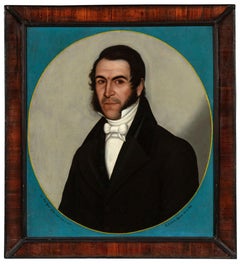
Portrait of Dr. Juan Ignacio Galves
Located in New York, NY
Signed and dated, along the bottom of the oval:
Dõr. Juan Ygnacio Galves nació el año de 1797. / Por J. Celestino Figueroa año de 1841.
Provenance: Luis Alberto Acuña (1904–1994), ...
Category
1840s Portrait Paintings
Materials
Canvas, Oil
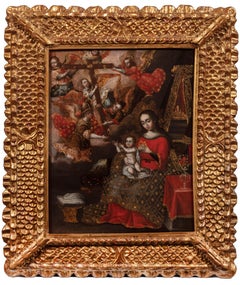
Virgin and Child with Angels Carrying the Cross (Vision of the Cross)
Located in New York, NY
Provenance: Fernandez Jimenez, Spain; part a family collection for over 80 years.
Prints transported to the New World for use in missionary work and religious instruction often serv...
Category
18th Century Old Masters Figurative Paintings
Materials
Canvas, Oil
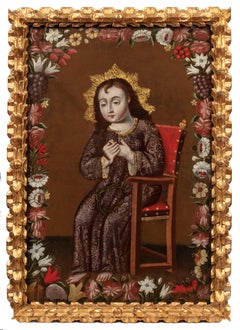
Young Christ Pricked by a Thorn (Niño de la Espina)
Located in New York, NY
Provenance: Private Collection, Paraguay, for at least the last 80 years
Painted in the Viceroyalty of Peru during the 18th century, the present work depicts the young Christ as the Niño de la Espina—a devotional representation of Christ as he looks down at his bleeding finger, which has been pricked by the crown of thorns resting on his lap. The subject of the Young Christ Pricked by a Thorn was especially popular in Cuzco, and the rich details and decorative elements of our work perfectly capture the essence and style of the Cuzco School of painting.
In our painting, Christ wears an intricately patterned floor-length robe trimmed with gilded cuffs and a gilded collar. The delicate gilding, including the halo of golden rays emanating from his head, are executed in brocateado, an ornamental over-gilding technique that is characteristic of the Cuzco School. The red chair on which Christ sits also includes brocateado in the decorative gilt elements. The form of the chair takes inspiration from those commonly used by friars both in Spain and the Andes, known as silla frailera or sillon frailero, and was also frequently employed in related depictions of the Virgin Mary Spinning. Here the young Christ is rendered with soft, elongated features that reflect the influence of the Italian Mannerist painters who were pivotal to the formation of the Cuzco School, including the Jesuit friar Bernardo Bitti and Matteo Pérez del Alesio. Additionally, while its origins can be traced to Northern European pictorial traditions, the lush flower garland that frames the work is a signature feature of Cuzqueño painting...
Category
18th Century Old Masters Figurative Paintings
Materials
Canvas, Oil
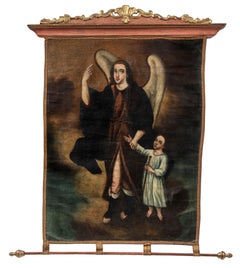
A Guardian Angel Leading a Child
Located in New York, NY
Provenance: Private Collection, Argentina; there acquired by
Mr. and Mrs. Ernest T. Harper, New York, by 1960; by descent to:
Mr. and Mrs. Alan Harper, New York, until 2024.
This s...
Category
18th Century Old Masters Figurative Paintings
Materials
Canvas, Oil
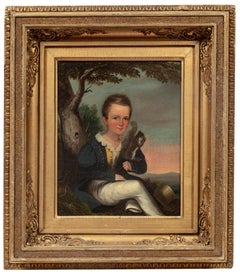
Portrait of a Boy with a Squirrel
Located in New York, NY
Provenance: Lewis J. Ruskin, Arizona, 1958–1981; thence by descent to the present owner.
This charming portrait of a young boy with his pet squirrel is a newly-discovered work by G...
Category
Mid-19th Century Portrait Paintings
Materials
Canvas, Oil
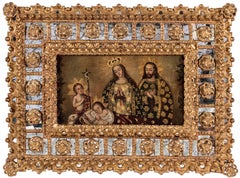
A Magnificent Gilt Wood Mirrored Frame
Located in New York, NY
Provenance: Private Collection, Argentina; there acquired by
Mr. and Mrs. Ernest T. Harper, New York, by 1960; by descent to:
Mr. and Mrs. Alan Harper, New York, until 2024.
This extraordinary mirrored frame is an exuberant and nearly perfectly preserved example of Andean 18th-century decorative art. Pierced mirrored rosettes surrounding floral motifs are set against mirrored surrounds along a broad frieze bordered within and without by elaborate raised moldings, inlaid by small, shaped mirrors. Repeating ornamental motifs reflecting both Spanish and indigenous designs surround both the inside panel and the exterior perimeter, the four corners of which are punctuated by mirrored rosettes.
Glass mirrors were unknown to the indigenous population of the Americas prior to the arrival of Europeans (obsidian mirrors...
Category
18th Century Old Masters Figurative Paintings
Materials
Canvas, Mirror, Wood, Oil
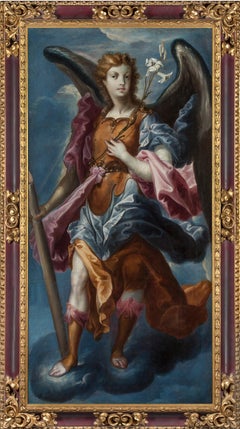
The Archangel Gabriel
By Cristobal de Villalpando
Located in New York, NY
Provenance: Private Collection, Cranston, Rhode Island (by the 1950s?); by family descent until sold at:
Bill Spicer Auction, North Kingstown, Rhode Island, 26 January 2011; where a...
Category
Late 17th Century Old Masters Figurative Paintings
Materials
Canvas, Oil
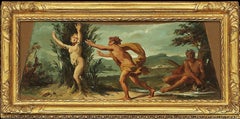
Seven Scenes from the Life of Apollo
By Jacopo Guarana
Located in New York, NY
Attributed to
Jacopo Guarana
(Verona 1720 – 1808 Venice)
Canvas, unsigned
The Deeds of Apollo
Provenance: Suida-Manning Collection
These seven scenes are brilliant evocations o...
Category
18th Century and Earlier Baroque Figurative Paintings
Materials
Oil
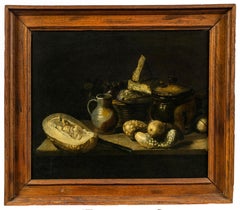
Still Life with Squash, Gourds, Stoneware, and a Basket with Fruit and Cheese
Located in New York, NY
Provenance:
Selma Herringman, New York, ca. 1955-2013; thence by descent to:
Private Collection, New York, 2013-2020
This seventeenth century Spanish still-life of a laden table, known as a bodegón, stands out for its dramatic lighting and for the detailed description of each object. The artist’s confident use of chiaroscuro enables the sliced-open squash in the left foreground to appear as if emerging out of the darkness and projecting towards the viewer. The light source emanates from the upper left, illuminating the array, and its strength is made apparent by the reflections on the pitcher, pot, and the fruit in the basket. Visible brush strokes accentuate the vegetables’ rough surfaces and delicate interiors. Although the painter of this striking work remains unknown, it is a characteristic example of the pioneering Spanish still-lifes of the baroque period, which brought inanimate objects alive on canvas.
In our painting, the knife and the large yellow squash boldly protrude off the table. Balancing objects on the edge of a table was a clever way for still-life painters to emphasize the three-dimensionality of the objects depicted, as well a way to lend a sense of drama to an otherwise static image. The knife here teeters on the edge, appearing as if it might fall off the table and out of the painting at any moment. The shape and consistency of the squash at left is brilliantly conveyed through the light brush strokes that define the vegetable’s fleshy and feathery interior. The smaller gourds—gathered together in a pile—are shrouded partly in darkness and stand out for their rugged, bumpy exterior. The stoneware has a brassy glaze, and the earthy tones of the vessels are carefully modulated by their interaction with the light and shadow that falls across them. The artist has cleverly arranged the still-life in a V-shaped composition, with a triangular slice of cheese standing upright, serving as its pinnacle.
Independent still-lifes only became an important pictorial genre in the first years of the seventeenth century. In Italy, and particularly through the revolutionary works of Caravaggio, painted objects became carriers of meaning, and their depiction and arrangement the province of serious artistic scrutiny. Caravaggio famously asserted that it was equally difficult to paint a still-life as it was to paint figures, and the elevation of this new art form would have profound consequences to the present day. In Spain Juan Sanchez Cotan...
Category
17th Century Old Masters Still-life Paintings
Materials
Canvas, Oil
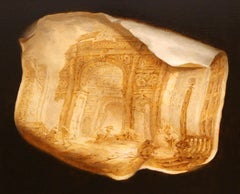
Manhattan Arch – Curled Paper
Located in New York, NY
Anthony Baus is an alumnus and instructor of the Grand Central Atelier in Long Island City, New York. His unique artistic vision, which mines the world of the Old Masters and antiqui...
Category
21st Century and Contemporary American Realist Figurative Paintings
Materials
Oil, Acrylic
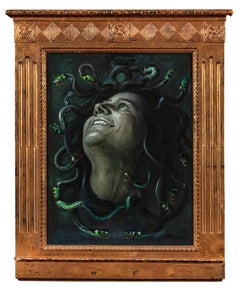
Head of Medusa
Located in New York, NY
Provenance:
David Davis, Los Angeles, California.
Toni Lynn Russo, Los Angeles, California; her estate until 2024.
Exhibited:
Münchener Glaspalast Jahres Ausstellung, 1902, no. 1071...
Category
19th Century Symbolist Figurative Paintings
Materials
Oil, Canvas
Head of the Virgin
Located in New York, NY
Provenance: Private Collection, Paraguay.
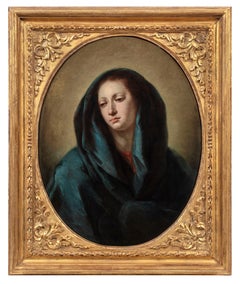
This unpublished Head of the Virgin is a new addition to the rich corpus of paintings by Giovanni Battista Tiepolo. While the artist freque...
Category
18th Century Old Masters Figurative Paintings
Materials
Oil, Canvas
Rebecca at the Well
Located in New York, NY
Provenance:
Dr. James Henry Lancashire, Manchester-by-the-Sea, Massachusetts, by 1925; probably by descent to:
Private Collection, Cumberland Foreside, Maine, until 2018
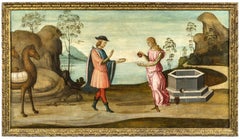
This unpublished panel is a characteristic work of the Master of the Apollo and Daphne Legend, an anonymous Florentine painter in the circle of Bartolommeo di Giovanni, Domenico Ghirlandaio, and Sandro Botticelli. The artistic personality of the Master of the Apollo and Daphne Legend was independently recognized by Everett Fahy and Federico Zeri at roughly the same moment in time. Fahy originally dubbed this artist the Master of the Ryerson Panels but later adopted Zeri’s name for the artist, which derives from his eponymous works from the Samuel H. Kress collection (Figs. 1-2). Fahy posited that the artist was most likely a pupil of Ghirlandaio active from roughly 1480 to 1510, and that he may be identifiable with one of Ghirlandaio’s documented pupils to whom no works have been securely attributed, such as Niccolò Cieco, Jacopo dell’Indaco, or Baldino Baldinetti. The present painting was first attributed to this master by Everett Fahy in 1989, who became aware of its existence only after publishing his definitive studies on the artist.
The surviving body of work by the Master of the Apollo and Daphne Legend is largely composed of series of panels treating the same theme. In addition to the works illustrating the legend of Apollo and Daphne, there are also series on the themes of Susanna and the Elders and the story of Saint Joseph, among others. The subject of the present panel is drawn from Genesis 24, the story of Isaac. It is possible that our painting relates to another work by the artist depicting the Sacrifice of Isaac formerly in the collection of E. A. McGuire in Dublin, Ireland (Fig. 3), and that these two panels were originally part of a decorative scheme based on the story of Isaac.
Although the Master’s paintings of this type have traditionally been considered painted fronts of wedding chests, known as cassoni, the scale of these paintings and the fact that they are often part of a series indicates that they are more likely spalliera panels—paintings set into furniture or the wainscoting of a room. The biblical episode depicted in this painting centers on the theme of marriage, which suggests that this work was likely commissioned for the domestic interior of a newly married couple. The Master has transcribed into paint even the minute details of this Old Testament story, in which Abraham sends a servant to travel by camel to the land of his father and seek out a wife for his son Isaac. The servant is here shown at the well...
Category
15th Century and Earlier Old Masters Figurative Paintings
Materials
Oil, Tempera, Wood Panel
Saint Martin de Porres
Located in New York, NY
Provenance: Private Collection, New York, until 2022.
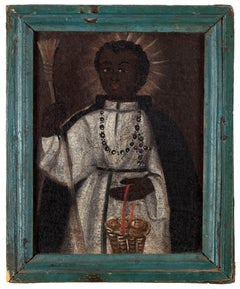
Martín de Porres was born in Lima in 1579, the illegitimate son of a Spanish-American father, J...
Category
Late 18th Century Paintings
Materials
Canvas, Oil
Portrait of a Man
Located in New York, NY
Provenance:
with Leo Blumenreich and Julius Böhler, Munich, 1924
Dr. Frederic Goldstein Oppenheimer (1881-1963), San Antonio, Texas; by whom given to:
Abraham M. Adler, New York, until 1985; thence by descent to the present owners
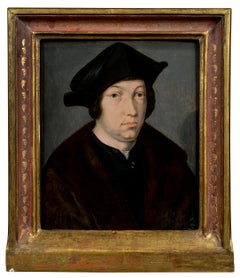
While old inscriptions on the verso of this panel propose its author to be Hans Holbein and the sitter Sir John More—a lawyer, judge, and the father of Sir Thomas More—this fine portrait has long been recognized to be by a Flemish hand. Max Friedländer gave the painting to Bernard van Orley (1487/1491 – 1541) in 1924, but did not include it in the volume dedicated to the artist in his Early Netherlandish Paintings...
Category
16th Century Old Masters Portrait Paintings
Materials
Oil, Panel

$52,500
The Resurrection of Christ
Located in New York, NY
Provenance:
with “Mr. Scheer,” Vienna, by July 1918; where acquired by:
Jindřich Waldes, Prague, 1918–1941; thence by descent to:
Private Collection, New York
Literature:
Rudolf Kuchynka, “České obrazy tabulové ve Waldesově obrazárně,” Památky archeologické, vol. 31 (1919), pp. 62-64, fig. 5.
Jaroslav Pešina, “K datování deskových obrazů ve Waldesově obrazárně,” Ročenka Kruhu pro Pěstování Dějin Umění: za rok (1934), pp. 131-137.
Jaroslav Pešina, Pozdně gotické deskové malířství v Čechách, Prague, 1940, pp. 150-151, 220.
Patrik Šimon, Jindřich Waldes: sběratel umění, Prague, 2001, pp. 166, 168, footnote 190.
Ivo Hlobil, “Tři gotické obrazy ze sbírky Jindřicha Waldese,” Umění, vol. 52, no. 4 (2004), p. 369.
Executed sometime in the 1380s or 1390s by a close associate of the Master of the
Třeboň Altarpiece, this impressive panel is a rare work created at the royal court in Prague and a significant re-discovery for the corpus of early Bohemian painting. It has emerged from an American collection, descendants of the celebrated Czech industrialist and collector Jindřich Waldes, who died in Havana fleeing Nazi-occupied Europe.
The distinctive visual tradition of the Bohemian school first began to take shape in the middle of the fourteenth century after Charles IV—King of Bohemia and later Holy Roman Emperor—established Prague as a major artistic center. The influx of foreign artists and the importation of significant works of art from across Europe had a profound influence on the development of a local pictorial style. Early Italian paintings, especially those by Sienese painters and Tommaso da Modena (who worked at Charles IV’s court), had a considerable impact on the first generation of Bohemian painters. Although this influence is still felt in the brilliant gold ground and the delicate tooling of the present work, the author of this painting appears to be responding more to the paintings of his predecessors in Prague than to foreign influences.
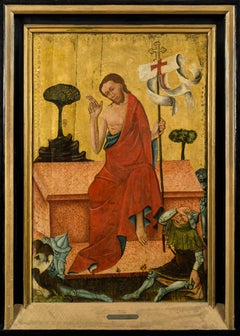
This Resurrection of Christ employs a compositional format that was popular throughout the late medieval period but was particularly pervasive in Bohemian painting. Christ is shown sitting atop a pink marble sarcophagus, stepping down onto the ground with one bare foot. He blesses the viewer with his right hand, while in his left he holds a triumphal cross with a fluttering banner, symbolizing his victory over death. Several Roman soldiers doze at the base of the tomb, except for one grotesque figure, who, beginning to wake, shields his eyes from the light and looks on with a face of bewilderment as Christ emerges from his tomb. Christ is wrapped in a striking red robe with a blue interior lining, the colors of which vary subtly in the changing light. He stands out prominently against the gold backdrop, which is interrupted only by the abstractly rendered landscape and trees on either side of him.
The soldiers’ armor is rendered in exacting detail, the cool gray of the metal contrasting with the earth tones of the outer garments. The sleeping soldier set within a jumble of armor with neither face nor hands exposed, is covered with what appears to be a shield emblazoned with two flies on a white field, somewhat resembling a cartouche (Fig. 1). This may be a heraldic device of the altarpiece’s patron or it may signify evil, referencing either the Roman soldiers or death, over both of which Christ triumphs.
This painting formed part of the collection assembled by the Czech industrialist and founder of the Waldes Koh-i-noor Company, Jindřich Waldes, in the early twentieth century. As a collector he is best remembered for establishing the Waldes Museum in Prague to house his collection of buttons (totaling nearly 70,000 items), as well as for being the primary patron of the modernist painter František Kupka. Waldes was also an avid collector of older art, and he approached his collecting activity with the goal of creating an encyclopedic collection of Czech art from the medieval period through to the then-present day. At the conclusion of two decades of collecting, his inventory counted 2331 paintings and drawings, 4764 prints, and 162 sculptures. This collection, which constituted the Waldesova Obrazárna (Waldes Picture Gallery), was first displayed in Waldes’ home in Prague at 44 Americká Street and later at his newly built Villa Marie at 12 Koperníkova Street. This Resurrection of Christ retains its frame from the Waldes Picture Gallery, including its original plaque “173 / Česky malíř z konce 14 stol.” (“Czech painter from the end of the 14th century”) and Waldes’ collection label on the reverse.
The Resurrection of Christ was one of the most significant late medieval panel...
Category
15th Century and Earlier Old Masters Paintings
Materials
Tempera, Panel
Madonna and Child with Angels in the Clouds
Located in New York, NY
Provenance: Charles H. and Virginia Baldwin, Claremont, Colorado Springs, Colorado ca. 1907-1934; thence by descent until sold in 1949 to:
Charles Blevins Davis, Claremont (renamed Trianon), Colorado Springs 1949 -until gifted in 1952 to:
The Poor Sisters of Saint Francis, Trianon, Colorado Springs, 1952 until acquired, 1960, by:
John W. Metzger, Trianon, renamed as the Trianon School of Fine Arts, Colorado Springs, 1960-1967; when transferred to:
The Metzger Family Foundation, Trianon Art Museum, Denver, 1967 - 2004; thence by descent in the Metzger Family until 2015
Exhibited: Trianon Art Museum, Denver (until 2004)
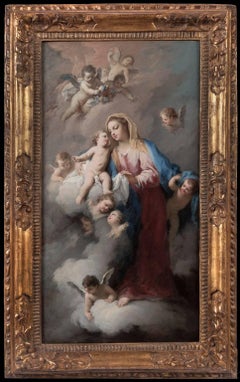
The present work is a spectacular jewel-like canvas by Amigoni, rich in delicate pastel colors, most likely a modello for an altarpiece either lost or never painted. In it the Madonna stands firmly upon a cloud in the heavens, her Child resting on a delicate veil further supported by a cloud, as he gently wraps his arm around his mother’s neck. From above angels prepare to lower flowers and a wreath, while other angels and seraphim surrounding the two joyfully cavort.
Dr. Annalisa Scarpa, author of the forthcoming monograph on Jacopo Amigoni...
Category
18th Century and Earlier Figurative Paintings
Materials
Canvas, Oil
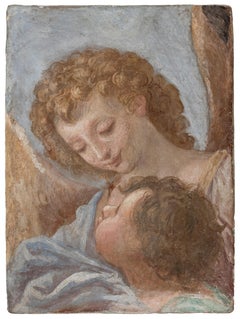
A Guardian Angel and a Child
Located in New York, NY
Provenance:
Cornelius Vanderbilt, New York; by whom gifted in 1880 to:
The Metropolitan Museum of Art, New York (80.3.673); deaccessioned and sold:
Christie’s, New York, 12 June 19...
Category
17th Century Old Masters Portrait Paintings
Materials
Terracotta, Gesso
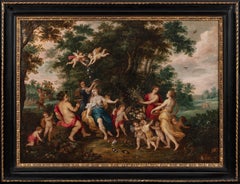
Allegory of Abundance
Located in New York, NY
Painted in collaboration with Hendrick van Balen (Antwerp, 1575 – 1632).
Provenance: Private Collection, Uruguay, since the 1930s.
The eldest son of Jan Br...
Category
17th Century Old Masters Paintings
Materials
Copper
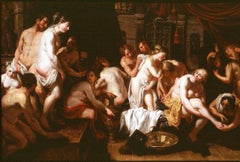
Esther in the Women
s House of Ahasuerus
By Artus Wolfort
Located in New York, NY
Born in Antwerp, Artus Wolffordt received his training in Dordrecht where he became a master in 1603 at the age of twenty-two. He returned to his native city in 1615 and initially worked as an assistant to Otto van Veen...
Category
17th Century Old Masters Paintings
Materials
Oil, Panel
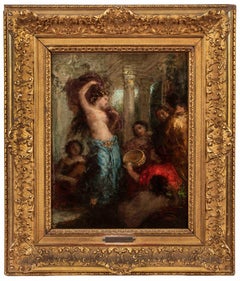
Orientale
By Henri Fantin-Latour
Located in New York, NY
Signed, lower right: Fantin
Provenance:
Gustave Tempelaere (1840–1904), Paris; possibly by descent to his son:
Julien Tempelaere (1876–1961) and with F. & J. Tempelaere, Paris, prob...
Category
1890s Romantic Figurative Paintings
Materials
Canvas, Paper, Oil
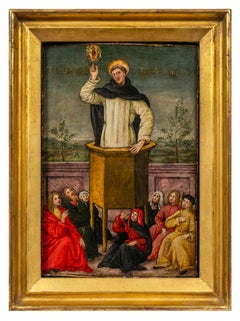
St. Vincent Ferrer Preaching to the People of Salamanca
Located in New York, NY
Provenance:
Private Collection, New Jersey
The present painting depicts Saint Vincent Ferrer preaching from a raised pulpit to a group of seven peopl...
Category
15th Century and Earlier Renaissance Figurative Paintings
Materials
Oil, Wood Panel
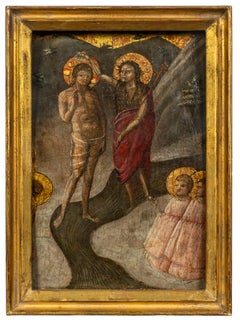
Baptism of Christ
Located in New York, NY
Provenance:
Achillito Chiesa, Milan
Luigi Albrighi, Florence, by 1 July 1955
with Marcello and Carlo Sestieri, Rome, 1969
Private Collection, Connecticut
Exhibited:
Mount Holyoke College Art Museum, South Hadley, Massachusetts (on loan, 2012)
Literature:
Carlo Volpe, “Alcune restituzioni al Maestro dei Santi Quirico e Giulitta,” in Quaderni di Emblema 2: Miscellanea di Bonsanti, Fahy, Francisci, Gardner, Mortari, Sestieri, Volpe, Zeri, Bergamo, 1973, pp. 19-20, fig. 18, as by the Master of Saints Quiricus and Julitta (now identified as Borghese di Piero).
This fine predella panel depicting the Baptism...
Category
15th Century and Earlier Old Masters Figurative Paintings
Materials
Tempera, Wood Panel
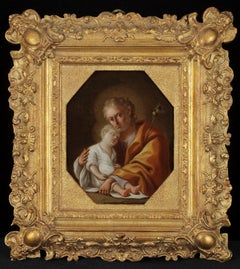
Joseph Holding the Christ Child
By Pietro Bardellino
Located in New York, NY
Provenance: Private Collection, Argentina.
A work of great delicacy and intimacy, this small painting on copper by Pietro Bardellino treats a subject which grew in popularity during the Baroque period: Saint Joseph and the Christ child...
Category
18th Century Baroque Paintings
Materials
Copper
Two Scenes of Diana and Actaeon (a pair)
By Giovanni Battista Viola
Located in New York, NY
Provenance:
Robert L. and Bertina Suida Manning, New York, until 1996
Private Collection, USA
Giovanni Battista Viola was born in Bologna a...
Category
17th Century Baroque Landscape Paintings
Materials
Copper
Head of a Classical Poet (Socrates?)
By Pier Francesco Mola
Located in New York, NY
Provenance:
Possibly Antonio Amici Moretti, Rome, 1690
Roy Clyde Gardner, Union, Mississippi, 1970s until 2004; by whom given to:
Mississippi Band of Choctaw Indians, 2004-2010
Lit...
Category
17th Century Baroque Paintings
Materials
Canvas, Oil

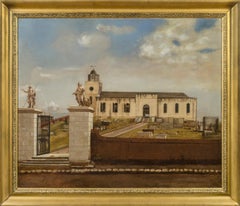
View of St. John’s Cathedral, Antigua
Located in New York, NY
Provenance:
Robert Hollberton, Antigua, ca. 1841
Private Collection, New York
The present painting depicts Old St. John’s Cathedral on the island of Antigua. The church was erected in the 1720s on the designs of the architect Robert Cullen. It measured 130 feet by 50 feet with north and south porches 23 x 20 ½ feet. The tower, 50 feet high with its cupola, was added in 1789. The church was elevated to the status of a cathedral, but disaster struck in the form of an earthquake that destroyed the building on 8 February 1843. A memorandum of that date relates the event:
“On Wednesday, 8th February, 1843, this island was visited by a most terrific and destructive earthquake. At twenty minutes before eleven o’clock in the forenoon, while the bell was ringing for prayers, and the venerable Robert Holberton was in the vestry-room, awaiting the arrival of persons to have their marriage solemnized, before the commencement of the morning service, the whole edifice, from one end to the other, was suddenly and violently agitated. Every one within the church, after the first shock, was compelled to escape for his life. The tower was rent from the top to the bottom; the north dial of the clock precipitated to the ground with a dreadful crash; the east parapet wall of the tower thrown upon the roof of the church; almost the whole of the north-west wall by the north gallery fell out in a mass; the north-east wall was protruded beyond the perpendicular; the altar-piece, the public monument erected to the memory of lord Lavington, and the private monuments, hearing the names of Kelsick, Warner, Otley, and Atkinson, fell down piecemeal inside; a large portion of the top of the east wall fell, and the whole of the south-east wall was precipitated into the churchyard, carrying along with it two of the cast-iron windows, while the other six remained projecting from the walls in which they had been originally inserted; a large pile of heavy cut stones and masses of brick fell down at the south and at the north doors; seven of the large frontpipes of the organ were thrown out by the violence of the shock, and many of the metal and wooden pipes within displaced; the massive basin of the font was tossed from the pedestal on which it rested, and pitched upon the pavement beneath uninjured. Thus, within the space of three minutes, this church was reduced to a pile of crumbling ruins; the walls that were left standing being rent in every part, the main roof only remaining sound, being supported by the hard wood pillars.”
The entrance from the southern side into the cathedral, which was erected in 1789, included two imposing statues, one of Saint John the Divine and the other of Saint John the Baptist in flowing robes. It is said that these statues were confiscated by the British Navy from the French ship HMS Temple in Martinique waters in 1756 during the Seven Years’ War and moved to the church. The statues are still in situ and can be seen today, much as they appeared in Bisbee’s painting, but with the new cathedral in the background (Fig. 1).
Little is known of the career of Ezra Bisbee. He was born in Sag Harbor, New York in 1808 and appears to have had a career as a political cartoonist and a printmaker. His handsome Portrait of President Andrew Jackson is dated 1833, and several political lithographs...
Category
19th Century Old Masters Landscape Paintings
Materials
Canvas, Oil
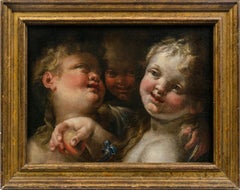
Three Angels
By Domenico Piola the Elder
Located in New York, NY
Provenance:
Robert L. and Bertina Suida Manning, New York, until 1996
Private Collection, USA
One of the leading artists in Genoa during the second half of the seventeenth century, Domenico Piola came from a successful family of artists, renowned for their many illusionistic ceiling programs throughout Genoese churches and palaces. A prolific draughtsman and painter, Domenico oversaw an extremely productive studio. In addition to his collaborations with numerous other artists, Domenico also provided many designs for book illustrations and prints that circulated throughout Europe, earning him international exposure and high acclaim in his own day.
As Dr. Anna Orlando has indicated (written communication), the present work is an early work by Piola, datable from the late 1640s. At this time the young artist came strongly under the influence of Castiglione and Valerio Castello, while admiring the works of Giulio Cesare Procaccini. Piola’s works from this period are exuberant and fluid, and the artist’s love of portraying children is evident from the angels and putti that populate both his altarpieces and more intimate paintings.
The present work depicts three angels...
Category
17th Century Baroque Figurative Paintings
Materials
Canvas, Oil
Ezekiel in the Valley of Dry Bones
By Philip Burne-Jones
Located in New York, NY
Provenance:
Christie’s, London, 3 March 1922, lot 46 (with The Tower of Babel);
James Nicoll
Private Collection
Sotheby’s, London, 29 March 1983, lot 157
Private Collection, New Yo...
Category
Late 19th Century Victorian Figurative Paintings
Materials
Canvas, Oil
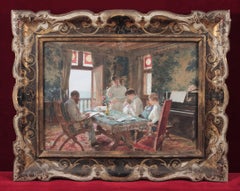
Leisure Moments (Interior Scene)
By Julius Schmid
Located in New York, NY
Charming watercolor of an intimate family scene in beautiful painted period frame. Signed in the lower right-hand corner.
Category
Early 19th Century Paintings
Materials
Watercolor
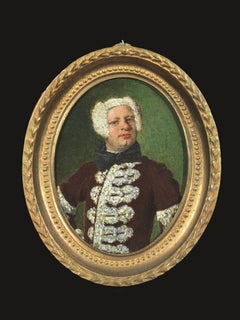
Portrait of a Bewigged Gentleman
By Vittore Ghislandi
Located in New York, NY
Vittore Ghislandi, called Fra Galgario
Provenance:
Robert L. and Bertina Suida Manning, New York, ca. 1966-1996
Private Collection, USA
Exhibited:
“Eighteenth Century European Pai...
Category
18th Century Baroque Paintings
Materials
Copper
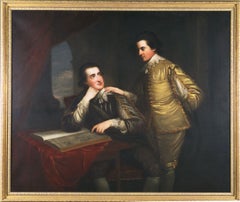
Portrait of George and Edward Finch-Hatton in Van Dyck Dress
By David Martin
Located in New York, NY
Appointed Portrait Painter to the Prince of Wales in Scotland in 1785, David Martin was the leading Scottish portrait painter of his generation. The artist is best known in the United States for his portrait of Benjamin Franklin, which is in the White House collection, Washington, D.C. The sitters depicted in this double portrait were the sons of the British diplomat Edward Finch-Hatton. George (1747-1823), later of Eastwell Park, Kent, is shown seated, reading an ancient charter or medieval manuscript...
Category
18th Century and Earlier Paintings
Materials
Canvas, Oil