Robert Simon Fine Art Sculptures
to
6
2
1
1
Overall Width
to
Overall Height
to
6
3
1
1
3
2
5
2
2
2
2
2
1
1
1
1
1
1
1
1
1
1
1
1
1
1
4
3
2
2
2
2
1
10
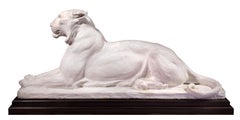
The Princeton Tiger
Located in New York, NY
Provenance: The artist; thence by descent to his granddaughter:
Rhoda Knight Kalt; from whom acquired by:
Private Collection, Pennsylvania, 1995–2025.
Literature: Richard Milner, Ch...
Category
1940s Figurative Sculptures
Materials
Plaster
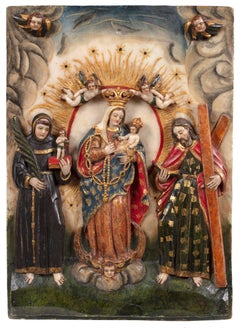
Virgin of the Rosary of Chiquinquirá with Saint Anthony of Padua and Saint Andre
Located in New York, NY
Provenance: Private Collection, Uruguay, for the last 90 years.
Dated 1673 on the reverse (Fig. 1), this exceptional relief is an early example of a distinctly Spanish American art...
Category
1670s Old Masters Figurative Sculptures
Materials
Alabaster
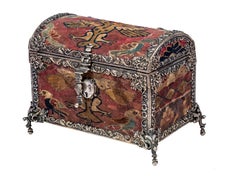
Silver and Transitional Andean Textile Casket
By Spanish Colonial (Peruvian)
Located in New York, NY
Silver was the material of choice for both ecclesiastical and domestic vessels in the New World, not only for its status as a precious metal, but also because of its abundance and du...
Category
Early 18th Century Sculptures
Materials
Silver
The Three Magi
Located in New York, NY
Provenance: Private Collection, Spain.
Known as Peruvian alabaster for its translucency and workability, Piedra de Huamanga is a highly prized material from the province of Ayacucho in Peru. In the 17th and 18th centuries, local craftsman in the town of Huamanga began to specialize in the production of small-scale, polychrome religious sculptures made from this distinctive stone. Huamanga sculptures are among the most accomplished examples of carving from the Spanish Americas, where polychrome wood sculpture was a far more common sculptural medium. These works, which were created as independent sculptures or as sculptural groups—such as our three Magi—were intended for ecclesiastical as well as domestics settings.
Our three figures likely formed part of a larger Nativity group—a New World variant of the tradition of the Neapolitan Crèche...
Category
Late 18th Century Figurative Sculptures
Materials
Alabaster

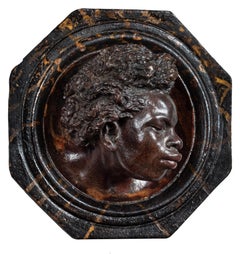
Head of a Young African Man
Located in New York, NY
Provenance: Private Collection, Spain.
This intriguing and enigmatic sculpture depicts the head of a young African man emerging from a circular opening ...
Category
Early 1800s Figurative Sculptures
Materials
Terracotta
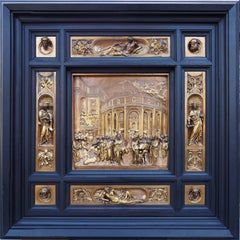
The Story of Joseph from the Second Baptistery Doors, Florence (“The Gates of Pa
By Ferdinand Barbedienne
Located in New York, NY
Ferdinand Barbedienne (Saint-Martin-de-Fresnay 1810 – 1892 Paris) after Lorenzo Ghiberti (Florence, 1378 – 1455)
Signed at the lower right of the principal relief: F. BARBEDIENNE
Provenance: Private Collection, USA.
Barbedienne’s “Gates of Paradise” reliefs are one of the triumphs of nineteenth-century bronze casting and patination. The nine panels that comprise our example are half-size reductions of the famous originals by Lorenzo Ghiberti, made for the Baptistery of Florence and now housed in the Museo del Opera del Duomo. Mounted in an impressive, mullioned frame surround, our work is an exceptional exemplar of the Renaissance Revival, the broadly influential style and movement that infused architecture, design, and artistic culture in the latter half of the nineteenth century.
The central scene, The Story of Joseph, is perhaps the most celebrated of the entire series depicting as it does seven episodes from the Biblical narrative integrated into a single composition: Joseph cast by his brethren into the well, Joseph sold to the merchants, the merchants delivering Joseph to the pharaoh, Joseph interpreting the pharaoh’s dream, the pharaoh paying him honor, Jacob sending his sons to Egypt, and Joseph recognizes his brothers and returns home. The surrounding reliefs—two vertical figures in niches, two recumbent figures, and four portrait heads in roundels—are as well faithful reductions of Ghiberti’s original bronzes on other parts of the doors.
The maker of these casts was the renowned 19th-century French fondeur Ferdinand Barbedienne. Gary Radke has recently written of this great enterprise:
“The Parisian bronze caster Ferdinand Barbedienne began making half-sized copies of ancient and Renaissance sculpture in the 1830s. His firm benefitted enormously from the collaboration of Achille Collas, whom Meredith Shedd has shown was one of numerous pioneers in the mechanical reproduction of sculpture. Their competitors largely devoted themselves to reproducing relief sculpture, but Collas devised a process for creating fully three-dimensional copies. A tracing needle, powered by a treadle, moved over the surface of a full-sized plaster cast or bronze of the original and triggered a complementary action in a cutting stylus set over a soft plaster blank…He signed an exclusive contract with Barbedienne on November 29, 1838, and won medals for his inventions in 1839 and 1844.
Barbedienne’s half-sized copies of the Gates of Paradise were famous not only for their fidelity to the original, but also for the way their gilding…suggested the glimmering surface that was hidden under centuries of dirt. Some critics even saw Collas’s and Barbedienne’s work as ‘philanthropic, an exemplary adaptation of industry to the requirements of art, the artist, the workers, and the public alike.’
At 25,000 francs, Collas’s and Barbedienne’s reduction of the Gates of Paradise was singularly more expensive than any other item for sale in their shop. All the reliefs, individual statuettes, and busts were cast separately and could be purchased either by the piece or as an ensemble. Fittingly, Barbedienne’s accomplishment earned him the Grand Prix at the 1878 Paris Exposition Universelle, along with numerous other medals.”
Three complete examples of the Barbedienne-Ghiberti doors are known. One, first installed in a chapel in the Villa Demidoff of San Donato near Pratolino, was later acquired by William Vanderbilt...
Category
Late 19th Century Figurative Sculptures
Materials
Bronze
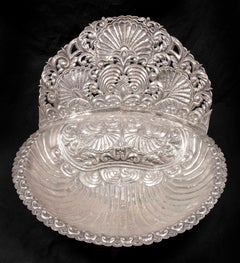
Cuzco School Baptismal Dish
By Spanish Colonial (Peruvian)
Located in New York, NY
Provenance:
Manuel Ortíz de Zevallos y García, Peru; and by descent in the family to:
Private Collection, New York.
This impressive baptismal dish is an example of eighteenth-cent...
Category
18th Century Old Masters Sculptures
Materials
Silver
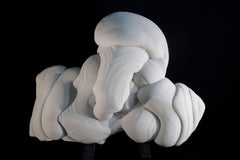
First Journey
Located in New York, NY
Provenance: Sables de Fontainbleau, Seine-et-Marne, France
“Gogottes” are natural creations formed out of sands deposited in Northern France during the Oligocene Period, approximately 30 million years ago. Much later, in a process that has only recently become understood, groundwater rich in silica flowed through the sands...
Category
15th Century and Earlier Naturalistic Abstract Sculptures
Materials
Sandstone
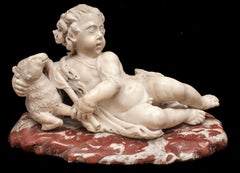
The Infant Saint John the Baptist with a Lamb
Located in New York, NY
Provenance:
James Byrnes, Los Angeles (1917-2011)
Giusto Le Court was born Josse or Justus de Corte in the Flemish city of Ypres. His father Jean was a sculptor and presumably his earliest training was with him before he entered the studio of Cornelis van Mildert. The young artist was clearly influenced by the dominant Flemish sculptor of the time, Artus Quellinus the Elder, with whom he may have worked on the decoration of the Amsterdam City Hall.
Following the lead of many northern artists he travelled to Rome, perhaps more than once, before settling in Venice around 1655. It was there, as one of a colony of expatriate artists, that he made his name as a sculptor. One of his first Venetian commissions was for the monument to Alvise Mocenigo in the Church of San Lazzaro dei Mendicanti, where Le Court sculpted the marble figures of Strength and Justice. He also collaborated with the celebrated architect Baldassare Longhena, most famously for the high altar of Santa Maria della Salute, where he carved the multi-figured altarpiece depicting the Queen of Heaven Expelling the Plague.
The present marble sculpture depicts the infant Saint John the Baptist, reclining, wearing his traditional hair-shirt, embracing a lamb, and holding the bottom of his attribute, a reed cross. Attached to his shirt is a baptismal cup, with which he would become associated later in his life. Veneration of the infant Saint John the Baptist was prevalent throughout Italy and images of the saint in childhood—often called “Giovannino,” or little John...
Category
17th Century Renaissance Sculptures
Materials
Marble
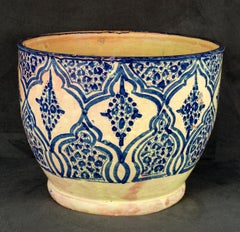
Moroccan, Fez or Meknes: Tall bowl (Jobbana) with geometric designs
Located in New York, NY
Provenance:
Collection of Emily Johnston De Forest and Robert Weeks De Forest, New York, by 1911-until 1942; thence by descent until 2018.
Literature: ...
Category
1810s Sculptures
Materials
Earthenware, Tin Glaze
Related Items
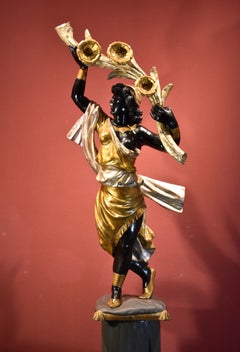
Antique Sculpture Female Moor Venice 19th Century Gold Italy
Located in Riva del Garda, IT
Antique sculpture of a female Moor with flowering cornucopia
Venice, 19th century
Carved, lacquered and gilded/silvered wood
Total height 202 cm (column base 82 cm, figure 120 cm)
...
Category
19th Century Old Masters Sculptures
Materials
Gold

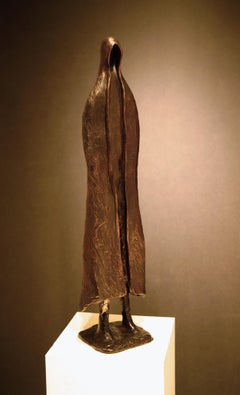
Bronze Sculpture “Understander”
By Frank Arnold
Located in Fresno, CA
Frank Arnold is thought by many to be one of the foremost abstract figurative painters and sculptors of our time. He is a living master whose work is considered to be both personal a...
Category
2010s Abstract Abstract Sculptures
Materials
Bronze
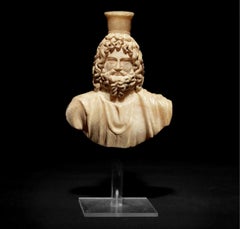
ANCIENT ROMAN ALABASTER BUST OF THE GOD SERAPIS, ROME CIRCA 1ST-2ND CENTURY A.D.
Located in Milan, IT
Wearing a chiton with a himation draped at the left shoulder, and a modius on the crown of his head, the god's characteristic luxuriant wavy hair falling in ri...
Category
15th Century and Earlier Figurative Sculptures
Materials
Alabaster
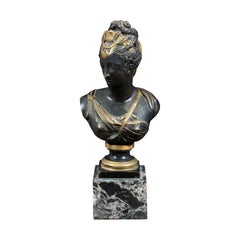
Early 19th century Empire figure bronze sculpture - woman
s bust
Located in Varmo, IT
Small bronze ornament - Bust of a woman. Italy, early 19th century.
8 x 8 x h 29 cm, without base h 23 cm.
Made entirely of patinated and gilded bronze. Depicting a female figure i...
Category
Early 19th Century Old Masters Figurative Sculptures
Materials
Marble, Bronze
$1,433 Sale Price
33% Off
H 11.42 in W 3.15 in D 3.15 in
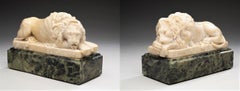
Pair of Italian "Alabaster Stone Lions" after Antonio Canova; Mid 19th Century
Located in SANTA FE, NM
"Pair Recumbent Stone Lions"
after Antonio Canova (1757-1822)
Italian (possibly Florence)
Mid 19th Century
Alabaster, marble
6 x 9 x 4 inches
This is an exquisite pair of Italian alabaster lions on marble bases based on the monumental lions carved by Antonio Canova (1757-1822), the greatest Italian neoclassical sculptor. Canova sculpted the marble lions for the monumental tomb of Pope Clement XIII in St. Peter’s, Rome in 1792
Canova Lions refers to the pair of copies of lion sculptures by Antonio Canova. When Canova created the sculptures in 1792, he installed them on the tomb of Pope Clement XIII. The marble sculptures are some of the most prominent features in St. Peter's Basilica in Rome. Given the intricacies of creating the original Canova lions, some artists created molds and replicated them. A good example is the pair of lion sculptures...
Category
1850s Italian School Figurative Sculptures
Materials
Alabaster, Marble
$6,150
H 6 in W 9 in D 4 in
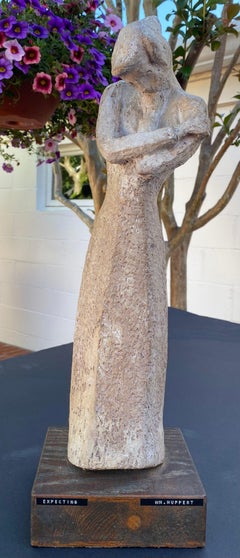
“Expecting”
Located in Southampton, NY
Original terracotta sculpture by the American sculptor William Huppert. Titled “Expecting”. Circa 1960. Post Modern. Overall height 18 inches including base. Base is 6 wide by 5.25 ...
Category
1960s Post-Modern Figurative Sculptures
Materials
Terracotta
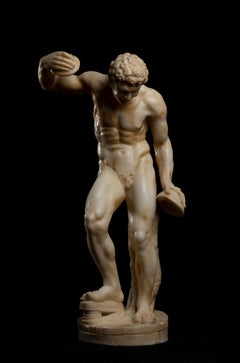
White Alabster Marble Sculpture Dancing Satyr Grand Tour Italian 19th Classical
Located in Roma, IT
The sculpture, is a Grand Tour scale, derived from the splendid marble that once belonged to the collection of the Roman prelate Eurialo Silvestri. After a brief stay at Villa Giulia...
Category
19th Century Figurative Sculptures
Materials
Alabaster
$11,349
H 24.02 in W 13.78 in D 7.88 in
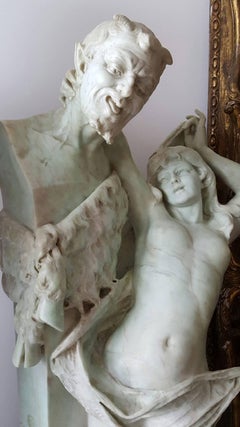
Erotic Sexual Mythological Marble Figural, Nude woman, Bacchante and Satyr Herm
Located in Miami, FL
Bacchic revelry. A sexy and nude curvaceous young Nymph/Bacchante makes amorous advances to a Herm - whose facial expression reflects her erotic touch. The Herm is stylized where his...
Category
Mid-19th Century Old Masters Nude Sculptures
Materials
Marble
$21,750 Sale Price
25% Off
H 54.5 in W 24 in D 13.5 in
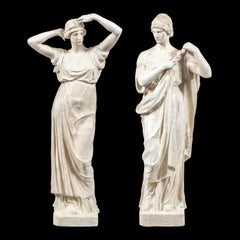
Pair of 19th century scagliola sculptures (Italian Neoclassicism) - Roman figure
Located in Varmo, IT
Pair of scagliola sculptures - Roman figures. Italian manufacture, 19th century.
51 x 26 x h 118 cm (left) - 41 x 28 x h 118 cm (right).
Made entirely of scagliola. Depicting two f...
Category
Early 19th Century Old Masters Figurative Sculptures
Materials
Plaster
$5,734 Sale Price
20% Off
H 46.46 in W 20.08 in D 10.24 in
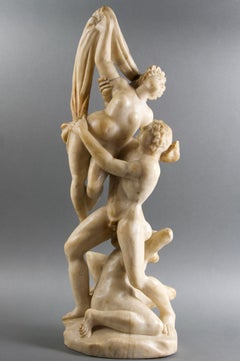
Italian Neoclassical Sculptural Group in Alabaster "The Rape of the Sabine Women" 18th
Located in Pistoia, IT
"The Rape of the Sabine Women," veined alabaster, large sculptural group with classical subject, Volterra manufacture, 18th century.
The so-called Rape of the Sabine Women is a scu...
Category
1790s Italian School Figurative Sculptures
Materials
Alabaster
$6,570
H 25.2 in W 10.63 in D 8.67 in
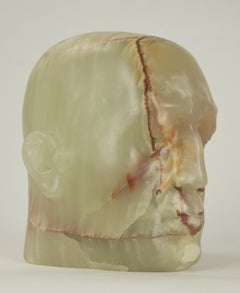
Translucent Alabaster Head Sculpture with Expressive Natural Veins. Light
By Óscar Aldonza Torres
Located in FISTERRA, ES
Translucent alabaster head sculpture with expressive natural veins, carved in direct carving for a unique interplay of light, stone and human form.
This unique alabaster head sculpt...
Category
2010s Expressionist Figurative Sculptures
Materials
Alabaster
$5,495
H 11.03 in W 7.88 in D 9.45 in
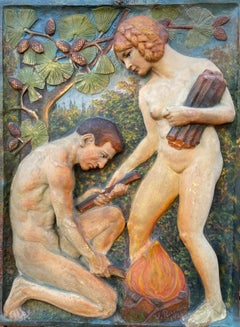
“Adam and Eve”
Located in Southampton, NY
Very rare Art Deco three dimensional terracotta sculpture of Adam and Eve by the Austrian artist, Virgil Rainer. Hand painted by the artist. Signed bott...
Category
1920s Art Deco Figurative Sculptures
Materials
Terracotta, Plaster