Robin s Antiques Sculptures and Carvings
to
1
1
1
1
1
1
1
1
1
1
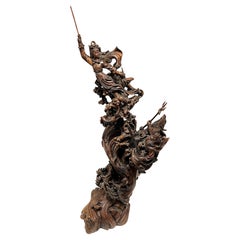
Antique Chinese Qing Period Carved Wooden Sculpture of Mythological Warriors
Located in New York, NY
Our monumental carved wooden sculpture, 50 inches tall, depicts a mythological female figure rising above rolling seas, surrounded by various sea creatures including crustaceans, fis...
Category
Antique Late 19th Century Chinese Sculptures and Carvings
Materials
Wood
Related Items
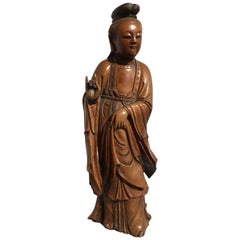
Chinese Carved Boxwood Figure of Guanyin, Mid-Qing Dynasty
Located in Austin, TX
A sublime Chinese carved boxwood figure of the Bodhisattva of Compassion, Avalokiteshvara, called Guanyin in Chinese, mid-Qing dynasty.
The an...
Category
Antique Late 18th Century Chinese Qing Sculptures and Carvings
Materials
Boxwood

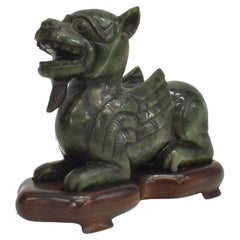
Qing Dynasty Chinese Carved Green Jade Chilong Dragon Sculpture
Located in Forney, TX
A magnificent Chinese carved spinach green jade chilong dragon sculpture, resting on fitted hardwood stand.
Rich deep bright green color with molten shades of lighter pale green, exceptionally carved, with intricate detail throughout. The mythical beast lying ready on all four, head raised, mouth ajar with teeth exposed, wings by its side, spiral scroll incised on hind legs.
Provenance:
Estate of Ali A. Abssi (1934-2020) and Florence Hall Abssi (1919-2014), founders of the Ishtar Gate...
Category
Antique 19th Century Sculptures and Carvings
Materials
Jade
Chinese Antique Large Qing Hand Carved Square Stone Stool Display Pedestal, 19c.
Located in South Burlington, VT
Rare and Hard To Find 19th Century
From China's Qing dynasty (1644-1912) a hard to find solid limestone finely carved square footed pedestal - perfect for displaying your indoor or ...
Category
Antique 19th Century Chinese Qing Sculptures and Carvings
Materials
Stone, Limestone

$2,240 Sale Price
20% Off
H 16 in W 16 in D 16 in
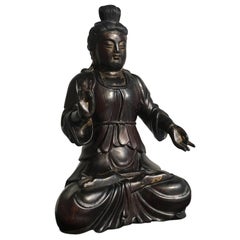
Chinese Carved Zitan Figure of a Bodhisattva, Qing Dynasty
Located in Austin, TX
A finely carved Chinese zitan wood figure of an unidentified bodhisattva, possibly Guanyin, late Qing Dynasty, circa 1900, China.
The androgynous figure has a plump, almost matronly face, with downcast eyes and a gentle smile. The hair in long tresses, gathered and tied in a high chignon.
The enlightened being is portrayed seated in dhyanasana, bare feet resting on crossed legs, both soles pointing up.
Thick robes billow and drape around the full figured body. The hands display...
Category
Early 20th Century Chinese Qing Sculptures and Carvings
Materials
Lapis Lazuli
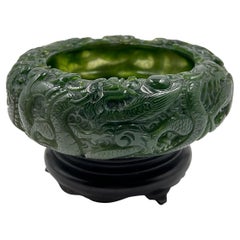
Chinese Jade Carved Bowl from the Qing Dynasty
Located in Autonomous City Buenos Aires, CABA
Chinese Carved Jade Bowl from the Qin Dynasty
Circular piece, finely hand-carved in deep green jade with lighter natural veins. It features an intrica...
Category
Antique Late 19th Century Chinese Other Sculptures and Carvings
Materials
Jade
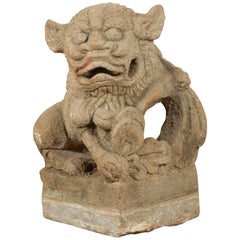
Chinese Qing Dynasty 19th Century Carved Stone Foo Dog Guardian Lion Sculpture
Located in Yonkers, NY
A Chinese Qing Dynasty period carved stone foo dog guardian lion from the 19th century, on square base. Created in China during the Qing Dynasty, this st...
Category
Antique 19th Century Chinese Qing Statues
Materials
Stone
$3,500
H 18 in W 18 in D 10 in
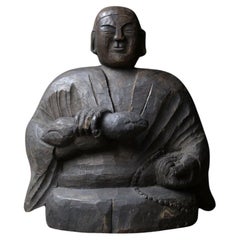
Antique Wooden Sculpture "Kobo Daishi" / Buddha Statues / Edo-Meiji Period
Located in Sammu-shi, Chiba
This is an old Japanese "Kobo Daishi" wooden figure.
"Kobo Daishi" means "Kukai".
"Kukai" was a monk from the early Heian period. His posthumous name was "Kobo Daishi". He is the fou...
Category
Antique 19th Century Japanese Edo Sculptures and Carvings
Materials
Cypress
$1,200
H 14.18 in W 10.63 in D 7.09 in
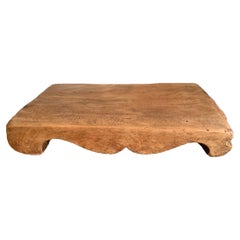
Antique Chinese Wooden Block / Chopping Block, Hand-Carved, c. 1900
Located in Jimbaran, Bali
An Antique Chinese chopping block with hand-carved detailing. Two original iron supports are wedged on both sides to support such a large piece of solid ...
Category
Early 20th Century Chinese Qing Butcher Blocks
Materials
Hardwood
$864 Sale Price
20% Off
H 4.73 in W 25.6 in D 18.12 in
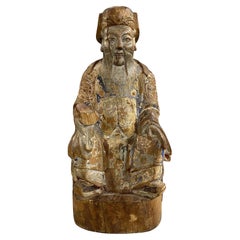
19th Century Chinese Carved Polychrome Wooden Ancestral Figure Sculpture
Located in Milford, NH
A fine hand carved polychrome wooden seated Chinese ancestral figure sculpture, dating to the 19th century, with deep back cutouts, some paint losses, shrinkage cracks, edge losses, ...
Category
Antique 19th Century Chinese Sculptures and Carvings
Materials
Hardwood
$1,600
H 18 in W 8.75 in D 6.75 in
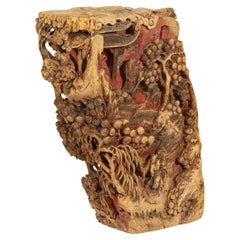
Antique Qing Dynasty Wooden Temple Corbel with Red Polychromy and Carved Pagodas
Located in Yonkers, NY
A Qing Dynasty hand carved wooden temple corbel from the 19th century, with characters, pagodas, vegetation and red polychromy. This antique Qing Dynast...
Category
Antique 19th Century Chinese Qing Sculptures and Carvings
Materials
Wood
$1,900
H 25 in W 16.5 in D 7.5 in
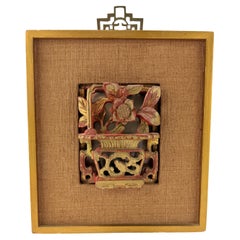
Chinese Qing Dynasty Carved
Giltwood Plaque W/ Mirrored Back
Located in Atlanta, GA
Chinese, framed in the mid 20th century, carving is earlier.
An antique Chinese carved and gilt wood bonsai planter with floral arrangement stemming from ...
Category
20th Century Chinese Chinese Export Sculptures and Carvings
Materials
Mirror, Giltwood
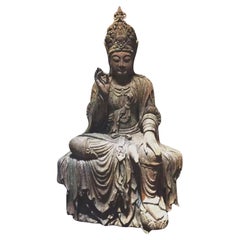
A Large Chinese Carved Wood Figure of Guanyin, Late Qing Dynasty
Located in ARMADALE, VIC
An impressive depiction of Guanyin, the Bodhisattva of compassion, whose name bears the meaning ‘One who hears the cries of the world.’ The rather androgynous figure is adorned with beaded jewellery and the princely regalia of a dhoti, draped across her body and spilling out over to partially obscure what she is resting upon. The goddess’ profile exhibits idealised features of Asian artistic convention; her face is soft and rounded, with full lips and relaxed eyes that provide a serene quality of youthfulness to the figure. Adhering to Chinese iconography of Guanyin, the figure is marked by an urna on her forehead, denoting her own enlightenment, as well as a diadem displaying Buddha Amitabha, the spiritual teacher of Guanyin. Seated in the Lalit asana pose, translated as ‘royal ease’, the figure exudes a fine example of the relaxed majesty typical in the characterisation of Guanyin. Whilst the figure’s left hand is placed restfully upon the left leg pendant, the right is raised in the gesture shuni mudra, the second finger held gently against the thumb. Otherwise known as the seal of patience, this gesture indicates the figure as one intended to bestow this virtue, along with compassion and understanding, upon the beholder.
Notes on the item:
Guanyin is the Chinese interpretation of Avalokiteshvara, the Indian Bodhisattva of compassion. The term “Bodhisattva” is derived from the Sanskrit “Bodhi”, meaning ‘awakening’ or ‘enlightenment’, combined with “Sattva”, meaning ‘spirit’ or ‘being’, referring to one on the path to achieving enlightenment. Bodhisattvas in Mayahana Buddhism are recognised as figures who have effectively achieved enlightenment yet relinquish their accension to nirvana in order to remain amongst mankind in the ultimate act of compassion to aid as spiritual guides. As such, the Bodhisattva inhabit a liminal space between samsara and nirvana; enlightened beings that maintain a relationship with humanity that buddhas cannot, as attaining Buddhahood necessitates the abandonment of all worldly attachments, including mankind. Guanyin’s very name, ‘One who hears the cries of the world’ highlights this role as a compassionate figure who acknowledges the suffering and strife of man. Along with Mahāsthāmaprāpta, a fellow bodhisattva, Guanyin serves as an attendant to Buddha Amitabha, with these three deities recognised as the Three Sages of Western Pure Land Buddhism, a sect of Mayahana Buddhism popular in East Asia.
Avalokiteshvara is commonly posited to have been adopted from Indian Buddhism into China as Guanyin around 200-400 CE, however it was the Tang dynasty (618-907) which saw the popularisation of the deity. By the Ming (1358–1644) and Qing (1644–1911) dynasties, Guanyin held the position as the most popular female deity in China. The unique state of religion in China held no monolithic canon regarding Buddhism and saw the assimilation of several belief systems, primarily Daoism, Buddhism and Confucianism. Consequently, Guanyin became a deity to be revered beyond Buddhism alone, appointed as both an official imperial deity and Daoist deity in the 12th century. Guanyin may also be seen to fulfil the role of idealised femininity as prescribed by Confucianism, with the scarcity of female Chinese deities perhaps accounting for the gradual gender shift Guanyin underwent.
The Indian Avalokiteshvara is unequivocally recognised as male, whilst the supposed gender of Guanyin remains contentious. Although there is a clear shift from the masculine Avalokiteshvara towards a more feminine representation, it is unclear if Guanyin is understood to be entirely feminine, to inhabit qualities of both genders or to be elevated beyond gender entirely, embodying neither. Depictions of Guanyin are highly androgynous, which some believe lends credence towards Guanyin symbolising the unity of dualistic forces as recognised in Daoism, displaying the anthropomorphism of yin and yang.
Comparative Analysis:
Market comparisons of similar Qing Dynasty polychrome figures of Guanyin include lot 767 (no.2) From Christies ‘Important Chinese Ceramics and Works of Art,’ New York, 25 March 2022, with the price realised USD 52,920 (Estimate USD 20,000 – USD 30,000). Christies also auctioned a comparable polychrome Guanyin...
Category
Antique Late 19th Century Chinese Qing Sculptures and Carvings
Materials
Hardwood
$28,500
H 57.09 in W 35.44 in D 25.6 in