Rockwell Antiques Decorative Boxes
to
15
13
2
1
2
10
8
7
5
4
15
9
8
5
5
3
Height
to
Width
to
15
15
15
1
1
1
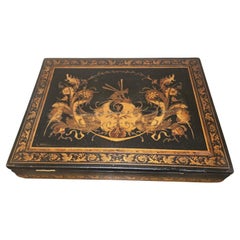
19C British Tunbridgeware Micro-mosaic Lap Desk - RARE
Located in Dallas, TX
PRESENTING an ABSOLUTELY GORGEOUS and EXTREMELY UNIQUE and RARE 19C British Tunbridgeware Micromosaic Lap Desk.
This lap desk is unlike any of it’s kind we have seen before.
From c...
Category
Antique Mid-19th Century English High Victorian Decorative Boxes
Materials
Boxwood, Maple, Walnut
Wedgwood Jasperware Pale Blue Small Circular Lidded Vanity Box
By Wedgwood
Located in Dallas, TX
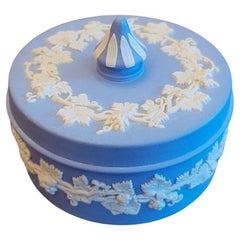
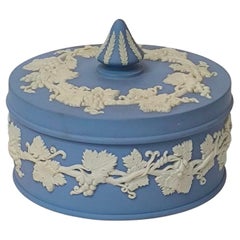
PRESENTING A LOVELY Wedgwood Jasperware Pale Blue Small Circular Lidded Vanity Box.
Made by Wedgwood in England in 1982 and fully and properly marked/stamped on base.
Marked: “Wedgwood, Made in England …. “PH” … “T” ….. “82”.
2.25 inches tall lidded vanity box with a diameter of 3.25 inches.
Rolling vine and grape cameo reliefs, all over the lid and base sides.
Fabulous large pointed finial on the lid with floral cameo reliefs on the sides.
In very good original condition with no chips or cracks.
A ‘PERFECT’ match for the larger and almost identical, lidded jasperware box...
Category
20th Century English Neoclassical Revival Decorative Boxes
Materials
Ceramic
19C Anglo Indian Vizagapatam Bone and Shell Domed Stationery Box
Located in Dallas, TX
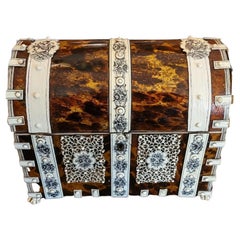
PRESENTING A LOVELY 19C Anglo Indian Vizagapatam Bone and Shell Domed Stationery Box – ‘Alice’s Box’.
Made in Vizagapatam, India, circa 1860-80.
We call this one: “Alice’s Box”! It has lived ‘a hard, well used and traveled life’, as is evident from the number of losses and repairs, as is obvious from the photos, especially to the faux ivory panels and bands to the top. The bonus to the loss of the frieze panels to the dome has a ‘bonus’, however, as their loss has revealed the most GORGEOUS faux blonde tortoiseshell underneath!
The box is dome/casket shaped.
The top has 3 bands, with the center one being the original. The 2 side bands are later ivorine.
The faux ivory and hand-painted medallions on the domed lid, have been saved and they depict Hindu Gods, Vishnu and Shiva.
The front and side panels are still in pretty good shape and are decorated with lac ink (indelible ink made from crushed beetles) depicting lovely floral designs.
The domed lid open to reveal a series of open compartments for envelopes, writing paper etc. and one lidded panel for stamps.
Inside the box are 2 paper labels: one probably being the original item ticket and the other with:
” Alice’s address is 272 Ashworth Ave, Toronto 4, Ontario”.
Probably, the original owner? Hence, we call it ‘Alice’s Box’.
What a journey/life this box has had!
Made in India, made its way to Canada, back to Ireland and then to Texas!
This is why, WE LOVE ANTIQUES...
Category
Antique 19th Century Indian Anglo-Indian Decorative Boxes
Materials
Bone, Shell, Sandalwood
19c Anglo Indian Highly Carved Teak and Sandalwood Sarcophagus Sewing Box
Located in Dallas, TX
PRESENTING A VERY NICE 19C Anglo Indian Highly Carved Teak and Sandalwood Sarcophagus Sewing Box.
Made in Bombay, India circa 1890-1900.
The box case/body is made of sandalwood wit...
Category
Antique Late 19th Century Indian Anglo-Indian Decorative Boxes
Materials
Bone, Sandalwood, Teak
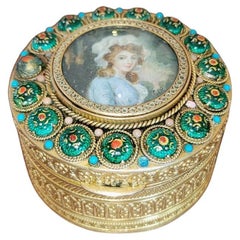
Early 19th Century French Gold Box with Enamel and Miniature Portrait
Located in Dallas, TX
PRESENTING A STUNNING Early 19C French Gold Box with Enamel and Miniature Portrait.
Box made with brass but has been plated with 18ct Gold with beau...
Category
Antique Early 19th Century French Grand Tour Jewelry Boxes
Materials
Gold, Enamel
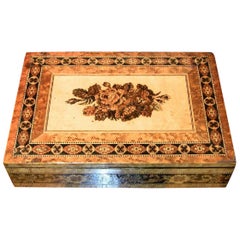
19C English Tunbridgeware Tabletop Stationary Box, Micro Mosaic
By Tunbridge Ware
Located in Dallas, TX
Stunning little 19th century tabletop stationary box made of micro-mosaic.
Made in Britain, circa 1870, in Tunbridge Wells, hence these type of works are called Tunbridgeware!
...
Category
Antique Late 19th Century English High Victorian Decorative Boxes
Materials
Boxwood, Ebony, Walnut, Burl
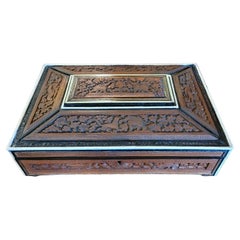
19C Anglo Indian Highly Carved Sadeli Mosaic Sarcophagus Sewing Box
Located in Dallas, TX
PRESENTING A GORGEOUS 19C Anglo Indian Highly Carved Sadeli Mosaic Sarcophagus Sewing Box.
Made in Bombay, India circa 1860-80.
Box made of sandalwood with highly carved teak wood reliefs and panels on all sides.
Edged with bone and ebony veneers and glorious sadeli mosaic, made from tiny pieces of faux ivory, pewter, green semi-precious stone.
The box is in a sarcophagus form with domed lid.
The original brass carry handles are on the sides.
The interior is in great condition and consists of a removeable mirror under the lid portion, with the original red velvet lining behind it.
The base is removeable and contains a number of lidded compartments.
6 of the interior lids on the base, are each inlaid with sadeli mosaic banding. The rest are also carved and chased.
The interior is fully complete with 7 lidded faux ivory/bone, thread canisters with sadeli domes and the original bone thimble.
The box sits on 4 brass ball or bun feet with the original velvet lining on the base.
Some minor repairs and losses, but this box is fully complete. This is ‘rare’ as many of these boxes have not survived in such condition!
Included in the sale are 2 photos that were in the box (under the base tray). Interestingly, one of them is a view of downtown Nassau, New Providence (Bermuda) from the early 20C and stamped on the rear. What a ‘journey’ this piece has made! Made in India … travelled to Bermuda, probably via Britain … back to Ireland (where we bought it) …. then to Texas!
These boxes were made by superb Indian craftsmen, specifically for sale to the ruling British elite. These types of boxes, carved padouk and sandalwood, (whilst beautiful and superbly crafted) were of a lesser quality, than the more profusely and intricately mosaic inlay, tortoiseshell and ivory boxes, made for the British ‘Upper Classes’ in the areas of Bombay and Vizagapatam. These type of boxes were much more affordable back in 1880 (and indeed today) and would probably have been bought by mid-level diplomats, civil servants or visitors.
Sewing boxes (in general), were in EVERY Victorian home in Britain in the 19th Century and like other boxes etc were ‘status symbols’ of your place in society! The more ornate the box, the more ‘Upper Class’ you were!
Of it’s type, this one, is one of the very higher quality one’s, than the norm!
SADELI MOSAIC: “Anglo Indian boxes were made in India for the English residents from the early part of the 18th century. They were brought back or sent back to England usually by the people who had commissioned them. From the beginning of the nineteenth century they were imported more commercially, although not in any significant numbers until the middle decades. They were very highly valued, especially the early ones, to the extent that the designs were copied on late 19th and early 20th century tins.
The ancient art of Sadeli Mosaic is said to have been introduced from Shiraz in Persia via Sind to Bombay, a long time before the Anglo Indian boxes were made. It was a technique, which required a high degree of skill and patience. It was executed very lavishly, in that the frequent cuts wasted a great amount of the precious materials used. The workmanship was however more than commensurable to the value of the materials.
Ivory, silver, pewter (or other metals), wood and horn were cut into faceted rods which were bound together to form geometric patterns. When the glue has set, the rods were sliced in transverse sections. This gave the maker a number of angled circular pieces in the original pattern. Several variations of patterns could be achieved by combining the materials in different ways. The ivory was sometimes dyed green to give an extra color.
The mosaic pieces in a combination of patterns, often separated by ivory, ebony, horn or silver stringing were used to veneer sandalwood boxes. In the early boxes, which date from the turn of the 18th to the 19th century, there are large panels of mosaic covering tops and sides of boxes. It took incredible skill to cover such large areas without any shakes or wavering of the pattern. The corners and joins on these boxes are impeccably matched.
The makers (reputed to be Persian) of Sadeli mosaic made in the first two decades of the 19th century displayed a total understanding of the qualities of the different materials they used. They combined substances, which can expand and contract according to atmospheric conditions with others, which are hard and unyielding. The result was a sharp definition of the lines and patterns, which made up the whole design.
On the early boxes the designs look deceptively simple. The fact is, they emerged from a culture, which had mastered geometry and understood how to generate a pattern from a set number of points. The patterns are so harmoniously combined that their incredible complexity is not immediately apparent.
The earliest Sadeli boxes...
Category
Antique 19th Century Indian Anglo-Indian Decorative Boxes
Materials
Bone, Sandalwood, Teak
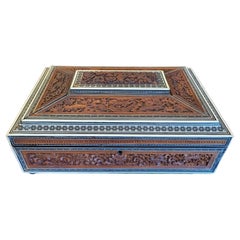
19C Anglo Indian Highly Carved Teak Sadeli Mosaic Inlaid Sewing Box
Located in Dallas, TX
PRESENTING A LOVELY 19C Anglo Indian Highly Carved Sadeli Mosaic Inlaid Sewing Box.
Made in Bombay, India, circa 1880.
The box is made of sandalwood with highly carved raised teak wood panels on all sides, depicting temple scenes, animals and foliage.
The box is in a sarcophagus form.
It is edged in bone (and we can tell it is bone and not ivory, from the color and evidence of capillaries, which are not found in ivory), and banded with Bombay Sadeli mosaic and ebony veneer.
The lid opens to reveal a removable tray with various open compartments and lidded compartments. 5 lidded compartments, 1 unlidded compartment and 8 holders for thimbles, etc
The tray lifts to reveal a blue velvet (original) lined section, for storing jewelry etc, with sections for collars etc.
The inside of the lid has a removable mirror (the mirror is missing on this one but can easily be replaced). Behind the mirror is the original green velvet lining.
It has its original brass carry handles on the sides and sits on 4 silvered button feet (of recent origin).
Some repairs to the exterior and condition issues (priced accordingly), but still a LOVELY COLLECTIBLE box!
These boxes were made by superb Indian craftsmen, specifically for sale to the ruling British elite. These types of boxes, carved padouk and sandalwood, (whilst beautiful and superbly crafted) were of a lesser quality, than the more profusely and intricately mosaic inlay, tortoiseshell and ivory boxes, made for the British ‘Upper Classes’ in the areas of Bombay and Vizagapatam. These type of boxes were much more affordable back in 1880 (and indeed today) and would probably have been bought by mid-level diplomats, civil servants or visitors.
Sewing boxes (in general), were in EVERY Victorian home in Britain in the 19th century and like other boxes etc were ‘status symbols’ of your place in society! The more ornate the box, the more ‘Upper Class’ you were!
SADELI MOSAIC: “Anglo Indian boxes were made in India for the English residents from the early part of the 18th century. They were brought back or sent back to England usually by the people who had commissioned them. From the beginning of the nineteenth century they were imported more commercially, although not in any significant numbers until the middle decades. They were very highly valued, especially the early ones, to the extent that the designs were copied on late 19th and early 20th century tins.
The ancient art of Sadeli Mosaic is said to have been introduced from Shiraz in Persia via Sind to Bombay, a long time before the Anglo Indian boxes were made. It was a technique, which required a high degree of skill and patience. It was executed very lavishly, in that the frequent cuts wasted a great amount of the precious materials used. The workmanship was however more than commensurable to the value of the materials.
Ivory, silver, pewter (or other metals), wood and Horn were cut into faceted rods which were bound together to form geometric patterns. When the glue has set, the rods were sliced in transverse sections. This gave the maker a number of angled circular pieces in the original pattern. Several variations of patterns could be achieved by combining the materials in different ways. The ivory was sometimes dyed green to give an extra color.
The mosaic pieces in a combination of patterns, often separated by ivory, ebony, Horn or silver stringing were used to veneer sandalwood boxes. In the early boxes, which date from the turn of the 18th to the 19th century, there are large panels of mosaic covering tops and sides of boxes. It took incredible skill to cover such large areas without any shakes or wavering of the pattern. The corners and joins on these boxes are impeccably matched.
The makers (reputed to be Persian) of Sadeli mosaic made in the first two decades of the 19th century displayed a total understanding of the qualities of the different materials they used. They combined substances, which can expand and contract according to atmospheric conditions with others, which are hard and unyielding. The result was a sharp definition of the lines and patterns, which made up the whole design.
On the early boxes the designs look deceptively simple. The fact is, they emerged from a culture, which had mastered geometry and understood how to generate a pattern from a set number of points. The patterns are so harmoniously combined that their incredible complexity is not immediately apparent.
The earliest Sadeli boxes...
Category
Antique Late 19th Century Indian Anglo-Indian Decorative Boxes
Materials
Bone, Sandalwood, Teak
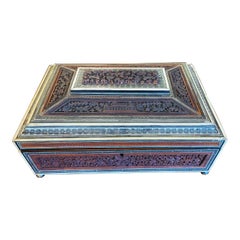
19th Century Anglo Ceylonese Specimen Wood Desk Companion Tray
Located in Dallas, TX
Another stunning 19th century Anglo-Ceylonese piece.
Made circa 1880 in Ceylon (Now Sri Lanka) of Coromandel wood and specimen woods.
This is a simply gorgeous and quality item!! Tray made of various compartments with various high quality specimen wood lids, all edged and banded in chevrons of bone, silver or pewter and ebony.
The tray itself is made of expensive coromandel wood. There are two open sections on either side of the tray which have bone and hand-painted lac ends. The main tray sits onto a base made of coromandel wood with green baize lining.
This tray could have a number of practical uses, for keeping stationary, watches, jewelry, or thinking outside of the box, holding you remote controls and candy!!
We have a matching box also in our Inventory and for auction.
ANGLO-INDIAN AND CEYLONESE BOXES: Anglo Indian boxes were made in India for the English residents from the early part of the 18th century. They were brought back or sent back to England usually by the people who had commissioned them. From the beginning of the nineteenth century they were imported more commercially, although not in any significant numbers until the middle decades. They were very highly valued, especially the early ones, to the extent that the designs were copied on late 19th and early 20th century tins.
Anglo-indian Boxes normally consist of 3 main types:-
(1) Most of the best and highest quality Anglo-Indian boxes in the 18th and 19th Centuries were made in Vizagapatam, India, renowned for its exquisite craftsmanship in using ivory and tortoiseshell and lac decoration. These are referred to as ‘Vizagapatam Boxes...
Category
Antique Late 19th Century Sri Lankan British Colonial Decorative Boxes
Materials
Ebony, Wood
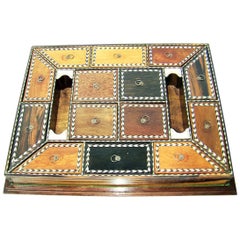
19C Anglo Ceylonese Sewing Box of Museum Quality
Located in Dallas, TX
Presenting an absolutely stunning 19c Anglo Ceylonese sewing box of museum quality.
Made in Ceylon (now Sri Lanka) circa 1860, this is one of the finest sewing boxes of it’s kind that we have ever seen!
The box is made from coromandel wood (an exotic hardwood found in Ceylon) and has a serpentine edging all over the front, back and sides.
Very often the lids/tops of these boxes suffer cracks due to shrinkage but this one is near perfect with no crack in the lid/top. There is some evidence of natural shrinkage but that is around the edges of the lid/top.
It is when you open this box that it reveals it’s true beauty, quality and treasure !
The inside of the lid/top is heavily and beautifully decorated with inlaid bone in scrolling floral patterns which have then been hand painted with red and black ‘lac’ ink. The central medallion is a circle of inlaid specimen exotic hardwoods radiating towards a central bone and hand painted flower. The circle is edged in bone, wood and silver chevrons.
What makes this box Exceptionally rare is that it contains 3 lift out base sections. Normally, there would be a maximum of 2.
The first tray/section is clearly for the purposes ancillary to sewing with a pair of sections with bone spools for thread etc. There are 17 other lidded compartments with each one highly decorated using hand painted bone and specimen woods to replicate tortoiseshell.
The first tray lifts out to reveal a second removeable tray which is made up of a pair of open sections and 8 specimen wood lidded sections each with chevron banding.
The third tray is a smaller tray underneath with 14 lidded compartments each with hand painted bone and specimen wood inlaid lids again, replicating the look of tortoiseshell. Again they are banded with a chevron border.
This is a museum quality piece !
It is in fantastic condition for it’s age with the minor shrinkage to the edges of the lid/top, some finger pulls missing and some very minor cracks to the tray lids and bases but nothing that in any way detracts from the piece. No key.
Dimensions: Closed the box is 16.75 inches wide, 11.25 inches deep and 7.5 inches high
Fully open the box is 16.5 inches high, 16.75 inches wide and 11.4 inches deep
Anglo-Indian and ceylonese boxes: Anglo Indian boxes were made in India for the English residents from the early part of the 18th century. They were brought back or sent back to England usually by the people who had commissioned them. From the beginning of the nineteenth century they were imported more commercially, although not in any significant numbers until the middle decades. They were very highly valued, especially the early ones, to the extent that the designs were copied on late 19th and early 20th century tins.
Anglo-Indian boxes normally consist of 3 main types:-
(1) Most of the best and highest quality Anglo-Indian boxes in the 18th and 19th centuries were made in Vizagapatam, India, renowned for its exquisite craftsmanship in using ivory and tortoiseshell and lac decoration. These are referred to as ‘Vizagapatam Boxes...
Category
Antique Mid-19th Century Sri Lankan Anglo-Indian Decorative Boxes
Materials
Silver
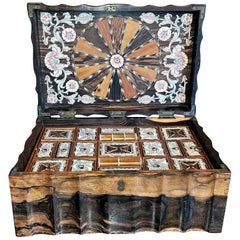
19C Anglo Ceylonese Lap Desk of Museum Quality
Located in Dallas, TX
Presenting an absolutely fantastic 19C Anglo Ceylonese lap desk of museum quality.
We can safely say that this is one of the finest lap desks we hav...
Category
Antique Early 19th Century Sri Lankan Anglo-Indian Decorative Boxes
Materials
Bone, Ebony, Sandalwood
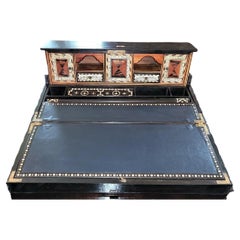
19C Anglo Indian Vizigapatam Stamp Box
Located in Dallas, TX
Presenting an absolutely gorgeous and very rare 19C Anglo Indian Vizigapatam stamp box.
Made in Colonial India (the Time of the Raj) circa 1860.
Prob...
Category
Antique Mid-19th Century Indian Anglo-Indian Decorative Boxes
Materials
Bone, Shell
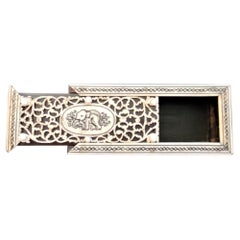
Vintage Japanese Temple Style Box
Located in Dallas, TX
PRESENTING A LOVELY Vintage Japanese Temple Style Box.
Made of rosewood, this box has a cover featuring ‘Buddhist Swastikas’ on the front.
The cover lifts off to reveal a tabernacle with 2 carved dragons on wither side.
Probably made in the first quarter of the 20th Century, circa 1920-30.
Rectangular shaped for the storage of deities statues...
Category
Early 20th Century Japanese Japonisme Decorative Boxes
Materials
Wood
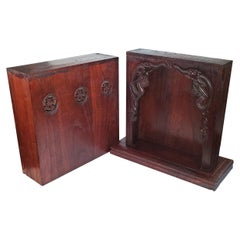
Pair of 19th Century American Henry Troemner Philadephia Pa Chinoiserie Tea Bins
By Henry Troemner
Located in Dallas, TX
Presenting a gorgeous and extremely rare pair mid-19th century, metal tea bins, by Henry Troemner of Philadelphia, PA in the chinoiserie style.
From circa 1845.
Made of black enamel...
Category
Antique Mid-19th Century American Chinoiserie Tea Caddies
Materials
Tin
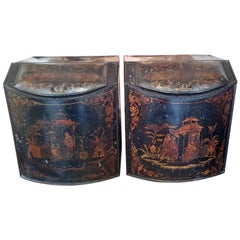
19th Century Italian Ruby Glass Box with Miniature of Basilica
Located in Dallas, TX
Lovely little 19th century ring jar or pill box made of a thick wine colored ruby glass.
It has a miniature of a Basilica on top, gilt metal mounts with beautiful filigree on the si...
Category
Antique Early 19th Century Vatican Grand Tour Decorative Boxes
Materials
Metal
Related Items
Rare Wedgwood Jewelry Box, Round Light Blue Jasperware Lidded Box
By Wedgwood
Located in Bochum, NRW
Light Blue Wedgwood Jasperware Trinket Box - Round Shape with Grape Leaves
Dimensions: Measure 10 cm in height and 12 cm in diameter.
In excellent condition.
Category
Vintage 1960s English Mid-Century Modern Candlesticks
Materials
Porcelain

19th Century French Enameled Porcelain Box
Located in Clearwater, FL
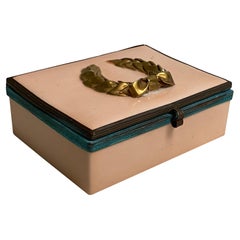
A salmon colored enamel box with patina bronze surround and latch and topped with a gold laurel wreath.
Category
Antique 1890s French Decorative Boxes
Materials
Bronze, Enamel
1950s Anglo Indian Micro Sadeli Mosaic Inlaid Jewelry Box
Located in Moreno Valley, CA
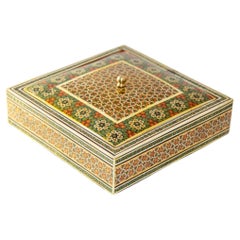
1950s Anglo Indian Micro Sadeli Mosaic Inlaid Jewelry Box.
DIMENSIONS: 7ʺW × 7ʺD × 2.5ʺH.
Indo Persian Moorish style micro mosaic inlaid jewelry box with lid.
Intricate inlaid Anglo ...
Category
Mid-20th Century Indian Moorish Decorative Boxes
Materials
Bone, Fruitwood
Moorish Micro Mosaic Inlaid Jewelry Box
By Rajhastani
Located in Moreno Valley, CA
Moorish style micro mosaic marquetry inlaid jewelry box with lid.
Intricate inlaid Anglo Indian box with floral and geometric Islamic
Moorish mosaic Sadeli design in a square shape form with mosaic inlay and marquetry, very fine artwork, lined in red velvet.
Museum collector piece like the one in Doris Duke Islamic Art Museum.
The repeating geometric patterns of Sadeli Mosaic are what give it beauty and richness. This decorative technique is a type of micro mosaic featuring repeating geometric patterns. A highly skilled craft, it has had a long history in India and the Middle East with early examples dating back to the 16th century. In the 1800s, it became popular as a decoration on a variety of boxes, card cases, and chess boards imported from India. Since Bombay became a center of making them, they became known as Bombay boxes...
Category
Mid-20th Century Indian Agra Jewelry Boxes
Materials
Wood
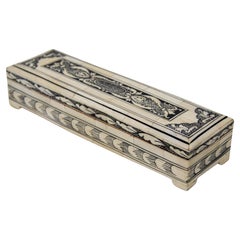
Moorish Islamic Mughal Raj Decorative Vizagapatam Carved Bone Jewelry Box India
Located in Moreno Valley, CA
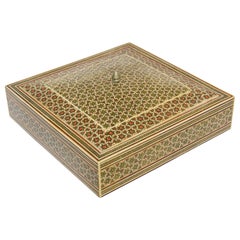
Decorative Mughal Raj Vizagapatam Carved Veneered Bone Jewelry Rectangular shape Box.
Vintage Asian lidded box crafted with bone finely engraved and hand painted in black with geometric Moorish designs.
Delightful Anglo Indian footed box crafted with an intricate patterned polished bone inlay mosaic over a wood frame.
Handmade in Vizagapatam, India, mid 20th century.
Elegant intricate pattern. A true work of Islamic artwork...
Category
Late 20th Century Indian Anglo-Indian Decorative Boxes
Materials
Bone, Wood
$695
H 2 in W 10 in D 3 in
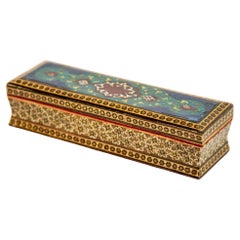
Micro Mosaic Moorish Inlaid Jewelry Pen Box
Located in Moreno Valley, CA
Micro Mosaic Persian Islamic Moorish Inlaid Jewelry Pen Box.
1950s Middle Eastern Moorish Inlaid Jewelry Trinket Mosaic Box.
Handcrafted mar...
Category
Mid-20th Century Lebanese Moorish Decorative Boxes
Materials
Fruitwood
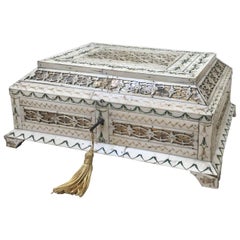
Early 19th Century Russian Stained and Carved Bone Table Box with delicate gold
Located in Larkspur, CA
Early 19th century Russian stained and hand-carved Bone Table Casket Kholmogory Box, veneered with panels of foliate engraved stained bone alternating with geometric and foliate fret...
Category
Antique Early 19th Century Russian Decorative Boxes
Materials
Bone
$1,650
H 5 in W 10.5 in D 7 in
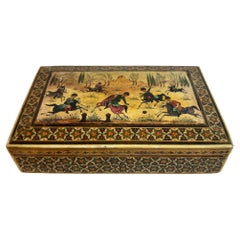
Antique Persian Khatam Micro Mosaic Inlaid Jewelry Box circa 1940s
Located in Moreno Valley, CA
Antique Persian Khatam Micro Mosaic Inlaid Jewelry Box with Miniature Polo Scene, circa 1940s
This exquisite Persian Khatam Kari trinket box is a rare example of masterful micro mosaic marquetry, handcrafted in the 1940s using the ancient Persian art of inlay.
Featuring an intricately detailed geometric design and a miniature hand-painted equestrian scene on the lid, this museum-quality piece is a stunning representation of Indo-Persian and Moorish craftsmanship.
Khatam Kari, or Persian marquetry, is a centuries-old decorative art that flourished during the Safavid dynasty. It involves the meticulous inlay of thousands of tiny pieces of wood and bone into intricate, repeating geometric patterns—each symbolic of harmony and cosmic order. The top of this box is adorned with a finely rendered painting of royal figures on horseback, possibly princes engaged in a ceremonial game of polo, echoing the refined court culture of the 19th-century Persian and Mughal aristocracy.
The box’s micro mosaic surface is covered in richly detailed star and polygon motifs typical of Khatam and Sadeli mosaic traditions.
These patterns require precise mathematical planning and exceptional artisanal skill, resulting in a surface that is as intellectually complex as it is visually stunning.
Details:
* Origin: Asia Indo-Persian
* Date: Circa 1940s
* Materials: Inlaid woods, camel bone, hand-painted miniature
* Style: Islamic Art, Moorish, Anglo-Indian, Micro Mosaic
* Dimensions: Height 1.5 in. x Width 6.5 in. x Depth 4.25 in.
* Condition: antique condition with minor wear consistent with age
These boxes were traditionally used to store writing instruments or jewelry, and today they serve as timeless collectors' pieces, suitable for display or thoughtful gifting.
Comparable examples can be found in major Islamic art collections, including the Doris Duke Museum of Islamic Art.
Keywords:
Persian Khatam Box...
Category
Mid-20th Century Indian Anglo-Indian Jewelry Boxes
Materials
Bone, Fruitwood
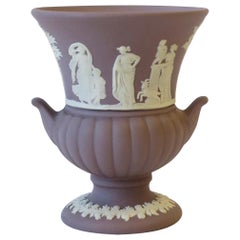
Wedgwood Jasperware Urn Vase Neoclassical Design, Small
By Wedgwood
Located in New York, NY
A beautiful, small, English Wedgwood Jasperware urn vase in the neoclassical design style, circa 20th century, England. Piece is a matte stonew...
Category
20th Century English Neoclassical Vases
Materials
Stoneware
$275 Sale Price
42% Off
H 3.38 in W 2.88 in D 2.75 in
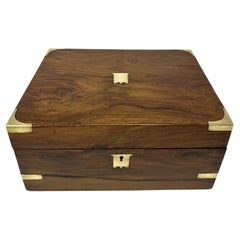
Antique Victorian Brass Bound Traveling Desk Walnut Wooden Writing Slope Box 19C
Located in Dublin, Ireland
An exceptionally fine early English Well Figured Solid grained Walnut Ladies or Gents Travelling Writing Slope of outstanding quality and compact proportions. Last quarter of the Nin...
Category
Antique 19th Century English Victorian Inkwells
Materials
Brass
$549 Sale Price
20% Off
H 5.75 in W 12 in D 8.75 in
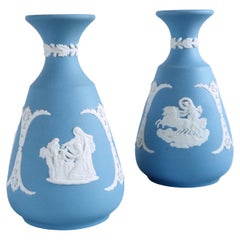
Wedgwood blue and white jasperware vases
By Wedgwood
Located in GRENOBLE, FR
Lovely pair of Wedgwood jasperware vases, beautiful neoclassical style item decorated with white antique-style scenes on a sky-blue background...
Category
20th Century English Neoclassical Vases
Materials
Ceramic, Stoneware
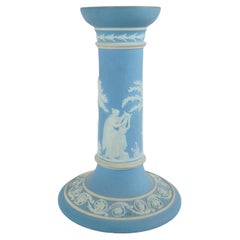
Wedgwood blue and white jasperware candlestick
By Wedgwood
Located in GRENOBLE, FR
A fine Wedgwood jasperware candlestick, neoclassical style item decorated with white antique-style characters and trees on a sky-blue backgroun...
Category
Mid-20th Century British Neoclassical Candlesticks
Materials
Ceramic, Stoneware