Rockwell Antiques Tea Caddies
to
3
3
3
2
1
1
1
3
2
1
1
1
1
Height
to
Width
to
3
3
3
1
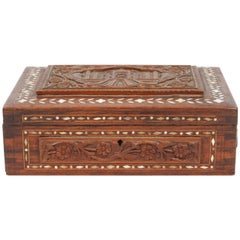
19th Century Anglo-Indian Spice or Tea Caddy with Silver Mounts
Located in Dallas, TX
PRESENTING A GORGEOUS 19C Anglo Indian Rosewood Caddy with Silver Mounts.
Really nice and unusual, 19th Century Anglo-Indian Spice or Tea Caddy, from cir...
Category
Antique Late 19th Century Indian Anglo Raj Tea Caddies
Materials
Sterling Silver
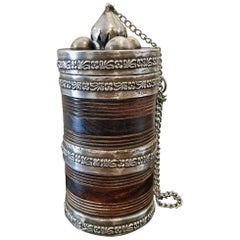
Set of 6 Mindanao Brass Silver Betel Boxes, Philippines
Located in Dallas, TX
Presenting an amazing set of 6 Mindanao brass silver betel boxes, Philippines.
Betel chewing was prevalent in the southern Philippines as in much o...
Category
Antique Late 19th Century Philippine Islamic Tea Caddies
Materials
Silver, Brass, Copper
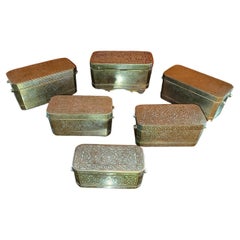
Pair of 19th Century American Henry Troemner Philadephia Pa Chinoiserie Tea Bins
By Henry Troemner
Located in Dallas, TX
Presenting a gorgeous and extremely rare pair mid-19th century, metal tea bins, by Henry Troemner of Philadelphia, PA in the chinoiserie style.
From circa 1845.
Made of black enamel...
Category
Antique Mid-19th Century American Chinoiserie Tea Caddies
Materials
Tin
Related Items
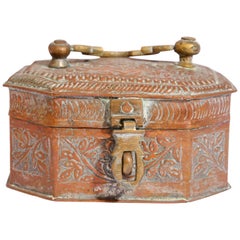
Handcrafted Antique Tinned Copper Metal Betel Box, India
Located in Moreno Valley, CA
Beautiful handcrafted antique tinned copper decorative octagonal betel box with with lid, handle and brass latch.
The metal is delicately and int...
Category
Early 20th Century Indian Folk Art Decorative Boxes
Materials
Brass, Copper, Tin

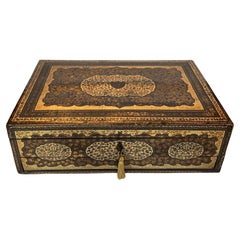
Chinoiserie Lacquer Sewing Box, 19th Century, Japan
Located in Toronto, CA
This is a remarkable 19th century, Japanese lacquered sewing box with multiple compartments on the interior.
The exterior is decorated in elaborate black and gilded motifs including...
Category
Antique Early 19th Century Japanese Chinoiserie Decorative Boxes
Materials
Bone, Wood, Lacquer
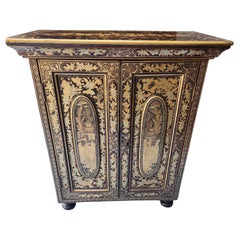
19th Century Chinoiserie Tall Box
Located in Los Angeles, CA
In great condition for its age. With bone handle pulls.
Category
Antique Late 19th Century Chinese Chinoiserie Jewelry Boxes
Materials
Bone, Wood, Lacquer
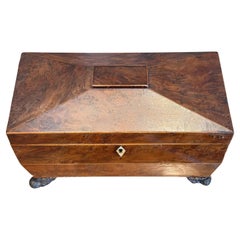
19th Century English Regency Tea Caddy
Located in Charlottesville, VA
A large English tea caddy. It is mahogany with brass feet.
Category
Antique 19th Century British Tea Caddies
Materials
Brass
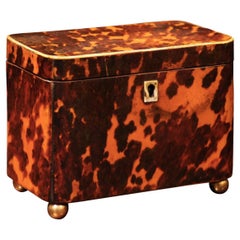
19th Century English Tortoiseshell Tea Caddy
Located in Atlanta, GA
19th Century English Tortoiseshell Tea Caddy
Category
Antique 19th Century English Tea Caddies
Materials
Tortoise Shell
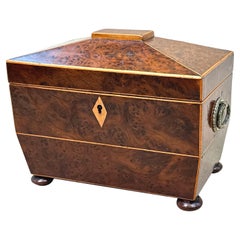
Burr Yew 19th Century Tea Caddy
Located in Bedfordshire, GB
A Very Attractive And Good Quality Early 19th Century Regency Period, Burr Yew Wood Tea Caddy Having Boxwood Strung Decoration Throughout, The Hinged Pagoda Top Enclosing Two Lidded ...
Category
Antique Early 19th Century English Regency Tea Caddies
Materials
Yew
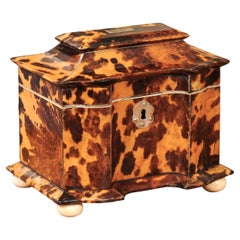
19th Century English Tortoiseshell Tea Caddy with Silver
Bone Details
Located in Atlanta, GA
19th Century English Tortoiseshell Tea Caddy with Silver & Bone Details
Category
Antique 19th Century English Tea Caddies
Materials
Tortoise Shell
$5,250 / set
H 6 in W 7 in D 5 in
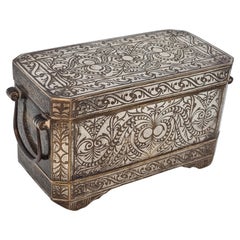
A Mindanao silver inlaid bronze betal nut box, Islamic, mid to late 19th century
Located in Central England, GB
This highly decorative box is a betal nut box. The habit of chewing was relevant in the southern Philippines and much of southeast Asia. Wealthy Maraneo families on the island of Mi...
Category
Antique Late 19th Century Philippine Tribal Decorative Boxes
Materials
Silver
$2,931
H 5.32 in W 9.45 in D 3.94 in
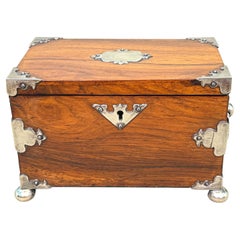
19th Century Anglo Chinese Padouk Tea Caddy
Located in Bedfordshire, GB
A Rare Mid 19th Century Anglo-Chinese Padouk Wood Rectangular Tea Caddy Having Attractive Silver Plate Mounted Decoration Throughout, The Hinged Lid Enclosing Two Lidded Divisions, W...
Category
Antique Mid-19th Century Chinese Victorian Tea Caddies
Materials
Padouk
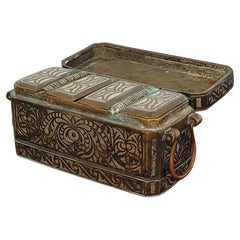
Antique Southeast Asian Filipino Maranao Silver Inlaid Brass Betel Nut Box
Located in Forney, TX
A scarce fine quality antique silver-inlaid solid brass betel nut box (Lutuan), dating to the second half of the 19th / early 20th century, hand-crafted in Mindanao, Philippines.
Boxes such as this were used to store the areca nut (also known as the betel nut) which would be wrapped in a betel leaf with lime paste and other ingredients, often tobacco, for chewing. Similar to the European tea caddy, these boxes often served as a way to impress while showing off ones wealth.
Betel chewing was prevalent in the southern Philippines as in much of the rest of Southeast Asia. Wealthier Maranao families on Mindanao were able to afford elaborate silver-inlaid brass betel boxes such as this example. Such boxes were used to show off to guests and from which they were offered betel and the other component such as leaves and lime to make up the betel quid.
Rare large size, most extant examples of such boxes tend to measure around 5 inches in length. At slightly more than 7.75 inches the example here is larger than most.
The distinctive decorative box features a very heavy strong-box like rectangular shaped chest form with canted corners, copper handles, and a conforming hinged lid, lifting open to reveal an interior divided into three compartments covered by four hinged lids. Each of these doors is inlaid with silver in stylized orchid flower patterns.
Exceptionally executed throughout, the arabesque silver inlaid exterior is decorated to the top with a large orchid motif within scrolling obid-obid (stylized rope) borders. The front, back and sides are inlaid with sets of stylized tail feathers of the sari-manok bird beneath which are unusual, highly stylized whimsical zoomorphic faces that appear like cat or tiger faces. (Such stylisation is accounted for by Southeast Asian Islamic preferences to avoid the overt and this potentially idolatrous representation of animal and human forms. Designs such as these are drawn from a local design repertoire that has its origins in wood carving.
Although the spread of Islam in the Philippines began in the 14th century, mostly through the influence of Muslim merchants from the western Malay Archipelago, decorative arts in this design remain exceptionally rare. This lutuan represents a fine example of Islamic metalwork from the most eastern outreach of Islamic art and civilisation: Mindanao island being significantly further east than even China – artwork from Islamic Southeast Asia remains chronically under-represented in the world’s major collections of Islamic art.
PROVENANCE / ACQUISITION
Acquired from highly reputable auction house, Austin Auction Gallery, established 1983, Austin, Texas.
References
Brownrigg, H., Betel Cutters...
Category
Antique 19th Century Philippine Islamic Decorative Boxes
Materials
Silver, Brass, Bronze, Copper
$1,100
H 3.25 in W 7.75 in D 3.25 in
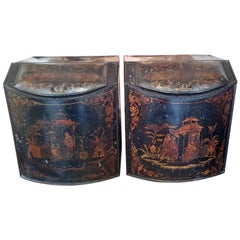
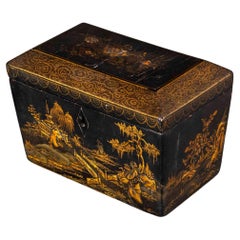
Rare 19th Century Chinoiserie Black Lacquer Tea Caddy, circa 1820
Located in Richmond, London
A very rare English Regency period chinoiserie style black lacquer box, exquisitely gilt-decorated with whimsical oriental motifs.
England, early 19th century.
Why we like it
A cha...
Category
Antique Early 19th Century European Chinoiserie Tea Caddies
Materials
Wood, Lacquer
19th Century Anglo-Indian Mughal Box
Located in Moreno Valley, CA
19th century Anglo-Indian Mughal wood box, inlaid and hand carved with the Taj Mahal and some flowers all around.
Jewelry box, Anglo-Raj box from India in great condition.
Nice Mughal Bombay Box...
Category
Antique Late 19th Century Indian Anglo Raj Decorative Boxes
Materials
Sandalwood