R Wholesale Diamond Jewels Porcelain
to
3
4
1
3
4
4
4
3
1
1
4
4
4
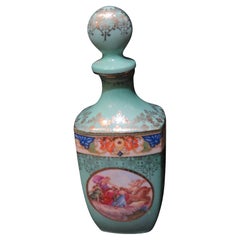
Beautiful 19th Century Painted NeoClassical Porcelain Bottle 1861 Prez Saxe
By Lalique
Located in New York, NY
The Following Item we are offering is This beautiful antique bottle features a lovely Neoclassical Scene. The vase is painted a Turquoise Green and porcelain has relief details which...
Category
Antique 19th Century German Porcelain
Materials
Porcelain
Important Estate Gorgeous Sevres Style Dresden Style Porcelain Napoleon
Located in New York, NY
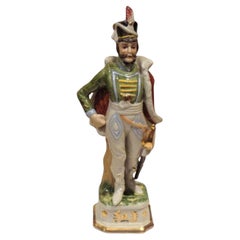
The Following Item we are offering is this Large Estate Signed Dresden Style RARE LARGE FRENCH NAPOLEON DRESDEN STYLE STANDING PORCELAIN FIGURE. Beautifully Handpainted with Fine Det...
Category
20th Century Unknown Porcelain
Materials
Porcelain

$1,250 Sale Price
50% Off
Beautiful Framed 19TH C Painting on Porcelain Woman Children Charles Chaplin
Located in New York, NY
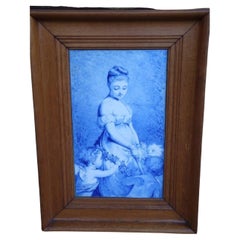
The Following Item we are offering is a Beautiful Museum Quality Painting on Porcelain of a Woman surrounded by Cherubs holding Garland. Magnificently done with Outstanding Detail. Framed in a Beautiful Wooden Frame, inscribed Ch. Chaplin. Taken out of the Penthouse Estate of the President of Prestige Jewelers Upper East Side, New York City.
Framed Measurements: 24" H x 33" W
Charles Joshua Chaplin (8 June 1825 – 30 January 1891) was a French painter and printmaker who painted both landscapes and portraits. He was an accomplished artist mastering different techniques such as pastels, lithography, watercolor, chalk, oil painting and etching. He was best known for his elegant portraits of young women.
Charles Joshua Chaplin was born on 8 June 1825 in Les Andelys, Eure, France. His mother, Olympia Adelle Moisy, was French, whereas his father, John Chaplin, was an art broker from England. Charles Chaplin spent his whole life in France, becoming a naturalized citizen in 1886.[1][2] He studied at the École des Beaux-Arts in Paris from 1840, and he took private lessons in the studio of Michel Martin Drolling, whose apprentices included Paul Baudry, Jules Breton and Jean-Jacques Henner. Later he also taught at the École des Beaux-Arts.[2]
In 1845 he entered the Salon de Paris, the official art exhibition of the Académie des Beaux-Arts, as a portrait and landscape painter with the painting Portrait of the Artist's Mother. Chaplin conducted art classes specifically for women at his studio. The American artist Mary Cassatt, the French artist Louise Abbéma and the English artist Louise Jopling were among Chaplin's students. His son Arthur Chaplin was also a painter. Chaplin died on 30 January 1891 in Paris as a wealthy man and is buried in the Père Lachaise Cemetery.[3][4]
Chaplin made his debut at the Salon with portraits, but he also painted landscapes, particularly the countryside of Auvergne. His early works, from 1848 to 1851, were painted in a more realistic style, and are characterized by an interest in realism, which was a style that had been reestablished in France by the French Second Republic, that had the motto Liberté, égalité, fraternité, and was ruled for three years by the republican government of France from the 1848 Revolution until the 1851 coup by Louis-Napoléon Bonaparte. Realism was an artistic movement that began in France in the 1850s, after the 1848 Revolution.[5] From the late 18th century Romanticism dominated French art and literature but was spurned by Realists, who revolted against the display of the emotions of the Romantic movement, seeking to depict real and characteristic contemporary individuals and situations with truth and accuracy.[6]
Chaplin painted many works in his early days, including floral studies that were displayed at the Salon de las Flores. Later, in the late 1850s, he abandoned naturalism, his earlier style, exchanging it for a more graceful, elegant and supple technique that brought him a certain notoriety in France during his time as a portrait painter; as such he embraced the idyllic and voluptuous and fashionable style of the prominent French painter, François Boucher (1703–1770).[7]
He also embraced the tradition of the great English portraitists. He developed his very own style of painting but was inspired by the British painters Joshua Reynolds and Thomas Gainsborough. He used to engrave the works of the Dutch artist Pieter Paul Rubens and gained further influence from his work.[2]
Later work
Gradually the muddy colours used by Chaplin transformed into white, grey and pink, depicting his models with an opalescent, mother-of-pearl complexion by applying a subtle palette of rosy flesh tones and light greys. After painting portraits and trying his skills on ornamental painting, Chaplin took up genre painting in the 1850s. His favourite subjects are the feminine grace of a young woman’s everyday life. He portrays women in several poses: resting; grooming; singing; and reading. He captures them with lightness and carelessness and accentuates the decorative elements of the composition.[2]
Empress Eugénie, the wife of Napoleon III and an admirer of the "Pompadour style", rapidly fell under the enchantment of the painter's neo-Rococo works. Chaplin was among Napoleon III and Empress Eugénie’s favourite court artists. In 1859, when his portrait of Aurora was banned by the judges of the Salon as "too erotically suggestive", Napoléon III defended Chaplin and overturned the disqualification order.[8] He was similarly valued as an interior decorator and was appointed to remodel the decor of Empress Eugénie's rooms.[8]
His sensual portraits of women and young girls, often with models posed erotically in hazy surroundings and frequently wearing transparent clothing, attracted the interest of the high society and aristocracy of Paris during the French Third Republic (1870–1940) guaranteeing his success and wealth. He was one of the most popular painters of his time, but nowadays his work is almost unknown, in spite of the fact that his works hang in many major museums around the world.[2]
He employed his Rococo style for his mythological scenes and genre scenes paintings. His genre pictures formed a significant part of his work. In 1861, working as a decorative painter. Chaplin painted the doors and several glass panels above them of the Salon des Fleurs in the Tuileries Palace.[3] The Palace was gutted by fire in 1871 and its ruins swiftly demolished.[9] He also undertook decorating work in the Salon de l’Hémicycle of the Palais de l’Elysée.[3]
Honours and awards
A Song Silenced, Private collection.
As a member of the Académie royale de peinture et de sculpture, Chaplin exhibited his paintings at the Salon de Paris, the official exhibition venue of members' work. He began exhibiting his paintings at the French Artists' Salon in 1845 and was represented there habitually each year. These exhibitions made him one of France's most famous portrait artists. Commencing in 1847, his work was exhibited regularly at the Royal Academy in London.[8]
During his lifetime he received acclamation for his artistic talents by the award of several medals: a third class medal in 1851; a second class medal the following year; and an Honour Medal...
Category
20th Century Unknown Porcelain
Materials
Porcelain
$3,600 Sale Price
80% Off
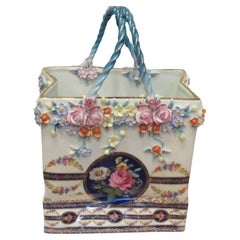
Rare Important Gorgeous Sevres Style / Dresden Style Porcelain Shopping Bag
Located in New York, NY
The following Item we are offering is a Spectacular Handpainted Sevres Style / Dresden Style Porcelain Shopping Bag/ Basket with Intricate Colorful Floral Motifs outside and inside o...
Category
20th Century Unknown Porcelain
Materials
Porcelain
$700 Sale Price
72% Off
Related Items
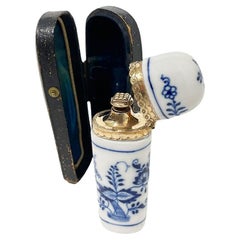
19th Century Small Gold and Porcelain Scent Perfume Bottle in Box
Located in Delft, NL
19th century small porcelain scent perfume bottle in case
Porcelain bottle with white and blue painted union pattern
The gold mounting on the bottle is marked with the Dutch gold...
Category
Antique 19th Century Dutch Bottles
Materials
Gold
$1,344
H 3.55 in W 1.19 in D 0.87 in
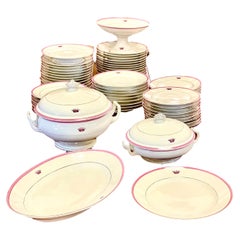
19th Century Porcelain Dinner Service from the Maison Charles Pillivuyt et Cie
By Charles Pillivuyt
Cie
Located in LA CIOTAT, FR
A gorgeous dinner service from the Maison Charles Pillivuyt et Cie, a manufacturer of high-quality porcelain founded in 1818. Each piece is hand-painted with a delicate rose- pink bo...
Category
Antique Late 19th Century French Napoleon III Dinner Plates
Materials
Porcelain
$2,800 Sale Price / set
20% Off
H 19.69 in Dm 19.69 in
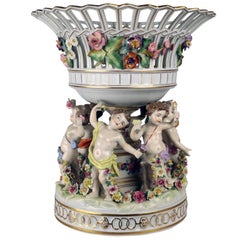
Dresden Porcelain Figural Centrepiece Raised Fruit Bowl
Located in Montreal, QC
This highly decorative footed bowl, reticulated and painted with flowers, is raised on a charmingly decorative base modelled with dancing putti ...
Category
Early 20th Century German Centerpieces
Materials
Porcelain
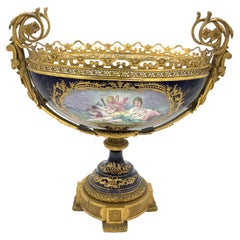
Massive Sevres Style Porcelain and Gilt Bronze Centrepiece
Located in London, GB
19th century sevres style centrepiece with impressive gilding all around it.
Category
Antique Late 19th Century French Planters, Cachepots and Jardinières
Materials
Porcelain
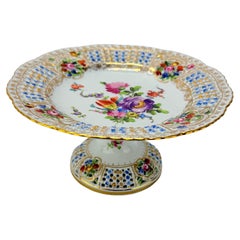
Antique Dresden Floral Encrusted
Pierced Porcelain Compote
By Dresden Porcelain
Located in Atlanta, GA
This early 20th-century Dresden floral encrusted and pierced porcelain compote retains the timeless elegance and sophisticated craftsmanship associated with the legendary Dresden por...
Category
Early 20th Century German Porcelain
Materials
Porcelain
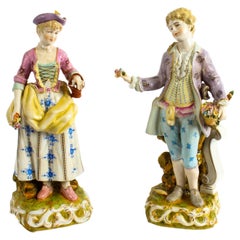
Pair Dresden Style Hand Painted Porcelain Figures Late 20th Century
Located in London, GB
This is a wonderful pair of hand painted porcelain figures in the Dresden style, dating from the last quarter of the 20th century.
This delightful pair features a woman and a man standing tall in grace, adorned in classical garb and holding a basket of lovely flowers at their hands. They are depicted with absolutely fantastic attention to detail.
These figures are a perfect addition to your existing collection or a good set to start your own porcelain collection.
Condition:
In excellent condition, please see photos for confirmation of condition.
Dimensions in cm:
Height 37 x Width 19 x Depth 15
Dimensions in inches:
Height 1 foot, 3 inches x Width 7 inches x Depth 6 inches
Dresden Porcelain - A King's Obsession
In the early 1700s, King Augustus II, prince elector of Saxony, held goldsmith Johann Bottger prisoner and commissioned him to create gold. Bottger instead discovered the method of creating porcelain, a favored and valuable item in the king's eyes.
The king announced to Europe in 1710 that he would open a porcelain manufactory in Dresden. He instead opened one at nearby Albrechtsburg castle. Espionage was rampant, and the king guarded his porcelain secret, even though it meant imprisoning workers within the castle walls.
By 1720, the secret was leaked and porcelain producers popped up in Vienna and Venice. Dresden Porcelain adopted Saxon crossed swords in under-glaze blue as its distinguishing mark.
In 1736, the porcelain manufactory produced the "Swan Service...
Category
Vintage 1980s Porcelain
Materials
Porcelain
$375 / set
H 14.57 in W 7.49 in D 5.91 in
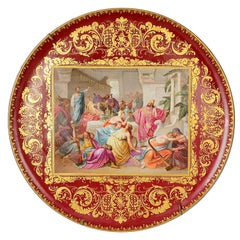
Large 19th Century Vienna Porcelain Charger
By Imperial Vienna Porcelain
Located in Brighton, Sussex
Entitled 'The banquet of Belsazar' a large fine quality Vienna porcelain charger, having a burgundy boarder with scrolling gilded decoration.
Category
Antique Late 19th Century Austrian Porcelain
Materials
Porcelain
19th French Century Signed Samson Porcelain
By Edmé Samson
Located in Roma, IT
19th French Century Signed Samson Porcelain
Beautiful and rare hand-decorated porcelain bowl from the famous Edmé Samson manufacture (b Paris, 1810; d Paris, 1891).
Displays the ori...
Category
Antique Early 19th Century French Neoclassical Porcelain
Materials
Porcelain
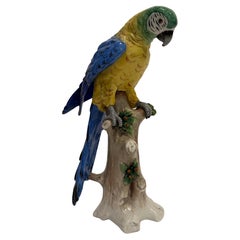
Fine 19th Century Italian Porcelain Parrot
By Capodimonte
Located in Norwood, NJ
Colorful and finely painted porcelain parrot in greens, yellows and blues, perched on realistic branch with leaves and berries. Bottom with crowned ...
Category
Antique Mid-19th Century Italian Ceramics
Materials
Porcelain
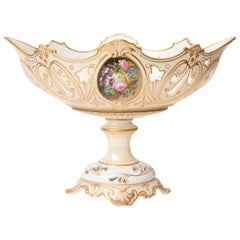
19th Century Old Paris Porcelain Centerpiece, Hand-Painted Florals
By Old Paris
Located in West Palm Beach, FL
A stunning piece of Old Paris porcelain that features two sides of beautiful hand-painted floral panels, hand-cut work and hand-painted trim. Nicely shaped with a long and deep boat ...
Category
Antique 1840s French Empire Revival Centerpieces
Materials
Porcelain
$1,450 Sale Price
58% Off
H 11 in W 15.5 in D 9.75 in
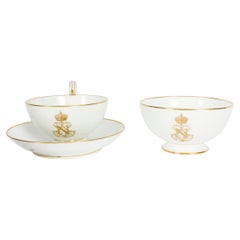
Antique Emperor Napoleon III Sevres Porcelain Cup Saucer
Sugar Bowl 19th C
Located in London, GB
This is an important fine Sèvres porcelain breafast cup and saucer with a footed sugar bowl dating from the mid 19th Century.
The cup saucer & bowl all feature the gilt crowned N cipher with gilt line borders on a white ground and the undersides bearing the red Imperial crowned N Sèvres mark with date letters for 1855 and 1860.
This is sure to be a treasured addition to your home.
Condition:
Both cup saucer and bowl are in very good condition with no signs of damage or restoration and the gilding is crisp.
Dimensions in cm:
height 9 x width 16 x depth 12 - cup
height 3.6 x width 18 x depth 18 - saucer
height 7.5 x width 14 x depth 14 - bowl
Dimensions in inches:
height 3 inches x width 6 inches x depth 5 inches - cup
height 1 inch x width 7 inches x depth 7 inches - saucer
height 3 inches x width 5 inches x depth 5 inches - bowl
Louis was king of France when the monarchy was overthrown during the French Revolution. He was guillotined in 1793.
Louis was born at Versailles on 23 August 1754. In 1770, he married Marie Antoinette, daughter of the emperor and empress of Austria...
Category
Antique 1850s French Porcelain
Materials
Porcelain
$1,059 / set
H 3.55 in W 6.3 in D 4.73 in
19th Century Italian Porcelain Centerpiece
Located in Dallas, TX
Late 19th century Italian porcelain centerpiece. Classical design depicting the four seasons.
Category
Antique 19th Century Italian Centerpieces
Materials
Porcelain