Solomon Treasure Cabinets
to
1
Height
to
Width
to
Depth
to
3
3
1
2
1
3
2
2
1
1
3
2
1
3
3
3
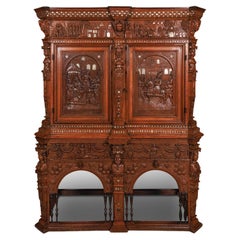
Rare and Important Renaissance "Judaica" Carved Oak Wood Cabinet
Located in Queens, NY
A Rare and Important Renaissance "Judaica" Carved Oak Wood Cabinet, circa 1680
We are pleased to present a rare and important Renaissance Judaica c...
Category
Antique 17th Century German Renaissance Cabinets
Materials
Mother-of-Pearl, Oak

$62,800 Sale Price
60% Off
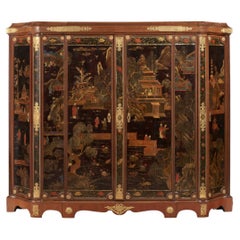
Rare Louis XV Ormolu-Mounted Tulipwood and Chinese Lacquer Cabinet
Located in Queens, NY
A Rare Louis XV Ormolu-Mounted Tulipwood and Chinese Lacquer cabinet, c. 1750 (Regence Period)
A truly magnificent, monumental, and one of a kind cabinet, painted throughout with gi...
Category
Antique 18th Century French Louis XV Cabinets
Materials
Ormolu
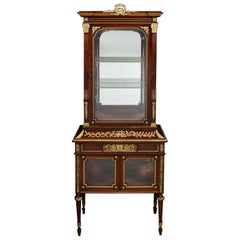
Exquisite French Ormolu-Mounted Mahogany and Glass Vitrine Cabinet
By François Linke
Located in Queens, NY
An exquisite French Ormolu-mounted mahogany and glass vitrine cabinet, attributed to Francois Linke, circa 1880.
Although unsigned, the jewel-like quality ormolu bronze mounts throughout, especially the corinthian columns, and the best mahogany and craftsmanship of the period, confirms our attribution to Francois Linke, who was almost certainly one of best furniture makers of the Belle Epoque period alongside Paul Sormani, Henry Dasson, Alexandre Chevrie...
Category
Antique 19th Century French Napoleon III Vitrines
Materials
Bronze, Ormolu
Related Items
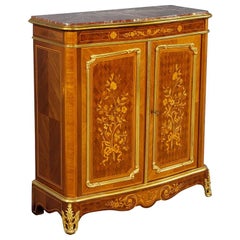
Antique French Louis XV Style Marble Top Commode Cabinet
Located in North York, ON
Exquisite antique king wood with bronze mounts in Louis XV style. This Commode is in excellent original condition. Featuring beautiful brass or...
Category
Vintage 1930s French Louis XV Commodes and Chests of Drawers
Materials
Marble, Brass
$5,600 Sale Price
20% Off
H 44 in W 39.5 in D 17 in
Ormolu and Boulle Ebonised Wood Antique Vitrine Cabinet
By André-Charles Boulle
Located in London, GB
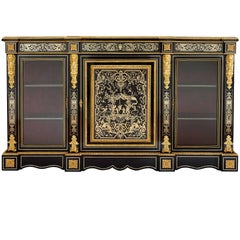
With panels of inlaid brass, the central door depicting a scene with cherubs playing amidst arabesque scrolls with phoenix and other exotic birds, the flanking glazed doors separated...
Category
Antique 19th Century English Victorian Cabinets
Materials
Brass, Bronze
19th Century French Vitrine of Kingwood and Gilt Bronze Mounts
By François Linke
Located in London, GB
A fine vitrine in the manner of Francois Linke
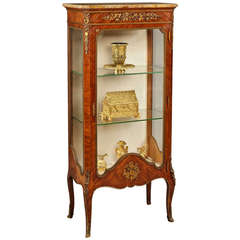
Constructed in kingwood, with gilt bronze mounts, in the Louis XVI Transitional style; rising from bronze foliate sabots, with gent...
Category
Antique 19th Century French Louis XVI Vitrines
Materials
Marble, Bronze
Renaissance Style Carved Cabinet in oak, XIXth century
Located in Beaune, FR
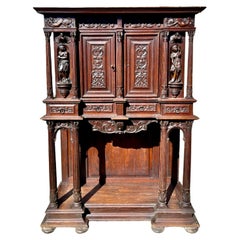
Cabinet, sideboard or splashback in solid oak in Renaissance style. Richly carved, this piece of furniture offers a very pretty architecture. The decorations are inspired by the Rena...
Category
Antique 19th Century French Renaissance Revival Cabinets
Materials
Oak
Antique French Renaissance Revival Oak Carved Hunt Bookcase Display Cabinet 97"
Located in Dayton, OH
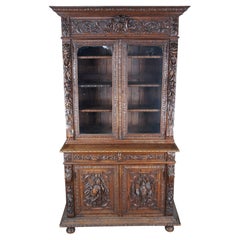
Exceptional Antique 19th Century Renaissance Revival Hunt Cabinet. Hand carved from oak with a large upper display portion that opens to three adjustable shelves. Door frames are neatly carved and flanked by meticulously carved outer stiles with figural ringed lion spandrels over a fruit and foliate motif. Crown is centered by a shell and scrolled foliate cartouche set between acanthus motif and French medallions.
The base of the cabinet has two hand dovetailed drawers with figural carved gargoyle...
Category
Antique 19th Century Renaissance Cabinets
Materials
Glass, Oak
$4,800 Sale Price
20% Off
H 97 in W 22.5 in D 54 in
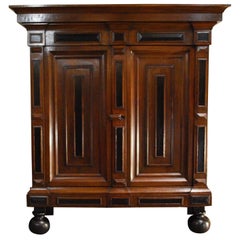
18th Century Dutch Renaissance Oak Cabinet
Located in Casteren, NL
A beautiful late 18th century cabinet in the best quality solid oak. This is a typical 'kussenkast' or pillow cabinet. Pillow refers to the shape of the...
Category
Antique Late 18th Century Dutch Renaissance Cabinets
Materials
Oak
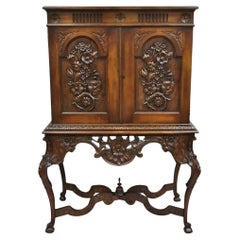
Antique French Renaissance Flower Carved Walnut China Cabinet Radio Bar Cabinet
Located in Philadelphia, PA
Antique French Renaissance Flower Carved Walnut China Cabinet Radio Bar Cabinet. Item features wonderful relief carved flowers throughout, shapely ca...
Category
Early 20th Century Unknown Renaissance Cabinets
Materials
Walnut
$1,500
H 61 in W 43 in D 22 in
Important Renaissance Cabinet from Lyon
France
with a Decor of Perspectives
Located in Saint-Ouen, FR
As soon as 1540 France's second Renaissance is in the making, intimately linked to the rediscovery of the Antique world. The development of the printing and engraving industry allows the spread of artworks and models in many cities and countries. The Italian influence can be perceived in every artistic field. While the French king entrust the most talented Italian artists with major projects such as Il Rosso or Primaticcio in Fontainebleau, French artists also travel to Italy to form themselves to this new style. In Italy they get acquainted with the work of Leo Battista Alberti the first to theorize perspective (De Pictura, 1435-36) and architecture (De re oedificatoria, 1541). Those two publications would have a revolutionary impact on arts.
Furniture is marked by the work of the most famous Italian architects of the time as well as French architects. Indeed Philibert de l'Orme competes with Alberti and by the end of his life publishes several treaties including one devoted to a theory of architecture (1567). Unfortunately he would not live to complete the second volume. In this treaty he expresses his interest for mathematical norms applied to architecture, copied from the Antique. His journeys in Italy allowed him to accumulate the most sophisticated references. Jean Bullant, another architect of great talent also theorizes his practice. He establishes rules characterizing Greco-Roman art staying faithful to Vitruvius.
Following this new inspiration the structure of furniture evolves. From then on appear columns, capitals, cornices, friezes and architraves. The ornamentation uses this inspiration as well with egg-and-dart, palm leaf and rose adorning the most beautiful pieces.
In Lyon, crossroad where meet merchants from everywhere those new experiments are welcomed. Lyon florishing printing industry allows the spreading of models and treaties essential to the artist's work. Thus the first publication of Vitruvius' De Architectura in France would be printed in Lyon in 1532.
Artists from Lyon rediscover and familiarize themselves with the Antique knowledge very early. They adopt those new ideas and use them in their own creations. Lyon cabinet-makers re interpret Antique architecture and Italian Renaissance palaces to give their pieces a pure and harmonious architectural structure. Grooved pilasters are particularly favored. They are topped by capitals of diverse orders always respecting the sequencing with simpler ones for the lower levels and the richest ones on the higher levels. As for the ornamentation, one of the great distinctiveness of Lyon workshops remains the architectural perspective illusions, drawing inspiration from Tuscany.
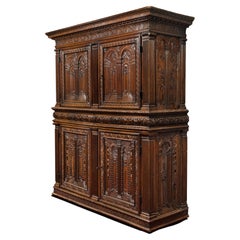
True masterpiece of the Second French Renaissance this important cabinet illustrates Lyon workshops' taste for fine Italian architecture inspired by Antiquity. An architectural perspective of great quality is treated in symmetry on each panel.
This two-bodied cabinet without recess stands on four rectangular feet. The base comprises a molding, a palm leaf frieze and is bordered by a braid.
The lower body is divided by three grooved pilasters with Tuscan capitals framing two door-leaves. The two panels are encircled by a moudled frame with palm leaves. They are finely carved with a decor of fantasized architecture depicting an Italian Renaissance palace erected symmetrically on each side of a grooved pilaster. On the ground floor a door opens through a stilted arch while the stories are opened with mullioned windows, dormers and occuli. Two large pegged-boss cladded pillars support the entablature enriched by a palm leaf frieze upon which stands an arch whose coffered intrados is centred by a rose. Behind this arch a pyramid appears, standing in front of a second facade with a window topped by a broken curvilinear pediment under a cul-de-four with a shell.
The checker flooring gives depth to the low-reliefs creating vanishing points structuring the panels and guiding the eye of the observer.
A thin laurel braid highlights the belt of the cabinet where are located two drawers. Their facades are adorned by palm leaves in hoops.
The upper body is encircled with palm leaves. The same ternary division as in the lower body appears. However, the pilasters are topped by Ionic capitals with volutes and egg-and-dart. The door-leaves are framed with flowers. On the panels the artist has designed another architectural decor. On the foreground open two arches on top of grooved pilasters with rectangular capitals adorned with palm leaves. The arches are enriched with braids and the coffered intrados bears a decor of roses. The spandrels also bear a flower decor. In the background another arcature hosts a fluted grooved column topped with double basket acanthus capital, characteristic of Corinthian order. The triangular pediment is interrupted by a choux bourguignon.
A large cornice crowns the cabinet. It stands on pilasters and forms an entablature comprising a palm leaf frieze and an egg-and-dart, triglyph and palm leaf cornice.
The cabinet's sides have also been carefully considered. The lower body's panels are enriched with an arch rising above a broken pediment portico hosting a twisted column. Flowers garnish the spandrels. An architectural facade completes the decor. The upper body's panels present two arches supported by a facade opened with dormers and mullioned windows as well as cartouches (one bears the inscription 1580 dating the cabinet) suggesting the interior of an Italian Renaissance palace, confirmed by the chandeliers. The flooring leads our gaze to a second arch with a broken curvilinear pediment where stands a flower vase. This arch opens onto a perspective of another facade along a road.
Inside the cabinet, on the lower body door-leaves appear two designs. On the right door is depicted a Crucifixion. Saint Mary and Saint John flank the Christ on the cross. In the bottom part is inscribed « Dure uiator abis nihil haec spectacula curas / Pendenti cum sis unica cura Deo. / Tota suo moriente dolet natura Magistro. / Nil qui solus eras caussa dolenda doles. ». The signature [Christoff Swartz Monachiensis pinx[it] / Ioa[nnes] Sadeler sculp[it]] tells us it was made by Johan Sadeler I (1550-1600) after Christoph Schwartz (1548-1592). This engraving belongs to an ensemble depicting the Passion of Christ Johan Sadeler executed in 1589 after an altar piece painted by Christoph Schwartz for the private chapel of Renée of Loraine, wife of Duke William V of Bavaria. This altar piece made of nine copper panels has been destroyed during the 19th century. The Crucifixion panel once in the centre of the altar piece is the only one that survived and is today kept in Munich's Alte Pinakothek.
On the left door appears Saint Francis receiving the stigmata. The inscription says : « Signastidomine Servum Tuum. Franciscum. Signis Redemptionis Nostrae ».
This Renaissance cabinet with an architectural decor appearing as much in the structure faithful to Antique rules...
Category
Antique 16th Century European Renaissance Cabinets
Materials
Walnut
$180,415
H 87.41 in W 74.81 in D 27.17 in
Antique French Louis XV Walnut and Glass Vitrine Cabinet, Circa 1880
Located in New Orleans, LA
Antique French Louis XV walnut and glass vitrine cabinet, Circa 1880.
Category
Antique 1880s French Vitrines
Materials
Walnut

Antique Dutch Renaissance Oak Cabinet
Located in Casteren, NL
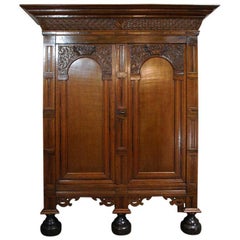
This extraordinary cabinet is made of the finest oak in the tradition of the Dutch Renaissance during the “Dutch golden age”
This cabinet is made in ...
Category
Antique Early 18th Century Dutch Renaissance Cabinets
Materials
Oak
Rare Renaissance Cabinet Richly Carved
Located in Saint-Ouen, FR
This rare Renaissance cabinet is richly decorated on the doors and drawers with carvings depicting the four seasons, and on the uprights and the entablature, alternating flower bouquets inlaid with mother of pearl. This is a beautifully conceived piece of furniture, representing a crowned portico with its entablature and cornice.
The upper body
Articulated separately in a ternary rhythm, as with the lower body, the upper part opens with two carved doors. The doors are framed by both the lateral uprights and the casing. There are cartouches carved into the casing in which mythological figures are depicted with flower bouquets.
On the doors:
On the right: Spring, a female figure crowned with a wreath of leaves, holding a basket full of flowers. She is wearing necklaces and bracelets on each arm, with drapery discretely wrapped around her body and is standing on a winged putti’s head. On each side are depicted a tree and a village with a steepled church. Above her head floats the three signs of the zodiac corresponding to the season: Aries, Taurus and Gemini.
On the left: Summer, a bearded man crowned with ears of corn and bearing armfuls of corn. He is standing on a similar winged putti, flanked by a tree and an ear of corn. The following three signs of the zodiac appear: Cancer, Leo and Virgo.
On the uprights and the central casing a number of smaller figures seem to represent virtues and vices that newly wedded couples should aspire to and avoid.
On each side, at the bottom of the uprights, there is a dog representing fidelity. Above, a lion embodies power, wisdom, and justice.
In between, on the left upright, there is a figure of noncombatant Athena wearing a helmet and holding a spear, an arrow pointing down and in her left hand, a shield, symbol of protective power. On the right upright, the goddess Venus controls the arrow of Cupid.
The iconography here acts as a clear reminder of the required virtues that both parts of a young couple need to fulfill: fidelity, power, wisdom and justice. For him, the goddess Athena focuses on the power. Whereas for her, it is Venus who shows how to control Cupid’s arrow.
On the central casing at the bottom, by way of contrast, there is a peacock, a symbol of pride and at the top, a monkey representing lust and mischief. In between, a woman holding a chain and a cup full of precious stones while on the floor sits a half empty opened casket. This can be interpreted as a symbol of extravagance.
Above, the entablature, decorated with male figures resting on leaking urns, may symbolize the passing of time. They are flanked by two consoles decorated with acanthus leaves and separated by flower bouquets (inlaid with mother of pearl). Finally on top, a cornice acts as a crown for the piece of furniture.
The lower body
The moulded base stands on four round, flattened feet.
Represented on the doors:
On the left: Autumn, a stocky, naked man crowned with vine leaves, holding fruits in his right hand and with his left, picking a bunch of grapes from a climbing vine. Standing on a mound, he is surrounded by a vine and a hill, at the foot of which a man presses the grapes in a big vat after the harvest. Above the climbing vine appear the signs of Libra, Scorpio and Sagittarius.
On the right: Winter, an elderly man wearing a fur cloak...
Category
Antique 16th Century French Renaissance Cabinets
Materials
Walnut
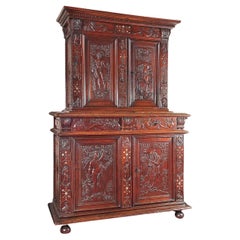
Signed Francois Linke Bronze Mounted Louis XV Kingwood Vitrine China Cabinet
By François Linke
Located in Swedesboro, NJ
Presenting an exquisite Signed François Linke Bronze Mounted Louis XV Kingwood Vitrine China Cabinet, a museum-quality piece that showcases the artistry and craftsmanship of one of F...
Category
Antique Early 1900s French Louis XV Vitrines
Materials
Bronze
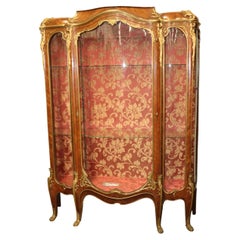
$49,500
H 77 in W 59 in D 16 in