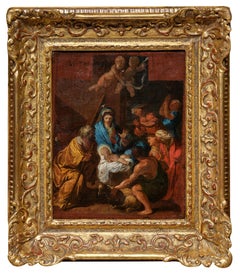
In an intimate atmosphere dominated by warm colors, Nicolas Loir offers us here a first thought, tightly focused and rigorously arranged, of the Adoration of the Shepherds in the Louvre Museum, in which he expresses his admiration for the art of Nicolas Poussin.
1. Nicolas Loir, a 17th-century Parisian artist inspired by Bourdon and Poussin
Nicolas Loir was born in Paris in 1623. His father, a goldsmith, first placed him with Simon Vouet and then with Sébastien Bourdon. At the age of 23, in 1647, he left for Rome, where he stayed for two years, drawing inspiration from the classicism of Raphael and, above all, Nicolas Poussin, whom he met and deeply admired.
On his return to France in 1649, he received his first major commissions for religious paintings for Parisian churches, the most prestigious of which was the May of Notre Dame for the year 1650. He also received numerous secular commissions for hotels and châteaux in the Paris region. Admitted to the Academy in 1663, he joined Le Brun's team and participated in the decoration of the royal castles of Vincennes, the Tuileries, and Versailles. Appointed professor at the Academy in 1666, then assistant to the rector in 1668, he died in 1679.
He married Marguerite Cotelle, daughter of the painter Jean I Cotelle, a specialist in monochrome paintings, and sister of the painter Jean II Cotelle. Dezallier d'Argenville, who owned several of his drawings, tells us that he was a man of gentle and modest temperament, deeply honest, and highly esteemed by his contemporaries, including as a portrait painter. We can see his amiable character features reflected in his portrait by Jean Tiger, which is kept at the Palace of Versailles (4th photo in the gallery).
2. Description of the painting and related artworks
Our painting depicts the adoration of the Holy Child, presented in the center of the composition on a pristine white cloth that catches the eye, by the shepherds. While the figure draped in yellow on the left is likely Saint Joseph, the Virgin Mary is depicted from the front, contemplating the Child with her right hand raised, her fingers spread as if to indicate her amazement at the realization of this Mystery. The five figures on the left, all dressed quite simply, are the shepherds who have come to worship the Child, as evidenced by the kid goat lying at his feet. Two cherubs carrying phylacteries fly in the sky and complete the composition.
Our Nativity was painted in oil on canvas coated with a brown-red preparation, visible in the two upper corners left unpainted, which is typical of French painting in the mid-17th century and found in the work of Nicolas Poussin. The overall atmosphere of the painting reveals Poussin's decisive influence, whether through the color palette dominated by primary colors (the blue of the Virgin's cloak, the orange-red of the shepherds' cloaks on the right, the bright yellow of St. Joseph's cloak on the left), the rather tubular treatment of the figures, but also through numerous direct references to Poussin's paintings. Examples include the two cherubs, which seem to be inspired by those above the Martyrdom of
Saint Erasmus...