Stephane Renard Fine Art
to
45
22
19
13
10
6
6
6
5
5
5
5
5
4
4
3
3
3
3
3
3
2
2
2
2
2
2
2
2
2
2
2
1
1
1
1
1
1
1
1
1
1
2
1
1
1
1
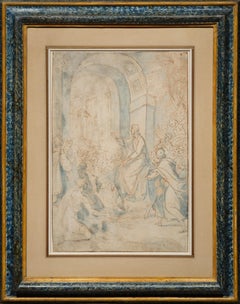
A large drawing by Il Cigoli depicting Christ
s Entry into Jerusalem
Located in PARIS, FR
This large sheet, delicately enhanced with blue ink wash, was created by Lodovico Cardi, known as Il Cigoli, the most prominent painter in Florence at the end of the 16th century. It...
Category
16th Century Old Masters Figurative Drawings and Watercolors
Materials
Paper, Chalk, Ink, Pen

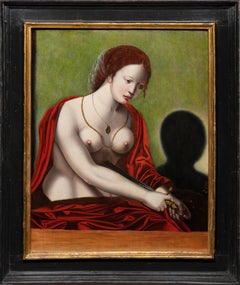
An intriguing Lucretia by the Follower of the Master of Female Half Lengths
Located in PARIS, FR
This painting depicting the suicide of Lucretia intrigues us with its strangeness. Although inspired by the artworks of the Master of Female Half-Lengths, it differs from them in its...
Category
16th Century Old Masters Nude Paintings
Materials
Oak, Oil
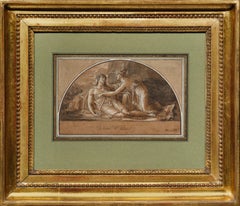
The Death of Adonis, a neoclassical drawing by Jean-Guillaume Moitte (ca. 1785)
Located in PARIS, FR
This elegant composition, whose curved shape suggests that it was intended for some decorative project, illustrates Moitte's shift around 1780 towards the neoclassical movement, insp...
Category
1780s Old Masters Figurative Drawings and Watercolors
Materials
Paper, Ink, Gouache, Pen
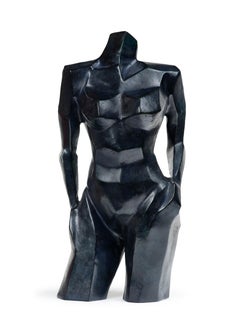
Douceur féminine (Feminine Softness) a bronze nude sculpture by Lili Mirante
Located in PARIS, FR
Lili Mirante (Paris, 1966 – last picture in the gallery) is a woman artist who lives and works in Paris. Born into a family of artists (her father was a renowned watercolorist), she ...
Category
2010s Modern Nude Sculptures
Materials
Bronze

Harmonie (Harmony), a bronze nude sculpture by Lili Mirante
Located in PARIS, FR
Lili Mirante (Paris, 1966 – last picture in the gallery) is a woman artist who lives and works in Paris. Born into a family of artists (her father was a renowned watercolorist), she ...
Category
2010s Modern Nude Sculptures
Materials
Bronze
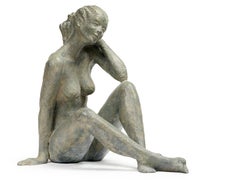
Sébastien (Sebastian), a nude bronze sculpture by Lili Mirante
Located in PARIS, FR
Lili Mirante (Paris, 1966 – last picture in the gallery) is a woman artist who lives and works in Paris. Born into a family of artists (her father was a renowned watercolorist), she ...
Category
2010s Modern Nude Sculptures
Materials
Bronze
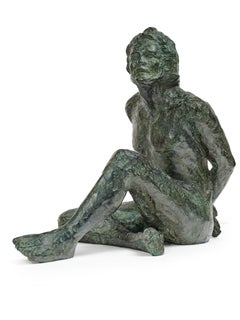
Loulou, a nude bronze sculpture by Lili Mirante
Located in PARIS, FR
Lili Mirante (Paris, 1966 – last picture in the gallery) is a woman artist who lives and works in Paris. Born into a family of artists (her father was a renowned watercolorist), she ...
Category
2010s Modern Nude Sculptures
Materials
Bronze
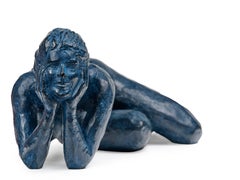
L
Eclatée (The Fragmented One), an abstract bronze sculpture by Lili Mirante
Located in PARIS, FR
Lili Mirante (Paris, 1966 – last picture in the gallery) is a woman artist who lives and works in Paris. Born into a family of artists (her father was a renowned watercolorist), she ...
Category
2010s Abstract Geometric Abstract Sculptures
Materials
Bronze
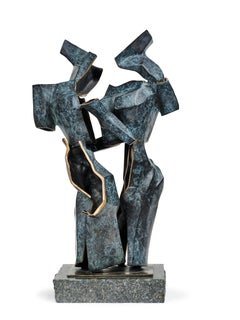
Humeur Vagabonde (Wandering Mood) a geometrical bronze sculpture by Lili Mirante
Located in PARIS, FR
Lili Mirante (born in Paris, 1966 - last picture in the gallery) is a woman artist who lives and works in Paris. Born into a family of artists (her father was a renowned watercoloris...
Category
2010s Abstract Geometric Nude Sculptures
Materials
Bronze
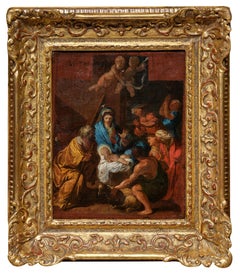
A first thought for Nicolas Loir
s Adoration of the Shepherds at the Louvre
Located in PARIS, FR
In an intimate atmosphere dominated by warm colors, Nicolas Loir offers us here a first thought, tightly focused and rigorously arranged, of the Adoration of the Shepherds in the Louvre Museum, in which he expresses his admiration for the art of Nicolas Poussin.
1. Nicolas Loir, a 17th-century Parisian artist inspired by Bourdon and Poussin
Nicolas Loir was born in Paris in 1623. His father, a goldsmith, first placed him with Simon Vouet and then with Sébastien Bourdon. At the age of 23, in 1647, he left for Rome, where he stayed for two years, drawing inspiration from the classicism of Raphael and, above all, Nicolas Poussin, whom he met and deeply admired.
On his return to France in 1649, he received his first major commissions for religious paintings for Parisian churches, the most prestigious of which was the May of Notre Dame for the year 1650. He also received numerous secular commissions for hotels and châteaux in the Paris region. Admitted to the Academy in 1663, he joined Le Brun's team and participated in the decoration of the royal castles of Vincennes, the Tuileries, and Versailles. Appointed professor at the Academy in 1666, then assistant to the rector in 1668, he died in 1679.
He married Marguerite Cotelle, daughter of the painter Jean I Cotelle, a specialist in monochrome paintings, and sister of the painter Jean II Cotelle. Dezallier d'Argenville, who owned several of his drawings, tells us that he was a man of gentle and modest temperament, deeply honest, and highly esteemed by his contemporaries, including as a portrait painter. We can see his amiable character features reflected in his portrait by Jean Tiger, which is kept at the Palace of Versailles (4th photo in the gallery).
2. Description of the painting and related artworks
Our painting depicts the adoration of the Holy Child, presented in the center of the composition on a pristine white cloth that catches the eye, by the shepherds. While the figure draped in yellow on the left is likely Saint Joseph, the Virgin Mary is depicted from the front, contemplating the Child with her right hand raised, her fingers spread as if to indicate her amazement at the realization of this Mystery. The five figures on the left, all dressed quite simply, are the shepherds who have come to worship the Child, as evidenced by the kid goat lying at his feet. Two cherubs carrying phylacteries fly in the sky and complete the composition.
Our Nativity was painted in oil on canvas coated with a brown-red preparation, visible in the two upper corners left unpainted, which is typical of French painting in the mid-17th century and found in the work of Nicolas Poussin. The overall atmosphere of the painting reveals Poussin's decisive influence, whether through the color palette dominated by primary colors (the blue of the Virgin's cloak, the orange-red of the shepherds' cloaks on the right, the bright yellow of St. Joseph's cloak on the left), the rather tubular treatment of the figures, but also through numerous direct references to Poussin's paintings. Examples include the two cherubs, which seem to be inspired by those above the Martyrdom of Saint Erasmus...
Category
Mid-17th Century Old Masters Figurative Paintings
Materials
Canvas, Oil
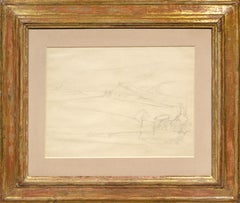
Study for « Paysage de Fribourg » - 1943 a drawing by Balthus (1908 - 2001)
By Balthus (Balthasar Klossowski de Rola)
Located in PARIS, FR
Provenance: Frédérique Tison, Château de Chassy (Burgundy-Franche Comté - France)
Bibliography: J. Clair, V. Monnier Balthus, catalogue raisonné of the complete works, Gallimard, Pa...
Category
1940s Modern Landscape Drawings and Watercolors
Materials
Paper, Pencil
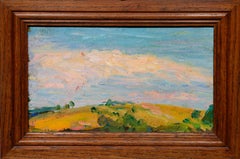
Two Studies of Clouds, a double-sided oil on panel by Henri Martin (ca. 1886)
By Henri Martin
Located in PARIS, FR
This rare double-sided oil on panel, probably painted during the summer of 1886, is an interesting testimony to the artist's style development. It present two complementary paintings...
Category
1880s Post-Impressionist Landscape Paintings
Materials
Oil, Wood Panel
Ten Dog Studies and a Study of a Stole, a panel attributed to Jan Weenix
By Jan Weenix
Located in PARIS, FR
This painting, formerly attributed to Hyacinthe Rigaud, is typical of the art of Jan Weenix, one of the best still life and hunting painters of the Dutch Golden Age. In a cleverly d...
Category
Late 17th Century Dutch School Animal Paintings
Materials
Oak, Oil

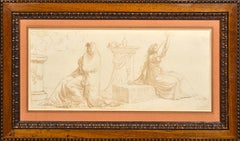
A rare neoclassical drawing by Jean-Pierre Péquignot, Girodet
s friend
Located in PARIS, FR
This neoclassical frieze, executed with great meticulousness in pen and ink, is a moving and rare testimony to the work of Jean-Pierre Péquignot, an extremely talented and particular...
Category
1790s Old Masters Figurative Drawings and Watercolors
Materials
Paper, Ink, Felt Pen
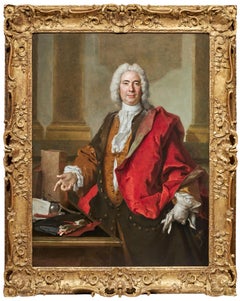
Portrait of Monsieur Aubert, a ceremonial portrait by Nicolas de Largillière
By Nicolas de Largillière
Located in PARIS, FR
Provenance :
Arnold S. Kirkeby (1901-1962)
Donated by Arnold S. Kirkeby to the Los Angeles County Museum of Art in 1955, where it remained until its sale at Sotheby's, New York on January 10, 1991, lot 82.
Christie's, London, July 7, 2010, lot 186, where it was purchased after the sale by the executors of the will of the late Edmund de Rothschild (1916-2009) for display at Exbury House
The Trustees of Exbury House
Literature :
R. Brown, Bulletin of the Art Division, Los Angeles County Museum, VIII, 1957, pp.8-9, no. 4;
S. Schaefer and P. Husco, European Paintings and Sculpture in the Los Angeles County Museum of Art (Los Angeles, 1987), p. 53 (illustrated and dated c. 1735)
This sumptuous ceremonial portrait, executed around 1725-1730, depicts Monsieur Aubert, the French General Comptroller of Bridges and Roadways, as we learn from a letter on the desk beside our model. The virtuoso treatment of the fabrics, the authoritative yet confident pose, the vigorous treatment of the two hands, are representative of Largillière's talent, here at the peak of his art as portraitist.
The portrait also has a rather extraordinary provenance: donated by Arnold S. Kirkeby, an American hotel magnate and real estate developer, it was exhibited during almost forty years in the collections of the Los Angeles County Museum, before being acquired in 2010 by the executors of Edmund de Rothschild's will to adorn his former home Exbury House (Hampshire), where it remained until its sale in 2022.
1. Nicolas de Largillière, a great European portraitist
Nicolas de Largillière (or Largillierre), one of Europe's premier painters of portraits, history paintings, and still lifes during the late seventeenth century and the first four decades of the eighteenth, was born in Paris in 1656. He was the son of a hatmaker and merchant who moved with his family to Antwerp in 1659. As a boy of nine, he traveled for the first time to London in the company of an associate of his father. After returning to Antwerp more than a year later, his artistic gifts were recognized and his father apprenticed him to Antoni Goubau (1616-1698), a painter genre scenes and landscapes. Something of a prodigy, he was admitted to the painters' Guild of Saint Luke when he was only seventeen. In 1675 he made a second trip to London, where he was employed at Windsor Castle and worked as a restorer under the direction of Italian painter and decorator Antonio Verrio (c. 1639-1707), who brought him to the attention of King Charles II (r. 1660-1685).
At this time Largillière painted several still life paintings in the manner of the Dutch and Flemish masters. Thereafter he practiced this branch of painting with consummate skill, a talent that allowed him to make brilliant use of flowers, fruit, and animals in some of his most ambitious portraits and contemporary history pictures.
In 1679 Largillière settled in Paris, where he specialized in baroque portraiture in the grand manner of Peter Paul Rubens (1577-1640), Anthony van Dyck (1599-1641), and Peter Lely (1618-1680). The Flemish battle painter Adam Frans van der Meulen (1631 or 1632-1690) introduced him to Charles Le Brun (1619-1690) who, as First Painter to King Louis XIV (r. 1643-1715) and director of the Académie royale de peinture et de sculpture, was the predominant figure in France's official art establishment. Upon his acceptance as a candidate for admission to the Académie, he agreed to execute as his diploma picture a large portrait of Le Brun (completed 1686, Paris, Musée du Louvre, eight photo in the gallery) seated in his studio surrounded by the accoutrements of his art and an oil study for the ceiling of Galerie des Glaces at Versailles.
In 1686, Largillière made a final trip to England, where he painted portraits of the newly crowned king, James II (r. 1685-1688) (Greenwich, National Maritime Museum) and his consort Mary of Modena...
Category
1720s Old Masters Portrait Paintings
Materials
Oil
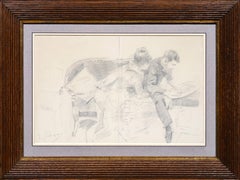
Portrait of Paul-César Helleu, a drawing by Rafael de Ochoa y Madrazo (ca. 1885)
Located in PARIS, FR
This lively drawing immerses us in the artistic world of Paris at the end of the 19th century. After meeting the painter Helleu in 1881, Rafael de Ochoa y Madrazo, a young Spanish pa...
Category
1880s Impressionist Portrait Drawings and Watercolors
Materials
Paper, Graphite
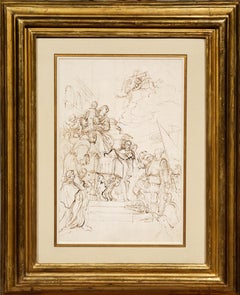
From Renaissance Venice to Barocco Naples, a drawing by Francesco La Marra
Located in PARIS, FR
This vigorous drawing presents a brilliant synthesis between the Venetian tradition of Titian, of which it is a distant echo, and the Neapolitan Baroque of Solimena, which strongly i...
Category
Mid-18th Century Old Masters Figurative Drawings and Watercolors
Materials
Paper, Ink, Felt Pen
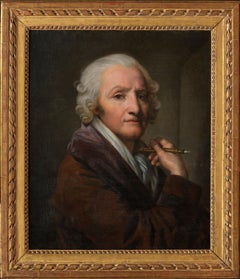
A replica of the JB Greuze
s last self-portrait, by his daughter Anne-Geneviève
Located in PARIS, FR
While the Petit-Palais is hosting the first exhibition dedicated to the artist in Paris in over a century, this replica of the last painting by Jean-Baptiste Greuze, executed by his ...
Category
Early 1800s Old Masters Portrait Paintings
Materials
Canvas, Oil
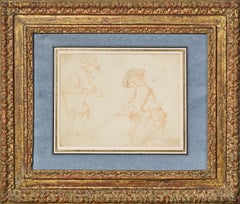
Study for a Hunting Scene, a red chalk sketch attributed to Karel du Jardin
Located in PARIS, FR
We would like to thank Carolina Trupiano Kowalczyk for suggesting this attribution to Karel du Jardin after direct examination of the artwork. Her study of the drawing (in Italian), ...
Category
1650s Old Masters Figurative Drawings and Watercolors
Materials
Chalk, Ink, Laid Paper
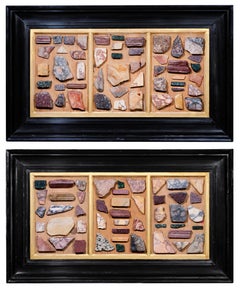
"The collection of a lifetime" : two triptychs featuring antique marble samples
Located in PARIS, FR
These two highly decorative triptychs feature 94 samples of antique marble, presumably collected by the same collector in the early 20th century from archaeological sites in Rome and...
Category
Early 20th Century Assemblage More Art
Materials
Alabaster, Granite, Marble
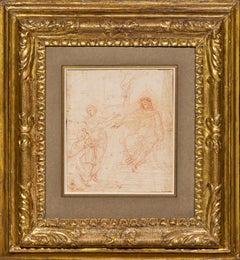
Studies for the Judgment of Solomon, a double-sided drawing by Simone Cantarini
Located in PARIS, FR
In this double-sided red chalk study, Simone Cantarini offers us a double reflection on the theme of the Judgment of Solomon. This sheet reveals his precise style and his sense of de...
Category
1640s Old Masters Figurative Drawings and Watercolors
Materials
Chalk, Laid Paper
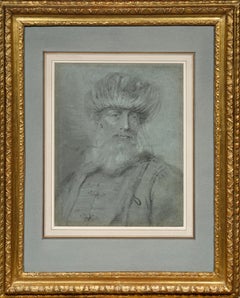
Portrait of an Ottoman Dignitary, a drawing by Giuseppe Nogari (ca. 1760)
Located in PARIS, FR
We would like to thank Mrs. Bozena Anna Kowalczyk for confirming the attribution of this drawing to Giuseppe Nogari in a study (available in Italian) from which we have taken our ins...
Category
1760s Old Masters Portrait Drawings and Watercolors
Materials
Chalk, Laid Paper
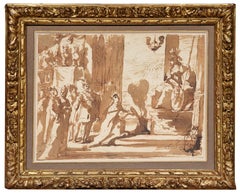
Allegory of the Treaty of Angoulême, a drawing attributed to Donato Mascagni
Located in PARIS, FR
We would like to thank Mrs. Ursula Verena Fischer Pace for suggesting the attribution to Donato Arsenio Mascagni.
We were immediately seduced by the rich tonalities of this allegory...
Category
1620s Old Masters Figurative Drawings and Watercolors
Materials
Ink
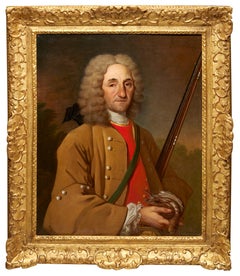
Portrait of Julien Prieur the bailiff of the Marquis d
Armentières as a Hunter
By Jean-Baptiste Oudry
Located in PARIS, FR
This portrait depicts us the trusted confidant of the Conflans d'Armentières family. More precisely, Julien Prieur was the fiscal procurator of the Marquisate of Armentières, playing...
Category
1730s Old Masters Portrait Paintings
Materials
Canvas, Oil
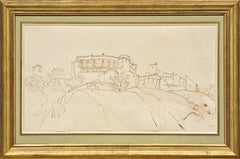
View of a Mansion in the South of France, a drawing by Claude-Joseph Vernet
By Claude-Joseph Vernet
Located in PARIS, FR
We would like to thank Madame Beck-Saiello for confirming the autograph nature of this drawing after an in-person examination.
It was probably during an excursion in the countryside near Avignon that Claude-Joseph Vernet executed this drawing, enhanced with pen and brown ink, depicting a mansion on a hilltop overlooking a small village with geometric shapes.
1. Joseph Vernet, a painter influenced by Italy
Claude-Joseph Vernet was born in Avignon in 1714, the son of Antoine Vernet (1689-1753), an artisan painter of architectural decorations, coach panels, and the like. He moved to the studio of Philippe Sauvan (1697-1792), a leading history painter in Avignon, and then worked with Jacques Viali (active 1681-1745), a decorative, landscape, and marine painter in Aix-en-Provence. Vernet's first recorded paintings were decorative overdoors executed in 1731 in the Aix townhouse of the marquise de Simiane. In 1734, Joseph de Seytres, marquis de Caumont, a leading amateur in Avignon, sponsored Vernet to make a study trip to Italy to complete his artistic education and to draw antiquities for his patron.
As Avignon was a papal territory in Vernet's day, he also had a number of useful introductions among influential churchmen when he arrived in Rome. Vernet was soon at home in the French community there, and he was encouraged by Nicolas Vleughels (1668-1737), director of the Académie de France in Rome, even though the young painter had no official affiliation with the royal institution. He likely entered the studio of the French marine painter Adrien Manglard...
Category
1730s Old Masters Landscape Drawings and Watercolors
Materials
Ink, Laid Paper, Pen, Carbon Pencil
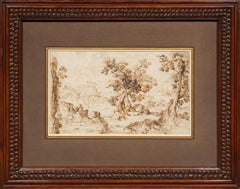
Rocky Landscape with Trees and Temple Ruins a drawing by Giulio Parigi (ca 1615)
Located in PARIS, FR
This Rocky Landscape with Trees and the Ruins of a Temple is a drawing by Giulio Parigi, an eclectic and prolific artist of the Medici court. An engraver, architect, furniture and je...
Category
1610s Old Masters Landscape Drawings and Watercolors
Materials
Ink, Laid Paper, Pen
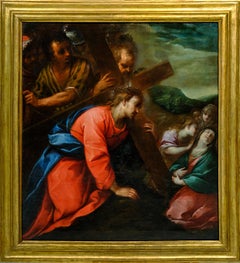
Christ Falling on the Way to Calvary, a painting by Carlo Francesco Nuvolone
Located in PARIS, FR
This painting by Carlo Francesco Nuvolone, the great Lombard master of the mid-seventeenth century, is striking for its dazzling composition and the brilliant colors of Christ's tuni...
Category
1640s Old Masters Figurative Paintings
Materials
Canvas, Oil
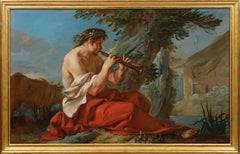
Mercury and Io, a rediscovered painting by Jean-Baptiste Marie Pierre (ca. 1740)
Located in PARIS, FR
We would like to thank Mr. Nicolas Lesur for confirming the autograph nature of the entire composition after a direct examination of the painting on November 27, 2024.
This painting...
Category
1740s Old Masters Figurative Paintings
Materials
Canvas, Oil
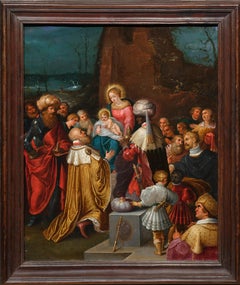
The Adoration of the Magi, an early painting by Frans Francken II (1581 - 1682)
By Frans Francken II
Located in PARIS, FR
We would like to thank Dr. Ursula Härting who, after examining the work, confirmed the autograph nature of this painting by Frans Francken the Younger in a certificate issued on December 9, 2024.
In this previously unpublished painting coming from a French private collection, Frans Francken the Younger tackles one of his favorite themes: the adoration of the Magi, the wise men who come from the East to adore the infant Jesus in Bethlehem, Judea. This theme was often taken up by the artist, but this version, which can be dated around 1610, is one of the earliest interpretations.
1. Frans Francken the Younger, "a surprisingly inventive painter".
Frans Francken the Younger is the best-known member of an extended artistic family that worked in Antwerp from the late sixteenth to the late seventeenth century. Born in 1581, he almost certainly studied with his father, Frans Francken the Elder (c. 1542-1616), before becoming a master in the Antwerp Saint Luke's Guild in 1605. In 1627 he became a member of the Antwerp archers' guild De Oude Handboog.
Francken was an extremely productive and imaginative artist who specialized in expressively rendered small-scale religious and mythological scenes. He also painted larger altarpieces for Catholic churches. His depictions of collectors' cabinets introduced a genre of painting that influenced several artists, including Jan Brueghel the Elder...
Category
1610s Old Masters Figurative Paintings
Materials
Copper
Stag Hunting in the Vicinity of Nuremberg by a German Artist Peter von Bemmel
Located in PARIS, FR
This small landscape shows a hunting scene: two riders are chasing a stag with their dogs at the edge of a forest. Signed by Peter von Bemmel, it is typical of the production of this...
Category
1720s Old Masters Landscape Paintings
Materials
Copper
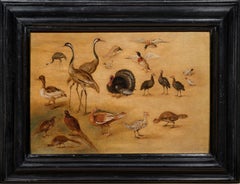
Bird Study, a painting on panel by the Studio of Jan Brueghel the Younger
Located in PARIS, FR
We would like to thank Dr. Ursula Härting for confirming that this painting belongs to the studio of Jan Brueghel the Younger, by means of a certificate issued on December 12, 2024.
This rare study, executed directly with a brush on a prepared wood panel without any prior drawing, features some twenty birds, most of them domesticated. It is a fascinating testimony to the transmission of forms created by Jan Brueghel the Elder...
Category
1620s Old Masters Animal Paintings
Materials
Oak, Oil
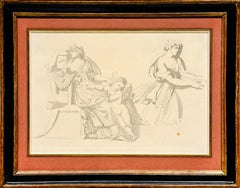
Frieze of antique figures, a drawing by the sculptor Antoine-Denis Chaudet
Located in PARIS, FR
Faithful to the neo-classical taste, sculptor Antoine-Denis Chaudet presents us with a frieze of antique figures executed in gray wash over pencil strokes, which is likely inspired b...
Category
Early 1800s Old Masters Figurative Drawings and Watercolors
Materials
Paper, Ink, Pencil
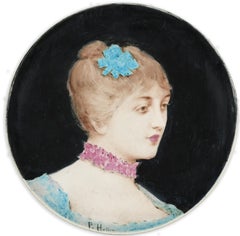
A circular dish decorated by Paul Helleu with a Portrait of a Woman
Located in PARIS, FR
This dish, inspired by the bellas of the Italian Renaissance, bears witness to the fruitful collaboration that began in 1882 between the ceramist Théodore Deck and the young artist Paul Helleu, before the latter became the fashionable portraitist of feminine elegance.
1. Paul Helleu
In 1913 Robert de Montesquiou wrote in his book devoted to the painter: "Helleu was born in Vannes in 1859, of a Breton father and a Parisian mother". He hardly knew his father, who died when he was three years old, and was brought up entirely by his mother, who sent him to continue his studies at the Lycée Chaptal in Paris in 1873.
The discovery of Edouard Manet's Chemin de Fer at the 1874 Salon is reported to be at the origin of his artistic vocation. He worked against his mother's wishes in the studio of the painter Gérôme, also frequented by the painters Giovanni Boldini, Jean-Louis Forain and Antonio de La Gandara...
Category
1880s Impressionist More Art
Materials
Earthenware, Glaze
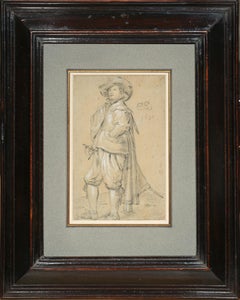
Young Man with a Sword, a Fist on his Hip, a drawing by Cornelis Saftleven
Located in PARIS, FR
Black chalk and white highlights on paper (originally washed in blue)
Monogrammed and dated 1630 on the right
This drawing, executed in black chalk and enhanced with white brushwor...
Category
1630s Old Masters Portrait Drawings and Watercolors
Materials
Paper, Chalk
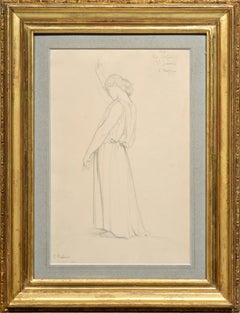
A Study for the Angel of Saint-Severin church in Paris, by Paul Flandrin
Located in PARIS, FR
After the restoration of the Saint-John chapel’s frescoes at the Saint-Severin church in Paris in 2022, the drawing presented here is a moving testimony to their creative process. It...
Category
1840s Old Masters Figurative Drawings and Watercolors
Materials
Chalk
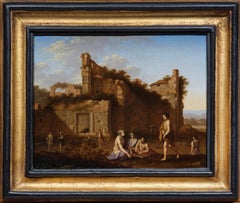
Gathering in antique Ruins, a monogrammed painting by Jan van Haensbergen
By Jan Van Haensbergen
Located in PARIS, FR
Jan van Haensbergen was a painter of the Dutch Golden Age and a pupil of Cornelius van Poelenburgh (Utrecht 1594 - 1667). The painting we are presenting is inspired by Poelenburgh’s landscapes from his Italian sojourn. The dreamlike atmosphere of this Gathering in antique ruins appealed to us. Against a backdrop of antique ruins, three draped characters (perhaps bathers) are sitting in a circle, greeting a fourth character walking towards them.
Their tranquility contrasts with the bustle of the other characters in the background. They constitute a vivid illustration of otium, this leisure time that allows us to realize our full potential. With this Arcadian landscape, Jan van Haensbergen invites us in turn to leave the hustle and bustle of everyday life behind, to take a break, to enjoy the present moment chatting with close friends…
1. Jan van Haensbergen, a landscape and portrait painter of the Dutch Golden Age
Jan van Haensbergen was born in 1642 in Gorinchem, a town in southern Holland to the east of Rotterdam. He was a pupil of Cornelius van Poelenburgh, and began by painting landscapes inspired by those of his master, in an Italianate style. Between 1668 and 1669, he was registered at the Guild of Saint Luke in Utrecht.
In 1669, he moved to The Hague, where he joined the Confrérie Pictura, an artist society founded in 1656. His portraits, which became his main activity as a painter after settling in The Hague, were strongly influenced by Caspar Netscher (Prague or Heidelberg 1639 - The Hague 1684), whom he met in The Hague and whose son Constantijn became his son-in-law by marrying his daughter Magdalena.
In addition to his work as an artist, Van Haensbergen was also an art dealer, probably helped by his appointment as Dean of the Confrérie Pictura, where he also teached.
2. Description of the artwork and related paintings
This painting seems to us to be a kind of allegory of otium, that quiet bliss promised by Epicurus. It might even evoke an Epicurean proverb: "It is better to lie on the naked ground and be at ease, than to have a golden carriage and a rich table and be worried" .
Three draped young people - two men and a woman in the background - are seated in a circle, greeting a fourth figure walking towards them, hair disheveled and body draped in a towel as if drying off after a bath, indicating the need for prior purification to fully enjoy this rest. Their nonchalance contrasts with the bustle of the various characters in the background.
The composition is punctuated by successive diagonals, and opens onto a landscape on the right, with a succession of mountainous planes. This painting is typical of the Italianate works produced by Van Haensbergen in the 1660s under the influence of Cornelis van Poelenburgh...
Category
17th Century Old Masters Landscape Paintings
Materials
Oak, Oil
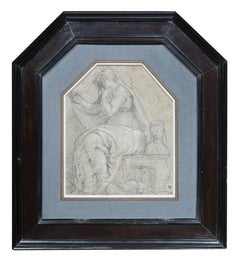
Allegory of Chastity, a drawing attributed to G. Porta with great provenance
Located in PARIS, FR
This magnificent drawing from the Venetian Renaissance intrigues us in many ways. It depicts an allegorical composition whose meaning partly escapes us: a veiled figure seated on a stone bench (which we have identified as Chastity), seems to be turning away from a woman's bust beside her, below which are two rabbits, a traditional allegory of fertility, but also sometimes of lust.
This drawing, executed on blue paper, undoubtedly belongs to the Venetian Renaissance. The inscriptions on the back of the old mounting board indicate the various attributions considered by its last owner, the British painter and art historian Sir Lawrence Gowing. We have retained the attribution to Giuseppe Porta proposed by art historian John Arthur Gere as the most relevant.
We were incredibly fortunate to find a hexagonal frame of a very similar format for this drawing, the upper corners of which were formerly cut (irregularly). This 17th-century Dutch frame comes from an aristocratic collection in Lombardy, and creates a kind of fascinating chase around this Venetian drawing...
Category
16th Century Figurative Drawings and Watercolors
Materials
Chalk
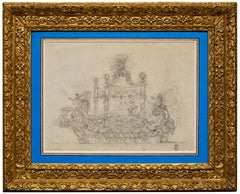
A dazzling Venetian Regatta Boat Study attributed to Alessandra Mauro
Located in PARIS, FR
This stunning Baroque study depicts a regatta boat, a type of vessel developed in eighteenth-century Venice for the regattas organized by the Serenissima during visits by royalty and princes. We propose to link this drawing to the work of Alessandro Mauro, an artist who specialized in this type of composition, as illustrated by a drawing from him at the Metropolitan Museum.
1. Description of the boat
The greatest decorative fantasy reigns in this preparatory study, which blends mythological and exotic elements with references to ancient Egypt. Our drawing is probably an initial thought, destined to be refined and clarified later in pen and ink (as evidenced by the ink stain in the lower right). A quadriga of seahorses guided by Neptune stands at the stern of the boat, shown well above the waterline (perhaps to outline its empty volume). One of the seahorses is ridden by a newt, while Amphitrite lies at the feet of the sea god.
The center of the boat is occupied by a vast baldachin resting on four atlantes and surmounted by a figure riding an animal (a dragon?). Three figures sit beneath the canopy, one of them on a griffin-shaped seat. This allusion to Egyptian antiquity echoes the winged sun (sometimes a symbol of the god Horus, as in the temple of Edfu in Egypt) that adorns the sides of the promontory on which this baldachin rests.
Another flag-bearer figure crouches at the stern of the boat on a raised seat, on the reverse of which is a crowned mermaid whose arm, extended backwards, rests on a mascaron decorated with a radiant face (Helios?) and whose torso surmounts an elephant's head. The heads of the rowers and their oars are sketched all along the boat, whose sides are embellished with elongated naiads.
2. The Venetian regatta boats
An exhibition held in 2013 at the Ca' Rezzonico (the Venetian eighteenth-century museum) paid tribute to these regatta boats through studies and prints depicting them. The regattas organized by the Serenissima in honor of visiting princes and sovereigns were among the most spectacular ceremonies in Venice. Some important artists of the 18th century contributed to the creation of these extravagant boats which were given exotic names such as bissona, malgarota or peota.
The specialists in this field were Andrea Urbani and the brothers Alessandro and Romualdo Mauro. They were born into a family of theater decorators in Piedmont, but little is known about their detailed biography. Alessandro was the architect of the Dresden opera house and of the St. Samuel Theater in Venice (in collaboration with his brother Romualdo), but also worked as stagehand and set designer in Vienna, Rome and Turin. A drawing produced around 1737 from the Metropolitan Museum (7th photo in the gallery) bears witness to his activity as a regatta boat designer.
This drawing is a much more elaborate version than the one presented here, having been entirely reworked in brown ink. However, a figure at the bow of the boat, executed solely in black chalk, still bears witness to a technique similar to that of our drawing.
It is difficult to know whether the boat depicted in our drawing was a project for an actual boat or whether it remained in the planning stage, but the front of our boat (Neptune and the quadriga of seahorses ridden by a newt) bears several similarities to that of a parade boat depicted in the print published by Michele Marieschi entitled Regatta on the Grand Canal, between the Foscari and Balbi Palaces (last photo in the gallery). This print is dated 1741, which could confirm that our work dates from around 1740.
The area between Neptune and the quadriga that precedes him on this strange paddle-boat appears to be partially submerged, confirming that the waterline of our boat was probably intended to be much lower than the one shown in our drawing.
The Correr Museum’s collection holds one of the most important collection of engravings and drawings devoted to these specifically Venetian Baroque productions. These boats were intended to last the duration of a festival. Today, they are only documented by preparatory drawings or prints that testify to the sumptuousness of their decoration. This taste for regatta boats lasted throughout the Venetian eighteenth century, and the conception of regatta boats also attracted great masters such as Giambattista Tiepolo, Francesco Guardi or Giambattista Piranesi...
Category
Mid-18th Century Old Masters Figurative Drawings and Watercolors
Materials
Chalk
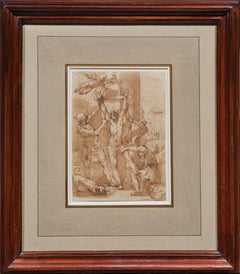
The Martyrdom of Saint Bartholomew, a preparatory drawing by Alessandro Casolani
Located in PARIS, FR
This powerful pen and brown ink wash drawing is a study for an altarpiece depicting The Martyrdom of Saint Bartholomew. Signed and dated 1604, it was painted at the end of his life b...
Category
Early 1600s Old Masters Figurative Drawings and Watercolors
Materials
Ink, Pen
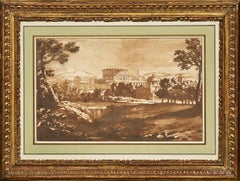
View of an Antique City, a wash landscape by Jan de Bisschop (1628 - 1671)
Located in PARIS, FR
The attribution to Jan de Bisschop has been confirmed by the RKD with the following comment: "We base this attribution on the dark washes, the subject represented and the monogram".
...
Category
17th Century Old Masters Landscape Drawings and Watercolors
Materials
Ink, Pen
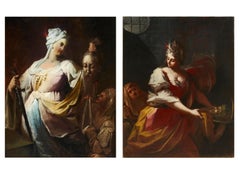
Judith and Salome, a pair of oil paintings on canvas by Francesco Conti
Located in PARIS, FR
This widely referenced pair of paintings is one of Francesco Conti’s most successful productions. Francesco Conti is one of the finest painters of 18th-century Florence. In the shimmering colors typical of his best work, he represents two opposite characters from the Bible: the virtuous Judith, whose courage saves her people by cutting off the head of the invader Holofernes, and the depraved Salome, who under the influence of her mother becomes responsible for the beheading of the prophet John the Baptist.
The artist's talent lies in his ability to treat these two macabre subjects with a light touch, presenting us with two attractive women who seem to twirl with glee amidst the severed heads...
1. Francesco Conti, the “Florentine Tiepolo”
Francesco Conti is a major painter of the Florentine school of the 18th century; he can even probably be considered, along with Giovanni Domenico Ferretti (1692-1768), as one of the two main painters of the second quarter of the Florentine 18th century.
Born in Florence in 1682, Francesco Conti began his apprenticeship in the workshop of Simone Pignoni (1611 - 1698), a disciple of Francesco Furini; he was also influenced by the Venetian Sebastiano Ricci. A protégé of Marquis Riccardi, he accompanied him to Rome between 1699 and 1705, where he frequented Carlo Maratta's studio. He settled permanently in Florence in 1705.
Painted exclusively on canvas, the majority of his work consists of religious subjects, altarpieces or private devotional works. It is likely that Conti himself was a devout churchgoer, as evidenced by his affiliation, in the third decade of the eighteenth century, to the Society of the Disciples of Saint-John-the-Baptist, and his entry, at the end of his life, into the fraternity of the Venerable Society of the Holy Trinity.
In Florence, Conti worked for the Grand Duchy's major patrons, including the last Medici - in particular Giangastone and Annamaria Luisa, Electress Palatine - and confirmed his role as a reference painter under the Lorraine Regency, as master of the Public Drawing School, which was closely linked to the institute responsible for the manufacture of semi-precious stone mosaics, then located in the Uffizi complex.
Matteo Marangoni, an art critic of the early 20th century, praised his "brushwork full of elegance and true spirit of the 18th century", pointing out that Conti was "probably one of the best colorists" of the Florentine school of his time. These two characteristics led the art historian Paolo dal Poggetto to nickname him the "Florentine Tiepolo".
2. Judith and Salome, two biblical characters opposing each other
These two paintings form a pair presenting two biblical episodes, which have in common the depiction of a "heroine" carrying the severed head of a man.
While the Salome episode might at first appear to be an echo of the Old Testament story of Judith, each character is the exact opposite of the other. Judith, whose story is told in the Book of Judith, is a beautiful young widow from Bethulia who, accompanied by her maid, went into the camp of the invading Assyrians and won the confidence of Holofernes, the general commanding the enemy army. Invited to a great feast on the fourth evening, she took advantage of Holofernes' drunkenness to cut off his head. “She went up to the bedpost near Holofernes’ head, and took down his sword that hung there. She came close to his bed, took hold of the hair of his head, and said, “Give me strength today, O Lord God of Israel!” Then she struck his neck twice with all her might, and cut off his head. Next she rolled his body off the bed and pulled down the canopy from the posts. Soon afterward she went out and gave Holofernes’ head to her maid, who placed it in her food bag...
Category
1710s Old Masters Figurative Drawings and Watercolors
Materials
Canvas, Oil
Erminia and the Shepherds, a painting by Francesco de Mura (Napoli 1696 - 1782)
By Francesco de Mura
Located in PARIS, FR
In this masterly painting, Francesco de Mura presents the meeting of Erminia and the shepherds, a famous episode taken from the seventh canto of Torquato Tasso's Jerusalem Delivered....
Category
1760s Old Masters Figurative Paintings
Materials
Canvas, Oil
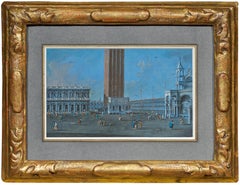
View of Piazza San Marco, a tempera signed by Giacomo Guardi (1764 - 1835)
Located in PARIS, FR
Signed and localized on the verso :
"Vedute di parte dalla Piazza dif.a alla Loggetta e cam
panil parte della Zecca ed in lontan Proc.e vechie e parte della chiesa
punto preso vic...
Category
Early 19th Century Old Masters Landscape Drawings and Watercolors
Materials
Tempera
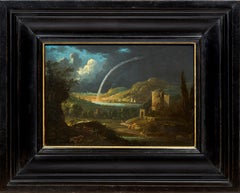
River Landscape with Shepherds and Architecture, a painting by Jan van Bunnik
By Jan van Bunnik
Located in PARIS, FR
This painting has been the subject of a study by the art historian Fabrizio Dassie (available on request), confirming its inclusion in Jan van Bunnik’s corpus.
In this painting, Ja...
Category
Late 17th Century Old Masters Landscape Paintings
Materials
Copper
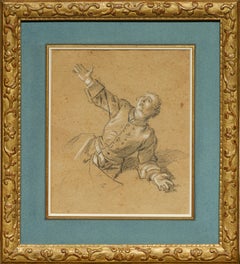
Soldier begging for Mercy a preparatory study by Jean-Marc Nattier (1685 - 1766)
By Jean-Marc Nattier
Located in PARIS, FR
This rare drawing by Nattier is part of a set of preparatory studies executed in 1717 for one of the painter's first commissions, the painting commissioned by Tsar Peter I of Russia ...
Category
1710s Old Masters Figurative Drawings and Watercolors
Materials
Chalk
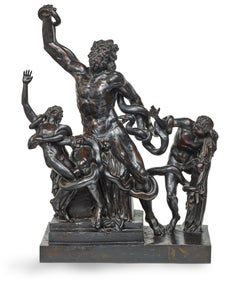
Laocoön and his Sons, an exceptional bronze sculpture by Giacomo Zoffoli
Located in PARIS, FR
This exceptional bronze group (unpublished), executed in Rome in the second half of the 18th century, bears witness to the fascination with the Laocoön since its discovery on January...
Category
1770s Italian School Nude Sculptures
Materials
Bronze
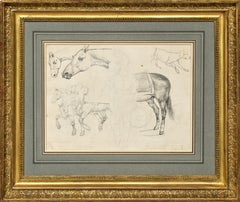
Double-sided Horse Studies by Théodore Géricault
By Jean Louis Andre Theodore Gericault
Located in PARIS, FR
Recto: two horses, preparatory study for the lithograph "Les Boueux" ("The Muddy Ones")
Verso: four studies of horse heads (including two preparatory studies for the watercolor "Plowing in England"), a study of a life guard with the rump of his horse (preparatory to the lithograph "A Party of Life...
Category
1820s Old Masters Animal Drawings and Watercolors
Materials
Carbon Pencil
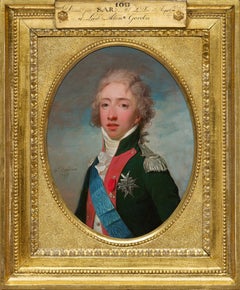
Two royal portraits (the Duc d
Angoulême and the Duc de Berry) by H.P. Danloux
Located in PARIS, FR
These two royal portraits are a major historical testimony to the stay of the Comte d'Artois (the future Charles X) and his family in Edinburgh in 1796-1797. Given by the sitters to Lord Adam Gordon, the Governor of Edinburgh, and kept by family descent to this day, these two portraits provide us with a vivid and spontaneous image of the Duc d’Angoulême and his brother the Duc de Berry. Danloux, who had emigrated to London a few years before, demonstrate his full assimilation of the art of British portrait painters in the brilliant execution of these portraits.
1. Henri-Pierre Danloux, a portraitist in the revolutionary turmoil
Born in Paris in 1753, Henri-Pierre Danloux was first a pupil of the painter Nicolas-Bernard Lépicié (1735 - 1784) and then, in 1773, of Joseph-Marie Vien (1716 - 1809), whom he followed to Rome when, at the end of 1775, Vien became Director of the Académie de France. In Rome he became friends with the painter Jacques-Louis David (1748 - 1825).
Returning to France around 1782, he settled in Lyon for a few years before returning to Paris in 1785. One of his first portraits was commissioned by the Baroness d'Etigny, the widow of the former Intendant of the Provinces of Gascony, Bearn and Navarre Antoine Mégret d'Etigny (1719 – 1767). He then became close to his two sons, Mégret de Sérilly and Mégret d'Etigny, who in turn became his patrons. In 1787, this close relationship with the d'Etigny family was further strengthened by his marriage to Antoinette de Saint-Redan, a relative of Madame d'Etigny. After his marriage, he left for Rome and did not return to France until 1789. It was during the winter of 1790-1791 that he painted one of his masterpieces, the portrait of Baron de Besenval. Set in a twilight atmosphere, this portrait of an aristocrat who knows that his death is imminent symbolizes the disappearance of an erudite and refined society which would be swept away by the French Revolution.
The Jacobin excesses led Danloux to emigrate to England in 1792; many members of his family-in-law who remained in France were guillotined on 10 May 1794. Danloux enjoyed great success as a portrait painter in England before returning to France in 1801.
During his stay in England, Danloux was deeply under the influence of English portraitists: his colors became warmer (as shown by the portrait of the Duc d'Angoulême that we are presenting), and his execution broader.
2. Description of the two portraits and biographical details of the sitters
The Duc d'Angoulême (1775-1844) was the eldest son of the Comte d'Artois, the younger brother of King Louis XVI (the future King Charles X), and his wife Marie-Thérèse of Savoie. He is shown here, in the freshness of his youth, wearing the uniform of colonel-general of the "Angoulême-Dragons" regiment.
He is wearing the blue cordon of the Order of the Holy Spirit, which was awarded to him in 1787, and two decorations: the Cross of Saint-Louis and the Maltese Cross, as he was also Grand Prior of the Order of Malta.
Born on 16 August 1775 in Versailles, Louis-Antoine d'Artois followed his parents into emigration on 16 July 1789. In 1792, he joined the émigrés’ army led by the Prince de Condé. After his stay in Edinburgh (which will be further discussed), he went to the court of the future King Louis XVIII, who was in exile at the time, and in 1799 married his first cousin Marie-Thérèse Charlotte of France, the daughter of Louis XVI and the sole survivor of the royal family. The couple had no descendants. He became Dauphin of France in 1824, upon the accession to the throne of his father but played only a minor political role, preferring his military position as Grand Admiral. Enlisted in Spain on the side of Ferdinand VII, he returned home crowned with glory after his victory at Trocadero in 1823.
He reigned for a very short time at the abdication of Charles X in 1830, before relinquishing his rights in favor of his nephew Henri d'Artois, the Duc de Bordeaux. He then followed his father into exile and died on 3 June 1844 in Gorizia (now in Italy).
His younger brother, the Duc de Berry, is shown in the uniform of the noble cavalry of the émigrés’ Army. He is wearing the blue cordon of the Order of the Holy Spirit, awarded to him in May 1789, and the Cross of Saint-Louis (partly hidden by his blue cordon).
Born on 24 January 1778 in Versailles, Charles-Ferdinand d'Artois also followed his parents into emigration and joined the émigrés’ army in 1792. After his stay in Edinburgh, he remained in Great Britain, where he had an affair with Amy Brown...
Category
1790s Old Masters Portrait Paintings
Materials
Canvas, Oil, Wood Panel
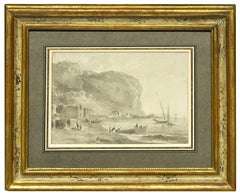
View of the Posillipo coastline near Naples by William Marlow (1740 - 1813)
By William Marlow
Located in PARIS, FR
In this drawing, inspired by his stay in Naples in 1765, William Marlow presents us with a view of Cape Posillipo, to the west of Naples, an essential stage during the Grand Tour. Th...
Category
1760s Old Masters Landscape Drawings and Watercolors
Materials
Ink
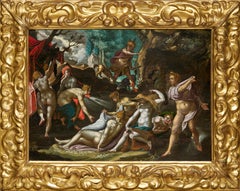
Diana and Actaeon, a Mannerist painting after Joseph Heintz the Elder
Located in PARIS, FR
This painting seduced us with its rich colors. Depicting Diana and her companions surprised by Actaeon, it was inspired by an engraving by Aegidius Sadeler II after a painting by Jos...
Category
17th Century Old Masters Nude Paintings
Materials
Oil, Wood Panel
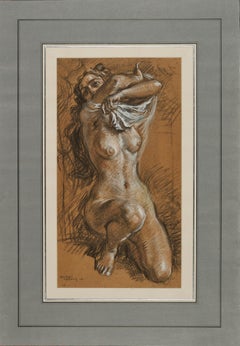
Study for the Spring (preparatory to the Four Seasons) by René-Marie Castaing
Located in PARIS, FR
René-Paris Castaing, winner of the Grand Prix de Rome in 1924, left a large body of work, both sacred and secular. Many churches in the Pyrénées-Atlantiques, in South-West France still bear witness to the diversity of his talent. In 1942, he began a major decoration project for the Château de Diusse, in the north-east of the county, including an allegory of the four seasons. The vigorous pastel we are presenting here is a study for Spring, depicted as Flore undressing. This commission was a veritable swan song for the artist, who died a year later at the age of 47.
1. René-Marie Castaing, the great inter-war painter in Pau
René-Marie Castaing was born in Pau on December 16th 1896. His father, Joseph Castaing, was also a painter: he was the official portraitist of Pau's high society, which was particularly cosmopolitan at the end of the century, when many rich foreigners spent the winter in Pau, taking advantage of the mild weather to enjoy an outdoor lifestyle punctuated by hunting, horse ridings and golf.
René-Marie Castaing was admitted to the Ecole Nationale Supérieure des Beaux-Arts in Paris in April 1920 and entered the studio of Paul-Albert Laurens (1870-1934). In 1924, he was awarded the First Grand Prix de Rome for Painting, which earned him a stay at the Villa Médicis for more than three years. He then returned to Pau in 1928, where he lived until his death.
Castaing's work is marked by the academic tradition, in which drawing plays as important a role as painting. Although his drawings are often sketches that help to set up large painted compositions, they stand as independent artworks in which the artist fully expresses the vivacity of his talent.
Castaing was a fervent Christian and religious painting played an essential part in his work, as shown by the decorations he created for the churches of Bizanos, Borce, Bidache and Salies-de-Béarn. The painter also created several secular decorations, such as that for the dining room of the Villa Saint-Basil's in Pau in 1935, and the Hunting at the Albret’s time commissioned in 1940 by the Prefecture of Pau. The décor created in 1942-1943 for the Château de Diusse, a mansion located north-east of Pau, was his last large-scale décor, as the painter died shortly after its completion on December 8th 1943.
2. Description of the drawing
Our pastel depicts an eminently secular theme: Spring is embodied by Flore, crouching on the ground with one knee touching the ground. She reveals her ample bosom by removing her shirt, her arms raised above her shoulders to undress.
Given Castaing's classical training at the Beaux-Arts and the influence of ancient statuary...
Category
1940s Art Deco Nude Drawings and Watercolors
Materials
Pastel
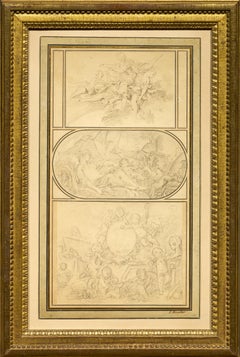
Three drawings by François Boucher in a mounting by Jean-Baptiste Glomy
By François Boucher
Located in PARIS, FR
We would like to thank Juliette Parmentier-Courreau of the Custodia Foundation for her welcome and support during the consultation of Glomy’s Journal des Ouvrages.
This spectacularly large "feuille de desseins ajustés" commissioned by François Boucher from Jean-Baptiste Glomy is emblematic of the painter's art and mastery of rocaille. It is also fully representative of the taste of this period in the field of decorative arts. The largest of these three drawings, placed at the bottom of the composition, is particularly interesting: dating from around 1756, it constitutes a modello (apparently unpublished) for the frontispiece of the "Catalogue des tableaux de Monsieur de Julienne"), preserved in the Morgan Library in New York.
1. François Boucher, the master of French rocaille
The extraordinary career of Francois Boucher was unmatched by his contemporaries in versatility, consistency and output. For many, particularly the writers and collectors who led the revival of interest in the French rococo during the last century, his sensuous beauties and plump cupids represent the French eighteenth century at its most typical. His facility with the brush, even when betraying the occasional superficiality of his art, enabled him to master every aspect of painting – history and mythology, portraiture, landscape, ordinary life and, as part of larger compositions, even still life. He had been trained as an engraver, and the skills of a draftsman, which he imbued in the studio of Jean-Francois Cars (1661 – 1738), stood him in good stead throughout his career; his delightful drawings are one of the most sought-after aspects of his oeuvre.
As a student of Francois Lemoyne (1688 - 1737), he mastered the art of composition. The four years he spent in Italy, from 1727-1731, educated him in the works of the masters, classics and history, that his modest upbringing had denied him.
On his return to Paris in 1734, he gained full membership of the Royal Academy of Painting and Sculpture with his splendid Rinaldo and Armida (Paris, Musée du Louvre). Although, throughout his career, he occasionally painted subjects taken from the Bible, and would always have considered himself first as a history painter, his own repertoire of heroines, seductresses, flirtatious peasant girls and erotic beauties was better suited to a lighter, more decorative subject matter. His mastery of technique and composition enabled him to move from large scale tapestry...
Category
1750s Old Masters Figurative Drawings and Watercolors
Materials
Chalk, Ink
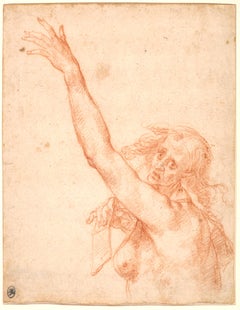
Study of a Fate at mid-body, a red chalk attributed to Giovanni da San Giovanni
Located in PARIS, FR
This spectacular red chalk drawing depicts an elderly woman, her eyes bulging, her hand stretched out towards the sky. This disturbing character, who seems close to dementia, and the elongation of her arm with its Mannerist overtones, plunge us into the Florentine artistic milieu of the first half of the 17th century. The proximity of this drawing to some characters in the fresco in the Pitti Palace representing The Muses, Poets and Philosophers chased from Parnassus, the last masterpiece of Giovanni da San Giovanni, leads us to propose an attribution to this artist and a dating of around 1635-1636.
1. Giovanni da San Giovanni, the painter of contradiction
We take here the title of the monography dedicated to the artist by Anna Banti in 1977, which remains the reference book for this artist. The son of a notary, Giovanni Mannozzi, known as Giovanni da San Giovanni, abandoned his studies to go to Florence at the age of sixteen, where he entered the studio of Matteo Rosselli (1578 - 1650) around 1609 and enrolled in the Academy of Drawing Arts in 1612. Around 1615 he produced his first known works, mainly frescoes for the city's tabernacles. He became famous in Florence for his originality, combining an obsessive application to the study of drawing and the reading of poetry and history with a disheveled appearance. Between 1619 and 1620 he decorated the facade of the Antella Palace in Piazza Santa Croce, a decoration that still partly survives today.
The death of Cosimo II in 1621 put an end to the Florentine building activity and Giovanni da San Giovanni left for Rome to find other sponsors with the painter Francesco Furini...
Category
17th Century Old Masters Nude Drawings and Watercolors
Materials
Chalk
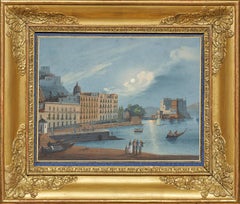
View of the Ovo Castle in the Moonlight, a 19th century Neapolitan gouache
Located in PARIS, FR
Neapolitan gouaches appeared in the eighteenth century when tourism in the Naples area was developing: the discoveries of Herculaneum and Pompeii made this city a mandatory stop on the Grand Tour, the journey made by wealthy Europeans to complete their education.
Generally small in size for ease of transport and affordable in price, these gouaches were the ideal travel souvenir that these tourists of the early days were bringing back to capture the idyllic landscapes they had discovered during their journey and to share them with family and friends upon their return at home.
The Bay of Naples and the eruptions of Vesuvius are the favourite themes of these views. Here we have a view of the Ovo Castle, which was rebuilt on the island of Partenope, in the middle of the Bay of Naples and about a hundred metres from the shore by the Normans in the 12th century on antique ruins...
Category
Early 19th Century Romantic Landscape Drawings and Watercolors
Materials
Paper, Gouache
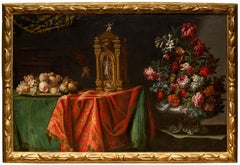
Baroque silver Vase with Flowers with a Fruit Tray and a Clock by A. Zuccati
Located in PARIS, FR
This unpublished composition is a recent addition to Adeodato Zuccati’s catalog. The study of this painting by Gianluca Bocchi, an Italian art historian specializing in Italian still lives, is available upon request.
This composition is typical of the productions of Adeodato Zuccati, an Emilian painter...
Category
Late 17th Century Old Masters Still-life Paintings
Materials
Canvas, Oil
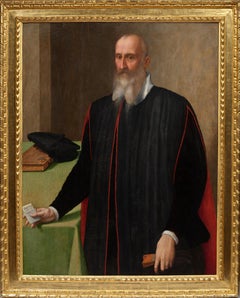
Portrait of Senator Bartolomeo Panciatichi by Santi di Tito (1574)
Located in PARIS, FR
This recently rediscovered portrait of Santi di Tito depicts a Florentine senator, with a letter in his hand indicating that the painting was executed in 1574 when the sitter was 66 years old. On the basis of these clues, it is tempting to view it as a portrait of Bartolomeo Panciatichi, who was painted some thirty years before by Bronzino (1503 - 1572). While the treatment of the hands recalls the Florentine tradition of Mannerist portraits, the comparison with Bronzino's portrait illustrates Santi di Tito's search for greater realism, despite the stereotyped composition.
1. Santi di Tito, Counter-Reformation painter and portraitist
Santi di Tito was the great painter of the Florentine Counter-Reformation. He proposed a new artistic language that broke away from Mannerism.
Little is known about his training in Florence (perhaps alongside Bronzino or Baccio Bandinelli), but this period of training enabled him to join the Company of Saint Luke, the guild of Florentine painters, in 1554. Between 1560 and 1564, Santi di Tito spent time in Rome, where he frequented the workshop of Taddeo Zuccari. This stay had a fundamental influence on his work, thanks to the discovery of the late work of Raphael, but also his encounters with the painters Francesco Salviati and Federico Barocci.
Around 1565, Santi di Tito returned to Florence, where he remained until the end of his life, dividing his talents between the creation of important religious paintings and countless portraits. He became one of the city's leading painters, distinguishing himself, in particular, in the creation of large religious compositions in which the spirit of the Counter-Reformation was reflected.
In 1568, Santi di Tito became a member of the Confraternity of Saint Thomas Aquinas...
Category
16th Century Old Masters Portrait Paintings
Materials
Poplar, Oil
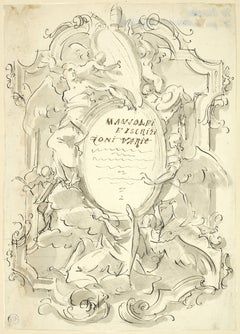
Study for a Frontispiece, a baroque drawing by Giovanni Antonio Pellegrini
By Giovanni Antonio Pellegrini
Located in PARIS, FR
This masterly frontispiece study, executed with a very sure hand, testifies to the survival of the great Baroque taste in 18th century Venice. It could be one of the very last works by Giovanni Antonio Pellegrini: the few lines that cross the papal arms evoke those of Benedict XIV, who became pope in 1740, one year before the artist's death.
1. Giovanni Antonio Pellegrini and the European influence of Venetian history painting in the 18th century
Giovanni Antonio Pellegrini was born in Venice in 1675 and trained in the studio of the Milanese painter Paolo Pagani (1655 - 1716). Pagani, who had been living in Venice since 1667, took him to Moravia and Vienna from 1690 to 1696. After a stay in Rome from 1699 to 1701, Pellegrini married Angiola Carriera in 1704, the sister of the great pastelist Rosalba Carriera.
From 1708 onwards, Pellegrini left Venice and began an extensive tour of Europe: he worked in England between 1708 and 1713, where he met great success, particularly at Kimbolton Castle and Castle Howard. He then worked in Germany and the Netherlands, then in Bohemia and Austria, before returning briefly to England in 1719. In 1720 he was in Paris where he decorated the ceilings of the Royal Bank for John Law...
Category
1740s Old Masters Figurative Drawings and Watercolors
Materials
Ink
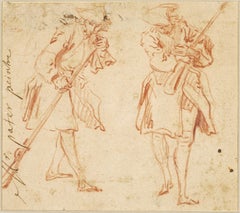
Two military studies, a preparatory red chalk drawing by Jean-Baptiste Pater
By Jean-Baptiste Pater
Located in PARIS, FR
As Florence Ingersoll-Smouse wrote in 1921 in her book devoted to Jean-Baptiste Pater, "a painter of the Fête galante, Pater is interesting both by his intimacy with Watteau, to whom many of his works are still attributed, and by his own value as an artist.” This sanguine, full of life and spontaneity, is typical of the preparatory studies made by the painter to be used later in the composition of his paintings.
1. Jean-Baptiste Pater, pupil and disciple of Antoine Watteau
Antoine Pater, Jean-Baptiste's father, belonged to the petty bourgeoisie of Valenciennes where he worked as a merchant-sculptor. His brother Jacques was a local painter who was probably involved in his nephew's training. Born on December 29, 1695, Jean-Baptiste Pater was first trained with Jean-Baptiste Guider, a local painter whose death in 1711 was probably the reason for Jean-Baptiste’s departure alongside Watteau, who was visiting Valenciennes. Watteau's difficult character led to their separation in 1713.
Back in Valenciennes, Jean-Baptiste Pater encountered difficulties with the powerful Corporation of Saint-Luke (to which he refused to belong) which forced him to return to Paris in 1718. He reconciled with Watteau shortly before his death (on July 18th 1721), inherited the commissions that Watteau had been unable to fulfil and completed some of his paintings.
Pater was accepted by the Académie Royale in 1725 but did not produce his reception painting The soldier’s revels until three years later. Throughout his brief career (he died at the age of forty on July 25th 1736), he mainly had a clientele of amateurs and received only one royal commission, shortly before his death.
2. Description of the drawing and related artworks
Pater had adopted his master Watteau's method of composition. His study drawings were carefully glued in a notebook and were used to animate his compositions.
His paintings sometimes suffer from a somewhat artificial composition, since the figures seem to be pasted one next to the other. This point has also been made about Watteau’s.
The theme of military scenes (which was at the time included in the genre of Fêtes galantes!) was one of Pater’s favourite subjects. Together with the Bathing Women...
Category
1720s Old Masters Figurative Prints
Materials
Chalk
Landscape with Trees and a Fisherman walking, a drawing by Jan Van Goyen
By Jan Josefsz Van Goyen
Located in PARIS, FR
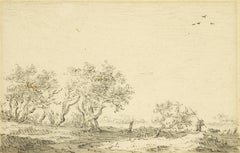
No Dutch draughtsman ever captured the atmosphere of the rural countryside of Holland with the same atmospheric and engaging simplicity that Van Goyen achieved in drawings such as this. Indeed, his landscapes were seminal in the development of the genre. The present sketch conveys a striking sense of movement within the natural landscape, conveyed by the deftly applied strokes of chalk, from which the artist’s hand can be sensed. The composition is characteristic of his work, with the low horizon affording significance to the broad sky and the soaring birds within. This feeling of windswept motion powerfully evokes the expansive Dutch farmland with which he was evidently preoccupied.
1. Jan van Goyen...
Category
1650s Old Masters Landscape Drawings and Watercolors
Materials
Chalk, Ink, Laid Paper
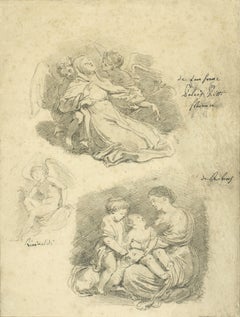
Three studies executed in the Pitti Palace in 1761 by Jean-Honoré Fragonard
By Jean-Honoré Fragonard
Located in PARIS, FR
This brilliant study sheet, of which we present here a counterproof, is a souvenir of Fragonard's return journey from Italy. Between April and September 1761, he accompanied the abbot of Saint-Non on his way back to France. Three studies after the masters taken from the Pitti Palace’s gallery in Florence are gathered on this sheet. Although The Ecstasy of Saint Margaret...
Category
1760s Old Masters Figurative Drawings and Watercolors
Materials
Carbon Pencil