Stephane Renard Fine Art Portrait Paintings
to
1
1
1
2
Overall Width
to
Overall Height
to
4
1
3
5
5
5
5
3
3
2
1
1
1
1
5
5
3
3
1
1
5
5
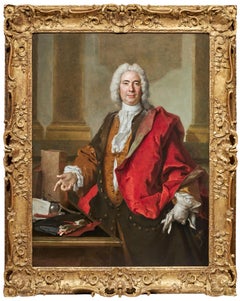
Portrait of Monsieur Aubert, a ceremonial portrait by Nicolas de Largillière
By Nicolas de Largillière
Located in PARIS, FR
Provenance :
Arnold S. Kirkeby (1901-1962)
Donated by Arnold S. Kirkeby to the Los Angeles County Museum of Art in 1955, where it remained until its sale at Sotheby's, New York on January 10, 1991, lot 82.
Christie's, London, July 7, 2010, lot 186, where it was purchased after the sale by the executors of the will of the late Edmund de Rothschild (1916-2009) for display at Exbury House
The Trustees of Exbury House
Literature :
R. Brown, Bulletin of the Art Division, Los Angeles County Museum, VIII, 1957, pp.8-9, no. 4;
S. Schaefer and P. Husco, European Paintings and Sculpture in the Los Angeles County Museum of Art (Los Angeles, 1987), p. 53 (illustrated and dated c. 1735)
This sumptuous ceremonial portrait, executed around 1725-1730, depicts Monsieur Aubert, the French General Comptroller of Bridges and Roadways, as we learn from a letter on the desk beside our model. The virtuoso treatment of the fabrics, the authoritative yet confident pose, the vigorous treatment of the two hands, are representative of Largillière's talent, here at the peak of his art as portraitist.
The portrait also has a rather extraordinary provenance: donated by Arnold S. Kirkeby, an American hotel magnate and real estate developer, it was exhibited during almost forty years in the collections of the Los Angeles County Museum, before being acquired in 2010 by the executors of Edmund de Rothschild's will to adorn his former home Exbury House (Hampshire), where it remained until its sale in 2022.
1. Nicolas de Largillière, a great European portraitist
Nicolas de Largillière (or Largillierre), one of Europe's premier painters of portraits, history paintings, and still lifes during the late seventeenth century and the first four decades of the eighteenth, was born in Paris in 1656. He was the son of a hatmaker and merchant who moved with his family to Antwerp in 1659. As a boy of nine, he traveled for the first time to London in the company of an associate of his father. After returning to Antwerp more than a year later, his artistic gifts were recognized and his father apprenticed him to Antoni Goubau (1616-1698), a painter genre scenes and landscapes. Something of a prodigy, he was admitted to the painters' Guild of Saint Luke when he was only seventeen. In 1675 he made a second trip to London, where he was employed at Windsor Castle and worked as a restorer under the direction of Italian painter and decorator Antonio Verrio (c. 1639-1707), who brought him to the attention of King Charles II (r. 1660-1685).
At this time Largillière painted several still life paintings in the manner of the Dutch and Flemish masters. Thereafter he practiced this branch of painting with consummate skill, a talent that allowed him to make brilliant use of flowers, fruit, and animals in some of his most ambitious portraits and contemporary history pictures.
In 1679 Largillière settled in Paris, where he specialized in baroque portraiture in the grand manner of Peter Paul Rubens (1577-1640), Anthony van Dyck (1599-1641), and Peter Lely (1618-1680). The Flemish battle painter Adam Frans van der Meulen (1631 or 1632-1690) introduced him to Charles Le Brun (1619-1690) who, as First Painter to King Louis XIV (r. 1643-1715) and director of the Académie royale de peinture et de sculpture, was the predominant figure in France's official art establishment. Upon his acceptance as a candidate for admission to the Académie, he agreed to execute as his diploma picture a large portrait of Le Brun (completed 1686, Paris, Musée du Louvre, eight photo in the gallery) seated in his studio surrounded by the accoutrements of his art and an oil study for the ceiling of Galerie des Glaces at Versailles.
In 1686, Largillière made a final trip to England, where he painted portraits of the newly crowned king, James II (r. 1685-1688) (Greenwich, National Maritime Museum) and his consort Mary of Modena...
Category
1720s Old Masters Portrait Paintings
Materials
Oil
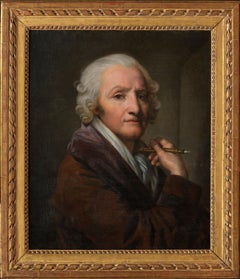
A replica of the JB Greuze
s last self-portrait, by his daughter Anne-Geneviève
Located in PARIS, FR
While the Petit-Palais is hosting the first exhibition dedicated to the artist in Paris in over a century, this replica of the last painting by Jean-Baptiste Greuze, executed by his ...
Category
Early 1800s Old Masters Portrait Paintings
Materials
Canvas, Oil
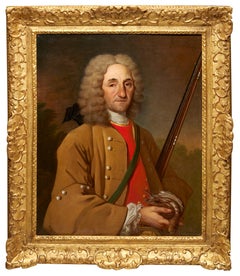
Portrait of Julien Prieur the bailiff of the Marquis d
Armentières as a Hunter
By Jean-Baptiste Oudry
Located in PARIS, FR
This portrait depicts us the trusted confidant of the Conflans d'Armentières family. More precisely, Julien Prieur was the fiscal procurator of the Marquisate of Armentières, playing...
Category
1730s Old Masters Portrait Paintings
Materials
Canvas, Oil
Two royal portraits (the Duc d
Angoulême and the Duc de Berry) by H.P. Danloux
Located in PARIS, FR
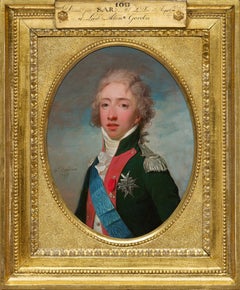
These two royal portraits are a major historical testimony to the stay of the Comte d'Artois (the future Charles X) and his family in Edinburgh in 1796-1797. Given by the sitters to Lord Adam Gordon, the Governor of Edinburgh, and kept by family descent to this day, these two portraits provide us with a vivid and spontaneous image of the Duc d’Angoulême and his brother the Duc de Berry. Danloux, who had emigrated to London a few years before, demonstrate his full assimilation of the art of British portrait painters in the brilliant execution of these portraits.
1. Henri-Pierre Danloux, a portraitist in the revolutionary turmoil
Born in Paris in 1753, Henri-Pierre Danloux was first a pupil of the painter Nicolas-Bernard Lépicié (1735 - 1784) and then, in 1773, of Joseph-Marie Vien (1716 - 1809), whom he followed to Rome when, at the end of 1775, Vien became Director of the Académie de France. In Rome he became friends with the painter Jacques-Louis David (1748 - 1825).
Returning to France around 1782, he settled in Lyon for a few years before returning to Paris in 1785. One of his first portraits was commissioned by the Baroness d'Etigny, the widow of the former Intendant of the Provinces of Gascony, Bearn and Navarre Antoine Mégret d'Etigny (1719 – 1767). He then became close to his two sons, Mégret de Sérilly and Mégret d'Etigny, who in turn became his patrons. In 1787, this close relationship with the d'Etigny family was further strengthened by his marriage to Antoinette de Saint-Redan, a relative of Madame d'Etigny. After his marriage, he left for Rome and did not return to France until 1789. It was during the winter of 1790-1791 that he painted one of his masterpieces, the portrait of Baron de Besenval. Set in a twilight atmosphere, this portrait of an aristocrat who knows that his death is imminent symbolizes the disappearance of an erudite and refined society which would be swept away by the French Revolution.
The Jacobin excesses led Danloux to emigrate to England in 1792; many members of his family-in-law who remained in France were guillotined on 10 May 1794. Danloux enjoyed great success as a portrait painter in England before returning to France in 1801.
During his stay in England, Danloux was deeply under the influence of English portraitists: his colors became warmer (as shown by the portrait of the Duc d'Angoulême that we are presenting), and his execution broader.
2. Description of the two portraits and biographical details of the sitters
The Duc d'Angoulême (1775-1844) was the eldest son of the Comte d'Artois, the younger brother of King Louis XVI (the future King Charles X), and his wife Marie-Thérèse of Savoie. He is shown here, in the freshness of his youth, wearing the uniform of colonel-general of the "Angoulême-Dragons" regiment.
He is wearing the blue cordon of the Order of the Holy Spirit, which was awarded to him in 1787, and two decorations: the Cross of Saint-Louis and the Maltese Cross, as he was also Grand Prior of the Order of Malta.
Born on 16 August 1775 in Versailles, Louis-Antoine d'Artois followed his parents into emigration on 16 July 1789. In 1792, he joined the émigrés’ army led by the Prince de Condé. After his stay in Edinburgh (which will be further discussed), he went to the court of the future King Louis XVIII, who was in exile at the time, and in 1799 married his first cousin Marie-Thérèse Charlotte of France, the daughter of Louis XVI and the sole survivor of the royal family. The couple had no descendants. He became Dauphin of France in 1824, upon the accession to the throne of his father but played only a minor political role, preferring his military position as Grand Admiral. Enlisted in Spain on the side of Ferdinand VII, he returned home crowned with glory after his victory at Trocadero in 1823.
He reigned for a very short time at the abdication of Charles X in 1830, before relinquishing his rights in favor of his nephew Henri d'Artois, the Duc de Bordeaux. He then followed his father into exile and died on 3 June 1844 in Gorizia (now in Italy).
His younger brother, the Duc de Berry, is shown in the uniform of the noble cavalry of the émigrés’ Army. He is wearing the blue cordon of the Order of the Holy Spirit, awarded to him in May 1789, and the Cross of Saint-Louis (partly hidden by his blue cordon).
Born on 24 January 1778 in Versailles, Charles-Ferdinand d'Artois also followed his parents into emigration and joined the émigrés’ army in 1792. After his stay in Edinburgh, he remained in Great Britain, where he had an affair with Amy Brown...
Category
1790s Old Masters Portrait Paintings
Materials
Canvas, Oil, Wood Panel
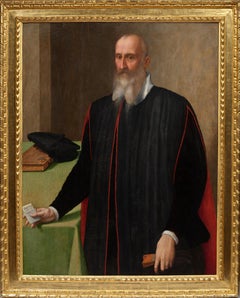
Portrait of Senator Bartolomeo Panciatichi by Santi di Tito (1574)
Located in PARIS, FR
This recently rediscovered portrait of Santi di Tito depicts a Florentine senator, with a letter in his hand indicating that the painting was executed in 1574 when the sitter was 66 years old. On the basis of these clues, it is tempting to view it as a portrait of Bartolomeo Panciatichi, who was painted some thirty years before by Bronzino (1503 - 1572). While the treatment of the hands recalls the Florentine tradition of Mannerist portraits, the comparison with Bronzino's portrait illustrates Santi di Tito's search for greater realism, despite the stereotyped composition.
1. Santi di Tito, Counter-Reformation painter and portraitist
Santi di Tito was the great painter of the Florentine Counter-Reformation. He proposed a new artistic language that broke away from Mannerism.
Little is known about his training in Florence (perhaps alongside Bronzino or Baccio Bandinelli), but this period of training enabled him to join the Company of Saint Luke, the guild of Florentine painters, in 1554. Between 1560 and 1564, Santi di Tito spent time in Rome, where he frequented the workshop of Taddeo Zuccari. This stay had a fundamental influence on his work, thanks to the discovery of the late work of Raphael, but also his encounters with the painters Francesco Salviati and Federico Barocci.
Around 1565, Santi di Tito returned to Florence, where he remained until the end of his life, dividing his talents between the creation of important religious paintings and countless portraits. He became one of the city's leading painters, distinguishing himself, in particular, in the creation of large religious compositions in which the spirit of the Counter-Reformation was reflected.
In 1568, Santi di Tito became a member of the Confraternity of Saint Thomas Aquinas...
Category
16th Century Old Masters Portrait Paintings
Materials
Poplar, Oil
Related Items
Deposition Atala De Roussy-trioson Paint Oil on canvas 19/20th Century French
Located in Riva del Garda, IT
The deposition of Atala
Follower of Anne-Louis Girodet de Roussy-Trioson (Montargis, 1767 - Paris, 1824)
19th-20th century
Oil on canvas
47 x 65 cm. - Framed 67 x 84 cm
The propos...
Category
Late 19th Century Old Masters Paintings
Materials
Oil

$2,082 Sale Price
20% Off
H 26.38 in W 33.08 in
17th century portrait of the wine merchant Caspar Rommerskirchen - Old master
Located in Aartselaar, BE
17th-century German portrait of the wine merchant Caspar Roemerskirchen at the age of 26 in 1628, Franz Kessler (attr.)
This highly decorative portrait depicts the 26-year-old Caspa...
Category
17th Century Old Masters Portrait Paintings
Materials
Oil, Wood
$14,792
H 34.26 in W 21.26 in
Fine Italian Old Master Oil Painting Angel
Saints Appearing to Figures
Located in Cirencester, Gloucestershire
Artist/ School: Italian Old Master, 18th century
Title: Angel and Saints appearing to figures, one dressed in a white ruff collar.
Medium: oil on canvas...
Category
Early 18th Century Old Masters Figurative Paintings
Materials
Canvas, Oil
$5,459 Sale Price
20% Off
H 22 in W 26 in
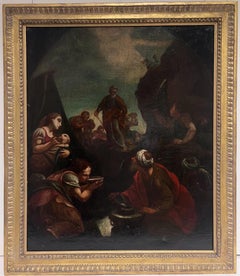
17th Century Italian Old Master Oil Painting Moses Striking Water from the Rock
By Pier (Pietro) Dandini
Located in Cirencester, Gloucestershire
Moses Striking Water from the Rock;
Circle of Pietro Dandini, Italian 1646-1712
Italian School, late 17th century
oil on canvas, framed
framed: 3...
Category
Early 18th Century Old Masters Portrait Paintings
Materials
Canvas, Oil
$6,824 Sale Price
20% Off
H 32 in W 28 in D 1 in
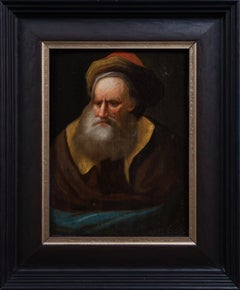
Portrait of an Old Bearded Man
Located in Stockholm, SE
We are pleased to offer a captivating portrait, most likely painted in the late 18th century, attributed to an artist within the circle of Christian Wilhelm Ernst Dietrich. This oil ...
Category
Late 18th Century Old Masters Portrait Paintings
Materials
Oil, Wood Panel
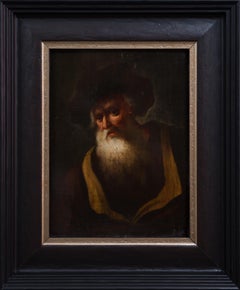
Portrait of an Old Bearded Man With a Black Cap
Located in Stockholm, SE
We are pleased to offer a captivating portrait, most likely painted in the late 18th century, attributed to an artist within the circle of Christian Wilhelm Ernst Dietrich. This oil ...
Category
Late 18th Century Old Masters Portrait Paintings
Materials
Oil, Wood Panel
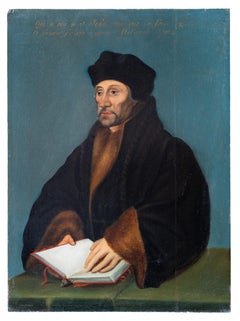
Erasmus of Rotterdam
By English School
Located in GB
Hans Holbein the Younger (1497/98 – 1543) was one of the greatest painters of the Northern Renaissance. Born in Augsburg, Germany, he was the son of Hans Holbein the Elder, also a pa...
Category
19th Century Old Masters Portrait Paintings
Materials
Oil, Wood Panel
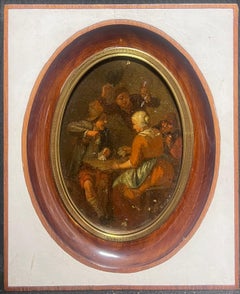
17th Century Dutch Old Master Oil Painting Oval Shape Figures in Tavern Interior
Located in Cirencester, Gloucestershire
Tavern Interior
Dutch School, 17th century
oil on metal, framed
framed: 8 x 6.75 inches
painting: 6 x 4.25 inches
provenance: private collection
condition: very good and sound condit...
Category
17th Century Old Masters Figurative Paintings
Materials
Oil
$1,293 Sale Price
20% Off
H 8 in W 6.75 in
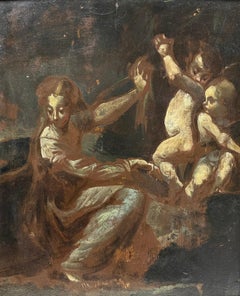
Angelic Cherubs with Classical Figure in Wilderness Finely Painted Preparatory
Located in Cirencester, Gloucestershire
Figure with Cherubim in Wilderness
Italian School, 17th century
oil painting on wood panel
framed 13 x 11 inches
condition: overall for its age very good, though the work is most likely a preparatory...
Category
17th Century Old Masters Figurative Paintings
Materials
Oil, Wood Panel
$2,839 Sale Price
20% Off
H 13 in W 11 in D 1 in
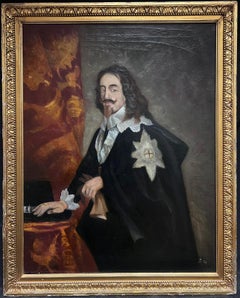
King Charles 1st Antique Oil Painting Portrait of Famous British Monarch
Located in Cirencester, Gloucestershire
King Charles I
British artist, early 20th century
signed with initials
oil on canvas, framed
framed: 36 x 29 inches
canvas: 32 x 26 inches
provenance: p...
Category
Early 1900s Old Masters Portrait Paintings
Materials
Oil, Canvas
$1,528 Sale Price
20% Off
H 36 in W 29 in
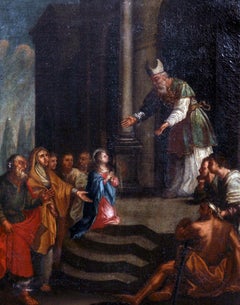
17th Century Italian Old Master Oil - Presentation of the Virgin in the Temple
Located in Cirencester, Gloucestershire
Artist/ School: 17th Century Italian School
Title: The Presentation of the Virgin in the Temple
Medium: oil painting on canvas, framed
Size: canvas: 21” x 16” (53.3 x 40.8cm)
Pro...
Category
17th Century Old Masters Figurative Paintings
Materials
Oil
$2,702 Sale Price
20% Off
H 23 in W 19 in D 1 in
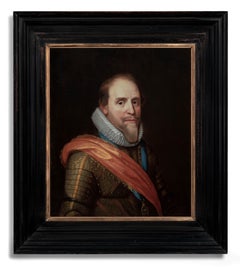
Dutch Old Master Portrait of Maurits, Prince of Orange-Nassau, Oil on Panel
Located in London, GB
In 1607, the Delft city council decided to commission a portrait of Stadholder Maurits of Nassau for the town hall, with Michiel van Mierevelt as the chosen artist due to the passing...
Category
17th Century Old Masters Portrait Paintings
Materials
Oil, Wood Panel
$10,578
H 37.8 in W 33.47 in D 2.37 in